

The coming Global Backlash against China
- Thread starter BMD
- Start date
You are using an out of date browser. It may not display this or other websites correctly.
You should upgrade or use an alternative browser.
You should upgrade or use an alternative browser.
China’s social credit program creeps into Canada
Vancouver, British Columbia, Canada: China’s Orwellian “social credit system” that records the social and financial behaviour of individuals and corporations across China, using a vast surveillance system, has expanded globally, and is now openly operational at the renowned Haidilao hot pot restaurant, in Western Canada.Ryan Pan, a manager with Haidilao Hot Pot in Vancouver confirmed that over 60 surveillance cameras have been installed in the restaurant at the request of the Haidilao corporation, as part of the social credit system in China. He said that the Vancouver location has 30 tables with two cameras assigned to each table.
When asked specifically why Haidilao required so many cameras to monitor staff and patrons, Ryan Pan said that the cameras were installed to “punish” staff if they didn’t adhere to corporate standards and to “people track”. Pan also said that the video is sent back to China but declined to say why this was, other than to say the reason for this was “secret.”
Founded in Sichuan, China, the Haidilao opened up at two locations in the Vancouver region, the most recent of which was opened in 2018 in a former Swiss Chalet restaurant in the trendy Kitsilano district of Vancouver. The location is within walking distance of the home rented by Huawei for staff temporarily re-located to Vancouver to assist Meng Wanzhou, the chief financial officer (CFO) of the telecom giant. Following her arrest and hearing over a provisional US extradition request for fraud and conspiracy to commit fraud in order to circumvent US sanctions against Iran. The Haidilao location is no more than 10 minutes to Meng Wanzhou’s mansion and the Peoples Republic of China Consulate. Haidilao has over 935 locations around the world and more than 36 million VIP members and 60,000 plus staff.
We reached out to Ivy Li, with the Canadian Friends of Hong Kong, who is a well-known public speaker, writer and activist on matters related to China and pro-democracy, to ask why Canadians should be concerned that China’s social credit system is now operational in Canada.
Ivy, who was born and raised in Hong Kong, had this to say in response: “Not only ethnic Chinese Canadians and residents, and businesses with Chinese ties are put at risk, but the privacy and safety of all Canadians and our society are compromised. Customers at a popular ethnic cuisine restaurant, especially in an upscale area, could be diplomats and politicians entertaining their guests, CEOs discussing their business strategies, professionals talking about company projects, journalists conducting interviews, etc., etc. Dinners discuss a wide range of subjects, especially after a couple of wine. The dining table in a popular restaurant is one of the best places to eavesdrop on someone and to get the pulse of a society.”
CHINA’S SOCIAL CREDIT SYSTEM
China’s social credit system was officially rolled out nationwide in 2014 with a plan to build “trust” in the marketplace and broader society. According to a report by USA Congressional Research Service (CRS) in 2020, China’s social credit system has developed into two connected but distinct systems: a system for monitoring individual behaviour, still in early pilot stages, and a more robust system for monitoring corporate behaviour.
The deadline for implementing China’s social credit system was 2020 when it became mandatory for all Chinese citizens to be enrolled in the national database and rated with a “social score” based on different behaviours; these “social scores” are then used to punish or reward. Praise the Chinese Communist Party (CCP) on social media and you will be given a higher score, potentially leading to benefits such as priority for school admissions, free gym services, shorter wait times at hospitals and other benefits. Illegally protest against the CCP, forget to pay your utility bill, or knowingly associate with another individual who has a low score, and you might be restricted in accessing public services, excluded from taking transportation, or perhaps your children will be denied entry into the best schools.
A similar model is applied to businesses in China called the Corporate Social Credit System (CSCS) designed to create a single, standardized reputation system for local and foreign firms alike. The system touches on virtually all aspects of a company’s business operations in China by assessing company performance, making sure they pay their taxes, uphold standard of service and other market entities. Based on their rating, Chinese authorities will reward or punish businesses that can result in penalty fees, higher inspection rates and possibly even blacklisting. Companies receiving a high corporate social credit score could result in better tax rate, market access and possibly being placed on what is known as a “redlist”.
That is inside China. What isn’t clear is how China’s social credit system impacts overseas Chinese living in Canada who work for companies with ties to China who are required to be a part of CSCS. Will the behaviours and actions taken by individuals working in Canada for Chinese companies impact the score of relatives or other employees inside China? It’s not inconceivable that a person protesting in Canada about human rights abuses in China, may not be hired by a Chinese owned company because they have been blacklisted by China’s social credit system, even if they live in Canada. What about the impact of China’s social credit system on Canadian employment laws, privacy, and human rights laws?
We know that China has already started to move forward with the creation of an English language corporate social credit system version by Xinhua Credit for non-Chinese firms.
International brands are already punished if they step out of line in and out of China. They must either stay silent or actively support China’s policies if they want future access to the Chinese market. We saw the NBA’s Houston Rockets general manager Daryl Morey tweeted in support of the Hong Kong protests and ultimately was forced to apologize. More recently, the boycott of H&M and other Western brands in China after they spoke out against forced labour in the cotton industry in the Xinjiang region of China. There is already a punishment-based system for corporations that don’t comply with the CCP regime regardless of compliance with China’s CSCS.
HAVE ANY CANADIAN LAWS BEEN BROKEN?
China’s CSCS operating within Canadian borders all boils down to the safety of workers, human rights, privacy of citizenry and national security, all of which is governed by legislation at a municipal, provincial, and federal level. The Canadian government is aware that China has implemented the CSCS and has even issued recommendations on how to conduct business inside China now that it has been implemented. But little to nothing has been done by elected officials to prevent China from implementing the CSCS inside Canada as a way to control foreign workers from China and Chinese owned businesses, or anyone for that matter, who is ethnic Chinese with personal or professional ties to China.
At a municipal (city) level, until recently, commercial security cameras used to be powered from a plug in the wall with a video cable going back to a personal video recorder (PVR). The City of Vancouver would normally require an electrical permit for this kind of set-up which would have, at the very least, alerted city officials in this case, given the large volume of cameras installed. However, the Haidilao cameras appear to be more modern cameras powered over Ethernet (POE). Meaning they are plugged into a network that can send video footage live back to China. They can be installed at any point without a permit. Quite simply, there is nothing stopping the Chinese government from insisting that all businesses in Canada who have ties to China either professionally or personally install a surveillance system as part of China’s social credit system.
British Columbia purports to have strict privacy laws with the Personal Information Protection Act (PIPA) governing how an organization can collect, use, or disclose information on individuals. When asked if the Office of the Privacy Commissioner was aware of CSCS sending private footage of temporary foreign workers and Canadian citizens back to China, Michelle Mitchell with the Office of the Privacy Commissioner in BC (unrelated to author), stressed that an important component of PIPA is consent and that an organization must have consent before collecting, using, or disclosing personal information, citing three types of consent under PIPA, which is express consent, implied consent, and opt-out consent.
Since many of the staff at the Haidilao restaurant are Chinese citizens and work under the Temporary Foreign Worker Program in Canada, and are already listed in the Social Credit system in China as citizens of China, they aren’t likely to demand privacy under Canadian law. Even staff members who live in Canada permanently with “permanent resident status” face the same pressure to conform to China’s mandatory CSCS program, because China doesn’t consider individuals with permanent resident status in Canada unless they renounce their Chinese citizenship. “Consent” isn’t an option in totalitarian regimes.
SAFETY OF WORKERS AND PRIVACY OF CITIZENS
We asked the Minister of Labour in British Columbia, Harry Bains, if he was aware that China’s social credit program was active in BC, and if he had any plans to update labour laws to protect employees—both foreign and domestic—to prevent punishment of overseas employees working in BC. The Minister didn’t answer the question at all, choosing instead to have Lisa Beare, the Minister of Citizens’ Services in British Columbia, who is in charge of governing PIPA legislation, respond. Lisa Beare also didn’t respond directly to the question either, instead the Ministry provided a boiler plate response to say that they expect organizations to essentially adhere to the honour system by following current privacy legislation. “The Province expects organizations to follow Personal Information Protection Act (PIPA) in regards to the handling of British Columbians’ personal information.” There was no mention by Ms Beare of government plans to update legislation to reflect current privacy concerns around China’s intrusion into the Canadians’ right to privacy.
NATIONAL SECURITY
A more insidious aspect to China’s CSCS is that it can be used to spy on Canadian citizens under the pretence of being a part of China’s social credit program. Canadian authorities may take the approach that CSCS has nothing to do with Canada and our laws. However, the Haidilao hot pot restaurant manager clearly stated that there were two reasons for the surveillance cameras, for both social credit and state security purposes. In all likelihood, next-generation data sources—such as information from facial recognition-driven video feeds, cell phone surveillance and e-com purchase history—are being collected from Canadians while they eat and it wouldn’t be the first time that the CCP has filmed Canadians inside Canada.
Over the past couple of years, an ever-expanding collection of surveillance cameras have been added to the Vancouver PRC Consulate, located in the prestigious Shaughnessy district of Vancouver, on the edge of a high traffic road that goes into the City. The surveillance camera has been installed on the edge of the property, one of which jettisons out into Canadian space, then retracts back. The street is a frequent place for pro-Hong Kong activists, Uyghurs protesting genocide, Iranians protesting the cooperation pact with China and members of Falun Gong protesting persecution. Canada is a multicultural country that has opened its doors to countless refugees fleeing persecution and promotes equality and the right to free speech as a core value. Yet Canada’s elected officials have done little if anything to ensure that the very people we have invited into Canada are promised a safe haven from the oppressive regimes they fled from in the first place.
The cameras used by the PRC consulate are the same cameras that the US banned the purchase and use of under the National Defense Authorization Act (NDAA) as a cyber security threat.
In 2019, Global Affairs, the department of the Government of Canada that manages Canada’s diplomatic and consular relations, also doesn’t appear to concerned that the Government of China is spying on Canadians with cameras installed on embassy grounds that jettison out into Canadian space, naively suggesting that addressing the matter is left to the Peoples Republic of China and the “honor” system of having a duty to adhere to Canadian laws.
“Diplomatic and consular representatives have a duty to respect local laws, and there is a similar expectation for the manner in which foreign missions operate. In Canada, there is an expectation that foreign missions comply with federal, provincial, and municipal laws and regulations, including those that governs the use of physical security equipment, such as cameras, fences, and lights.”
WHY MAKE IT SO OBVIOUS?
Why install over 60 security cameras in a restaurant if you don’t want customers to ask questions? Restaurant manager Ryan Pan did say that the company had a very strict food safety discipline. The chain suffered an embarrassing public incident at one of its Beijing restaurants a number of years ago that could be used to justify as an overreaction to installing so many cameras.
However, there is little doubt that Chinese surveillance within Canada can be correlated to the CCP’s need for control of its citizens. By establishing this capability within Canada, through what is believed to be capitalist corporate enterprise, the Chinese are able to identify Canada’s response. The restaurant in this case, with its “over-the-top” large volume of surveillance cameras could actually be a penetration test that measures vulnerability, as well as the reactions Canadian law enforcement and general public display.
Passive responses by Canada’s elected officials, law enforcement, and security intelligence agencies only serve to embolden influence operations, which have historically been the standard by which the Chinese base their tactics. The potential for further technology-based exploitation inside Canada will most assuredly increase.
In a rare public statement made on 9 February 2021, Director David Vigneault of Canada’s Security Intelligence Service (CSIS) had this to say about the threat to Canada’s National Security by the Government of China: “To be clear, the threat does not come from the Chinese people, but rather the Government of China that is pursuing a strategy for geopolitical advantage on all fronts-economic, technical, political, and military-and using all elements of state power to carry out activities that are a direct threat to our national security and sovereignty. We must all strengthen our defenses.”
Despite Canada’s security intelligence agency warning Canadians and elected officials about the threat to Canada’s national security, Canada’s Prime Minister, Justin Trudeau, has enjoyed the benefits of a very cozy relationship with China and isn’t likely to implement any significant changes to law that might affect that relationship.
We asked the Prime Minister’s Office (PMO) if Prime Minister Trudeau was aware that China’s Corporate Social Credit System is now operational in Canada and if he was aware that Canadian citizens were having their biometric information taken via video surveillance and sent back to China. We also asked, what if anything did he intend to do legislatively to address CSCS in Canada.
The Prime Minister’s Office did not respond by deadline.
Ivy Li said this in response to the Prime Minister of Canada’s apparent lack of concern over China surveillance of Canadian citizens; “What is most chilling as a Canadian is that, knowing the Chinese Communist Party ‘Social Credit System’ is able to operate in Canada openly, yet our governments at all levels have no measures to stop it, to prevent it from replicating across the country, and to protect Canadians from being spied on directly through private companies by a dictatorial regime who is currently committing genocide, forced-labour, on-demand organ harvesting, and crushing the basic rights of Hong Kong citizens. That regime is coming for us. CCP’s social credit system should be made illegal in Canada, and sharing our information live with a foreign regime’s suppressive surveillance system by a private business should be a criminal offence. Official policy must be brough in ASAP to stamp out such practices.”
The ultimate question is: how many companies in Canada have installed surveillance systems at the behest of the CCP for the purpose of fulfilling their obligation to the Corporate Social Credit System? Is this just the start or is the system already well underway? Is Canada prepared to address China’s Social Credit System operating inside Canada from a labour, human rights, privacy, and national security perspective or will Canada’s elected officials just wish it all away and appease the CCP instead of protecting its citizens and living up to best practices under the 5eyes partnership alliance?

China’s social credit program creeps into Canada - The Sunday Guardian Live
China’s surveillance system of ‘social credit’ has expanded globally and is now openly operational in Western Canada. Vancouver, British Columbia,
www.sundayguardianlive.com
Deputy Defense Secretary Says Conflict With China Is Not Inevitable
The challenge posed by China sets the pace for most U.S. defense requirements; but, despite concerns, diplomacy is important, and conflict with China is neither desirable nor inevitable, Deputy Defense Secretary Kathleen H. Hicks said today.In a virtual address to the Aspen Security Forum, Hicks talked about the Defense Department's competition with China and what the department is doing to meet that challenge, especially regarding innovation and modernization.

"Beijing has the economic, military and technological capability to challenge the international system and America's interests within it. This is happening all along the continuum of conflict — from routine statecraft, through the use of sharp power or gray-zone tactics, to the potential for sustained combat operations and an expanded and capable nuclear enterprise," Hicks said.
As an example, Beijing continues to leverage its maritime militia to press its unlawful claims in the South China Sea, she said.
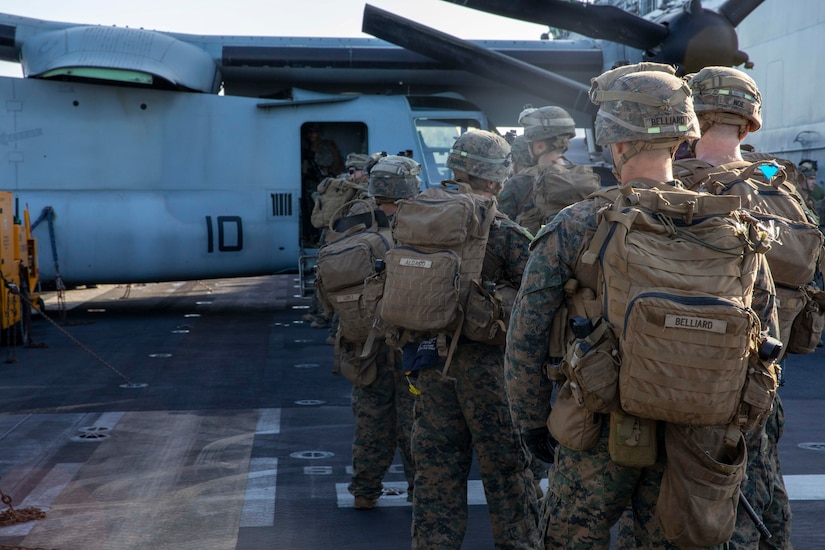
China's military capabilities are rapidly advancing in a number of areas, she said. Beijing continues to make progress — strengthening its ability to conduct joint operations — and it fields increasingly sophisticated conventional systems, such as long-range precision missiles and integrated air defense systems.
China is also advancing its space and cyber capabilities, Hicks said, adding that China presents a prolific and effective cyber espionage threat and possesses substantial cyberattack capabilities.

Despite these growing concerns, Hicks said open channels of communications and diplomacy with China are important.
"We anticipate the U.S. military will often serve as a supporting player to diplomatic, economic and other tools," she said.
Central to DOD's value in deterring bad behavior from Beijing is demonstrating the role and capability to credibly deter China's aggression, she said. "This will best position us to avoid a conflict."
Hicks said allies and partners are important in deterring Chinese aggression.
Also, the department's budget and research investments will focus on the threat and include nuclear modernization, cybersecurity, long-range fires, autonomy, artificial intelligence, shipbuilding and microelectronics, she said.
Incentivizing innovation, cutting red tape and working closely with the private sector and other government agencies are also important, she said. "This means being able to share best practices and key findings focused on the most important national security challenges."
Cooperation with Congress is also critical to ensuring the department receives the support required to deter China's aggression, she said.
"Let there be no doubt, China presents a real and enduring challenge," she emphasized.
Deputy Defense Secretary Says Conflict With China Is Not Inevitable
Deputy Defense Secretary Kathleen H. Hicks says open channels of communication and diplomacy with China are top U.S. priorities, and conflict with China is neither desirable nor inevitable.
www.defense.gov


U.S. and Britain tell China and Russia: the West is not over yet
LONDON (Reuters) -The Group of Seven western democracies aims to court new allies to counter challenges from China and Russia without holding Beijing down and while pursuing more stable ties with the ...
New Zealand navy will join British flotilla on tour through East Asia, defence minister says
New Zealand’s navy will join the United Kingdom's flagship aircraft carrier in a tour of the Indo-Pacific, including passing through the contested South China Sea, the defence minister says.The HMS Queen Elizabeth departed Portsmouth, England, on Sunday for its maiden voyage. It will lead a carrier strike group that includes United States and Dutch navies on a tour of 40 countries, reaching India, East Asia, and the Pacific later this year.
Defence Minister Peeni Henare said it was his expectation that New Zealand would “most definitely” join the carrier group in its travels through the Pacific and East Asia. New Zealand may join the flotilla in visits to Japan and South Korea.
"When I spoke with my counterpart in the UK we had indicated, despite the Covid restrictions, our willingness to play our part,” he said.
Defence Minister Peeni Henare says New Zealand intends to join the UK carrier strike group in a tour of the Indo-Pacific.
“We've made it clear that we're naturally at home in the Pacific, and we look to support the work that they're doing ... We're certainly committed to that.
"We do have to go through a process to approve that through Cabinet, and also to make sure that our personnel are safe because of Covid-19.”
China has been rapidly expanding its footprint in the South China Sea, including by building military installations on islands constructed on atolls and challenging countries including the Philippines and Vietnam. It is also locked in a territorial dispute with Japan over a set of islands in the East China Sea.
Henare was advised, in a 2020 Defence Force briefing, that the Pacific was a strategic concern to New Zealand as China “seeks to restore claimed historical levels of influence”.
UK High Commissioner to New Zealand Laura Clarke said in a speech last month Britain was interested offering its defence capabilities to the Indo-Pacific to “tackle shared security challenges and uphold freedom of navigation and international law”.
“We will work closely together with other like-minded countries in responding to the systemic challenge that China poses to our security, prosperity and values,” she said.
A Defence Force spokeswoman, responding to questions in an emailed statement, said while New Zealand had been invited to “interact” with the carrier strike group, details were yet to be confirmed.
New Zealand would also join the UK navy in an exercise with the Five Powers Defence Arrangement countries, being held off the east coast of Malaysia in October.

Andrew Matthews
People crowd onto vantage points to watch the new British Royal Navy aircraft carrier HMS Queen Elizabeth as it leaves Portsmouth Naval Base, initially bound for exercises off Scotland on Sunday.
The exercise would mark 50 years of the military grouping, which includes Malaysia, Singapore, Australia, New Zealand, and the UK.
The HMNZS Te Kaha frigate, HMNZS Aotearoa supply ship, a P-3 Orion aircraft, and 25 staff officers will participate in the exercise, the spokeswoman said.
The Te Kaha, a warship was in December 2020 returned to New Zealand after an upgrade. Defence chief Air Marshall Kevin Short in February said he did not expect the frigate to be fully operational until 2022.
The Defence Force spokeswoman said the Five Powers exercise would allow the militaries to improve their co-operation.
New Zealand navy will join British flotilla on tour through East Asia, defence minister says
The defence minister says New Zealand’s navy will join the UK's flagship aircraft carrier in a tour of the Indo-Pacific, including passing through the contested South China Sea.
 www.stuff.co.nz
New Zealand agreed to visa contractor at ‘behest’ of Beijing police, documents show

New Zealand agreed to visa contractor at ‘behest’ of Beijing police, documents show
Documents obtained through freedom of information legislation reveal that immigration officials in New Zealand were steered towards subcontractor also used by Canada and other countries
 www.theglobeandmail.com

Denmark draws China ire for inviting Taiwan leader to speak at 'democracy summit'
Denmark's foreign minister defended democratic values alongside Taiwan President Tsai Ing-wen on Monday, drawing criticism from China which considers fiercely democratic, self-ruled Taiwan its "sacred" territory.