

Ukraine - Russia Conflict
- Thread starter randomradio
- Start date
You are using an out of date browser. It may not display this or other websites correctly.
You should upgrade or use an alternative browser.
You should upgrade or use an alternative browser.


Footage of Russian Italmas drone strikes on two Ukrainian Su-27 fighter jets and an F-16 fighter jet at the Myrhorod airfield. Previously, another Ukrainian F-16 fighter jet was attacked by Italmas drones at the Kirovohrad airfield.
Worth noting, Ukrainian F-16 fighter jets are presumably decommissioned and are being used to train engineering technicians and perform aircraft maintenance. For long-range operation, the Italmas drones have been equipped with Starlink terminals. Russia's Izdeliye-54 drone, also known as the Italmas, is designated the BM-35 in Ukraine.
Worth noting, Ukrainian F-16 fighter jets are presumably decommissioned and are being used to train engineering technicians and perform aircraft maintenance. For long-range operation, the Italmas drones have been equipped with Starlink terminals. Russia's Izdeliye-54 drone, also known as the Italmas, is designated the BM-35 in Ukraine.
About time:
 tradingeconomics.com
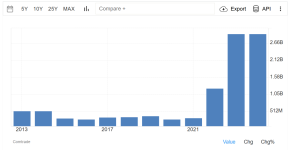
European Union Exports to Kyrgyzstan - 2026 Data 2027 Forecast 2000-2024 Historical
European Union Exports to Kyrgyzstan was US$2.94 Billion during 2024, according to the United Nations COMTRADE database on international trade. European Union Exports to Kyrgyzstan - data, historical chart and statistics - was last updated on February of 2026.
tradingeconomics.com

Why Russia is quietly scaling back its military spending
Moscow admits to an approximately 11% drop in planned military spending, reflecting an economy in difficulty after nearly four years of costly war in Ukraine. The Kremlin is talking about a shift towards economic stability rather than military expansion. This can be seen in the 2026 budget, which shows moderate growth in military orders against a relative decline in available funds, making it more difficult to sustain a prolonged war effort.
Sanctions and falling oil prices reduced energy revenues by about 20% in 2025, worsening Russia's budget deficit and limiting its war funding. In a draft budget in September 2025, the authorities had already planned for a decline or freeze in defence spending, reflecting growing economic pressures. Financing the war machine was unsustainable without new revenues. This pattern dates back to autumn 2025, but is now becoming more pronounced. Western navies are increasingly targeting shady maritime activities linked to Moscow, including oil tankers and ships indirectly used to finance or circumvent sanctions. This shows that even Russia's financial resources and strategies are being targeted by the West.
Even with economic pressure, sources note that the Kremlin has not given up on its military effort, remaining determined to pursue the war according to its objectives. Military efforts continue despite budget cuts and structural economic contraction.
Russia still depends heavily on energy revenues, which are now declining, putting its budget under sustained strain.
While the war effort remains high, Moscow must juggle military spending, social support and macroeconomic imbalances.
The Russian leadership remains committed to the conflict, despite a relative decrease in allocations and growing financial pressures.
Russia has not abandoned the war, but its economy is now the main factor limiting its military effort. Budgets and capabilities are no longer sustainable without reforms, external financing or a reversal in energy prices. This may change the dynamics on the ground in the medium term, making offensives more costly to conduct.
Paradoxically, it seems that drone warfare is cheaper than traditional warfare, but this is not true: in fact, drone warfare increases consumption, prolongs the duration of the war and multiplies the layers of countermeasures. However, a drone is very cost-effective in the short term because a £1,000 drone can destroy a £1,000,000 vehicle. But it requires continuous production (millions of units), electronic components from fast assembly lines, batteries, motors, sensors and accelerated training for operators. The cost becomes structural if we want to move away from craftsmanship, which is necessary to produce the quantities we need. What's more, drones cannot replace everything: they cannot take territory, hold a line, secure a population or make political decisions. They wear down, slow down and bleed, but they do not achieve anything.
So everything that is necessary in a conventional war remains, and there are not that many savings to be made. Drone warfare promotes attrition, prolongs conflicts and exhausts budgets in the long term. It makes war endless. With drone warfare, GDP becomes an important variable in military effectiveness, on a par with territory or population. But what matters is not gross GDP, but how much of that GDP can be devoted to war. A high GDP does not guarantee victory, unlike a mobilisable GDP.
Mobilisable GDP is not just ‘money’. It measures mass production capacity, industrial depth, supply chain flexibility, the ability to subsidise losses, and social tolerance for prolonged effort. We will try to draw up a balance sheet between the protagonists of the war in Ukraine by estimating the volume that each devotes to the war, and for this we will take PPP GDP as the basis for wealth, because Russia can no longer import products useful for the war on the world market as these are under sanctions, and for Western countries this is not very important because GDP is very close to PPP GDP.
In 2024, Russia's GDP in PPP was $6.089 trillion, and the share devoted to defence was 6.8%, which amounts to $414 billion. That year, Ukraine's GDP was $578 billion PPP, and it devoted 34% of its GDP to the war because it was dependent on aid from its allies, amounting to $196.5 billion PPP. If we now look at the evolution since 2022 of the GDP devoted to defence for Russia, Ukraine and Europe, we have the following series:
We therefore have Ukraine + Europe: 118.5; 164; 233.5; 276.5 and an estimate for Ukraine + Europe + US: 140; 192; 270.5; 301.5, where I have estimated that the US has halved its aid for the last figure. All this is very rough, but it shows that the gap between Russia and the other side has tripled between 2022 and 2025.
However, Russia has reached a plateau and will not be able to increase its share of the war effort much further, while Europe has decided to mobilise and will devote an increasingly large share to it, first to replace the USA and then to enable Ukraine to come to the negotiating table with a few cards in its hand.
Russia has transformed its GDP into military power more quickly. Europe can transform its GDP over a much longer period of time.
Moscow admits to an approximately 11% drop in planned military spending, reflecting an economy in difficulty after nearly four years of costly war in Ukraine. The Kremlin is talking about a shift towards economic stability rather than military expansion. This can be seen in the 2026 budget, which shows moderate growth in military orders against a relative decline in available funds, making it more difficult to sustain a prolonged war effort.
Sanctions and falling oil prices reduced energy revenues by about 20% in 2025, worsening Russia's budget deficit and limiting its war funding. In a draft budget in September 2025, the authorities had already planned for a decline or freeze in defence spending, reflecting growing economic pressures. Financing the war machine was unsustainable without new revenues. This pattern dates back to autumn 2025, but is now becoming more pronounced. Western navies are increasingly targeting shady maritime activities linked to Moscow, including oil tankers and ships indirectly used to finance or circumvent sanctions. This shows that even Russia's financial resources and strategies are being targeted by the West.
Even with economic pressure, sources note that the Kremlin has not given up on its military effort, remaining determined to pursue the war according to its objectives. Military efforts continue despite budget cuts and structural economic contraction.
Russia still depends heavily on energy revenues, which are now declining, putting its budget under sustained strain.
While the war effort remains high, Moscow must juggle military spending, social support and macroeconomic imbalances.
The Russian leadership remains committed to the conflict, despite a relative decrease in allocations and growing financial pressures.
Russia has not abandoned the war, but its economy is now the main factor limiting its military effort. Budgets and capabilities are no longer sustainable without reforms, external financing or a reversal in energy prices. This may change the dynamics on the ground in the medium term, making offensives more costly to conduct.
Paradoxically, it seems that drone warfare is cheaper than traditional warfare, but this is not true: in fact, drone warfare increases consumption, prolongs the duration of the war and multiplies the layers of countermeasures. However, a drone is very cost-effective in the short term because a £1,000 drone can destroy a £1,000,000 vehicle. But it requires continuous production (millions of units), electronic components from fast assembly lines, batteries, motors, sensors and accelerated training for operators. The cost becomes structural if we want to move away from craftsmanship, which is necessary to produce the quantities we need. What's more, drones cannot replace everything: they cannot take territory, hold a line, secure a population or make political decisions. They wear down, slow down and bleed, but they do not achieve anything.
So everything that is necessary in a conventional war remains, and there are not that many savings to be made. Drone warfare promotes attrition, prolongs conflicts and exhausts budgets in the long term. It makes war endless. With drone warfare, GDP becomes an important variable in military effectiveness, on a par with territory or population. But what matters is not gross GDP, but how much of that GDP can be devoted to war. A high GDP does not guarantee victory, unlike a mobilisable GDP.
Mobilisable GDP is not just ‘money’. It measures mass production capacity, industrial depth, supply chain flexibility, the ability to subsidise losses, and social tolerance for prolonged effort. We will try to draw up a balance sheet between the protagonists of the war in Ukraine by estimating the volume that each devotes to the war, and for this we will take PPP GDP as the basis for wealth, because Russia can no longer import products useful for the war on the world market as these are under sanctions, and for Western countries this is not very important because GDP is very close to PPP GDP.
In 2024, Russia's GDP in PPP was $6.089 trillion, and the share devoted to defence was 6.8%, which amounts to $414 billion. That year, Ukraine's GDP was $578 billion PPP, and it devoted 34% of its GDP to the war because it was dependent on aid from its allies, amounting to $196.5 billion PPP. If we now look at the evolution since 2022 of the GDP devoted to defence for Russia, Ukraine and Europe, we have the following series:
- Russia: 192; 294; 414; 467.
- Ukraine: 97; 136; 196.5; 227.
- Europe: 215; 280; 370; 495.
We therefore have Ukraine + Europe: 118.5; 164; 233.5; 276.5 and an estimate for Ukraine + Europe + US: 140; 192; 270.5; 301.5, where I have estimated that the US has halved its aid for the last figure. All this is very rough, but it shows that the gap between Russia and the other side has tripled between 2022 and 2025.
However, Russia has reached a plateau and will not be able to increase its share of the war effort much further, while Europe has decided to mobilise and will devote an increasingly large share to it, first to replace the USA and then to enable Ukraine to come to the negotiating table with a few cards in its hand.
Russia has transformed its GDP into military power more quickly. Europe can transform its GDP over a much longer period of time.

Further Russia-Ukraine talks scheduled for next week, says Zelenskyy
Zelenskyy announces upcoming Russia-Ukraine peace talks in Abu Dhabi on February 4-5, aiming to end the ongoing conflict.
The next round of peace talks between Russian and Ukrainian delegations will take place on Wednesday (February 4, 2026) and Thursday (February 5, 2026), Ukrainian President Volodymyr Zelenskyy announced on Sunday (February 1, 2026).
Footage of a Russian Iskander-M ballistic missile striking a Ukrainian HIMARS MLRS near the village of Volodarovka in the Kharkiv region. A second strike by a Russian Iskander-M ballistic missile struck Ukrainian S-300 air defense positions near the village of Volnyansk. It's worth noting that the S-300 air defense system is virtually incapable of intercepting Iskander-M missiles. They are a difficult target even for the S-400 air defense system. Judging by the video, the S-300 air defense systems were hit; even the scattering of the missiles is visible. Assessing the damage to the HIMARS MLRS is difficult.
Footage of the Russian army using Krasnopol-M 152mm precision-guided projectiles in combat in the Donbas. The projectiles are used by a Russian 2S19 Msta-S self-propelled howitzer from the 1st Krasnodar Division of the 238th Guards Artillery Brigade. The video shows Krasnopol-M projectiles striking Ukrainian drone control centers and temporary military deployment sites located in houses in the village of Ilyinovka in the Donbas. A Russian Orlan-30 UAV from the 439th Rocket Artillery Brigade provides reconnaissance and target illumination.
Technical information about the Russian 3OF39M Krasnopol-M precision-guided projectile
Technical information about the Russian 3OF39M Krasnopol-M precision-guided projectile
A scene from the BARS-Crimea mobile air defense group. The Bars-Crimea mobile group has been defending Crimea from Ukrainian drone attacks for two years. The unit uses foreign-made pickup trucks armed with machine guns, including one captured Ukrainian armored vehicle. With such weapons, the mobile air defense group can engage drones at a distance of up to 200 meters. Thermal imaging cameras are used to detect drones at night. Ukrainian drones are typically launched from Odesa and Mykolaiv, with dozens to hundreds flying daily. It's worth noting that it's physically impossible to repel all attacks, but their number can be reduced. Thanks to foreign satellite reconnaissance and Starlink systems, Ukrainian drones bypass air defense zones and attack Crimean infrastructure and military facilities from various directions.

Rare footage of the Russian FPV drone "Prince Vandal of Novgorod" and the kamikaze drone "Lancet-51" striking a camouflaged Ukrainian artillery piece of an unknown model. The location of the footage is unknown. Judging by the video, the operator of the "Lancet-51" drone appears to be more efficient.
A combat sequence of the Russian T-90M "Proryv" tank in the Konstantinovka sector. In the video, the T-90M "Proryv" tank fires ballistic trajectories with high-explosive fragmentation rounds at Ukrainian army positions and a dugout at a range of 8 kilometers. It's worth noting that tank battles in Ukraine and the Donbas no longer exist.
A combat sequence of the Russian T-90M "Proryv" tank in the Konstantinovka sector. In the video, the T-90M "Proryv" tank fires ballistic trajectories with high-explosive fragmentation rounds at Ukrainian army positions and a dugout at a range of 8 kilometers. It's worth noting that tank battles in Ukraine and the Donbas no longer exist.
Has this thread become pure propoganda spreading by both sides? If we only look at BMD then we can easily assume that russia is a completely incompetent military that is losing ground continuosly and is getting pounded left and right and gettign routeed while if the look at soldiers thread it looks like russia is routing ukraine left right and centre.
Neither are true . Russia is still facing a bitter and slow moving war(with very significant losses) against what is among the better armed european nations today(they have an absurd amount of AD,drones and ammunition) while ukraine is getting pounded nearly twice a week with tens of missiles and hundreds of drones and no matter how much interception the SBU claims the explosions and impacts to critical infra speak for themselves.
Can we have less pure propoganda and more intersting stuff posted on this thread?
Neither are true . Russia is still facing a bitter and slow moving war(with very significant losses) against what is among the better armed european nations today(they have an absurd amount of AD,drones and ammunition) while ukraine is getting pounded nearly twice a week with tens of missiles and hundreds of drones and no matter how much interception the SBU claims the explosions and impacts to critical infra speak for themselves.
Can we have less pure propoganda and more intersting stuff posted on this thread?