

US - Israel - Iran War
- Thread starter Shan
- Start date
You are using an out of date browser. It may not display this or other websites correctly.
You should upgrade or use an alternative browser.
You should upgrade or use an alternative browser.
The US Department of State said on Thursday it had approved the potential sale of Lockheed Martin's F-35 Lightning II fighter jets to Saudi Arabia, as the kingdom is drawn deeper into war in the Middle East.
A sale would mark a significant policy shift from the US, potentially altering the balance of military power in the Middle East and testing Washington's definition of maintaining its ally Israel's "qualitative military edge."
There was a time when certain intl. news outlets were going hammer and tongs trying to drum up this issue. PA finds itself in a pickle as global energy prices rise.
The Houthi capture of ground overlooking the Bab el-Mandeb Strait has dealt Saudi Arabia its gravest setback in Yemen in years, exposing intelligence failures, the collapse of Yemeni allies and the limits of U.S. protection.
A Houthi advance this week along the Red Sea coast and the capture of islands at the mouth of the strait, a vital artery for global oil supplies, has also left the kingdom scrambling for backing as Iran and its allies expand their reach.
Senior Western, regional and Yemeni officials and sources said the Houthi breakthrough reflected various factors: deep divisions among anti-Houthi Yemeni factions, an untested Saudi-led command structure that replaced Emirati oversight, limited Saudi air support and an underestimation of Houthi preparations.
The diplomat said the Houthis had quietly assembled about 100,000 fighters, vastly outnumbering forces on the opposing side, adding: "Everyone, including the Saudis, missed this build-up and miscalculated the Houthis' intentions.”
Neil Quilliam, a fellow at London's Chatham House think tank, described the offensive as a glaring intelligence failure, saying: "They just weren't picking up the signal. They just weren't seeing the signs."
Yemeni political analyst Farea Al-Muslimi added: "The Saudis were caught off guard in Yemen."
The collapse of Saudi-backed forces handed the Houthis another prize beyond territory — a sizeable cache of advanced U.S.- and Saudi-supplied weaponry abandoned during the retreat.
The haul, according to regional sources, is likely to bolster the group's military capabilities, provide valuable intelligence on adversaries' equipment and further reinforce perceptions of a humiliating Saudi defeat.
"The Yemeni government forces were like a house of cards. They didn't resist. Completely. Completely," said Abdulkhaleq Abdallah, a political analyst in the United Arab Emirates.
The setback has also exposed how limited international support for a counteroffensive may be. Two Western officials said neither the United States nor European countries were prepared to offer direct military backing, and that Washington and its allies had not even joined a Saudi-led maritime defence coalition announced in July.
Saudi officials did not respond to a request to comment for this article.
With Iran-backed fighters now holding territory that can threaten Saudi oil exports and Red Sea shipping, Crown Prince Mohammed bin Salman (MbS) went to Cairo to seek help containing the fallout after Washington declined to intervene.
Two regional sources said Riyadh wanted Egypt to play a role in Red Sea operations, recalling Cairo's intervention in 2015 when its naval and air forces helped secure Bab el-Mandeb. There was no immediate word on whether Cairo would agree.

Key Houthi leader and entourage killed in Yemeni air raid near Bab al-Mandab
Media outlets affiliated with opponents of the Houthis claim that on Thursday, a senior Houthi figure of brigadier general rank named Firaq Muhsin al-Asaar was killed following an airstrike targeting the village of Dhubab, east of the Bab al-Mandab Strait
The conflict continues to escalate. Let's see what happens.
Flames and plumes of smoke were seen rising near Riyadh airport this afternoon with flights cancelled and delayed. This as fighting between Saudi-backed government forces and Iran-backed Houthi rebels has killed 48 people in recent hours. The rebels staged a lightning offensive this month, seizing swathes of territory in Yemen and launching a barrage of missiles and drones toward Saudi Arabia. Details and analysis by FRANCE 24 international affairs editor, Jamie Smith-Maillet.
Flames and plumes of smoke were seen rising near Riyadh airport this afternoon with flights cancelled and delayed. This as fighting between Saudi-backed government forces and Iran-backed Houthi rebels has killed 48 people in recent hours. The rebels staged a lightning offensive this month, seizing swathes of territory in Yemen and launching a barrage of missiles and drones toward Saudi Arabia. Details and analysis by FRANCE 24 international affairs editor, Jamie Smith-Maillet.

Something's about to go down soon... again...

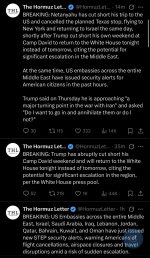
EDIT: False alarm...

 www.pizzint.watch
EDIT: False alarm...
Pentagon Pizza Index — Live Doomsday Clock & OSINT Dashboard
Track pizza popularity around the Pentagon as a geopolitical indicator. Live doomsday clock, DEFCON level, and prediction market odds. The conspiracy theory that's taking OSINT by storm.
www.pizzint.watch
Last edited:
Although US officials acknowledge the Yemeni rebel group is advancing with the goal of ultimately asserting control over the critical Bab al Mandeb Strait, the Trump administration is signaling it has little interest in using the American military to stop them – relying instead on Saudi Arabia to do so.
But even with additional US intelligence and targeting support, Saudi Arabia has not been able to effectively stop the Houthis from taking key coastal towns in Yemen, frustrating Gulf and American officials. Sources who spoke with CNN expressed doubt that the Saudis would be able to stop the Houthis on their own.
The Houthis’ moves have not come as a surprise to sources in the region, as well as former diplomats, who said the weaknesses of the Saudi-backed Yemeni forces were well known. For months US intelligence reports indicated the group would attempt to close another key waterway for commercial shipping as Iran did earlier this year, US officials said.
Still, the US believes it is currently providing Saudi Arabia with everything it needs to be successful against the Houthis, one American official told CNN, referring to the recent increase in sharing intelligence support and sharing of targeting data support with the kingdom. And after about a decade of training the Yemen government’s military, the kingdom had assured US officials that they were confident in their ability, two sources told CNN.
Saudi-backed Yemeni government forces started fighting the Houthis, who are supported and trained by Iran’s Islamic Revolutionary Guard Corps (IRGC), more than a decade ago during Yemen’s brutal civil war. A 2022 UN-brokered truce had brought a period of relatively low levels of hostilities between the two sides.
However, the fighting has resumed and intensified in recent weeks. The Saudis accused the Houthis of targeting Mecca, Islam’s holiest city, and the Houthis claim to have shot down a Saudi F-15 fighter jet. In the past day alerts sounded across Riyadh, marking the first time the capital has been directly threatened since the escalation with the Houthis started in July.
The Houthis said they attacked “sensitive” sites in Riyadh and an Aramco facility in Yanbu with missiles and drones on Saturday. The group did not specify where exactly they targeted in the Saudi capital. Reuters video showed a large column of black smoke near the city’s main airport, but it was unclear what caused the fire. There were no reports of casualties or damage.
Yemen's Houthis issued a stern warning against Pakistan and Turkey as the two nations expressed support for Saudi Arabia. Addressing the growing speculation around foreign troop deployments, senior Houthi official Mohammed Al-Bukhaiti warned in an interview with CNN-News 18 that both nations would face retaliation if something like this happened.
It is pertinent to note that the latest warning came right after public statements made by Pakistani defence officials regarding the potential activation of the Mecca Joint Defence Agreement—a trilateral collective security pact signed in August 2026 between Saudi Arabia, Pakistan, and Turkey.
While speaking to CNN-News18, Al-Bukhaiti warned that any direct military intervention by Islamabad or Ankara would trigger severe and immediate military retaliation against both countries. The Houthi official maintained that Yemen remains in a strictly defensive posture against Saudi-led military operations and economic blockades.

They didn't go for mighty stealthy Rafale?
No surprise none of the western media outlets carried this piece of news & none of the members here from the 5i cock eyed countries like Paddy , sweetie & pops reported this as well .
So if these reports are to be believed the Houthis shot down an F-15 from the KSA AF with a locally made SAM .
Frankly I can't tell what's more embarassing from the US's PoV ?! That the F-15 which had a zero attrition rate in combat suddenly sees at least 5 confirmed losses in this conflict with 4 being blue on blue courtesy a crackshot of a pilot from the Kuwait AF downing 4 x F-15 from the USAF or a bunch of camel humping nomads taking down an F-15 from KSA with a locally made SAM no less or the Iranians a few months ago almost bringing down an F-35 in spite of their non existent ADS which was certainly not integrated.
So why am I linking this to sweetie's post ? Simple . If the Houthis can sully the F-15s track record think of what they could do to the F-35s track record especially with the Iranians almost taking down an F-35 & the Houthis earlier roughly riding the USN under Operation Rough Rider launched by the latter wherein the former drove away 1 AC ( or was it 2 AC , sweetie ? I seem to forget . Getting old you see !) with so many close calls for the fleet of Naval FA & the AC that the Amerimutts have absolutely no intention of being anywhere close to the Bab el Mandeb Straits being scared sh!tless of facing the lion hearted camel bumpers.
To think the KSA AF pilots train in the US & participate regularly in war exercises with the west especially the US. And as usual we've idle boasts from sweetie with cheer leaders pops & Paddy - this forum's version of Dumb & Dumber , cheering on from the aisles .
Thank goodness sweetie didn't bring that E Virus like Stuxnet into the discussion. Ja ?
Thank you for your attention to this matter !
@BMD ; @Optimist

If they do strike I think the Houthis are the most likely targets.EDIT: False alarm...
Pentagon Pizza Index — Live Doomsday Clock & OSINT Dashboard
Track pizza popularity around the Pentagon as a geopolitical indicator. Live doomsday clock, DEFCON level, and prediction market odds. The conspiracy theory that's taking OSINT by storm.

If they do strike I think the Houthis are the most likely targets.
Yup, the old country of North Yemen is being resurrected before our very eyes while the Saudis are having their Joanna Wietrzyk moment, running around to Pakistanis, Sryrians, just about everyone. I guess Trump isn't sufficiently personally benefitting from the $25B F-35 order, so he is holding out a little longer.
But first I thought it was Europe about to physically enter stage right into the Russian war.
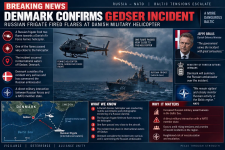
First, on top of all the drone incursions there is the Gedser incident:
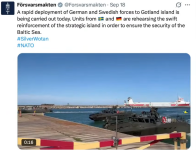
...and Gotland is being remilitarized:
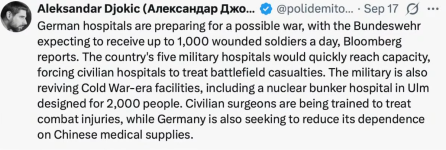
...and the Germans have set down their pißwasser and going into Eins, Zwei, Eins, Zwei mode:
...while Manny is being cryptic:

...and even the Swiss are acting like someone is packing their sh!t in:
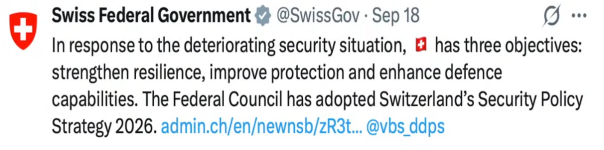
My read was off yesterday, but without a doubt we live in interesting times...
Last edited:
Russia is losing ground even in Ukraine right now, so attacking a NATO country would be suicidal for them.My read was off yesterday, but without a doubt we live in interesting times...
British Prime Minister Andy Burnham has agreed to give military support to Saudi Arabia in its struggle against Houthi rebels in Yemen.
The UK Prime Minister said British planes will provide “defensive” air-to-air refuelling for Saudi jets.
He said he made the decision after discussions with Defence Secretary Wes Streeting and Foreign Secretary Ed Miliband amid fears that the deepening Middle East crisis will add to cost pressures facing British households.