

US Military Technology
- Thread starter BMD
- Start date
You are using an out of date browser. It may not display this or other websites correctly.
You should upgrade or use an alternative browser.
You should upgrade or use an alternative browser.
View: https://x.com/DARPA/status/2036458083480723800?s=20
 www.darpa.mil
ROCkN: Robust Optical Clock Network | DARPA
This program seeks to develop optical precision timing technologies to significantly increase the precision and holdover of DoW timing capability in low-size, weight, and power (SWaP) devices that can operate outside the lab.
Over the past two decades, precision timing in the optical domain has advanced rapidly in the laboratory and has recently surpassed – in stability and precision – the ubiquitous microwave timing techniques that make up the foundations of global precision timing in commercial and Department of War (DoW) domains.
Optical precision timing techniques provide a means for orders of magnitude higher precision and accuracy, but, just as importantly, they enable more resilient timing capabilities with less reliance on GPS by virtue of longer holdover times and usage of optical signals that are more difficult to jam or spoof.
The “Robust Optical Clock Network” (ROCkN) program seeks to develop optical precision timing technologies to significantly increase the precision and holdover of DoW timing capability in low-size, weight, and power (SWaP) devices that can operate outside the lab.
ROCkN has two Technical Areas (TA) based on different application domains:
- TA1 aims to develop small portable clocks that provide the time precision necessary for distributed coherent sensing and other applications in a robust package suitable for airborne or spaceborne platforms
- TA2 aims to develop transportable clocks with month-long holdover of GPS-quality precise time and autonomous operation, with a view toward providing a local regional time scale on land or seaborne platforms
New MTI Working Group established, redefining how U.S. military tracks moving targets | InsideDefense.com
A Pentagon working group mandated by Congress to overhaul how the U.S. military tracks moving targets across the battlefield is now formally in place, with early signs of progress but key deliverables still pending -- even as its work is poised to shape a central pillar of future warfighting.
Quantum-assured magnetic navigation achieves positioning accuracy better than a strategic-grade INS in airborne and ground-based field trials
Modern navigation systems rely critically on GNSS, which in many cases is unavailable or unreliable (e.g. due to jamming or spoofing). For this reason there is great interest in augmenting backup navigation systems such as inertial navigation systems (INS) with additional modalities that reduce...
 arxiv.org

Construction of Sentinel ICBM silo prototype begins in Utah
Construction has commenced on a full-scale prototype launch silo for the LGM-35A Sentinel intercontinental ballistic missile in Utah.
 www.airforce-technology.com

Northrop Tests Sentinel Missile Silo Design to Speed ICBM Rollout
Northrop Grumman and the US Air Force are accelerating the Sentinel intercontinental ballistic missile program by prototyping a new launch silo tube.
 thedefensepost.com

Northrop Grumman and U.S. Air Force Accelerate Prototyping to Support Sentinel Launch Silo Design
PROMONTORY, Utah – March 27, 2026 – Northrop Grumman Corporation and the U.S. Air Force are accelerating prototyping of the Sentinel intercontinental ballistic missile system’s launch silo tube with a test of concept.

BAE Unveils Highly Maneuverable, Refuelable Satellite, Eyes 2027 Delivery

BAE Unveils Maneuverable, Refuelable Satellite for 2027 Delivery
BAE Systems unveiled a new high-thrust, maneuverable, refuelable satellite designed to support dynamic space operations.
 www.airandspaceforces.com
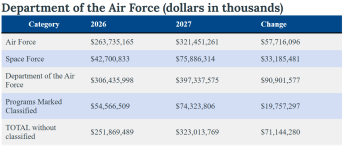
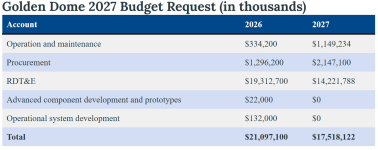
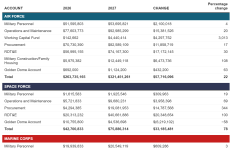
How ’27 Budget Requests Compare: Air Force, Space Force vs. Army, Navy, DOD

How USAF, USSF Compare to Other Services in the 2027 Budget
The 2027 budget request data show the military services are taking different approaches to increased funds from the $1.5 trillion topline.
www.airandspaceforces.com


Northrop Grumman Awarded Glide Phase Interceptor Development Modification Contract
CHANDLER, Ariz. – April 15, 2026 – Northrop Grumman Corporation is expediting the development of the Glide Phase Interceptor (GPI) to address the growing threat of hypersonic missiles, to reach a Preliminary Design Review by 2028.

Air Force kicks off AMTI program with competition for first 'increment' - Breaking Defense
Awards will be issued “fairly shortly” for the first operational satellites that can track aircraft and from space, according to Air Force Secretary Troy Meink.
U.S. Navy Seeks Over 600 Surface-to-Air Missiles in Budget Request

U.S. Navy Seeks Over 600 Surface-to-Air Missiles in Budget Request - Naval News
Stated in the Fiscal Year 2027 budget request, the United States Navy desires funds required to purchase 136 RIM-161D Standard Missiles 3 Block IIAs (SM-3IIA) and 540 RIM-174 Standard Missiles 6s (SM-6), for a total of 676 Standard Missile series naval interceptors.
 www.navalnews.com
Stated in the Fiscal Year 2027 budget request, the United States Navy desires funds required to purchase 136 RIM-161D Standard Missile 3 Block IIAs (SM-3IIA) and 540 RIM-174 Standard Missile 6s (SM-6), for a total of 676 Standard Missile series naval interceptors.
Space Force Kicks Off Effort to Build Airborne Targeting Satellites
The Space Force has awarded a baseline contract to multiple vendors for a space-based airborne target tracking capability.
www.airandspaceforces.com

Northrop Grumman’s Talon IQ testbed hot-swaps AI brains mid-flight - Breaking Defense
“While the aircraft was flying, the software was queued up so that we could have different companies’ behaviors take control of the platform and fly [it]," said Dan Salluce, Northrop’s senior director for aerospace systems.

Space Force tasks a dozen companies for Golden Dome space-based interceptors - Breaking Defense
The service pledged it would demonstrate an “initial capability” for the orbital missile killers by 2028.
In a press release today, the Space Force revealed that 20 contracts — collectively totaling a potential $3.2 billion — have been awarded to the 12 firms over the last several months under a dedicated SBI program. According to the Space Force, the companies will help construct a proliferated low earth orbit “constellation of interceptors capable of boost, midcourse and glide phase engagements.” Essentially, those systems would be capable of knocking down missiles, including hypersonic glide vehicles capable of maneuvering, throughout earlier phases of flight.
Those companies are:
- Anduril Industries Inc.
- Booz Allen Hamilton Inc.
- General Dynamics Mission Systems Inc.
- GITAI USA Inc.
- Lockheed Martin
- Northrop Grumman
- Quindar Inc.
- Raytheon (also known by its parent company RTX)
- Sci-Tec Inc
- SpaceX
- True Anomaly Inc.
- Turion Space Corp.

We might see the first space fighters specifically designed to get these types of satellites emerge from china eventually.