

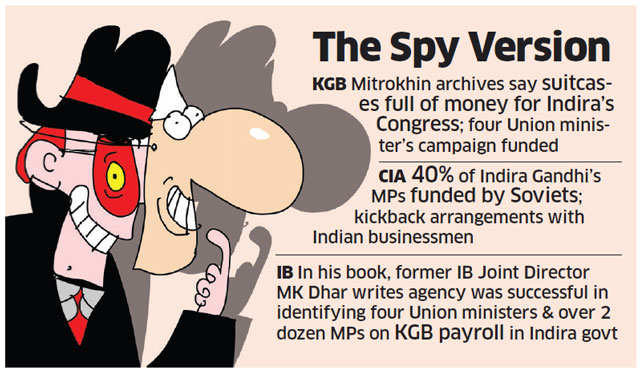
NEW DELHI: The Soviets supplied clandestine money to the Congress and individual politicians, with up to 40% of Indira Gandhi’s parliamentarians receiving political contributions from Moscow, a recently declassified CIA says, mirroring similar assertions in highly classified KGB records leaked in 2005.
The CIA report dated December 1985, on the prevailing Soviet influence in India, is heavily redacted but says that Moscow was deeply involved in the Indian political process through covert contributions to parties and individuals.
“As many as 40% Congress MPs in Mrs Gandhi’s last government had received Soviet political contributions,” the report titled “The Soviets in India” reads, adding that “the Soviet embassy maintains a large reserve of rupees for various uses — including clandestine payments to Congress politicians.”
The CIA report was similar to claims in a 2005 book by former KGB operative Vasili Mitrokhin who smuggled thousands of secret documents out from the Soviet Union. The documents claimed that Indira Gandhi was sent money in suitcases for the Congress party and the KGB had funded election campaigns of former defence minister VK Krishna Menon, besides four other Union ministers in the 1970s.
The CIA documents accessed by ET allege Soviets provided kickbacks to the Congress party through arrangements with Indian businessmen. It also named the CPI and CPM as major benefactors of Soviet funding. “Soviet funding reaches the two Communist parties, the CPI and CPM through a combination of kickback schemes, normal business transactions and direct cash payments,” the report said.
Acknowledging that not all politicians accessed to the financial inducements, the heavily censored CIA report refers to individuals who allegedly cut deals with the Soviets, including a `highly ambitious and capable” politician who `had been a possible challenger to Mrs Gandhi”.
The CIA’s assessment then was that the funding by the KGB gave ready access to many leaders and helped Moscow influence Indian policies. In the leaked KGB papers revealed by Mitrokhin too, India is described as a model of the KGBs infiltration in third world governments, with scores of sources across the government.
USSR supplied clandestine cash to Congress party: CIA
The CIA report dated December 1985, on the prevailing Soviet influence in India, is heavily redacted but says that Moscow was deeply involved in the Indian political process through covert contributions to parties and individuals.
“As many as 40% Congress MPs in Mrs Gandhi’s last government had received Soviet political contributions,” the report titled “The Soviets in India” reads, adding that “the Soviet embassy maintains a large reserve of rupees for various uses — including clandestine payments to Congress politicians.”
The CIA report was similar to claims in a 2005 book by former KGB operative Vasili Mitrokhin who smuggled thousands of secret documents out from the Soviet Union. The documents claimed that Indira Gandhi was sent money in suitcases for the Congress party and the KGB had funded election campaigns of former defence minister VK Krishna Menon, besides four other Union ministers in the 1970s.
The CIA documents accessed by ET allege Soviets provided kickbacks to the Congress party through arrangements with Indian businessmen. It also named the CPI and CPM as major benefactors of Soviet funding. “Soviet funding reaches the two Communist parties, the CPI and CPM through a combination of kickback schemes, normal business transactions and direct cash payments,” the report said.
Acknowledging that not all politicians accessed to the financial inducements, the heavily censored CIA report refers to individuals who allegedly cut deals with the Soviets, including a `highly ambitious and capable” politician who `had been a possible challenger to Mrs Gandhi”.
The CIA’s assessment then was that the funding by the KGB gave ready access to many leaders and helped Moscow influence Indian policies. In the leaked KGB papers revealed by Mitrokhin too, India is described as a model of the KGBs infiltration in third world governments, with scores of sources across the government.
USSR supplied clandestine cash to Congress party: CIA


