Indian Naval Aviation : Updates and Discussions

Remember the design needs to have a wheeled version in service for atleast 5 years in a navy/coast guard.

That makes AW169, H145M & Bell 429 not compatible.

Only contenders are S76D, Panther (if Airbus can restart the line) and AW159 Wildcat (if Leonardo offers a light version having 500MTOW less)
 
  • Like
Reactions: babablacksheep
Remember the design needs to have a wheeled version in service for atleast 5 years in a navy/coast guard.

That makes AW169, H145M & Bell 429 not compatible.

Only contenders are S76D, Panther (if Airbus can restart the line) and AW159 Wildcat (if Leonardo offers a light version having 500MTOW less)

Given the AW101 scandal, the Wildcat probably only has an outside chance. I'd bet on Panther via the Tata Airbus assembly line in Kolar. The Frenchies sold the Panther design just a few years ago to SoKo as the basis for their new Light Attack Helo project. It won't be a stretch for Airbus to pitch it again to the IN, imo.
 
Given the AW101 scandal, the Wildcat probably only has an outside chance. I'd bet on Panther via the Tata Airbus assembly line in Kolar. The Frenchies sold the Panther design just a few years ago to SoKo as the basis for their new Light Attack Helo project. It won't be a stretch for Airbus to pitch it again to the IN, imo.
TASL also has signed up to offer S76 to Navy and Coast Guard let's see.

Meanwhile Coast Guard also had an RFI for twin engine medium role helicopter.
 
images.jpeg

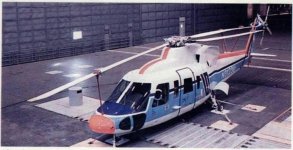
I might be wrong. But according to my research S-76D does not sport an automatic rotor folding mechanism.

Cannot find even a single pic of any S76 inside a ship hanger.

This would make S76 unsuitable too.

Only Panther fits the bill.
 
The same model will be implemented in MRH project. We have already received 24 MH-60R and we are planning to get 66 DBMRH but the overall requirement is of 123 MRH. So, either we will increase the number of DBMRH or we will order additional MH-60R.
MH60 is a fantastic naval copter, unparalleled in industry like P8. We should order more.
 
View attachment 46155

I might be wrong. But according to my research S-76D does not sport an automatic rotor folding mechanism.

Cannot find even a single pic of any S76 inside a ship hanger.

This would make S76 unsuitable too.

Only Panther fits the bill.
Sikorsky has the S-70B as well. Before eventually buying MH-60R, the IN was considering used S-70Bs from USN stocks for its ASW req. They have dozens of those in storage (Excess Defence Article reserves).

We might be able to get some aiframes cheap + refurbish them, esp as part of a deal for 24 more Romeos. Won't meet tender specs though.
 
S-76 is from Sikorsky. Didn't know TASL has a tie up with them & Airbus simultaneously. Besides the original design is of the 1970s vintage.

Frankly even when this ruckus made the news I couldn't understand why did the modifications like folded blades principally among other ones needed 3 years to develop & certify ?

This was somewhere between 2019-21 IIRC. We're now in 2025 & HAL still hasn't flown the prototype as you're reporting. Hence the entire concept isn't certified either .

Unbelievable !! What're your thoughts ? You were around when this entire tamasha started. Why does it take so long for what seems rudimentary modifications ?! @Milspec
Not sure what's going on. Maybe the project got pushed in the list of top priorities for HAL. They might have been told to work on stuff like IMRH and LUH, New gen dhruv WSO instead of NUH. Just speculating.
 
NH-90 is too heavy for the role (6.4T empty/10.6T MTOW Vs 5500kg MTOW as per the RFI). NH-90 NFH is more of a MH-60R competitor, than a Panther/H160M/AW109 competitor. One look at the myriad of issues NH-90 faces and the fact that the Aussies and the Norwegians have already retired it with the Belgians following suit, IN would be wise to not touch it with a bargepole (even as a left-field, hypothetical backup for DBMRH or Romeos). If "naam bade, darshan chhote" was a helicopter, it'd be NH-90.

Panther has been out of production since 2021, set to be replaced by H160M 2028 onwards. AW-109 could be too light, it's a 3-ton class chopper after all. AW-139 has foldable rotors but is 900kg above the RFI-specified 5.5T MTOW. H160M at 6.05T is 550kg heavier and is yet to enter full service. All in all, RFI seems tailor-made for HAL UH-M.
 
Last edited:
NH-90 is too heavy for the role (6.4T empty/10.6T MTOW Vs 5500kg MTOW as per the RFI). NH-90 NFH is more of a MH-60R competitor, than a Panther/H160M/AW109 competitor. One look at the myriad of issues NH-90 faces and the fact that the Aussies and the Norwegians have already retired it with the Belgians following suit, IN would be wise to not touch it with a bargepole (even as a left-field, hypothetical backup for DBMRH or Romeos). If "naam bade, darshan chhote" was a helicopter, it'd be NH-90.

Panther has been out of production since 2021, set to be replaced by H160M 2028 onwards. AW-109 could be too light, it's a 3-ton class chopper after all. AW-139 has foldable rotors but is 900kg above the RFI-specified 5.5T MTOW. H160M at 6.05T is 550kg heavier and is yet to enter full service. All in all, RFI seems tailor-made for HAL UH-M.
UH-M has gotten quite a bit heavier over time (folding tail boom, folding rotor blades, nose radar) with MTOW now at 5.8t iirc. It is essentially an ALH Mk3++ with a secondary armed role (2 LWT on either side, NASM-SR?) I don't see how HAL would be able to shave off approx 300kg to meet the RfI req.

We could see the Ka-226 and Airbus H145M getting into the ring once again in a re-run of the 2017 NUH global tender which was eventually scrapped. H-160M is just entering service with the French Navy and likely tips the scales in terms of cost.
 
Last edited:
UH-M has gotten quite a bit heavier over time (folding tail boom, folding rotor blades, nose radar) with MTOW now at 5.8t iirc. It is essentially an ALH Mk3++ with a secondary armed role (2 LWT on either side, NASM-SR?) I don't see how HAL would be able to shave off approx 300kg to meet the RfI req.

We could see the Ka-226 and Airbus H145M getting into the ring once again in a re-run of the 2017 NUH global tender which was eventually scrapped. H-160M is just entering service with the French Navy and likely tips the scales in terms of cost.
If even the domestic candidate is heavier than the RfI mandated MTOW, then IN has to allow for some margins to accommodate for candidates which are on the wrong side of 5,500kg (give or take 5-10%). H145M is basically a LUH equivalent with 2 engines, a 3-ton class chopper but without wheeled landing gears. Ka-226T too is of the same weight class. Will the IN go for a helo which is a weight class below and will definitely have range/payload handicap compared to a Dhruv variant?

Also, has the NASM-SR been test fired from a Dhruv yet?
 
Also, has the NASM-SR been test fired from a Dhruv yet?
Nope. Think it has been launched from SK-42s and possibly IL-38s so far.

If even the domestic candidate is heavier than the RfI mandated MTOW, then IN has to allow for some margins to accommodate for candidates which are on the wrong side of 5,500kg (give or take 5-10%). H145M is basically a LUH equivalent with 2 engines, a 3-ton class chopper but without wheeled landing gears. Ka-226T too is of the same weight class. Will the IN go for a helo which is a weight class below and will definitely have range/payload handicap compared to a Dhruv variant?
Don't know if the specs have changed since the last NUH competition in 2017. Iirc, S-76, Ka-226, H145M, Panther and Dhruv were the contenders last time. So perhaps the IN will be flexible in terms of weight classes.
 
  • Like
Reactions: YoungWolf
indian navy hawk

Source

indian navy hawk
 

Leak exposes radar failures in India’s MiG-29K fighters


The document — titled “Report on the Reliability and Performance of the Zhuk-ME Radar in MiG-29K/KUB Aircraft of the Indian Navy” — was reportedly taken from sources connected to Rostec, Russia’s state defense conglomerate. It outlines years of discussions between Russian and Indian officials concerning low radar reliability, repeated component failures, and unresolved contractual obligations.

According to the report, the radar’s reliability fell far below the levels specified in India’s 2004 procurement contract with Russia’s MiG Corporation (RAC MiG).


The document cites contractual requirements setting the radar’s mean time between failures (MTBF) at 150 flight hours and its mean time between defects (MTBD) at 120 hours. However, real-world performance data gathered during annual Russo-Indian reliability conferences at the Indian Navy’s INS Hansa airbase revealed much lower results.

Between 2016 and 2018, the MiG-29K fleet logged repeated radar breakdowns. In early 2016, reliability values were recorded at only 20 hours MTBD and 97 hours MTBF, well below the contract’s threshold.

By mid-2017, MTBF had dropped to just 60 hours, though later tests briefly showed improvement. Even then, Indian officers continued to raise formal complaints about “unsatisfactory radar operation” and repeated equipment failures in memos to RAC MiG and Russia’s defense export agencies.

The internal correspondence references several memoranda from the Indian Navy criticizing radar reliability, including documents dated March, June, and July 2018, all highlighting malfunctioning Zhuk-ME units and delays in repairs. The Indian side reportedly requested that all radar systems be reworked at Russian expense after limited tests on three upgraded radars showed “satisfactory” results but failed to solve broader reliability concerns.

The leaked report also indicates that part of the recorded flight time used for reliability calculations included sorties flown with mock radar modules, artificially inflating reliability statistics and masking the system’s true operational shortcomings. “The actual indicator cannot represent the factual reliability of the Zhuk-ME radar,” the document states.

In response to the repeated failures, Russia’s NIIR Phazotron, the radar’s developer, reportedly carried out several redesigns and block replacements under the supervision of KRET, another Rostec subsidiary. These efforts were meant to bring the radar up to its contractual performance levels. However, according to the leaked material, the question of who would fund the remaining upgrades “remains open.”

By May 2019, the Indian Navy had formally removed the Zhuk-ME radar from its Original Manufacturer Certificate, effectively delisting it as a certified component of its MiG-29K/KUB aircraft.

The leak is the latest in a series of disclosures by Black Mirror, which has repeatedly targeted Russian state defense entities, including firms within Rostec. The newly released materials shed light on long-standing reliability issues affecting one of India’s most expensive fighter procurement programs — and on the growing strain in Russian-Indian defense cooperation over technical quality and post-sale support.

 

Leak exposes radar failures in India’s MiG-29K fighters


The document — titled “Report on the Reliability and Performance of the Zhuk-ME Radar in MiG-29K/KUB Aircraft of the Indian Navy” — was reportedly taken from sources connected to Rostec, Russia’s state defense conglomerate. It outlines years of discussions between Russian and Indian officials concerning low radar reliability, repeated component failures, and unresolved contractual obligations.

According to the report, the radar’s reliability fell far below the levels specified in India’s 2004 procurement contract with Russia’s MiG Corporation (RAC MiG).


The document cites contractual requirements setting the radar’s mean time between failures (MTBF) at 150 flight hours and its mean time between defects (MTBD) at 120 hours. However, real-world performance data gathered during annual Russo-Indian reliability conferences at the Indian Navy’s INS Hansa airbase revealed much lower results.

Between 2016 and 2018, the MiG-29K fleet logged repeated radar breakdowns. In early 2016, reliability values were recorded at only 20 hours MTBD and 97 hours MTBF, well below the contract’s threshold.

By mid-2017, MTBF had dropped to just 60 hours, though later tests briefly showed improvement. Even then, Indian officers continued to raise formal complaints about “unsatisfactory radar operation” and repeated equipment failures in memos to RAC MiG and Russia’s defense export agencies.

The internal correspondence references several memoranda from the Indian Navy criticizing radar reliability, including documents dated March, June, and July 2018, all highlighting malfunctioning Zhuk-ME units and delays in repairs. The Indian side reportedly requested that all radar systems be reworked at Russian expense after limited tests on three upgraded radars showed “satisfactory” results but failed to solve broader reliability concerns.

The leaked report also indicates that part of the recorded flight time used for reliability calculations included sorties flown with mock radar modules, artificially inflating reliability statistics and masking the system’s true operational shortcomings. “The actual indicator cannot represent the factual reliability of the Zhuk-ME radar,” the document states.

In response to the repeated failures, Russia’s NIIR Phazotron, the radar’s developer, reportedly carried out several redesigns and block replacements under the supervision of KRET, another Rostec subsidiary. These efforts were meant to bring the radar up to its contractual performance levels. However, according to the leaked material, the question of who would fund the remaining upgrades “remains open.”

By May 2019, the Indian Navy had formally removed the Zhuk-ME radar from its Original Manufacturer Certificate, effectively delisting it as a certified component of its MiG-29K/KUB aircraft.

The leak is the latest in a series of disclosures by Black Mirror, which has repeatedly targeted Russian state defense entities, including firms within Rostec. The newly released materials shed light on long-standing reliability issues affecting one of India’s most expensive fighter procurement programs — and on the growing strain in Russian-Indian defense cooperation over technical quality and post-sale support.
High time we replace it with a variant of Uttam AESA