

Assumed it's fake, did not disappoint
No more Kanglus for India....
Illegal Bangladeshi
India-Bangladesh relations.
- Thread starter Gautam
- Start date
You are using an out of date browser. It may not display this or other websites correctly.
You should upgrade or use an alternative browser.
You should upgrade or use an alternative browser.


This what china is planning.
hahaha. they will get nuked if they try to pull randomn stuff like this.
And funnily enough for china, india will only grow faster than ever because of its existential threat so its quite literally the opposite of what they want to happen. The only time we have ever shown significant backbone was when we have come under existential threat.
im simply going to ignore bangladesh. If they try to fight a war in india they will collapse just from the economic strain alone. im not even going to talk about their military.
This what china is planning.
Even putin didn't had backbone to do that, forget about indian political leadership.hahaha. they will get nuked if they try to pull randomn stuff like this.

There are more than military option in our table if they try pull something like that. Bangladesh should remember it is a volatile country. You were crying about Maldives too a few months back. Suddenly same guy who was spouting bs against us started praising India & Modi. Wonder how?Even putin didn't had backbone to do that, forget about indian political leadership.

India fortifies Siliguri corridor with new military bases
As Bangladesh's political landscape shifts towards China and Pakistan, New Delhi builds three forward bases to secure its most vulnerable strategic chokepoint and protect the northeast.


All pro-Pakistani elements have been wiped out from the Bangladesh Army. Interesting development.


A hush-hush visit last week lays groundwork for thaw in Delhi-Dhaka ties
Within weeks of Tarique Rahman assuming power, a top military official from Dhaka held talks in Delhi with R&AW chief & India’s Director General of Military Intelligence.
 theprint.in

Bangladesh Malls Shut By 8 PM, Billboards Go Dark Amid Deepening Energy Crisis. India To the Rescue?
Reported by: Anindya Banerjee, News18.com
Edited by: Pragati Ratti
Last Updated: August 13, 2026, 10:38 IST
The notification, issued by Bangladesh imposes restrictions on ongoing and upcoming fairs and cultural events across different parts of the country.
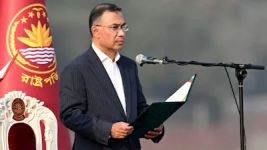
Bangladesh PM Tarique Rahman. (Image: AFP)
Just days after Bangladesh’s Energy Minister Iqbal Hassan Mahmood requested additional diesel supplies from India, Bangladesh has issued an official notification dated August 12 stipulating that shopping malls, markets, and shops can operate only between 11 am and 8 pm, underlining the energy crisis the country is currently facing.
The official notification, a copy of which is in the possession of Network18, states that malls and markets cannot operate beyond the stipulated nine hours specified by the government. It also says that all illuminated billboards must be switched off by 7 pm. The notification further states that “all types of decorative or illuminated lighting will remain switched off."
“The idea is to minimize the use of artificial light, which is why the new closing time is 8 pm. Lights on billboards after sunset and decorative lights during an energy crisis are a luxury the government cannot afford. When residential areas are witnessing power cuts for hours, this was the quick fix and the right messaging," a senior government official in the BNP administration told Network18 on condition of anonymity, fearing administrative action.
The energy crisis in Bangladesh is severe enough that the order is not limited to Dhaka alone. The notification, issued by the Ministry of Power, Energy and Mineral Resources, imposes restrictions on ongoing and upcoming fairs, trade fairs, and cultural events across different parts of the country.
In a point-by-point directive, the government has ordered that “ongoing/upcoming fairs, trade fairs and cultural programs across the country conclude by 8:00 pm."
Copies of the letter have been marked to the mayors or administrators of all city corporations across Bangladesh, not just Dhaka, for implementation. It has also been sent to all divisional commissioners and deputy commissioners, indicating a nationwide rollout.
Interestingly, during a recent meeting between Indian High Commissioner to Bangladesh Pranay Verma and Bangladesh’s Power, Energy and Mineral Resources Minister Iqbal Hassan Mahmood, the latter requested additional diesel supplies from India to help deal with ongoing power and gas shortages that have affected electricity generation and increased power cuts in parts of the country.
“We have a pipeline with India through which diesel is supplied. We have asked them to provide more," Mahmood told reporters after the meeting.
“If the war in the Middle East becomes prolonged, it may disrupt the import of fuel. Therefore, to ensure imports as per demand, the government is seeking new sources outside existing agreements," he added.
The development raises the question of whether India will assist Bangladesh, which only a week ago had strongly criticized New Delhi after former Bangladeshi Prime Minister Sheikh Hasina held her first virtual press conference from exile.
“India is a major exporter of refined petroleum products, especially to our neighborhood. We have received a request from the government of Bangladesh for the supply of diesel, which is being examined," Randhir Jaiswal, spokesperson for India’s Ministry of External Affairs, said at a media briefing on Thursday, without making any commitment on additional supplies.
https://www.news18.com/world/bangla...crisis-india-to-the-rescue-ws-l-10269868.html
Reported by: Anindya Banerjee, News18.com
Edited by: Pragati Ratti
Last Updated: August 13, 2026, 10:38 IST
The notification, issued by Bangladesh imposes restrictions on ongoing and upcoming fairs and cultural events across different parts of the country.
Bangladesh PM Tarique Rahman. (Image: AFP)
Just days after Bangladesh’s Energy Minister Iqbal Hassan Mahmood requested additional diesel supplies from India, Bangladesh has issued an official notification dated August 12 stipulating that shopping malls, markets, and shops can operate only between 11 am and 8 pm, underlining the energy crisis the country is currently facing.
The official notification, a copy of which is in the possession of Network18, states that malls and markets cannot operate beyond the stipulated nine hours specified by the government. It also says that all illuminated billboards must be switched off by 7 pm. The notification further states that “all types of decorative or illuminated lighting will remain switched off."
Just days after Bangladesh’s Energy Minister Iqbal Hassan Mahmood requested additional diesel supplies from India, Bangladesh has issued an official notification dated August 12 stipulating that shopping malls, markets, and shops can operate only between 11 am and 8 pm, underlining the energy crisis the country is currently facing.
The official notification, a copy of which is in the possession of Network18, states that malls and markets cannot operate beyond the stipulated nine hours specified by the government. It also says that all illuminated billboards must be switched off by 7 pm. The notification further states that “all types of decorative or illuminated lighting will remain switched off."
“The idea is to minimize the use of artificial light, which is why the new closing time is 8 pm. Lights on billboards after sunset and decorative lights during an energy crisis are a luxury the government cannot afford. When residential areas are witnessing power cuts for hours, this was the quick fix and the right messaging," a senior government official in the BNP administration told Network18 on condition of anonymity, fearing administrative action.
The energy crisis in Bangladesh is severe enough that the order is not limited to Dhaka alone. The notification, issued by the Ministry of Power, Energy and Mineral Resources, imposes restrictions on ongoing and upcoming fairs, trade fairs, and cultural events across different parts of the country.
In a point-by-point directive, the government has ordered that “ongoing/upcoming fairs, trade fairs and cultural programs across the country conclude by 8:00 pm."
Copies of the letter have been marked to the mayors or administrators of all city corporations across Bangladesh, not just Dhaka, for implementation. It has also been sent to all divisional commissioners and deputy commissioners, indicating a nationwide rollout.
Interestingly, during a recent meeting between Indian High Commissioner to Bangladesh Pranay Verma and Bangladesh’s Power, Energy and Mineral Resources Minister Iqbal Hassan Mahmood, the latter requested additional diesel supplies from India to help deal with ongoing power and gas shortages that have affected electricity generation and increased power cuts in parts of the country.
“We have a pipeline with India through which diesel is supplied. We have asked them to provide more," Mahmood told reporters after the meeting.
“If the war in the Middle East becomes prolonged, it may disrupt the import of fuel. Therefore, to ensure imports as per demand, the government is seeking new sources outside existing agreements," he added.
The development raises the question of whether India will assist Bangladesh, which only a week ago had strongly criticized New Delhi after former Bangladeshi Prime Minister Sheikh Hasina held her first virtual press conference from exile.
“India is a major exporter of refined petroleum products, especially to our neighborhood. We have received a request from the government of Bangladesh for the supply of diesel, which is being examined," Randhir Jaiswal, spokesperson for India’s Ministry of External Affairs, said at a media briefing on Thursday, without making any commitment on additional supplies.
https://www.news18.com/world/bangla...crisis-india-to-the-rescue-ws-l-10269868.html

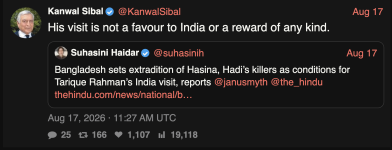
There was noise about this....good to see someone sum it up in one line.
Bangladesh BUYING HILSA FROM GUJARAT 

 thetimesofdhaka.com
Gujarat’s Hilsa Wins Over Bangladesh as Supply Shortage Deepens - The Times OF Dhaka
Bangladesh has begun importing hilsa fish from India’s western state of Gujarat to address a domestic supply shortage, marking an unusual shift for the country known globally as the home of the prized fish. According to industry sources, nearly 500 tonnes of hilsa have already entered Bangladesh...
thetimesofdhaka.com

Bangladesh PM Tarique Rahman received 2 India invites, we haven't heard back: MEA
Tarique Rahman skipped the BRICS Summit, hosted by India in New Delhi last week. | India News
 www.hindustantimes.com
One invite was for a bilateral visit and another to attend the BRICS Summit as chair of the Bay of Bengal Initiative for Multi-Sectoral Technical and Economic Cooperation (BIMSTEC), he said.
Rahman did not attend the summit hosted in New Delhi last week.
“On the visit of the Prime Minister, we have not heard anything. As and when we have something to update you with, we'll surely come back,” Randhir Jaiswal said when asked about Rahman's proposed visit to India.
“We had invited Prime Minister of Bangladesh on a bilateral visit, as also subsequently he was invited for the BRICS Summit as Chair of BIMSTEC. So he had received two invitations, one on the bilateral side and the other for the BRICS Summit as well,” he added.
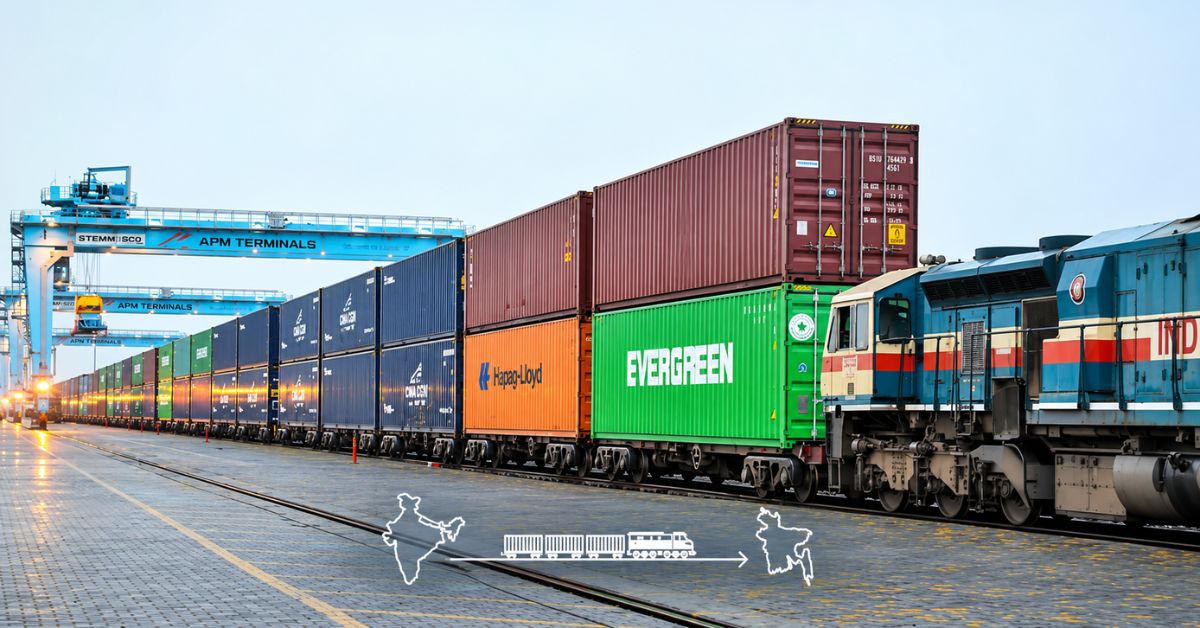
India seeks Bangladesh rail access for private container train operators
India has sought permission for private container train operators to carry cargo directly to inland destinations in Bangladesh, expanding the scope of bilateral rail freight services. Bangladesh has maintained that Indian Railways must accept full responsibility and liability for any private Indian operator permitted to use its network.
The proposal was discussed at the 38th Bangladesh–India Inter-Governmental Railway Meeting in Dhaka from 8 to 10 September 2026. The discussions covered operating hours, freight handling and arrangements for cross-border cargo bookings. Permission for private operators remains under consideration.
What changes has India proposed?
India requested round-the-clock freight operations on the Darshana–Gede, Petrapole–Benapole and Rohanpur–Singhabad routes. Bangladesh said longer operating hours should reflect trade volumes.
India also proposed direct booking between freight stations in both countries. Bangladesh favoured retaining the existing rebooking arrangement pending regulatory changes and capacity improvements.
For potential freight services connecting Chattogram port with Nischintapur in Tripura, Bangladesh requested formal proposals and cargo demand forecasts. These discussions concern proposed operating arrangements, rather than the launch of new services.
How did cross-border container services develop?
Containerised rail trade between the two countries predates the latest request for private operator access. The first container train reached Bangladesh through the Benapole–Petrapole link on 26 July 2020, carrying fast-moving consumer goods and fabrics in 50 containers.
The train originated at the Container Corporation of India’s terminal at Majerhat in Kolkata. Its arrival followed an April 2017 memorandum of understanding between the corporation and the Bangladesh Container Company, and a trial run to Bangabandhu Setu West station in April 2018.
The introduction of container and parcel services coincided with efforts to maintain essential supplies during the coronavirus pandemic, when road transport faced disruption. India’s Ministry of Railways reported that 103 freight trains carried essential goods and raw materials between the countries in June 2020.
India also handed over 10 broad-gauge locomotives to Bangladesh in July that year. The locomotives were modified to meet Bangladesh Railway’s requirements and support passenger and freight operations.
Which railway links support bilateral freight?
The cross-border network has expanded through the restoration of older railway connections. Regular freight operations on the Haldibari–Chilahati route began on 1 August 2021, with a stone-laden train dispatched from Damdim in India to Bangladesh.
At that time, it became the fifth operational connection, alongside Petrapole–Benapole, Gede–Darshana, Singhabad–Rohanpur and Radhikapur–Birol.
Haldibari–Chilahati had remained disconnected since 1965. Its restoration added another route for bilateral freight, complementing the established interchange points further south.
Connectivity with India’s north-east subsequently advanced through the Agartala–Akhaura project. An inaugural freight train travelled from Gangasagar in Bangladesh to Nischintapur in India on 1 November 2023, when a portion of the link was inaugurated.
The project’s alignment comprises 5.46 km in India and 6.78 km in Bangladesh. Indian authorities described it as the first railway project connecting the north-eastern states with Bangladesh, providing an additional route for bilateral trade.
What must happen before private services can begin?
The latest proposal would extend participation in an established cross-border freight market, but access depends on agreement over operational responsibility. Bangladesh’s requirement that Indian Railways assume liability remains central to further consideration.
Infrastructure capacity is also part of the discussions. Bangladesh identified locomotive, staffing and track limitations when responding to requests for faster train acceptance. The negotiations therefore involve both access arrangements and the practical ability to handle additional freight.
 www.maritimegateway.com
India has sought permission for private container train operators to carry cargo directly to inland destinations in Bangladesh, expanding the scope of bilateral rail freight services. Bangladesh has maintained that Indian Railways must accept full responsibility and liability for any private Indian operator permitted to use its network.
The proposal was discussed at the 38th Bangladesh–India Inter-Governmental Railway Meeting in Dhaka from 8 to 10 September 2026. The discussions covered operating hours, freight handling and arrangements for cross-border cargo bookings. Permission for private operators remains under consideration.
What changes has India proposed?
India requested round-the-clock freight operations on the Darshana–Gede, Petrapole–Benapole and Rohanpur–Singhabad routes. Bangladesh said longer operating hours should reflect trade volumes.
India also proposed direct booking between freight stations in both countries. Bangladesh favoured retaining the existing rebooking arrangement pending regulatory changes and capacity improvements.
For potential freight services connecting Chattogram port with Nischintapur in Tripura, Bangladesh requested formal proposals and cargo demand forecasts. These discussions concern proposed operating arrangements, rather than the launch of new services.
How did cross-border container services develop?
Containerised rail trade between the two countries predates the latest request for private operator access. The first container train reached Bangladesh through the Benapole–Petrapole link on 26 July 2020, carrying fast-moving consumer goods and fabrics in 50 containers.
The train originated at the Container Corporation of India’s terminal at Majerhat in Kolkata. Its arrival followed an April 2017 memorandum of understanding between the corporation and the Bangladesh Container Company, and a trial run to Bangabandhu Setu West station in April 2018.
The introduction of container and parcel services coincided with efforts to maintain essential supplies during the coronavirus pandemic, when road transport faced disruption. India’s Ministry of Railways reported that 103 freight trains carried essential goods and raw materials between the countries in June 2020.
India also handed over 10 broad-gauge locomotives to Bangladesh in July that year. The locomotives were modified to meet Bangladesh Railway’s requirements and support passenger and freight operations.
Which railway links support bilateral freight?
The cross-border network has expanded through the restoration of older railway connections. Regular freight operations on the Haldibari–Chilahati route began on 1 August 2021, with a stone-laden train dispatched from Damdim in India to Bangladesh.
At that time, it became the fifth operational connection, alongside Petrapole–Benapole, Gede–Darshana, Singhabad–Rohanpur and Radhikapur–Birol.
Haldibari–Chilahati had remained disconnected since 1965. Its restoration added another route for bilateral freight, complementing the established interchange points further south.
Connectivity with India’s north-east subsequently advanced through the Agartala–Akhaura project. An inaugural freight train travelled from Gangasagar in Bangladesh to Nischintapur in India on 1 November 2023, when a portion of the link was inaugurated.
The project’s alignment comprises 5.46 km in India and 6.78 km in Bangladesh. Indian authorities described it as the first railway project connecting the north-eastern states with Bangladesh, providing an additional route for bilateral trade.
What must happen before private services can begin?
The latest proposal would extend participation in an established cross-border freight market, but access depends on agreement over operational responsibility. Bangladesh’s requirement that Indian Railways assume liability remains central to further consideration.
Infrastructure capacity is also part of the discussions. Bangladesh identified locomotive, staffing and track limitations when responding to requests for faster train acceptance. The negotiations therefore involve both access arrangements and the practical ability to handle additional freight.
India seeks Bangladesh rail access for private container train operators | Maritime Gateway
India has sought permission for private container train operators to carry cargo directly to inland destinations in Bangladesh, expanding the scope of
www.maritimegateway.com