India vs China - War Gaming Scenarios : Related News , Updates , Discussions & Analysis .

bro like please dont take this the wrong way but rn your being delusional. There is no VHF/UHF radar out there that can track at those ranges. theresolution is simply tooo low. Like sure you know that something is there in a 2kmx2kmx4 km box but thats not even close to enough for tracking.
Design goal of Surya VHF is to track 0.01m2 target from 200kms while DRDO'S VHF-SR would do that from more than 300kms. And yes that is for tracking and not just detection. Take it for what it is and feel free to disagree👍
 
lets just agree to disagree cause your taking half points and assuming the rest without any proff even if irl physics contardict your statements.
Design goal of Surya VHF is to track 0.01m2 target from 200kms while DRDO'S VHF-SR would do that from more than 300kms. And yes that is for tracking and not just detection. Take it for what it is and feel free to disagree👍
 
lets just agree to disagree cause your taking half points and assuming the rest without any proff even if irl physics contardict your statements.
Even if you don't agree with my viewpoint about our next-gen VHF radars tracking VLO fighters, you are having quite a parochial view as you are ignoring rest of what I wtote here:
Along with all of the above, our strategy to counter enemy 5th/6th gen fighterd/bombers isn't just a 'one trick pony' but a multi-faceted one which means proper sensor-fusion backed by AI enabled software algorithms fusing all our sensors(VHF, PCLR, L, S & X band along with EO data and Sat feed) into one comprehensive battlespace picture which allows us to see the unseen and vanquish the unvanquished.
I already said that we would fuse all our available sensors to defeat Chinese stealth threat and not only rely on any one stand-alone system. What's to disagree with this?
 
Even if you don't agree with my viewpoint about our next-gen VHF radars tracking VLO fighters, you are having quite a parochial view as you are ignoring rest of what I wtote here:

I already said that we would fuse all our available sensors to defeat Chinese stealth threat and not only rely on any one stand-alone system. What's to disagree with this?
How soon is this system of system expected to be deployed ?
 
  • Like
Reactions: Rajput Lion
How soon is this system of system expected to be deployed ?
PCLR-alr deployed in important sectors
surya VHF-ordered and deployed
DRDO VHF-not yet deployed
photonics radar - currently in prototype field testing( probably not full scale but idk)
kusha radar - i think its in testing rn but could have also finished testing since its bascically a modified version of the radar on INS avnesh(at least thats what ive heard but could be wrong)

there has been good progress but need the photonic radar to become a full scale land mobile radar. Will limit the stealth advantage even furthur
 
Last edited:
Surya VHF is a 3D tracking radar, so it can tell range, azimuth & elevation of the target.

Yeah, because of the plus-shaped antenna. AWACS sacrifices accuracy in altitude.

I don't know the dimensions of the Surya's radar. We can use that to calculate what box-size we can get at what range.

Whether it can meet the minimum necessary to match the Erieye or not is still unknown.
 
  • Like
Reactions: Rajput Lion
bro like please dont take this the wrong way but rn your being delusional. There is no VHF/UHF radar out there that can track at those ranges. theresolution is simply tooo low. Like sure you know that something is there in a 2kmx2kmx4 km box but thats not even close to enough for tracking.

Pretty much, but the expectation is modern BVR seekers can correct the difference. This is how Erieye is used. And you need volleys.
 
bro like please dont take this the wrong way but rn your being delusional. There is no VHF/UHF radar out there that can track at those ranges. theresolution is simply tooo low. Like sure you know that something is there in a 2kmx2kmx4 km box but thats not even close to enough for tracking.
Indeed.


But illuminating from multiple direction will also help in tracking stealth target at BVR ranges(100-200km)
Along with better onboard seekers in missiles themselves.


Also.


Indeed.


But illuminating from multiple direction will also help in tracking stealth target at BVR ranges(100-200km)
Along with better onboard seekers in missiles themselves.


Also.


With the advent of air launched SoW going upto 200 kms likely 250-300 kms in some cases , the detection & tracking ranges of LO / VLO will have to be 400+ as well as accurate & steady respectively.

Otherwise if the present trend of detection & tracking at 150 kms continues you're likely to see the target better growing bigger before the entire thing ends in a ball of fire on you.
 
  • Like
Reactions: Rajput Lion
With the advent of air launched SoW going upto 200 kms likely 250-300 kms in some cases , the detection & tracking ranges of LO / VLO will have to be 400+ as well as accurate & steady respectively.

Otherwise if the present trend of detection & tracking at 150 kms continues you're likely to see the target better growing bigger before the entire thing ends in a ball of fire on you.
Most powerful awacs right now can barely detect fighter(non stealth) sized targets at ranges ~400-500km assuming both fighter and awacs is flying at 30000+ feet.

You don't need stealth for standoff strike.

Stealth fighter's role to dominate enemy fighter jets(non-stealth) in air in both offensive and defensive role, and to penetrate & degrade enemy ground based airdefense and other high value targets.
 
  • Like
Reactions: Rajput Lion
Most powerful awacs right now can barely detect fighter(non stealth) sized targets at ranges ~400-500km assuming both fighter and awacs is flying at 30000+ feet.
I never brought up the AWACS . I merely said we'd have to develop systems which detect & track LO from a minimum of 400 kms if not further.

Now whether we deploy air based assets to do it or ground or space based or a combination would have to be worked out.
 
  • Like
Reactions: Rajput Lion
You don't need stealth for standoff strike.
With the kind of radars deployed or being developed you will soon see LO / VLO with SoW carrying out SEAD / DEAD missions.

Stealth fighter's role to dominate enemy fighter jets(non-stealth) in air in both offensive and defensive role, and to penetrate & degrade enemy ground based airdefense and other high value targets.
Who denied this ? At the same time evolution of radars to detect VLO is also a reality.
 
  • Like
Reactions: Rajput Lion
With the kind of radars deployed or being developed you will soon see LO / VLO with SoW carrying out SEAD / DEAD missions.
Who denied this ? At the same time evolution of radars to detect VLO is also a reality.
Not at 400+km , that will require latest 2+ decades of development, then also time for fielding,even at current rate of radar tech development.

At the same time stealth tech is also improving.
 
I never brought up the AWACS . I merely said we'd have to develop systems which detect & track LO from a minimum of 400 kms if not further.

Now whether we deploy air based assets to do it or ground or space based or a combination would have to be worked out.
No we don't need & will not achieve performance of a radar that can track stealth target at a minimum of 400 km, atleast within 2 decades.

For Future within 2 decades,200-300+km for tracking of stealth targets is a reasonable estimate using powerful UHF & VHF radars and emitting from multiple directions.
 
The L-Band radar array of LRTR can track a 0.1m2 target at 1500kms away and using this formula: 1500x(0.0001÷0.1)^(1/4) gives a range of 267 kms for tracking of a 0.0001m2 or -40dBsm target. And our radar tech is evolving each year. Rather than in next two decades, we'll be able to track VLO & ELO targets from well beyond 400kms maybe within next two years;) @_Anonymous_
 
  • Like
Reactions: _Anonymous_
The L-Band radar array of LRTR can track a 0.1m2 target at 1500kms away and using this formula: 1500x(0.0001÷0.1)^(1/4) gives a range of 267 kms for tracking of a 0.0001m2 or -40dBsm target. And our radar tech is evolving each year. Rather than in next two decades, we'll be able to track VLO & ELO targets from well beyond 400kms maybe within next two years,) @_Anonymous_
Its maximum range is upto *1500km*

upgraded version of India's indigenous Swordfish Long Range Tracking Radar (LRTR), designed to track ballistic missiles up to 1,500 km.


A reentry warhead of a MRBM's generally has MEDIAN rcs of 0.1-1m2 range

Not 0.1m2 as a SINGLE number.

A MRBM( re-entry + booster) generally has median RCS of 3-10m2.


The still UNCOMFIRMED but most known stat about its performance is( not Google instant search ones)

" able to detect objects as small as a cricket ball at long distances"

"with the quantitative RCS figure of 0.25 m² at 1,000 km"

If we assume this figure as accurate.

The radar will detect a 0.1m2 target at a range of ~800km.
and a 0.0001m2 target at a range of ~140km.


===

Also radar horizon/line of sight of a ground radar for a fighter/object flying at

20,000 feet is ~320km.

30,000feet is ~400km

40,000 feet is ~450km.

Which is not *well beyond* 400km.


For fighter jets, Cruising for fuel efficiency usually occurs at 31,000–42,000 feet.

 
Last edited:
Its maximum range is upto *1500km*

upgraded version of India's indigenous Swordfish Long Range Tracking Radar (LRTR), designed to track ballistic missiles up to 1,500 km.


A reentry warhead of a MRBM's generally has MEDIAN rcs of 0.1-1m2 range

Not 0.1m2 as a SINGLE number.

A MRBM( re-entry + booster) generally has median RCS of 3-10m2.


The still UNCOMFIRMED but most known stat about its performance is( not Google instant search ones)

" able to detect objects as small as a cricket ball at long distances"

"with the quantitative RCS figure of 0.25 m² at 1,000 km"

If we assume this figure as accurate.

The radar will detect a 0.1m2 target at a range of ~800km.
and a 0.0001m2 target at a range of ~140km.


===

Also radar horizon/line of sight of a ground radar for a fighter/object flying at

20,000 feet is ~320km.

30,000feet is ~400km

40,000 feet is ~450km.

Which is not *well beyond* 400km.


For fighter jets, Cruising for fuel efficiency usually occurs at 31,000–42,000 feet.
There is a new version VLRTR. It has maximum range in excess of 2000kms(read close to 3000kms). Plus, real range is classified and much more than what is available in public domain. Tracking -40dBsm or even less(ELO) targets from 400kms isn't as far away in future like we would like to believe.
 
There is a new version VLRTR. It has maximum range in excess of 2000kms(read close to 3000kms). Plus, real range is classified and much more than what is available in public domain. Tracking -40dBsm or even less(ELO) targets from 400kms isn't as far away in future like we would like to believe.
We'll see in future.


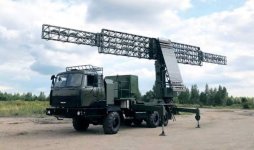
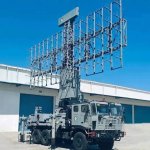
& we are NOT gonna be using giant fixed space Anti-ballistic radars of any kind for conventional airdefense role.


We need something smaller, able to fit in trucks and mobile.

images (1).jpegimages.jpeg
GrjCIGLaIAACDFw.jpg
These are the radars mid-late stages/final stages of development
that will form for *backbone* for our conventional long range airdefense for next 15-20 years.
 
Not at 400+km , that will require latest 2+ decades of development, then also time for fielding,even at current rate of radar tech development.

At the same time stealth tech is also improving.
The Russians are already claiming such technology courtesy the Nebo-M (55Zh6ME) .


In between there was chatter online we'd be going in for their Voronezh radars as well as the Nebo M .
 
  • Agree
Reactions: Rajput Lion