
Photonic systems will also give significant advantage against stealth since theyre extremely large bandwidths and operate at high frequencies on top of having low phase noise. There is going to be a generational improvement to radars in the next 5-10 yrs or so. similar to the PESA/AESA revoltution.We'll see in future.
& we are NOT gonna be using giant fixed space Anti-ballistic radars of any kind for conventional airdefense role.
We need something smaller, able to fit in trucks and mobile.
View attachment 50831View attachment 50832
View attachment 50833
These are the radars mid-late stages/final stages of development
that will form for *backbone* for our conventional long range airdefense for next 15-20 years.
India vs China - War Gaming Scenarios : Related News , Updates , Discussions & Analysis .
- Thread starter _Anonymous_
- Start date
You are using an out of date browser. It may not display this or other websites correctly.
You should upgrade or use an alternative browser.
You should upgrade or use an alternative browser.


Common logic says that fixed BMD radars are only to detect BMs, right? But then IACCS(the force which thwarted Pakistani attack from multiple vectors and form), takes data from every single sensor available and would continue to evolve further. The reason our IADS was so successful while Pakistani AD failed was exactly this sensor fusion. So, all our fixed(like BMD radars, OTH radars etc.) or road-mobile radars(like VHF-SR, Surya VHF, multiple other FCRs in higher-bands), are going to be used along with our maritime & space-based radars/EO sensors to create a comprehensive battlespace picture to thwart enemy invasion of BMs, CMs, Drones, Stealth UCAVs & Stealth fighters/bombers.We'll see in future.
& we are NOT gonna be using giant fixed space Anti-ballistic radars of any kind for conventional airdefense role.
We need something smaller, able to fit in trucks and mobile.
View attachment 50831View attachment 50832
View attachment 50833
These are the radars mid-late stages/final stages of development
that will form for *backbone* for our conventional long range airdefense for next 15-20 years.
It is NOT going to be just our VHF radar vs J-20 but our entire sensors fusing their data against it and its brethren. This net-centric approach is the real power of IAF which our enemies just can't overcome.

Voronezh is a gaint fixed OTH( over the horizan) radarIn between there was chatter online we'd be going in for their Voronezh radars as well as the Nebo M .
the Voronezh radar cannot achieve a "weapons-grade lock" on its own. While it is an extremely powerful tool for strategic awareness, its technical design limits its role to early warning loose tracking.
The Russians are already claiming such technology courtesy the Nebo-M (55Zh6ME)

Nebo-M - Wikipedia
RLM-M (in Cyrillic: «РЛМ-М» «РЛС метрового диапазона») or 55Zh6UME (export version RLM-ME) or Nebo-U and modernized variant Nebo-UM is 3-D VHF and UHF acquisition radar[13] and the main component of the Nebo-M system. It is the successor to the old 1L13 Nebo "Box Spring" radar and is easy to distinguish from it as the direction of polarization is vertical rather than horizontal. It has a range of 600 km (370 mi) and can track objects flying as fast as Mach 6.4.
* it doesn't mention the 600km range is for stealth target*
It says it has the range of 600km and also detect stealth targets, it does not say it can detect stealth targets at 600km*
Also its accuracy is listed as 400m which is not enough for weapons grade lock, unlike the chinese radar i posted about.
also horizon would limit it even if the tech was available( that's why in his calculations flankerchan used 450km as max range for detection in case of chinese radar)
Also radar horizon/line of sight of a ground radar for a fighter/object flying at
20,000 feet is ~320km.
30,000feet is ~400km
40,000 feet is ~450km.
Which is not *well beyond* 400km.
For fighter jets, Cruising for fuel efficiency usually occurs at 31,000–42,000 feet.

Its highly misunderstood concept.Photonic systems will also give significant advantage against stealth since theyre extremely large bandwidths and operate at high frequencies on top of having low phase noise. There is going to be a generational improvement to radars in the next 5-10 yrs or so. similar to the PESA/AESA revoltution.
First
It would still follow the 4th root law.
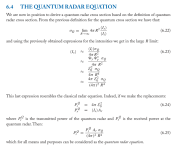
It will still emit RF waves but with sthg sthg quantum Idk fancy signal processing.
It will not emit photons
if you send an entangled photon pair out in the atmosphere entanglement lasts for a very short time.
even with super high fidelity lab optics (i.e. big optical telescopes) you'd get about a 20km round trip & SNR with entanglement is shit.
Basically photonic radars are not coming, atleast unless a unexpected breakthrough happens.
What the world is working on it quantum radars, the standard RF radars but with quantum processing.
And again they are not getting mainstream within 20 years minimum.
=====
I'll say it again
these radars are our future for next 15-20 years.
Post in thread 'India vs China - War Gaming Scenarios : Related News , Updates , Discussions & Analysis .' India vs China - War Gaming Scenarios : Related News , Updates , Discussions & Analysis .
Yeah good.Common logic says that fixed BMD radars are only to detect BMs, right? But then IACCS(the force which thwarted Pakistani attack from multiple vectors and form), takes data from every single sensor available and would continue to evolve further. The reason our IADS was so successful while Pakistani AD failed was exactly this sensor fusion. So, all our fixed(like BMD radars, OTH radars etc.) or road-mobile radars(like VHF-SR, Surya VHF, multiple other FCRs in higher-bands), are going to be used along with our maritime & space-based radars/EO sensors to create a comprehensive battlespace picture to thwart enemy invasion of BMs, CMs, Drones, Stealth UCAVs & Stealth fighters/bombers.
It is NOT going to be just our VHF radar vs J-20 but our entire sensors fusing their data against it and its brethren. This net-centric approach is the real power of IAF which our enemies just can't overcome.
Now back to the topic
your not gonna get weapons grade track/lock on a j-20 from ~400km away currently and in near future.
The large fixed radars like Swordfish or upgraded Swordfish etc are mainly for early warning & loose tracking in this case, if they wanna maintain their field of view to a large area to give early warning to a large area( their role) unless they are being used for BMD and narrowing their focus( tracking 0.1-1m2 targets at 500-1000km range)
for majority of cases of target acquisition/fire control you need radars that are more focused on specific sector and even then have to narrow focus even more to get weapons grade lock on a ~dozen target our of 100+ targets being detected in that specific sector.
That's why world uses
lots of mobile radars for a lots of local area area defence to create a nation wide dense airdefence coverage.
Instead of just building very large fixed highly power consuming
radars for our conventional air defence.
Same case with kinematics, there's a reason missiles like 40N6( 400km+ range) are used for anti-ballistic defence( ingressing target) or slow moving independent targets like awacs, tankers etc
The longest range fighter jet kill is at ~217km range by R37m fired by su35 guided by ground based radar.
And that's for a non stealth fighter.
Last edited:
Forget about our ground radars tracking J-20 from 400kms, the target and design goal of Virupaksha is to track J-20 from 200kms away, of course in a non-clattered/EW environment. Bear in mind that J-20 is primarily stealth in X-band and yet we're looking to track it from 200kms through our GaN based X-band radar. Our radar tech has absolutely become ground breaking. Shape based stealth won't cut it in future without EW. Whichever side will dominate the EW spectrum will dominate the future wars.Yeah good.
Now back to the topic
your not gonna get weapons grade track/lock on a j-20 from ~400km away currently and in near future.
The large fixed radars like Swordfish or upgraded Swordfish etc are mainly for early warning & loose tracking in this case, if they wanna maintain their field of view to a large area to give early warning to a large area( their role) unless they are being used for BMD and narrowing their focus( tracking 0.1-1m2 targets at 500-1000km range)
for majority of cases of target acquisition/fire control you need radars that are more focused on specific sector and even then have to narrow focus even more to get weapons grade lock on a ~dozen target our of 100+ targets being detected in that specific sector.
That's why world uses
lots of mobile radars for a lots of local area area defence to create a nation wide dense airdefence coverage.
Instead of just building very large fixed highly power consuming
radars for our conventional air defence.
Same case with kinematics, there's a reason missiles like 40N6( 400km+ range) are used for anti-ballistic defence( ingressing target) or slow moving independent targets like awacs, tankers etc
The longest range fighter jet kill is at ~217km range by R37m fired by su35 guided by ground based radar.
And that's for a non stealth fighter.
Source? For all these performance claimsForget about our ground radars tracking J-20 from 400kms, the target and design goal of Virupaksha is to track J-20 from 200kms away, of course in a non-clattered/EW environment. Bear in mind that J-20 is primarily stealth in X-band and yet we're looking to track it from 200kms through our GaN based X-band radar. Our radar tech has absolutely become ground breaking. Shape based stealth won't cut it in future without EW. Whichever side will dominate the EW spectrum will dominate the future wars.


Voronezh is a gaint fixed OTH( over the horizan) radar
the Voronezh radar cannot achieve a "weapons-grade lock" on its own. While it is an extremely powerful tool for strategic awareness, its technical design limits its role to early warning loose tracking.
Nebo-M - Wikipedia
en.wikipedia.org
RLM-M (in Cyrillic: «РЛМ-М» «РЛС метрового диапазона») or 55Zh6UME (export version RLM-ME) or Nebo-U and modernized variant Nebo-UM is 3-D VHF and UHF acquisition radar[13] and the main component of the Nebo-M system. It is the successor to the old 1L13 Nebo "Box Spring" radar and is easy to distinguish from it as the direction of polarization is vertical rather than horizontal. It has a range of 600 km (370 mi) and can track objects flying as fast as Mach 6.4.
* it doesn't mention the 600km range is for stealth target*
It says it has the range of 600km and also detect stealth targets, it does not say it can detect stealth targets at 600km*
Also its accuracy is listed as 400m which is not enough for weapons grade lock, unlike the chinese radar i posted about.
also horizon would limit it even if the tech was available( that's why in his calculations flankerchan used 450km as max range for detection in case of chinese radar)
The Russian Nebo-M (55Zh6ME) radar system is designed to track stealth aircraft, such as the F-22 and F-35, at ranges exceeding 300 km (approximately 186+ miles) using its VHF component, which is effective against low-observable targets. The system has a maximum overall detection range of 600 km for aerodynamic targets and 1,800 km for ballistic targets.
I suggest try not to use basic Google search its wrong most of the time in any technical topic that is complex.
Same thing with A.I.
===
Offical russian data says.
400m accuracy in range
in range and 0.67°
in angular accuracy.
That level of accuracy can provide loose tracking, helping cue other more accurate but less range radars( that are also part of nebo-m complex) but by itself that level of accuracy is not enough to get a weapons grade lock to guide a missile.
Last edited:
Source: @Rajput LionSource? For all these performance claims


Nebo-M is very good example of what I have written on this thread so far. It's one system consisting of three different radars operating in three different bands: VHF, L & X. Then all the data from these different sensors is fused to track VLO fighters from more than 300kms. Here is a representative image from Researchgate:
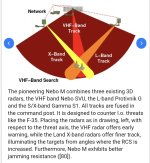
This is what we're going to do and even better than the Russians.
Yea
Yeah, the graph doesn't say anything about *300km*Source: @Rajput Lion
Nebo-M is very good example of what I have written on this thread so far. It's one system consisting of three different radars operating in three different bands: VHF, L & X. Then all the data from these different sensors is fused to track VLO fighters from more than 300kms. Here is a representative image from Researchgate:
View attachment 50862
This is what we're going to do and even better than the Russians.
Frankly I've yet to see citations or references from your end contradicting what I or other members have put out. All we have is your word. Which is fine by me too .I suggest try not to use basic Google search its wrong most of the time in any technical topic that is complex.
Same thing with A.I.
===
Offical russian data says.
400m accuracy in range
in range and 0.67°
in angular accuracy.
That level of accuracy can provide loose tracking, helping cue other more accurate but less range radars( that are also part of nebo-m complex) but by itself that level of accuracy is not enough to get a weapons grade lock to guide a missile.
400 mtrs accuracy would mean nothing if the seekers are powerful enough to remain cued to the target. I've no clue if they are. Besides is that 0.67° angular accuracy supposed to be a deal breaker ?

Yea
Yeah, the graph doesn't say anything about *300km*
Long-Range Detection Power: The Nebo-M can detect normal aircraft at up to 600km distance and even track some ballistic targets at 1,800km. For stealth jets, the VHF radar lets it pick up small targets over 300km away even if the target has a very small radar cross-section. This makes it effective against modern stealth aircraft, as per the reports.
Source: Russia’s $100 million radar systems detect fighter jets like F-22, F-35, and missiles early
Frankly I've yet to see citations or references from your end contradicting what I or other members have put out. All we have is your word. Which is fine by me too .
400 mtrs accuracy would mean nothing if the seekers are powerful enough to remain cued to the target. I've no clue if they are. Besides is that 0.67° angular accuracy supposed to be a deal breaker ?
Радиолокационный комплекс 55Ж6М 'Небо-М' решает задачи не только ПВО, но и нестратегической ПРО
Технологический шедевр Концерна ВКО 'Алмаз – Антей' обладает уникальными характеристиками и не имеет аналогов в мире
 oborona.ru
*Thanks to the high energy parameters of the meter and decimeter modules( UHF, VHF band), even in surveillance mode, the detection range of targets with an RCS of 1 square meter reached 550-600 km, which is a record among all modern radars*
Now while this radar has too low of any accuracy for weapons grade lock/track( you need 20-30m accuracy minimum in current context) it can still loosly track the moving targeting, allowing cuing for other more accurate radar.
Based on its quoted detection ability of 1m2 target at 550-600km( which is guess should be 30km altitude for line of sight reasons)
Using the radar range equation(4th root law) (and its SNR form) we get the track(loose) range of ~400km for 1m2 target.
A stealth target in uhf, vhf band shows median rcs range of 0.1-0.5m2 based on shape, and assuming *CONSERVATIVELY* -15DBSM REDUCTION By RAS&RAM.
We get the rcs range of 0.01-0.03m2.
At this rcs, using same equation we get the tracking(loose) range of 150-200km.
For stealth targets.
Last edited:
A much better source than WION
Post in thread 'India vs China - War Gaming Scenarios : Related News , Updates , Discussions & Analysis .' India vs China - War Gaming Scenarios : Related News , Updates , Discussions & Analysis .
photonic radars are not emitting photons lmao.Its highly misunderstood concept.
First
It would still follow the 4th root law.
View attachment 50857
It will still emit RF waves but with sthg sthg quantum Idk fancy signal processing.
It will not emit photons
if you send an entangled photon pair out in the atmosphere entanglement lasts for a very short time.
even with super high fidelity lab optics (i.e. big optical telescopes) you'd get about a 20km round trip & SNR with entanglement is shit.
Basically photonic radars are not coming, atleast unless a unexpected breakthrough happens.
What the world is working on it quantum radars, the standard RF radars but with quantum processing.
And again they are not getting mainstream within 20 years minimum.
=====
I'll say it again
these radars are our future for next 15-20 years.
Post in thread 'India vs China - War Gaming Scenarios : Related News , Updates , Discussions & Analysis .' India vs China - War Gaming Scenarios : Related News , Updates , Discussions & Analysis .
Theyre emmiting RF waves that are generated using optical fibres and PICs. This means that to emit the same amount they require significantly less power since they do not have the same amount of heat generated. Since theyre generated by PICs they have significantly wider bandwidth(11-30Gz of bandwidth, the DRDO one is centered around34HGZ with 11 GHZ bandwidth so 29-40GHZ range). This means that for the same power photonic radars are significantly better than a normal GaN based Oscillator radar. Photonic radars still use (GaN/Ga2O3)
It also means that they can transmit there waves at the same time with significantly less phase noise which means smaller radar pings are a lot easier to spot since there is so much less noise. This is why they're significantly mor effective vs stealth.
never did i say anywhere that photonic radars use photons. thats not possible with current tech since photons are incredibly easy to disturb in the atmosphere. They might be ultra precise but clouds and dust are going to scatter way to many photons.
Ah that, well The name *photonic* can be considered misinformed.photonic radars are not emitting photons lmao.
Theyre emmiting RF waves that are generated using optical fibres and PICs. This means that to emit the same amount they require significantly less power since they do not have the same amount of heat generated. Since theyre generated by PICs they have significantly wider bandwidth(11-30Gz of bandwidth, the DRDO one is centered around34HGZ with 11 GHZ bandwidth so 29-40GHZ range). This means that for the same power photonic radars are significantly better than a normal GaN based Oscillator radar. Photonic radars still use (GaN/Ga2O3)
It also means that they can transmit there waves at the same time with significantly less phase noise which means smaller radar pings are a lot easier to spot since there is so much less noise. This is why they're significantly mor effective vs stealth.
never did i say anywhere that photonic radars use photons. thats not possible with current tech since photons are incredibly easy to disturb in the atmosphere. They might be ultra precise but clouds and dust are going to scatter way to many photons.
At most they are hybrid: Photonic/optical frontend + electronic PA + antenna.
I was thinking you are talking about the concept of Generating a pairs of entangled microwave photons in quantum state. One photon (signal) is transmitted toward the target the other (idler) is kept locally.
what your talking about is quantum entaglement based radars and they're at least 10 yrs away if not more.Ah that, well The name *photonic* can be considered misinformed.
At most they are hybrid: Photonic/optical frontend + electronic PA + antenna.
I was thinking you are talking about the concept of Generating a pairs of entangled microwave photons in quantum state. One photon (signal) is transmitted toward the target the other (idler) is kept locally.
AI reports RF seekers can correct deviations of upto 500 mtrs or more due to limitations in Radar track mid flight. Didn't do a similar exercise for IIR seekers.Радиолокационный комплекс 55Ж6М 'Небо-М' решает задачи не только ПВО, но и нестратегической ПРО
Технологический шедевр Концерна ВКО 'Алмаз – Антей' обладает уникальными характеристиками и не имеет аналогов в мире
*Thanks to the high energy parameters of the meter and decimeter modules( UHF, VHF band), even in surveillance mode, the detection range of targets with an RCS of 1 square meter reached 550-600 km, which is a record among all modern radars*
Now while this radar has too low of any accuracy for weapons grade lock/track( you need 20-30m accuracy minimum in current context) it can still loosly track the moving targeting, allowing cuing for other more accurate radar.
Based on its quoted detection ability of 1m2 target at 550-600km( which is guess should be 30km altitude for line of sight reasons)
Using the radar range equation(4th root law) (and its SNR form) we get the track(loose) range of ~400km for 1m2 target.
A stealth target in uhf, vhf band shows median rcs range of 0.1-0.5m2 based on shape, and assuming *CONSERVATIVELY* -15DBSM REDUCTION By RAS&RAM.
We get the rcs range of 0.01-0.03m2.
At this rcs, using same equation we get the tracking(loose) range of 150-200km.
For stealth targets.
So assuming Nebo M reports a track off by 500 mtrs at a distance of 300 kms at say 30,000 mtrs where's the problem ?
Seeker of a missiles definitely can help, especially modern and upcoming ones.AI reports RF seekers can correct deviations of upto 500 mtrs or more due to limitations in Radar track mid flight. Didn't do a similar exercise for IIR seekers.
So assuming Nebo M reports a track off by 500 mtrs at a distance of 300 kms at say 30,000 mtrs where's the problem ?
Though still, the higher the radar track accuracy the tighter/narrower the "handover basket" (uncertainty volume at seeker activation), the more loose this handover basket is the less chance of PK(probability kill) especially at longer ranges, where missile's kinematics are mostly exhausted especially against fast agile independent targets like fighter jets, it will not be a high confidence intercept also as modern fighter jets have rwr,MAWS etc for early warning .
Now all this is theory.
Now as for reality.
** right now there is no missile that has kinematics and seeker performance to hit a fighter jet(non stealth) at 300+km(or even150+ km reliably) using loose radar track of 400-500m accuracy**
That's why the uhf/vhf component of russian nebo-m is used for cueing other radars, not For fire control, unlike the chinese radar which has Cross Dipole antenna, That indicates the radar works using circular polarization which gives more accuracy and more performance in high clutter enviornment( good snr).
The longest range kill of a fighter jet is ~217km against a older *ingressing* Ukraine su-27 by a russian R-37m fired by Russian su-35 guided by ground based radars, and from the reports the Ukrainian fighter didn't react/try to evade the incoming missilse most likely due to not having rwr or MAWS( which modern fighters do), and also large rcs of Ukrainian su27( su-35 has ram treatment)
Second, by using the calculation, the tracking(loose) range of nebo-m's uhf/vhf component is ~150-200km against a stealth target, not 300km.
In future within 2 decades we will probably have missiles( also radars & radar grids with longer range and more accuracy at the same time) that can hit ingressing fighter jets( non-stealth) at ~400km away, but hitting a *stealth jet* at that range within 2 decades of development is highly unlikely.
Last edited: