

Ukraine - Russia Conflict
- Thread starter randomradio
- Start date
You are using an out of date browser. It may not display this or other websites correctly.
You should upgrade or use an alternative browser.
You should upgrade or use an alternative browser.

What the transcript reveals about ground drones is, in my view, far more significant than the simple notion that “robots are coming to the battlefield.”
The first lesson—and arguably the most significant one—is that ground drones did not initially succeed where everyone expected them to. The military imagination, in Ukraine as elsewhere, envisioned small unmanned tanks: vehicles capable of moving forward, firing, taking up a position, and supporting an assault. Yet that is not what actually worked first. What worked was far more modest, far less spectacular, and far more decisive: last-mile logistics. The useful ground drone was not initially a heroic killer, but a pack animal. It carried ammunition, batteries, water, spare parts, drones, fuel, and sometimes the wounded. In short, it replaced humans where humans were dying needlessly—that is, on supply routes that had become untenable under drone fire.
The second lesson is that this evolution did not arise from a clear doctrine handed down from above. It emerged in defiance of the spontaneous vision of the hierarchy. Command staff wanted “small tanks”; the units that truly achieved results started by doing something else. They took imperfect, unglamorous, often improvised platforms and put them to work on a concrete problem. This ties into a near-universal law of military innovation: the first truly effective use of a new technology is not the one that makes the biggest impression, but the one that resolves an immediate vulnerability. Here, the immediate vulnerability was not the lack of robotic assault tanks; it was the growing inability to sustain sophisticated logistics.
The third lesson is that ground drones cannot be considered in isolation. Their effectiveness depends on an ecosystem. The transcript illustrates this very well: to operate a UGV, you need communications, so often Starlink; you sometimes need aerial drones to see where it’s going, because visibility is poor from ground level; you need people to manage the relays, maps, routes, batteries, retrieval, and repairs. In other words, a ground drone is not an autonomous device that you simply set loose on its own. It is a node in a broader architecture. Perhaps this is what explains why the early fantasies failed: we thought we were buying a machine; in reality, a chain had to be created.
The fourth lesson is that the terrain matters far more than it does for aerial drones. The speakers emphasize this: an UGV is much harder to operate than a flying drone. It must navigate potholes, craters, mud, slopes, obstacles, trees, debris, and areas churned up by artillery. It is slow, low-flying, sometimes blind, and often easier to lose. This means that robotic ground warfare is not simply a ground-based version of aerial drone warfare. It is a different world, with different constraints. That is why development is slower.
The fifth lesson—and it is crucial—is that the rise of UGVs was not driven by abstract progress, but by a very specific Russian constraint: the rise of fiber-optic FPVs. As long as the logistics zone near the front remained manageable, the need for ground drones existed without being absolute. When Russia began making logistics deadly up to about ten kilometers, the nature of the problem changed. From that point on, the ground drone was no longer a bonus, but almost a necessity. This is a very important point: innovation does not advance on its own; it is often abruptly accelerated by an adversary’s innovation. Ukrainian UGVs did not gain their importance because they were suddenly wonderful, but because the tactical environment had become so hostile that there was no other option.
The sixth lesson is that ground drones have a very specific economic value in warfare. They are less valuable than a human, but not entirely disposable. Experts say that a UGV can be hit frequently, but that it is sometimes recoverable. We are therefore in an intermediate category: it is neither the prestigious vehicle that we absolutely do not want to lose, nor the small, fully expendable aerial drone. It is a manageable attrition tool. This matters greatly, as it allows for a more flexible operational approach than that of large manned systems, without descending into total waste.
The seventh lesson is that once the logistical phase is under control, combat operations resume, but in a more realistic manner. The Ukrainians describe the initial mistake very well: wanting to use an assault robot before learning how to operate it effectively. Now that they have learned to “walk,” certain fire functions are reappearing: positional defense, fire support, firing from prepared positions, and more demanding operations. But this progression toward direct combat comes after logistics, not before. It is a very instructive progression. It means that, in ground robotization, the first threshold is not the destruction of the enemy, but the survival of support.
The eighth, deeper lesson is that the ground drone challenges an old mental separation between logistics and combat. In many armies, logistics is thought of as a rear-area function. Yet in this war, the final mile of logistics has become a pure combat zone. Delivering water or a battery may require more cunning, sensors, communications, and risk than a “classic” fire mission. The ground drone brings this into sharp relief: logistics is no longer behind the war; it is within it.
The ninth lesson is that innovation in ground drones confirms the strength of the Ukrainian model of distributed experimentation. Official units mandated from above often expected too much from the machines too soon. More informal units, supported by civil-military networks, learned faster because they did not have to immediately “prove” a grandiose vision. They could start small, succeed in modest applications, gather feedback, and then win others over. This means that the success of UGVs is not merely technical; it is also organizational. An army that cannot allow this kind of solution to grow from the bottom up would have had a much harder time deriving any benefit from it.
Finally, the last lesson is perhaps the most important for the future: the ground drone does not yet replace the infantryman, but it is beginning to replace certain missions where the infantryman was exposed without strategic necessity. That is very different. We are not yet on a battlefield without men. We are on a battlefield where we are increasingly seeking to reserve the human for what only he can still do: hold ground, search, make on-the-spot decisions, interpret, secure, and exploit. Anything involving purely repetitive exposure, transport under threat, blind approaches, or lethal routine missions tends to be shifted to platforms.
So, if I had to condense this entire discussion on ground drones into a single sentence, I would say this:
Ground drones have not yet revolutionized combat through robotic assault, but they are already revolutionizing warfare by eliminating an increasing portion of the logistical and tactical tasks in which humans served primarily as targets.
The first lesson—and arguably the most significant one—is that ground drones did not initially succeed where everyone expected them to. The military imagination, in Ukraine as elsewhere, envisioned small unmanned tanks: vehicles capable of moving forward, firing, taking up a position, and supporting an assault. Yet that is not what actually worked first. What worked was far more modest, far less spectacular, and far more decisive: last-mile logistics. The useful ground drone was not initially a heroic killer, but a pack animal. It carried ammunition, batteries, water, spare parts, drones, fuel, and sometimes the wounded. In short, it replaced humans where humans were dying needlessly—that is, on supply routes that had become untenable under drone fire.
The second lesson is that this evolution did not arise from a clear doctrine handed down from above. It emerged in defiance of the spontaneous vision of the hierarchy. Command staff wanted “small tanks”; the units that truly achieved results started by doing something else. They took imperfect, unglamorous, often improvised platforms and put them to work on a concrete problem. This ties into a near-universal law of military innovation: the first truly effective use of a new technology is not the one that makes the biggest impression, but the one that resolves an immediate vulnerability. Here, the immediate vulnerability was not the lack of robotic assault tanks; it was the growing inability to sustain sophisticated logistics.
The third lesson is that ground drones cannot be considered in isolation. Their effectiveness depends on an ecosystem. The transcript illustrates this very well: to operate a UGV, you need communications, so often Starlink; you sometimes need aerial drones to see where it’s going, because visibility is poor from ground level; you need people to manage the relays, maps, routes, batteries, retrieval, and repairs. In other words, a ground drone is not an autonomous device that you simply set loose on its own. It is a node in a broader architecture. Perhaps this is what explains why the early fantasies failed: we thought we were buying a machine; in reality, a chain had to be created.
The fourth lesson is that the terrain matters far more than it does for aerial drones. The speakers emphasize this: an UGV is much harder to operate than a flying drone. It must navigate potholes, craters, mud, slopes, obstacles, trees, debris, and areas churned up by artillery. It is slow, low-flying, sometimes blind, and often easier to lose. This means that robotic ground warfare is not simply a ground-based version of aerial drone warfare. It is a different world, with different constraints. That is why development is slower.
The fifth lesson—and it is crucial—is that the rise of UGVs was not driven by abstract progress, but by a very specific Russian constraint: the rise of fiber-optic FPVs. As long as the logistics zone near the front remained manageable, the need for ground drones existed without being absolute. When Russia began making logistics deadly up to about ten kilometers, the nature of the problem changed. From that point on, the ground drone was no longer a bonus, but almost a necessity. This is a very important point: innovation does not advance on its own; it is often abruptly accelerated by an adversary’s innovation. Ukrainian UGVs did not gain their importance because they were suddenly wonderful, but because the tactical environment had become so hostile that there was no other option.
The sixth lesson is that ground drones have a very specific economic value in warfare. They are less valuable than a human, but not entirely disposable. Experts say that a UGV can be hit frequently, but that it is sometimes recoverable. We are therefore in an intermediate category: it is neither the prestigious vehicle that we absolutely do not want to lose, nor the small, fully expendable aerial drone. It is a manageable attrition tool. This matters greatly, as it allows for a more flexible operational approach than that of large manned systems, without descending into total waste.
The seventh lesson is that once the logistical phase is under control, combat operations resume, but in a more realistic manner. The Ukrainians describe the initial mistake very well: wanting to use an assault robot before learning how to operate it effectively. Now that they have learned to “walk,” certain fire functions are reappearing: positional defense, fire support, firing from prepared positions, and more demanding operations. But this progression toward direct combat comes after logistics, not before. It is a very instructive progression. It means that, in ground robotization, the first threshold is not the destruction of the enemy, but the survival of support.
The eighth, deeper lesson is that the ground drone challenges an old mental separation between logistics and combat. In many armies, logistics is thought of as a rear-area function. Yet in this war, the final mile of logistics has become a pure combat zone. Delivering water or a battery may require more cunning, sensors, communications, and risk than a “classic” fire mission. The ground drone brings this into sharp relief: logistics is no longer behind the war; it is within it.
The ninth lesson is that innovation in ground drones confirms the strength of the Ukrainian model of distributed experimentation. Official units mandated from above often expected too much from the machines too soon. More informal units, supported by civil-military networks, learned faster because they did not have to immediately “prove” a grandiose vision. They could start small, succeed in modest applications, gather feedback, and then win others over. This means that the success of UGVs is not merely technical; it is also organizational. An army that cannot allow this kind of solution to grow from the bottom up would have had a much harder time deriving any benefit from it.
Finally, the last lesson is perhaps the most important for the future: the ground drone does not yet replace the infantryman, but it is beginning to replace certain missions where the infantryman was exposed without strategic necessity. That is very different. We are not yet on a battlefield without men. We are on a battlefield where we are increasingly seeking to reserve the human for what only he can still do: hold ground, search, make on-the-spot decisions, interpret, secure, and exploit. Anything involving purely repetitive exposure, transport under threat, blind approaches, or lethal routine missions tends to be shifted to platforms.
So, if I had to condense this entire discussion on ground drones into a single sentence, I would say this:
Ground drones have not yet revolutionized combat through robotic assault, but they are already revolutionizing warfare by eliminating an increasing portion of the logistical and tactical tasks in which humans served primarily as targets.

1:5 kill ratio: Ukraine inflicts heavy Russian losses using drones, says Finnish president

1:5 kill ratio: Ukraine inflicts heavy Russian losses using drones, says Finnish president - Breaking Defense
Finnish President Alexander Stubb said during his visit to Washington that Ukraine is in a much better place than it has been at any stage of the war thus far.
Ukraine currently has a military advantage over Russia, according to Finnish President Alexander Stubb, with Moscow experiencing personnel losses at a rate five times higher than Kyiv’s, largely due to Ukraine’s steadily improving drone kill rates.
“I think Ukraine is in a much better place than it has been at any stage in this horrific war — the killing ratio right now is 1:5, one Ukrainian soldier to five Russian soldiers. … The rate at which they’re going now is roughly 150 to 157 dead [Russian] soldiers per square kilometers,” Stubb said during a panel organized by the Brookings Institution on Monday while on an official visit to Washington.
What this transcript shows is not merely that Ukraine uses a lot of drones. It shows that, through Victory Drones, Ukraine has managed to create a radically new warfighting structure—a hybrid of a training center, an incubator, a distribution network, and a civil-military interface. It is this type of organization that makes it possible to transform a local innovation into a genuinely useful capability and then disseminate it rapidly. Without this, drones would remain scattered DIY projects. With this, they become a system. This is likely one of the most important lessons for European armies: they don’t just need new machines; they need structures capable of capturing, filtering, testing, teaching, and rapidly scaling up innovation from the field. This is a war where the entire architecture of combat is changing. Ground drones, for example, did not initially succeed as small unmanned tanks, as many imagined. What worked first was much simpler and much more important: last-mile logistics. The robot did not initially replace the infantryman to take a position; it replaced the infantryman who would carry ammunition, water, batteries, and spare parts into an area where a pickup truck would be destroyed. This is a major lesson: true military innovation is not primarily what impresses; it is what eliminates a concrete vulnerability.
The second lesson is that Starlink is not merely a practical tool. It is a war infrastructure. Without stable connectivity, there is no short-loop feedback, no actionable video feed, no rapid fire correction, no efficient robotic logistics, and no modern distributed warfare. This point is huge, because it shows that future warfare depends as much on the actionable flow of information as it does on the ammunition itself. And that means one very simple thing for Europe: OneWeb and then IRIS² are not technocratic whims. They are prerequisites for operational sovereignty. A modern army that relies entirely on a foreign private network to conduct its distributed warfare has a major strategic problem.
The third lesson, perhaps the most profound, is that the Ukrainians are innovating not because they have a perfect doctrine, but because they have a structure that allows innovation to grow from the bottom up. They tinker, they try, they make mistakes, they start over, they disseminate, and then they institutionalize. Victory Drones is almost more interesting than any single drone, because it serves as the bridge between the military, civilians, engineers, the needs of the front lines, and scaling up. And this is probably where European armies have the most to learn: they don’t just need more drones; they need structures capable of rapidly transforming local innovation into widespread capability.
Ultimately, this analysis conveys a very simple truth: modern warfare is becoming a system of systems, where humans do not disappear, but where they must increasingly be reserved for what only they can still do: decide, hold, operate, and orchestrate. Everything that is repetitive, logistical, too exposed, or too mindlessly lethal is beginning to be delegated to machines. And this applies on the ground as well as in the air. The ground drone replaces part of the suicidal logistics, the aerial drone replaces part of the immediate exposure, the satellite connects everyone, and AI is beginning to emerge in the background as a tool for sorting, guidance, and soon broader autonomy.
So the real lesson for Europe is not “let’s buy a few more drones.” The real lesson is: we need armies capable of learning quickly, disseminating information rapidly, accepting expendable systems, automating their logistics, shortening their decision-making loops, and achieving complete autonomy in tactical communications. Otherwise, they will have impressive programs but a disastrous war.
The second lesson is that Starlink is not merely a practical tool. It is a war infrastructure. Without stable connectivity, there is no short-loop feedback, no actionable video feed, no rapid fire correction, no efficient robotic logistics, and no modern distributed warfare. This point is huge, because it shows that future warfare depends as much on the actionable flow of information as it does on the ammunition itself. And that means one very simple thing for Europe: OneWeb and then IRIS² are not technocratic whims. They are prerequisites for operational sovereignty. A modern army that relies entirely on a foreign private network to conduct its distributed warfare has a major strategic problem.
The third lesson, perhaps the most profound, is that the Ukrainians are innovating not because they have a perfect doctrine, but because they have a structure that allows innovation to grow from the bottom up. They tinker, they try, they make mistakes, they start over, they disseminate, and then they institutionalize. Victory Drones is almost more interesting than any single drone, because it serves as the bridge between the military, civilians, engineers, the needs of the front lines, and scaling up. And this is probably where European armies have the most to learn: they don’t just need more drones; they need structures capable of rapidly transforming local innovation into widespread capability.
Ultimately, this analysis conveys a very simple truth: modern warfare is becoming a system of systems, where humans do not disappear, but where they must increasingly be reserved for what only they can still do: decide, hold, operate, and orchestrate. Everything that is repetitive, logistical, too exposed, or too mindlessly lethal is beginning to be delegated to machines. And this applies on the ground as well as in the air. The ground drone replaces part of the suicidal logistics, the aerial drone replaces part of the immediate exposure, the satellite connects everyone, and AI is beginning to emerge in the background as a tool for sorting, guidance, and soon broader autonomy.
So the real lesson for Europe is not “let’s buy a few more drones.” The real lesson is: we need armies capable of learning quickly, disseminating information rapidly, accepting expendable systems, automating their logistics, shortening their decision-making loops, and achieving complete autonomy in tactical communications. Otherwise, they will have impressive programs but a disastrous war.
Ukraine now appears to be using drone technology to wear down Russian forces more effectively than ever before.1:5 kill ratio: Ukraine inflicts heavy Russian losses using drones, says Finnish president
1:5 kill ratio: Ukraine inflicts heavy Russian losses using drones, says Finnish president - Breaking Defense
Finnish President Alexander Stubb said during his visit to Washington that Ukraine is in a much better place than it has been at any stage of the war thus far.breakingdefense.com
I would really hesitate to accept numbers from a country at war. regardless of country at war.1:5 kill ratio: Ukraine inflicts heavy Russian losses using drones, says Finnish president
1:5 kill ratio: Ukraine inflicts heavy Russian losses using drones, says Finnish president - Breaking Defense
Finnish President Alexander Stubb said during his visit to Washington that Ukraine is in a much better place than it has been at any stage of the war thus far.
They're not from Ukraine if you read.I would really hesitate to accept numbers from a country at war. regardless of country at war.
Theyre from europe(finland). An ally very close to ukraine. Not much different.They're not from Ukraine if you read.
NATO figures are very different to Ukraine's. Russia has 3.5x population, if kill ratio was in Ru's favour they'd have won already.Theyre from europe(finland). An ally very close to ukraine. Not much different.
Footage of precision strikes by the Russian 300mm Tornado-S MLRS, possibly the Sarma MLRS, on temporary deployment sites of Ukrainian units stationed in abandoned buildings. The videos were filmed in the Zaporizhzhia and Kharkiv directions.
Footage of a Russian Kh-38 missile striking a temporary Ukrainian army base in the village of Lesnaya Stenka in the Kharkiv region. The building housed soldiers from the 77th Separate Airmobile Brigade of the Ukrainian Army. The attack was carried out by a Su-34 fighter-bomber. As a result of the Kh-38 missile strike, part of the building was destroyed.
mate its at max a 1.5-1x kill favour. 1.5 russians for every one ukranian. You do realise that ukraine has been trying to go on the offensive on multiple fronts right? Its not only the ukranians who have drones but the russians as well.
NATO figures are very different to Ukraine's. Russia has 3.5x population, if kill ratio was in Ru's favour they'd have won already.
We are alr seeing manpower issues within the ukranian army lmao, multiple generals complaining and the abduction of draft dodgers off the street is not a sign of healthy manpower. The main reason for slow russian advances is the fact that ukraine has the densest air defense on planet earth. The amount of patriots, s300, IRST and other sam variants within ukraine is insane.
Drones have also completely stopped manuever warfare. This means a lot of gains have to be done by foot. You also have to give credit to the soldiers of ukraine who have dug through even after a lot of stupid decisions from the main command.
This is precisely why a land war in iran would have been catastrophic for the US. drones have completely changes how land wars work. Iran is just as mountainous as afghanistan if not more. Drones have completely changed land warfare and soon they will change warfare at sea as well.

I would really hesitate to accept numbers from a country at war. regardless of country at war.
Yeah, numbers from both sides are fake. I stopped looking at them long ago.
The only thing visible is Russia keeps taking territories while Ukraine keeps getting pushed back.
And what can be verified is Russia hands over more bodies to Ukraine than vice versa.
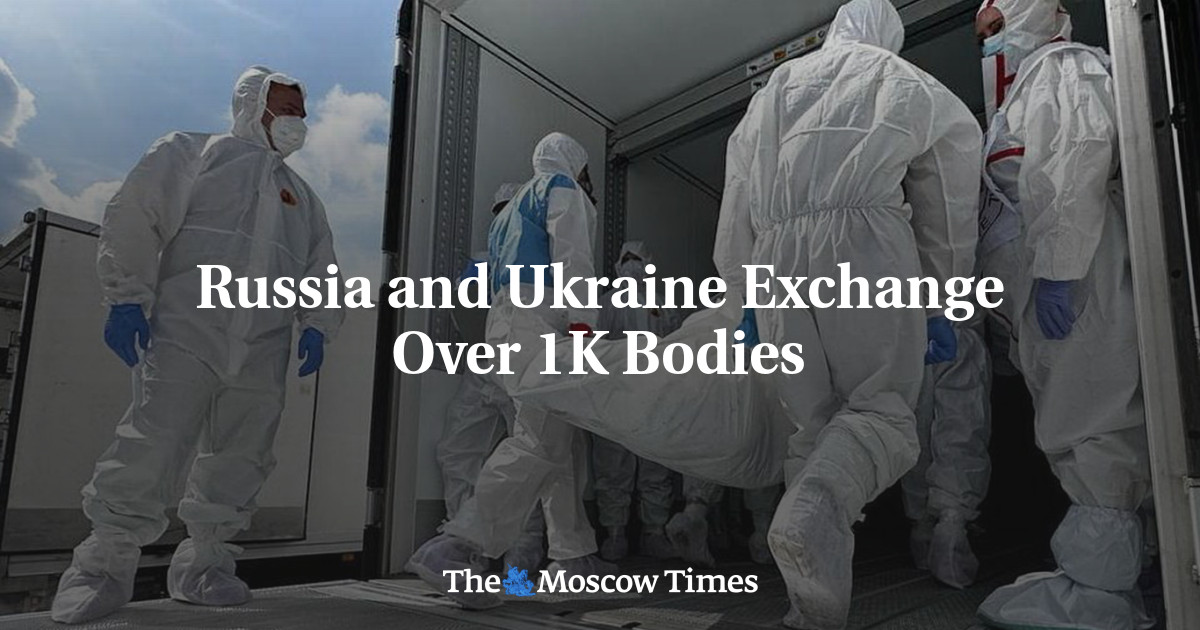
Russia and Ukraine Exchange Over 1K Bodies - The Moscow Times
Russia and Ukraine carried out a major repatriation of fallen service members on Thursday, with Moscow handing over the remains of 1,000 Ukrainian soldiers in exchange for 41 Russian bodies.
Here's another from last year.

Ukraine war: 1,212 soldiers' bodies repatriated in latest swap with Russia
Russia receives 27 soldiers' bodies as the warring sides continue their large-scale prisoner swap deal.
 www.bbc.com
In return Russia received 27 bodies, Moscow's chief negotiator Vladimir Medinsky said.
There have been over 70 such transfers.
you alsohave to realise that russia is advancing so they win recover a lot more of thei rown bodies. I still believe the ratio is 1.5 russains per ukranianYeah, numbers from both sides are fake. I stopped looking at them long ago.
The only thing visible is Russia keeps taking territories while Ukraine keeps getting pushed back.
And what can be verified is Russia hands over more bodies to Ukraine than vice versa.
Russia and Ukraine carried out a major repatriation of fallen service members on Thursday, with Moscow handing over the remains of 1,000 Ukrainian soldiers in exchange for 41 Russian bodies.Russia and Ukraine Exchange Over 1K Bodies - The Moscow Times
Russia and Ukraine carried out a major repatriation of fallen service members on Thursday, with Moscow handing over the remains of 1,000 Ukrainian soldiers in exchange for 41 Russian bodies.www.themoscowtimes.com
Here's another from last year.
The bodies of 1,212 Ukrainian soldiers have been returned from Russia, Kyiv says, as part of a prisoner exchange agreement between the warring countries.Ukraine war: 1,212 soldiers' bodies repatriated in latest swap with Russia
Russia receives 27 soldiers' bodies as the warring sides continue their large-scale prisoner swap deal.
In return Russia received 27 bodies, Moscow's chief negotiator Vladimir Medinsky said.
There have been over 70 such transfers.
you alsohave to realise that russia is advancing so they win recover a lot more of thei rown bodies. I still believe the ratio is 1.5 russains per ukranian
The offensive is not so fast that the Ukrainians are completely unable to recover their own bodies while under fire while the Russians can recover the bodies of both sides while under fire.
I don't know about kill ratios, 'cause they are all fake anyway, but this shows a lot of kala in the daal.
This article deserves to be taken seriously, with one caveat: Stubb is offering a political interpretation based on recent Ukrainian figures, not a definitive, independent assessment.Yeah, numbers from both sides are fake. I stopped looking at them long ago.
The only thing visible is Russia keeps taking territories while Ukraine keeps getting pushed back.
And what can be verified is Russia hands over more bodies to Ukraine than vice versa.
Russia and Ukraine carried out a major repatriation of fallen service members on Thursday, with Moscow handing over the remains of 1,000 Ukrainian soldiers in exchange for 41 Russian bodies.Russia and Ukraine Exchange Over 1K Bodies - The Moscow Times
Russia and Ukraine carried out a major repatriation of fallen service members on Thursday, with Moscow handing over the remains of 1,000 Ukrainian soldiers in exchange for 41 Russian bodies.
Here's another from last year.
The bodies of 1,212 Ukrainian soldiers have been returned from Russia, Kyiv says, as part of a prisoner exchange agreement between the warring countries.Ukraine war: 1,212 soldiers' bodies repatriated in latest swap with Russia
Russia receives 27 soldiers' bodies as the warring sides continue their large-scale prisoner swap deal.
In return Russia received 27 bodies, Moscow's chief negotiator Vladimir Medinsky said.
There have been over 70 such transfers.
The strongest point is that Stubb did indeed say this at Brookings on April 13: a casualty ratio of 1:5, approximately 150 to 157 Russian soldiers killed per square kilometer, and a Ukraine that he considers “in a much better position than at any previous stage of the war.” The Brookings transcript and corroborating reports make this clear.
The second solid point is that the 95% attributed to drones did not come out of thin air. Stubb did indeed cite this figure, and it fits a documented trend: Reuters had already reported in August 2025, via Fedorov, that 80 to 90% of Russian targets struck were hit by drones, and then other sources in early 2026 cited figures of over 80%. So 95% is a higher estimate, but not inconsistent with Ukraine’s recent trajectory.
The third solid point is the figure of 33,000 enemy drones destroyed in March. It is clearly cited by the Ukrainian Ministry of Defense, by Fedorov, and reported by CEPA and other media outlets. It is therefore not a baseless rumor.
Where caution is needed is regarding the analytical significance of these figures. The 1:5 ratio is much more favorable to Ukraine than the CSIS’s earlier estimates, which were closer to 1:2 to 1:2.5. This could mean three things at once: Ukrainian drones have genuinely improved the attrition ratio, the period under observation is particularly favorable to Kyiv, and Stubb is also selecting the most politically advantageous figures.
So, if we take this seriously, the correct conclusion would be:
1. Attrition appears to have worsened significantly for Russia.
If the 1:5 ratio is even roughly accurate for the recent period, this means the war is costing Moscow far more in terms of manpower than before.
2. Ukrainian drone superiority has likely become a defining factor, not a marginal one.
The figures on destruction, interceptions, and drone loss rates all point in this direction.
3. This reinforces the idea that the war is becoming a war of attrition rather than one of breakthrough.
Whoever best replaces their losses—their drones, their lines of communication, and their units—retains the advantage, even without a major, spectacular offensive.
4. If Ukraine today needs less “American-style” Western support than at the start, it is because it is better at converting the aid it receives into attrition gains.
And the article’s final point should not be overlooked either: Stubb emphasizes Ukraine’s ability to strike at a range of 3,000 km. Even if this isn’t the core of the paper, it means he sees not only a Ukraine that is better at defense, but also a Ukraine that is better at projecting a threat.
So my assessment would be:
This is an important signal.
Not because every figure is gospel.
But because, taken together, these figures all tell the same story: Ukraine today seems better able than ever before to use drone technology to wear down Russian forces.
And if this holds true over several months, then:
the inexorable advance is no longer inexorable.
Based on NATO figures, which are the most reliable, the overall ratio is 1:2-2.5. Ukraine hasn't even started receruiting under 26s yet, Russia has been doing that from the start.mate its at max a 1.5-1x kill favour. 1.5 russians for every one ukranian. You do realise that ukraine has been trying to go on the offensive on multiple fronts right? Its not only the ukranians who have drones but the russians as well.
We are alr seeing manpower issues within the ukranian army lmao, multiple generals complaining and the abduction of draft dodgers off the street is not a sign of healthy manpower. The main reason for slow russian advances is the fact that ukraine has the densest air defense on planet earth. The amount of patriots, s300, IRST and other sam variants within ukraine is insane.
Drones have also completely stopped manuever warfare. This means a lot of gains have to be done by foot. You also have to give credit to the soldiers of ukraine who have dug through even after a lot of stupid decisions from the main command.
US has air superiority, Russia doesn't.This is precisely why a land war in iran would have been catastrophic for the US. drones have completely changes how land wars work. Iran is just as mountainous as afghanistan if not more. Drones have completely changed land warfare and soon they will change warfare at sea as well.
LMAO WHAT? ukraine hasnt even recruited yet cause they put everyone above cause everyone above 25 is being drafted lmao. The only reason theyre not going below 25 is cause it would completely destroy the demographic of ukraine especially since more people would flee the country. Even then there is a voluntary recruiment campaign,Based on NATO figures, which are the most reliable, the overall ratio is 1:2-2.5. Ukraine hasn't even started receruiting under 26s yet, Russia has been doing that from the start.
Russian still hasnt had a full scale draft like ukraine. They have conscription campaign where russian males have to serve at least 1 year in a military btw the ages of 18 and 30 but by law they cannot be deployed to ukraine. Might be deployed in kursk and belgorod or "encouraged" to sign the the contracts to earn more money in combat areas but its still not a full scale draft like in ukraine.
I dont constantly see the same volume of videos of people getting abducted on the streets of russia like I do from ukraine. Hell, ukraine themselves has been screaming about manpower issues since 2023. Lets not be delusional because you hate the opponent. Wont solve shite.
As for NATO figures, yea I dont really buy those either because their ally in ukraine is at war vs the enemy for which they were created to fight againt(russia or more specifically the soviet union). It is in their best interest to show ukraine in a better light. trusting NATO figures in a war vs russia is like trusting russian MoD figures. This is not unique and applies to all countries vs their opponents.