Hydrogen generation in India: News & Updates


L&T Energy GreenTech Enters Green Ammonia Partnership with Japan’s ITOCHU

22 April 2026

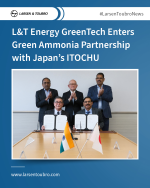
Mumbai: L&T Energy GreenTech Ltd (LTEGL), a wholly owned subsidiary of Larsen & Toubro, has signed a long-term partnership with ITOCHU Corporation of Japan. Under the partnership, LTEGL will supply ITOCHU, on a captive long-term take-or-pay basis, 300000 tonnes of green ammonia per annum from its proposed production facility at Kandla, Gujarat.
1776973479063.png

The long-term agreement was signed by Derek M Shah, CEO & MD, LTEGL, and Hiroyuki Tsubai, EVP, Member of the Board and President - Machinery Company, ITOCHU Corporation, at ITOCHU’s headquarters in Tokyo. The signing took place in the presence of Masahiro Okafuji, Chairman & CEO - ITOCHU Corporation, S N Subrahmanyan, Chairman & MD - L&T, and Subramanian Sarma, Deputy MD & President - L&T.

This latest agreement builds on the Joint Development Agreement (JDA) between the two companies signed in July 2025 and marks a significant progression in the partnership – from joint development to securing long-term demand. It reinforces the collaboration between LTEGL and ITOCHU and advances the shared vision of establishing a globally competitive green ammonia value chain.

ITOCHU will utilise the green ammonia supplied from Kandla to support its expanding green bunkering applications, aligned with its strategy to develop a global green ammonia ecosystem across key maritime trade routes. Singapore, one of the world’s leading marine fuel hubs, is emerging as a critical centre for ammonia bunkering. This represents an important step towards decarbonising the maritime sector and supports the growing adoption of low-carbon fuels in shipping.

The agreement also reinforces LTEGL’s strategy to scale its green hydrogen and derivatives platform, positioning Kandla as a strategic export hub for low-carbon fuels. In line with India’s National Green Hydrogen Mission, the project supports the country’s ambition to become a leading exporter of green energy derivatives.

Through this partnership with LTEGL, supplies from Kandla are expected to support ITOCHU’s bunkering operations in Singapore and other locations, enabling the early adoption of green ammonia as a next-generation marine fuel.

Commenting on the development, Subramanian Sarma, Deputy Managing Director & President - L&T, said: “The agreement with ITOCHU is a significant step in translating L&T’s clean energy ambitions into large-scale, bankable projects. By securing long-term demand through a reputed global partner like ITOCHU, we are strengthening the commercial foundation of our green ammonia platform, while contributing meaningfully to global decarbonisation”.

Hiroyuki Tsubai, Executive Vice President, Member of the Board, and President - Machinery Company, ITOCHU Corporation, said: “Establishing a reliable and scalable supply of green ammonia is critical to accelerating its adoption as marine fuel. Our partnership with LTEGL provides a strong and credible supply base, enabling us to expand our bunkering business and support the shipping industry’s transition towards low-carbon operations”.

L&T Energy GreenTech Enters Green Ammonia Partnership with Japan’s ITOCHU
 
A small re-cap of where this is going:

We have massive coal reserves & we have recently developed the tech needed for making Methanol from locally available coal. BHEL has a pilot project running:


There is also a pilot project running on Methanol production from captured CO2:


Eventually we plan to use Hydrogen spiked LPG/LNG etc. for our domestic & industrial needs. Experiments on spiking natural gas with Hydrogen has already started:


Over the next 2-3 decades we plan to switch the baseload non-renewable energy needs from oil to gas (LPG/LNG/Hydrogen). But we don't want to have as big an import dependence on gas as we have for oil. I've written about Hydrogen economy a while back:


We've also had some breakthroughs in Hydrogen storage tech:


Now we seem to have developed tech needed to produce gaseous DME as an alternative to LNG. So, we now have a tech chain that can produce gaseous DME from domestic Indian Coal. The next challenge is scaling, if we can overcome that we could see a big reduction in gas imports in a decade from now:

Pune-based scientists develop synthetic gas that can become an alternative to LPG

By Trending Desk, ET Online
Last Updated: Mar 16, 2026, 04:25:00 PM IST
View attachment 50449

Synopsis
CSIR-NCL scientists have developed an indigenous technology to produce Dimethyl Ether (DME), a clean-burning fuel that can be blended with LPG. This innovation aims to reduce India's reliance on imported cooking fuel and bolster energy self-reliance. The technology offers a cost-effective way to produce DME, with potential for significant foreign exchange savings.

India’s heavy dependence on imported cooking fuel may soon get a small but significant breather. Scientists at the CSIR-National Chemical Laboratory (CSIR-NCL) in Pune have developed an indigenous technology to produce Dimethyl Ether (DME), a clean-burning fuel that can be used as an alternative to Liquefied Petroleum Gas (LPG). According to a press release issued by the institute, the technology could help reduce the country’s reliance on imported LPG while supporting India’s push for energy self-reliance.

A cleaner fuel option emerges

The research team at CSIR-NCL has developed a patent-protected technology to produce Dimethyl Ether, a synthetic fuel known for burning cleanly. Scientists say DME can serve as a sustainable alternative to LPG and support the government’s broader Atmanirbhar Bharat goal of strengthening domestic energy capabilities.

Energy security remains a pressing concern for India, which imports more than 80 per cent of its fossil energy needs. Global supply disruptions have also pushed LPG prices higher in recent years, affecting many households, especially those using subsidised cylinders under the Pradhan Mantri Ujjwala Yojana.

Why DME is getting attention

Dimethyl Ether is considered a cleaner fuel because it releases much lower amounts of soot, nitrogen oxides (NOx), sulfur oxides (SOx) and particulate matter compared with many conventional fuels. At the same time, scientists say it offers thermal efficiency comparable to LPG.

The Bureau of Indian Standards has already laid down rules for its use. Under the standard IS 18698:2024, up to 20 per cent DME can be blended with LPG for domestic, commercial and industrial use.

Experts note that blending up to 8 per cent DME with LPG can be done without modifying existing LPG infrastructure such as cylinders, regulators, hoses or burners. That means households could potentially use the blended fuel without changing their current kitchen setups.

Big import bill, bigger savings potential

India imported nearly 21 million tonnes of LPG in 2024. Scientists estimate that replacing just 8 per cent of that with DME could save around ₹9,500 crore in foreign exchange every year.

For households under the Ujjwala scheme, the scale of demand is significant. Substituting part of LPG supply for the scheme’s 10.5 crore connections would require DME production capacity of about 1,300 tonnes per day.

Beyond kitchens: Other uses for DME
Apart from cooking fuel, DME has several industrial and commercial uses. It can work as an automotive fuel and also as a propellant in aerosol products, where it can replace ozone-depleting chlorofluorocarbons (CFCs).

The compound also acts as a chemical intermediate in the production of lower olefins, dimethyl sulfate and methyl acetate.

How the technology works

The technology developed at CSIR-NCL converts methanol into Dimethyl Ether using a highly active and cost-effective catalyst. The research team was led by Thirumalaiswamy Raja, who combined catalyst chemistry with reactor engineering to build an efficient production process.

According to the institute’s release, the system allows DME production at about 10 bar pressure. This makes it possible to directly fill the fuel into LPG cylinders while keeping operational costs relatively low.

The process has already been scaled up to a pilot capacity of 250 kg per day.

Burner prototype tested

To make the technology more practical for everyday use, CSIR-NCL scientists have also designed a patented burner prototype. The burner can operate in a flexible mode — from 100 per cent LPG to 100 per cent DME, as well as any mixture in between.

The prototype has been tested for efficiency at the LPG Equipment Research Centre in Bengaluru.

Next step: Moving toward industrial scale

The institute is now preparing to build an industrial demonstration plant capable of producing 2.5 tonnes of DME per day. Scientists aim to set it up within the next six to nine months in collaboration with a process engineering partner.

If the demonstration succeeds, it could lead to commercial plants producing between 50 and 100 tonnes per day.

CSIR-NCL has also expressed interest in partnering with major oil public sector undertakings and bioenergy companies to scale up the technology.

Scientists say widespread adoption of DME could help India cut LPG imports, improve energy security and move towards a cleaner energy mix.

Pune-based scientists develop synthetic gas that can become an alternative to LPG

20% DME-LPG blend can cut imports by 6.3 MT, save around Rs 34,200 cr yearly: Report

By PTI
Apr 19, 2026, 02:28:00 PM IST
1777309541588.png
Synopsis

India can significantly cut LPG imports by blending 20 per cent dimethyl ether, derived from coal gasification. This move could save 6.3 million tonnes of LPG annually, translating to over USD 4 billion in foreign exchange. The Bureau of Indian Standards permits this blending. Domestic DME production is currently limited, but a clear policy can unlock investments.


New Delhi: The blending of 20 per cent dimethyl ether (DME) --produced from coal gasification -- with LPG could reduce LPG imports by about 6.3 million tonnes annually, leading to a saving of forex of up to USD 4.04 billion (around Rs 34,200 crore) per year, according to a latest report.

Coal gasification converts coal into syngas, which is then transformed into DME' s clean-burning fuel that serves as a homegrown substitute for imported LPG.

The report assumes significance in the wake of India facing Liquefied Petroleum Gas (LPG) supply constraints since the war broke out in West Asia.

According to the report titled 'Coal gasification for energy and chemical security' by EY-Parthenon and New Era Cleantech Solution Ltd -- a domestic coal gasification firm -- "DME, producible from coal gasification, can partially substitute LPG imports".

It further said 20 per cent blending could displace approximately 6.3 million tonnes of LPG imports annually.

The Bureau of Indian Standards (BIS) has already notified standards permitting up to 20 per cent DMG-LPG blending in India.

The report further said DME is emerging as a clean fuel alternative, particularly for LPG blending. India currently has limited pilot-scale domestic DME production.

Balasaheb Darade, MD, New Era Cleantech, said, "A clear blending policy will be key to unlocking investments and scaling domestic DME production."

DME can be produced from coal gasification, natural gas reforming, biomass gasification or waste-derived syngas through two major production pathways: the indirect route (syngas to methnol to DME) and the direct route (syngas to DME via single reactor catalytic process).

Countries with large coal reserves can therefore produce DME domestically through coal gasification technologies.

DME combustion produces significantly lower emissions compared with conventional hydrocarbon fuels.

China accounts for nearly 90 per cent of global DME production capacity, primarily due to its large scale coal-to-chemicals industry.

Global DME production is dominated by coal-based routes, which account for overwhelming majority of output. A much smaller shares come from natural gas or methane based pathways, while bio DME contributes only a minimal fraction.

20% DME-LPG blend can cut imports by 6.3 MT, save around Rs 34,200 cr yearly: Report - The Economic Times
 
20% DME-LPG blend can cut imports by 6.3 MT, save around Rs 34,200 cr yearly: Report

By PTI
Apr 19, 2026, 02:28:00 PM IST
View attachment 51334
Synopsis

India can significantly cut LPG imports by blending 20 per cent dimethyl ether, derived from coal gasification. This move could save 6.3 million tonnes of LPG annually, translating to over USD 4 billion in foreign exchange. The Bureau of Indian Standards permits this blending. Domestic DME production is currently limited, but a clear policy can unlock investments.


New Delhi: The blending of 20 per cent dimethyl ether (DME) --produced from coal gasification -- with LPG could reduce LPG imports by about 6.3 million tonnes annually, leading to a saving of forex of up to USD 4.04 billion (around Rs 34,200 crore) per year, according to a latest report.

Coal gasification converts coal into syngas, which is then transformed into DME' s clean-burning fuel that serves as a homegrown substitute for imported LPG.

The report assumes significance in the wake of India facing Liquefied Petroleum Gas (LPG) supply constraints since the war broke out in West Asia.

According to the report titled 'Coal gasification for energy and chemical security' by EY-Parthenon and New Era Cleantech Solution Ltd -- a domestic coal gasification firm -- "DME, producible from coal gasification, can partially substitute LPG imports".

It further said 20 per cent blending could displace approximately 6.3 million tonnes of LPG imports annually.

The Bureau of Indian Standards (BIS) has already notified standards permitting up to 20 per cent DMG-LPG blending in India.

The report further said DME is emerging as a clean fuel alternative, particularly for LPG blending. India currently has limited pilot-scale domestic DME production.

Balasaheb Darade, MD, New Era Cleantech, said, "A clear blending policy will be key to unlocking investments and scaling domestic DME production."

DME can be produced from coal gasification, natural gas reforming, biomass gasification or waste-derived syngas through two major production pathways: the indirect route (syngas to methnol to DME) and the direct route (syngas to DME via single reactor catalytic process).

Countries with large coal reserves can therefore produce DME domestically through coal gasification technologies.

DME combustion produces significantly lower emissions compared with conventional hydrocarbon fuels.

China accounts for nearly 90 per cent of global DME production capacity, primarily due to its large scale coal-to-chemicals industry.

Global DME production is dominated by coal-based routes, which account for overwhelming majority of output. A much smaller shares come from natural gas or methane based pathways, while bio DME contributes only a minimal fraction.

20% DME-LPG blend can cut imports by 6.3 MT, save around Rs 34,200 cr yearly: Report - The Economic Times
And we are like third when it comes to coal reserves in the world. Although, quality of our coal is pretty avg. Correct me if I'm wrong but quality of the coal don't matter much for coal gasification right?
 
And we are like third when it comes to coal reserves in the world. Although, quality of our coal is pretty avg. Correct me if I'm wrong but quality of the coal don't matter much for coal gasification right?
Indian coal has high ash content. So commercially available coal gasification plants from abroad aren't as effective on Indian coal. The output is low yield & low purity. So, we have developed our own gasification tech suited for Indian coal. BHEL is running a pilot plant in Hyderabad. We have solved the purity problem. Methanol produced from this pilot have 99.5% purity; yield is still an issue. Even with its current yield this tech could be a game changer if successfully scaled to national levels.

If you want a long read on this: Hydrogen generation in India: News & Updates
 
ONGC, CSIR-NCL to launch pilot project to test dimethyl ether as LPG alternative

By Pushpita Dey
Updated on: 03 May 2026, 10:24 pm

The pilot project will also test the commercial viability of DME production and its application as a substitute for LPG in industrial heating and processing.
1777998029265.png
CSIR-NCL develops indigenous Dimethyl Ether technology to reduce LPG imports

Oil and Natural Gas Corporation (ONGC), along with CSIR–National Chemical Laboratory (CSIR-NCL), is set to launch an industrial pilot project to produce dimethyl ether (DME) in Pune as an alternative to liquefied petroleum gas (LPG), primarily for industrial use, according to sources familiar with the development.

According to the officials aware of the matter, the pilot project is expected to run for three years. The first year is primarily dedicated for setting up the plant for the pilot.

“The pilot will run for three years, first year will be for setting up the plant. The operation cost will be taken care by ONGC. The aim is to have 2.5-ton capacity for the industrial pilot at ONGC, Hazira,” said the source. The research will be primarily done by the NCL Pune team. Later on, industrial level commercial plant capacity may be 500-1000 TPD (ton per day).

The pilot project will also test the commercial viability of DME production and its application as a substitute for LPG in industrial heating and processing. Based on the success of the pilot project, further decisions will be taken regarding the industrial deployment of the same.

Scientists at Pune’s CSIR-NCL have created a homegrown technology to manufacture DME that can be used as a clean-burning fuel. The development comes amid ongoing global energy uncertainties and rising fuel costs, underscoring the importance of strengthening domestic energy capabilities.

At a time when there is a growing concern over the LPG supply and a fear of energy crisis, due to the West Asia crisis, India is exploring all possible measures to diversify their source countries for the energy import, primarily LPG and also to enhance the domestic production of the same.

To mitigate geopolitical supply risks arising due to the West Asia crisis, Indian government mandated refineries and petrochemical complexes to maximize LPG production. As per the government, by adopting measures like diverting alternate streams (such as propane, butane, and propylene) to the LPG pool, domestic production has surged by up to 40%.

“We can increase the production only up to a certain level. It won’t be possible to enhance the production to a large extent immediately as we have limited number of wells only. We have to enhance minutely, thus, exploring alternate sources is the viable option,” said the source.

The ONGC-NCL collaboration is expected to focus on scaling up production, optimizing costs, and assessing operational challenges in real-world industrial settings. The pilot will also evaluate long-term supply chains, and the team aims to expand the approach to commercial facilities with capacities ranging from 100 to 500 tons per day.

ONGC, CSIR-NCL to launch pilot project to test dimethyl ether as LPG alternative


Thermax ties up with Ankur Scientific to set up India’s first green methanol plant at Deendayal Port

The facility will produce up to 18,000 tonnes of green methanol annually, marking a significant step towards meeting India’s projected demand of 37,000 tonnes.

Updated On May 4, 2026, at 06:09 PM IST
1777998393553.png
India’s shipping industry is projected to require around 37,000 tonnes of methanol by 2030

Thermax Limited, an energy and environment solutions provider, on Monday announced its partnership with Ankur Scientific, a bioenergy and waste-to-energy solutions company, to set up India’s first Green Methanol Production Facility at Deendayal Port Authority (DPA), Kandla, Gujarat.

According to the official statement, the project targets the maritime sector, where fuel demand is rising alongside decarbonisation pressures.

India’s shipping industry is projected to require around 37,000 tonnes of methanol by 2030. The proposed plant, with an annual capacity of 18,000 tonnes, is expected to meet nearly half of this demand.
Advt

The company said the facility, planned as a modular, integrated unit spread over about one acre within the port premises, will produce approximately 5 tonnes of green methanol per day. The output will meet international ASTM standards with over 99.9 per cent purity and comply with European Union certification norms for green bio-methanol.

The company added that the methanol produced will be used as a cleaner marine fuel, supporting efforts to reduce dependence on fossil fuels in the shipping sector. The initiative aligns with the government’s push to promote sustainable alternatives in hard-to-abate industries such as maritime transport, positioning Deendayal Port among the first in India to adopt such a solution.

The project will utilise Ganda Baval (mesquite), a low-value, widely available biomass, as the feedstock. It will be processed using Ankur Scientific’s gasification technology.

“With the Ministry of Ports, Shipping and Waterways emphasising the adoption of green fuels, we are proud to facilitate this initiative at Deendayal Port. This project is a significant step toward enabling sustainable solutions in the maritime sector, while reinforcing our commitment to future-ready, environmentally responsible port operations,” said Sushil Kumar Singh, IRSME Chairperson, Deendayal Port Authority(DPA).
Advt

“We are proud to be part of this initiative, which highlights the potential of biomass-based technologies in producing clean fuels at scale and supporting India’s transition towards sustainable energy,” said Ankur Jain, Managing Director, Ankur Scientific.

Thermax ties up with Ankur Scientific to set up India’s first green methanol plant at Deendayal Port