PAK-FA / Sukhoi Su-57 - Updates and Discussions

Wrong, the AMCA avionics is nothing but in paper, infact the avionics in Su57 is 5 generations ahead until AMCA becomes operational. The Su57's kinematic performance is also much superior.

A lot of AMCA tech will enter testing soon.

Surpass in every way? The Su57 is the best fighter on the planet right now, you gotta be less delusional about said claims. Su57 had superior aerodynamics, control surfaces, twr, suoermaneuverability, supercruise, longer combat radius, bigger internal weapons bay, AI and ability to command drones and can even act as mother ship, better multi band senor suite, a decade more mature and proven tech by the time AMCA get deployed, blanketed claims like hold no meaning. Don't get me wrong, the AMCA is gonna be a great jet but claims like AMCA is gonna surpass the Su57 in every way is peak delusion from lack of understanding both's capability and maturity.

AMCA's stealth and avionics will exceed the Su-57 by a significant margin.

AMCA will also have supermaneuverability, supercruise etc.

Yes, AMCA will also act as a "mothership" and carry a multi-band sensor suite.

But no, a lot of technologies for AMCA will be proven on LCA Mk2 and MKI. The Russians don't have a bridge program of the sort we do. So AMCA will have mature tech when it's ready.
 
Indeed, the Chinese military apparatus conducted exhaustive systemic evaluations to disparage the imported SDV platform, the Romanian-supplied T-72, the Soviet-baseline Su-27SK, the Project 1143.6 hull, and the AL-31F propulsion system as inherently deficient and unreliable. Yet, the definitive irony remains: after squandering decades on persistent indigenous technical iterations, the cumulative resulting output fell catastrophically short of the original baseline performance milestones established by those very platforms

Subsequently, And then they came up with the legendary Type 88 Shotgun Sniper Rifle, the Type 99A Parade Heavy Tank, the J-11B Level-Flight Missile Transport Aircraft, the 001A Damage Control Training Aircraft Carrier, and the WS-10 Parts-Spraying Engine.

The bureaucratic techno-elites of both Beijing and New Delhi share an identical psychological and operational matrix: they harbor an unspoken veneration for American and Western infrastructure—resulting in the fragmented acquisition of half-realized platforms; conversely, they publicly express disdain for Russian hardware—yet invariably capitulate to purchasing it in the final procurement cycle.

Their childs are uniformly offshored to Harvard University,
even as they perform intense, state-sanctioned anti-American hostility, while simultaneously preserving their umbilical economic reliance on American trade matrices.
The ultimate irony of this mirror-image pathology is that despite operating on identical systemic tracks, they remain structurally incapable of tolerating one another's existence

Given the catastrophic operational outcomes observed across the Red Sea and the Persian Gulf, the aircraft carrier will be rendered structurally obsolete and entirely non-viable by 2040

While TEDBF comes with risks, everything else you said does not apply to India.

The Indian system of procurement is simple. Any Indian product must be as good or better than the foreign technology it will replace even if it's slightly, about 10%, inferior to a foreign system competing with it.

India's created its own requirements by fighting actual wars right from WW2 onwards. In 1971 as well, carrier aviation played a crucial role in Bangladesh. So India's carrier ambitions are backed by warfighting experience.

I see nothing wrong with American naval performance in the Red Sea and Persian Gulf, it's good if we can emulate it. But their losses in Yemen and Iran have nothing to do with their navy. The Americans make poor political decisions.

The novel conceit of gas-turbine propulsion for aircraft carriers is structurally relegated to secondary and minor naval powers. As established, this is a compromise for capital-expenditure reduction, characterized primarily by suppressed operational maintenance overheads and simplified lifecycle servicing. Conversely, supercarriers invariably deploy steam turbine architectures, which yield superior absolute shaft horsepower, expanded blue-water endurance, minimized logistical footprint constraints, and the thermodynamic capacity required to actuate catapult systems. It represents a staggering display of fiscal myopia to allocate five billion dollars toward an empty hull and squander over ten billion more to procure a contingent of fewer than thirty airframes, only to abruptly manifest anxiety over long-term maintenance overheads.

We will use IEPS. It's efficient. The gas turbines will power electric motors. And no catapults, only ramp.

Even if there are only 30 airframes, the sortie capacity will be higher than a small carrier with 2 catapults.

When 2.5 billion dollars are readily hemorrhaged to procure forty-five Russian-baseline fighter aircraft, the systemic price differential alone would comfortably subsidize the carrier's fleet operational expenditures for decades.

The Mig-29Ks will be replaced at end-of-life though. They will go through MLU soon and will be replaced by 2045. Standard 30-year life.

Furthermore, is India structurally resigned to indefinitely maintaining this middle size carrier air wing of a mere twenty-odd aircraft? In the future event that New Delhi attempts to construct a Super fleet carrier—notwithstanding the platform's overarching strategic obsolescence—to what geopolitical broker will they pay an even more extortionate premium to acquire a legacy steam turbine architecture, driven by their own institutional path dependency?

Overall, 3 small carriers with 3 air wings. Then a follow-on 60-65k DWT CATOBAR carrier with 40-50 aircraft. Beyond that of course, supercarriers.

As long as fighter jets are relevant, carriers will be relevant.
 
Ah, and the US ads claim the F-35 is "incredibly affordable," while the C-5B's official marketing numbers versus actual Air Force test data show a 50% difference in max-payload range and 50% more runway needed for takeoff. Then there's the 120mm HEAT round that can supposedly punch through bunkers, and one "war-changing" decisive weapon after another on the Russia-Ukraine battlefield — Switchblade, M1A2, M777, Hellfire, HIMARS, F-16. Oh, and let's not forget the USS Freedom littoral combat ship, USS Independence littoral combat ship, DDG-1000, and the world's safest Boeing 737 MAX...

Many weapons fail, nothing wrong with it.

Also, nobody cares about your ISA sea-level static thrust numbers. Air combat doesn't happen on the runway, after all.

ISA+15 at sea level is the standard for all engines. It's relevant to ambient temperature that enters the inlets. Even as you go higher, it impacts engine performance.
 
A lot of AMCA tech will enter testing soon.
Still doesnt change the facts I laid out.
AMCA's stealth and avionics will exceed the Su-57 by a significant margin.
Not really, Su57 especially the Su57M will have better stealth profiles on its side and rear aspects due to its flatter design, smaller rudders and flat nozzle, AMCA might have the advantage in forward stealth. Again, paper capability versus real world operational and tested capability.
AMCA will also have supermaneuverability, supercruise etc.
I don't see how its gonna have supermaneuverability with no 3d thrust vectoring and control surfaces like Su57 and its also not gonna be able to supercruise with the GE 414 engine, its gonna take the MK2 with JV engine to be able to do these and its still not gonna kinematically outperform the Su57, its literally an upgraded version of the F22 Kinematcially.
Yes, AMCA will also act as a "mothership" and carry a multi-band sensor suite.
Everything the Su57 was already designed to do before the AMCA. Heck even the inferior J20 was able to beat the F22 95% of the time in combat with drone support, imagine what the Su57 could do.
But no, a lot of technologies for AMCA will be proven on LCA Mk2 and MKI. The Russians don't have a bridge program of the sort we do. So AMCA will have mature tech when it's ready.
There are still technology that needs to deployed and proven in the AMCA itself unlike the Su57 which already did so earlier. But I agree that many of the subsystem will indeed be proven by the time AMCA gets ready but the aircraft as an integrated fifth-generation platform will still be less proven than the Su-57 for many years after entry into service.
 
Many weapons fail, nothing wrong with it.


ISA+15 at sea level is the standard for all engines. It's relevant to ambient temperature that enters the inlets. Even as you go higher, it impacts engine performance.
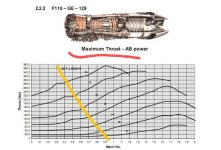
The specific diagram you provided serves as definitive empirical corroboration of my precise thesis: the Sea-Level (SL) baseline curve at zero coordinates resides strictly at the 22000-pound threshold, which translates to an empirical metric equivalent of exactly 9972 kilograms
As long as fighter jets are relevant, carriers will be relevant.


The manned combat aircraft is rapidly devolving into a sunset combat arm. Concurrently, naval warfare is undergoing a profound paradigm shift, evolving into a synthesis of seabed-anchored static bastion warfare and protracted, long-range kinetic salvo exchanges dominated by hypersonic cruise missiles, loitering munitions, and autonomous uncrewed surface vessels (USVs).
The nuclear-powered submarine is the ultimate arbiter of decisive fleet engagement
 
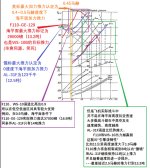
Here's the key point: the Al-31F sustains 12 tons of thrust at 11 km altitude at Mach 2.3 — and this needs to be pointed out specifically, it requires zero modifications. This is the original 1980s version.
Meanwhile, the F110-GE-129 can't even manage 8 tons at that same altitude ceiling, and can only reach Mach 1.9 at best.
At even higher altitudes, the F110 and F100 produce less thrust than an RD-33.


Executing a transformation on your specific diagram is a thoroughly trivial matter; the datasets simply need to be mapped onto a unified coordinate system for direct comparative analysis.


The following is a chart I made on a Chinese forum. Just bear with it—red represents the F110-129 at 0 altitude and 11 kilometers respectively, and blue represents the first-generation AL-31F.
↓↓↓↓↓
View attachment 52172

Now you are just comparing Flanker high-altitude, high speed performance to Falcon's medium altitude, low speed performance.

AL-31F has lower bypass meant for high altitude while F-16 needs higher bypass for lower altitudes. 0.56:1 vs 0.76:1.

You should be comparing AL-31F with F100-229. 0.36:1.
 
Still doesnt change the facts I laid out.

It's irrelevant though. It doesn't impact the IAF's decision making.

Not really, Su57 especially the Su57M will have better stealth profiles on its side and rear aspects due to its flatter design, smaller rudders and flat nozzle, AMCA might have the advantage in forward stealth. Again, paper capability versus real world operational and tested capability.

Lol. I'm sure your expertise is now better than ADA's.

I don't see how its gonna have supermaneuverability with no 3d thrust vectoring and control surfaces like Su57 and its also not gonna be able to supercruise with the GE 414 engine, its gonna take the MK2 with JV engine to be able to do these and its still not gonna kinematically outperform the Su57, its literally an upgraded version of the F22 Kinematcially.

AMCA will get TVC.

Everything the Su57 was already designed to do before the AMCA. Heck even the inferior J20 was able to beat the F22 95% of the time in combat with drone support, imagine what the Su57 could do.

Why would that matter to us? Good for the Russians.

We will get the same through AMCA.

There are still technology that needs to deployed and proven in the AMCA itself unlike the Su57 which already did so earlier. But I agree that many of the subsystem will indeed be proven by the time AMCA gets ready but the aircraft as an integrated fifth-generation platform will still be less proven than the Su-57 for many years after entry into service.

AMCA isn't a 5th gen jet. It fuses a 5th gen airframe with a 5.5th gen engine and 6th gen avionics.
 
It's irrelevant though. It doesn't impact the IAF's decision making.
Is isn't, there a world of difference between paper capability and real world capability.
Lol. I'm sure your expertise is now better than ADA's.
I don't know what specific statement from ADA disproves my particular statement but if you wanna pretend like ADA has better design experience and capability than those of Sukhoi who we historically depended to protect us unlike the Tejas Mk1 which our own army didnt event want, then thats on you.
AMCA will get TVC.
Yeah, its gonna take a good 15 years away at least and its still will not display the same level of supermaneuverability and supercruise capability as Su57.
Why would that matter to us? Good for the Russians.We will get the same through AMCA.
Because you were making BS claims like always, this time about the AMCA being superior to the Su57 in everyway when in reality its the opposite more likely which I've already proven.

Not to mention it matter because we are gonna acquire it for our own requirements.
AMCA isn't a 5th gen jet. It fuses a 5th gen airframe with a 5.5th gen engine and 6th gen avionics.
It's a 5th gen airframe and which will employ a 4th gen engine until a decade later with 5th gen engine. I'm not sure what 6th gen avionics you are referring to here, if done good for us. Anyway doesnt change anything I said to refute your claims.
 
The specific diagram you provided serves as definitive empirical corroboration of my precise thesis: the Sea-Level (SL) baseline curve at zero coordinates resides strictly at the 22000-pound threshold, which translates to an empirical metric equivalent of exactly 9972 kilograms

That's not the max performance of the engine. That's just a minimum burner to full thrust transition curve for an F-16/F-15E from takeoff to level flight.

The graph is just showing the F-16/F-15E's most efficient performance where the increase in thrust is gradual compared to the AL-31F.

You are incorrectly assuming the highest thrust it can manage in static conditions is 22000 lbs.
 
Is isn't, there a world of difference between paper capability and real world capability.

It still doesn't matter because AMCA is a development program and will be given a higher priority than an import.

I don't know what specific statement from ADA disproves my particular statement but if you wanna pretend like ADA has better design experience and capability than those of Sukhoi who we historically depended to protect us unlike the Tejas Mk1 which our own army didnt event want, then thats on you.

No. Su-57 doesn't have good stealth profile from the sides and rear. Which even the Russian admit. AMCA has been designed with all-aspect stealth in mind with far higher thresholds than the Su-57, even from the front.

Yeah, its gonna take a good 15 years away at least and its still will not display the same level of supermaneuverability and supercruise capability as Su57.

AMCA will have much, much higher TWR. 1.29 vs 1.02 in Indian conditions.

Because you were making BS claims like always, this time about the AMCA being superior to the Su57 in everyway when in reality its the opposite more likely which I've already proven.

Pretty much every way. Stealth will at least be 10-100 times superior. Avionics is a full generation ahead using a 6th gen multiplexed switching network and photonics. TWR is much higher, at least 25-30% superior, which translates into a 15% superiority in performance. It will climb faster, accelerate faster and so on. It will have full 3D TVC compared to Su-57's 2D.

Everything on it is superior to the Su-57 by a massive degree. It will have to go through an M2 upgrade to catch up, which will take roughly the same time as AMCA.

It's a 5th gen airframe and which will employ a 4th gen engine until a decade later with 5th gen engine. I'm not sure what 6th gen avionics you are referring to here, if done good for us. Anyway doesnt change anything I said to refute your claims.

Typhoon and MKI are similar to each other, Typhoon is a step above in data sharing. Rafale F3 is a step above Typhoon even when using very similar hardware. F-22, Rafale F5, F-35, and Su-57 are at a similar level, 5th gen avionics using fiber optics. AMCA, GCAP, F-47, SCAF will 6th gen switched networks.

What this means is MKI's data rate is at 1 Mbps, which moves up to 20 Mbps on Rafale and Typhoon, and a few Gbps on 5th gen, whereas 6th gen data rates will be measured in 100s of Gbps to a few Tbps. Even wireless tech will take it to that level.

What this means is what the Su-57 can do inside its own airframe in terms of control, the AMCA will be able to do planet-wide. A commander sitting in a ship in the IOR will be able to direct an AMCA battle in Europe as though he is inside the jet.
 
That's not the max performance of the engine. That's just a minimum burner to full thrust transition curve for an F-16/F-15E from takeoff to level flight.

The graph is just showing the F-16/F-15E's most efficient performance where the increase in thrust is gradual compared to the AL-31F.

You are incorrectly assuming the highest thrust it can manage in static conditions is 22000 lbs.
No one will show the so-called "smooth, gentle, optimal afterburner curve"—the chart clearly states it's the maximum afterburner.
Moreover, this is clearly an F-15E, not an F-16, because the F-16's fixed intake wouldn't cause such bizarre multiple kinks in the engine. These undulations come from the F-15's flight-control variable intake.Image_1781255847083_619.jpg

As for thrust, the F110's military thrust is 7.8 tons at Mach 0.3; the AL-31F produces the same 7.8 tons, but at static conditions.

Ultimately, aside from a certain advantage in descending maneuvers from 6,000 m to 3,000 m against the Su-27, the F-15 is dominated in every other maneuver—including climbs at any altitude, descending maneuvers from 10,000 m to 6,000 m, and horizontal maneuvers at any altitude.
And maneuvers in directions other than the kinematic normal (supermaneuvers), such as the Cobra maneuver, etc.

In fact, when it comes to climbing performance, the F-15 is far, far, far inferior to the MiG-29… It’s just that video games and Hollywood have done a lot of hype.

Russian products always come from behind to surpass.
 
It still doesn't matter because AMCA is a development program and will be given a higher priority than an import.


No. Su-57 doesn't have good stealth profile from the sides and rear. Which even the Russian admit. AMCA has been designed with all-aspect stealth in mind with far higher thresholds than the Su-57, even from the front.


AMCA will have much, much higher TWR. 1.29 vs 1.02 in Indian conditions.


Pretty much every way. Stealth will at least be 10-100 times superior. Avionics is a full generation ahead using a 6th gen multiplexed switching network and photonics. TWR is much higher, at least 25-30% superior, which translates into a 15% superiority in performance. It will climb faster, accelerate faster and so on. It will have full 3D TVC compared to Su-57's 2D.

Everything on it is superior to the Su-57 by a massive degree. It will have to go through an M2 upgrade to catch up, which will take roughly the same time as AMCA.


Typhoon and MKI are similar to each other, Typhoon is a step above in data sharing. Rafale F3 is a step above Typhoon even when using very similar hardware. F-22, Rafale F5, F-35, and Su-57 are at a similar level, 5th gen avionics using fiber optics. AMCA, GCAP, F-47, SCAF will 6th gen switched networks.

What this means is MKI's data rate is at 1 Mbps, which moves up to 20 Mbps on Rafale and Typhoon, and a few Gbps on 5th gen, whereas 6th gen data rates will be measured in 100s of Gbps to a few Tbps. Even wireless tech will take it to that level.

What this means is what the Su-57 can do inside its own airframe in terms of control, the AMCA will be able to do planet-wide. A commander sitting in a ship in the IOR will be able to direct an AMCA battle in Europe as though he is inside the jet.
These theories and arguments are an exact replica of the scenes on the Chinese internet years ago, when people were swearing and vowing over whether China should import the Su-35. I personally witnessed someone solemnly swear that if China ever bought the Su-35, they would literally eat their own computer screen. In the end, not a single one of them fulfilled their vows.
They especially love to brag that China’s electronics engineering and composite weight-reduction technologies are exponentially superior—by multiple orders of magnitude—to whatever 'Russian garbage' is out there.
After all, when every single tangible, hard parameter of their hardware gets absolutely demolished in the real world, they have no choice but to retreat into the nebulous, ethereal realm of 'electronics metaphysics' to salvage their pride

The most recent, catastrophic reality check for this exact crowd occurred just a couple of days ago, when Ukrainian hackers confirmed that the Chinese military had actually purchased Russian 2S25 Sprut-SD airborne tank destroyers. The entire Chinese internet erupted into a collective wail of despair, because for years, these people had spent countless hours boasting about how the domestic Type 15 and VT5 light tanks—with their supposed 'black technology'—could effortlessly slaughter any piece of Russian junk.
So, this naturally begs the question: is India currently hosting its own version of this 'Sprut barbecue' festival as well?


Today's debate is nothing more than pure 'Same'—using the PPT possibilities of a non-existent project to clash with the advanced capabilities of an already existing, tangible product. They operate on the absolute, blind conviction that a planned domestic product will inherently surpass an available foreign alternative, and then they use this delusion to engage in endless circular reasoning and self-referencing citation loops
 
Last edited:
  • Like
Reactions: Lolwa
What this means is what the Su-57 can do inside its own airframe in terms of control, the AMCA will be able to do planet-wide. A commander sitting in a ship in the IOR will be able to direct an AMCA battle in Europe as though he is inside the jet.
That's a factor of latency, not bandwidth. You can share tracks of hundreds of targets over a Mbit link, different matter with sharing visual information.
 
It still doesn't matter because AMCA is a development program and will be given a higher priority than an import.
Did I talk about priority? Why do you always shift goal posts when you lose? I'm saying real operational capability will always be superior than something stuck in a lab.
No. Su-57 doesn't have good stealth profile from the sides and rear. Which even the Russian admit. AMCA has been designed with all-aspect stealth in mind with far higher thresholds than the Su-57, even from the front.
What's your source about AMCA having better stealth in these profiles than Su57 which has better stealth profile in these angles.
AMCA will have much, much higher TWR. 1.29 vs 1.02 in Indian conditions.
Wrong, the Su57 has much higher TWR than AMCA along with more optimised aerodynamic shaping.
Pretty much every way. Stealth will at least be 10-100 times superior. Avionics is a full generation ahead using a 6th gen multiplexed switching network and photonics. TWR is much higher, at least 25-30% superior, which translates into a 15% superiority in performance. It will climb faster, accelerate faster and so on. It will have full 3D TVC compared to Su-57's 2D.

Everything on it is superior to the Su-57 by a massive degree. It will have to go through an M2 upgrade to catch up, which will take roughly the same time as AMCA.
Again wrong as usual, you fail to understand how stealth works especially about how average RCS is similar for most 5th gen, AMCA doesnt have any revolutionary stealth shapping which enables it have such stealth, even the world's stealthiest fighter F22 which is stealthier than Su57 in many some angles doesnt make such absurd claims.

The TWR of Su57M is much superior along with aerodynamic optimised shaping as I've already explained.

Also AMCA has never shown any 6th gen avionics capability, even Russia is developing photonics radar but they don't make such ridiculous and brain dead takes like yours of it being 6th gen, let alone the AMCA being one. Real world performance will always be astronomically more valuable than something not proven in real world.
Typhoon and MKI are similar to each other, Typhoon is a step above in data sharing. Rafale F3 is a step above Typhoon even when using very similar hardware. F-22, Rafale F5, F-35, and Su-57 are at a similar level, 5th gen avionics using fiber optics. AMCA, GCAP, F-47, SCAF will 6th gen switched networks.

What this means is MKI's data rate is at 1 Mbps, which moves up to 20 Mbps on Rafale and Typhoon, and a few Gbps on 5th gen, whereas 6th gen data rates will be measured in 100s of Gbps to a few Tbps. Even wireless tech will take it to that level.

What this means is what the Su-57 can do inside its own airframe in terms of control, the AMCA will be able to do planet-wide. A commander sitting in a ship in the IOR will be able to direct an AMCA battle in Europe as though he is inside the jet.
Cool story, we will believe such stories when it can be proved.
 
  • Haha
Reactions: Rajput Lion
No one will show the so-called "smooth, gentle, optimal afterburner curve"—the chart clearly states it's the maximum afterburner.
Moreover, this is clearly an F-15E, not an F-16, because the F-16's fixed intake wouldn't cause such bizarre multiple kinks in the engine. These undulations come from the F-15's flight-control variable intake.View attachment 52176

As for thrust, the F110's military thrust is 7.8 tons at Mach 0.3; the AL-31F produces the same 7.8 tons, but at static conditions.

Ultimately, aside from a certain advantage in descending maneuvers from 6,000 m to 3,000 m against the Su-27, the F-15 is dominated in every other maneuver—including climbs at any altitude, descending maneuvers from 10,000 m to 6,000 m, and horizontal maneuvers at any altitude.
And maneuvers in directions other than the kinematic normal (supermaneuvers), such as the Cobra maneuver, etc.

The F-15E is still an aircraft meant for low-medium altitude performance. It uses the same high bypass engine. You are comparing a high altitude fighter with a low/medium altitude aircraft.

And I still think the 22000 lbs is within specific constraints where the engine accelerates to max burner rather than start with max burner. There is no noticeable dip at mach 0.3-0.4.

In fact, when it comes to climbing performance, the F-15 is far, far, far inferior to the MiG-29… It’s just that video games and Hollywood have done a lot of hype.


Russian products always come from behind to surpass.

Sure, I don't think even the Americans dispute that.

Eagle, Flanker, Fulcrum, Rafale, Typhoon, F-22. That's the current order.
 
These theories and arguments are an exact replica of the scenes on the Chinese internet years ago, when people were swearing and vowing over whether China should import the Su-35. I personally witnessed someone solemnly swear that if China ever bought the Su-35, they would literally eat their own computer screen. In the end, not a single one of them fulfilled their vows.
They especially love to brag that China’s electronics engineering and composite weight-reduction technologies are exponentially superior—by multiple orders of magnitude—to whatever 'Russian garbage' is out there.
After all, when every single tangible, hard parameter of their hardware gets absolutely demolished in the real world, they have no choice but to retreat into the nebulous, ethereal realm of 'electronics metaphysics' to salvage their pride

In India, we have checks and balances. We have transparent programs. China doesn't.

The most recent, catastrophic reality check for this exact crowd occurred just a couple of days ago, when Ukrainian hackers confirmed that the Chinese military had actually purchased Russian 2S25 Sprut-SD airborne tank destroyers. The entire Chinese internet erupted into a collective wail of despair, because for years, these people had spent countless hours boasting about how the domestic Type 15 and VT5 light tanks—with their supposed 'black technology'—could effortlessly slaughter any piece of Russian junk.
So, this naturally begs the question: is India currently hosting its own version of this 'Sprut barbecue' festival as well?

This doesn't make sense. Sprut is an airborne vehicle meant for paratroopers, Type 15 is a larger vehicle that supports mountain infantry. These tanks complement each other. Buying the Sprut does not diminish the Chinese industry.

Today's debate is nothing more than pure 'Same'—using the PPT possibilities of a non-existent project to clash with the advanced capabilities of an already existing, tangible product. They operate on the absolute, blind conviction that a planned domestic product will inherently surpass an available foreign alternative, and then they use this delusion to engage in endless circular reasoning and self-referencing citation loops

No. Like I said, we are more transparent.

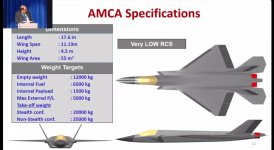
What I've posted is public. AMCA comes with 12T empty airframe, 6.5T fuel, and 1.5T internal payload, MTOW is 25T. It was recently enhanced to 2T internal payload and 26T MTOW. And this is because the engine was upgraded from 110 kN to 120 kN. So overall thrust is 24.5T.

ADA has announced that the jet will use fly-by-light and will use a next gen switched network and will operate in a combat cloud. And the govt has already announced a program for a global satellite comm and recon network for military use.

And this is being done by the US and China.

Europe is working on it too.

All real programs.
 
That's a factor of latency, not bandwidth. You can share tracks of hundreds of targets over a Mbit link, different matter with sharing visual information.

That's fine. If you can play videogames with someone on the other side of the world, you can do this as well.

The operator is only making decisions for strategic employment, the tactical decisions will be made by the aircraft itself. He only needs the macro picture.

Plus I'm exaggerating for effect. Obviously within AMCA's timeframe, its operational environment will be within the IOR and in fact much closer, like Jodhpur or Bareilly or Gwalior to the border areas.

But this technology will be transferrable to longer ranged systems in case we eventually operate them, like Mig-41, B-21, or any new 7th gen fighter in the future with strategic range.
 
Did I talk about priority? Why do you always shift goal posts when you lose? I'm saying real operational capability will always be superior than something stuck in a lab.

Lose what? You're saying we should import Su-57 over AMCA. Why on earth would I support that view?

Why not the F-35 then? It's even more ready than the Su-57?

Your reasoning is just dumb.

What's your source about AMCA having better stealth in these profiles than Su57 which has better stealth profile in these angles.

Common sense. And because ADA said so.

Wrong, the Su57 has much higher TWR than AMCA along with more optimised aerodynamic shaping.

Yes, sir, whatever you say.

Again wrong as usual, you fail to understand how stealth works especially about how average RCS is similar for most 5th gen, AMCA doesnt have any revolutionary stealth shapping which enables it have such stealth, even the world's stealthiest fighter F22 which is stealthier than Su57 in many some angles doesnt make such absurd claims.

The TWR of Su57M is much superior along with aerodynamic optimised shaping as I've already explained.

Also AMCA has never shown any 6th gen avionics capability, even Russia is developing photonics radar but they don't make such ridiculous and brain dead takes like yours of it being 6th gen, let alone the AMCA being one. Real world performance will always be astronomically more valuable than something not proven in real world.

Of course, you know more than ADA. Why didn't I see this coming? Oh, I did.

Cool story, we will believe such stories when it can be proved.

Sure, forget reality. Let's live in your world.
 
In India, we have checks and balances. We have transparent programs. China doesn't.


This doesn't make sense. Sprut is an airborne vehicle meant for paratroopers, Type 15 is a larger vehicle that supports mountain infantry. These tanks complement each other. Buying the Sprut does not diminish the Chinese industry.


No. Like I said, we are more transparent.

What I've posted is public. AMCA comes with 12T empty airframe, 6.5T fuel, and 1.5T internal payload, MTOW is 25T. It was recently enhanced to 2T internal payload and 26T MTOW. And this is because the engine was upgraded from 110 kN to 120 kN. So overall thrust is 24.5T.

ADA has announced that the jet will use fly-by-light and will use a next gen switched network and will operate in a combat cloud. And the govt has already announced a program for a global satellite comm and recon network for military use.

And this is being done by the US and China.

Europe is working on it too.

All real programs.
The F-15E is still an aircraft meant for low-medium altitude performance. It uses the same high bypass engine. You are comparing a high altitude fighter with a low/medium altitude aircraft.

And I still think the 22000 lbs is within specific constraints where the engine accelerates to max burner rather than start with max burner. There is no noticeable dip at mach 0.3-0.4.


Sure, I don't think even the Americans dispute that.

Eagle, Flanker, Fulcrum, Rafale, Typhoon, F-22. That's the current order.


So you want to admit that this jet has 17 tons of thrust at Mach 0.7 , but you refuse to admit it only has 10 tons at zero speed.

What a beautiful self‑contradiction you’ve landed yourself in.

American thrust ratings? They just measure at Mach 0.4. It’s really that simple.

You post something you don’t even understand, get called out on the spot, and then hit us with ‘you think what you want to think’… Who cares what you think?

The same thing happens with the F414. That thing’s high‑speed performance is even worse. On Chinese forums, people jokingly call it ‘the world’s most powerful subsonic engine’.

‘AMCA comes with 12T empty airframe, 6.5T fuel, and 1.5T internal payload, MTOW is 25T. It was recently enhanced to 2T internal payload and 26T MTOW. And this is because the engine was upgraded from 110 kN to 120 kN. So overall thrust is 24.5T.’

Oh, I see. So the AMCA, despite being one ton lighter than the F‑15A, carries 1.5 tons more fuel, has 5‑15% more engine thrust, and on top of that, it apparently has an internal missile bay.
For this thing to actually fly, it must be running on Minovsky particles or something.
 
So you want to admit that this jet has 17 tons of thrust at Mach 0.7 , but you refuse to admit it only has 10 tons at zero speed.

What a beautiful self‑contradiction you’ve landed yourself in.

American thrust ratings? They just measure at Mach 0.4. It’s really that simple.

You post something you don’t even understand, get called out on the spot, and then hit us with ‘you think what you want to think’… Who cares what you think?

The same thing happens with the F414. That thing’s high‑speed performance is even worse. On Chinese forums, people jokingly call it ‘the world’s most powerful subsonic engine’.

You are assuming max thrust at zero and max thrust at high altitude. It would make more sense when there's a gradual increase in thrust to max thrust from min burner.

The thrust curves you posted in the second image for the AL-31F and F110 are both different. F110 climbs up straight without ram drag while AL-31F does. It's obvious both thrust curves have been tested for something specific.

2.jpg

Oh, I see. So the AMCA, despite being one ton lighter than the F‑15A, carries 1.5 tons more fuel, has 5‑15% more engine thrust, and on top of that, it apparently has an internal missile bay.

For this thing to actually fly, it must be running on Minovsky particles or something.

It's normal specs for this generation. It's an efficiency-focused design compared to F-15A.

1.jpg