Good to see some clean-up, some points got lost in there. So some new + lost points.
> Su-30MKI Vs Su-57 MKI
- IDK if new Su-30MKIs are planned by HAL. If so then instead some Su-57 could be better.
- We should ask Russia to allow us to use our own RAM, RAS, some S/w.
> Su-57 suitability to Indian environment. I discussed this on foreign forums also.
- in simple way, if Su-30MKI with Brahmos & many AAMs are manageable then also Su-57, but let me elaborate some tech points.
- AFAIK all engine dry/wet thrust & A/c MTOW are quoted after testing in a chamber at ISA (International Standard Atmosphere) of 1 atm/1013 HPa & 15C temperature, on a ramp, with bell-mouth. This is "uninstalled baseline thrust"
- After installing on a jet, there're 3-15% losses depending upon A/c design due to -
-- Inlet Losses: Airflow distortion, friction, and boundary layer separation in the inlet ducts.
-- Ram Drag: The penalty incurred by accelerating the incoming air from free-stream velocity to the engine's capture velocity.
-- Bleed Air & Power Extraction: Energy diverted from the engine core to run the aircraft's air conditioning, electrical systems, and hydraulic pumps.
-- Exhaust & Nozzle Losses: Pressure and geometric discrepancies between the exhaust nozzle and the surrounding ambient air.
- Now if engine is moved to ISA+30-35C environment, the air density decreases, AMF (Air Mass Flow) decreases by 20% +/-.
-- AMF can be calculated by Ideal Gas Law Formula or Isentropic Compressible Flow formula.
-- Then Thrust by F = M.a = M.(V~exit - V~inlet), assuming this acceleration is constant.
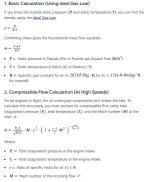
- let's consider thrust loss due to installation + less density to be 20%.
- Engines can produce much higher than quoted baseline uninstalled thrust, like 50% more, but flat-rated or limited to prevent damage.
- Core temp, TET, vibration, etc are metrics to monitor & limit the thrust by FADEC.
- So if engines are flat-rated to ISA+15C then remaining thrust loss due 15C gap remains uncompensated.
- When a jet releases brakes & pushes to AB wet thrust for takeoff then -
-- theoretically dry thrust gets lower by 20% but aux intakes or bigger intake can compensate some loss of thrust, IDK exactly how much.
-- Su-57 seems to have mesh grills below & side of intakes.

-- extra fuel in AB also compensates the loss of wet thrust needed for t/o, again IDK how much.
-- if intake + AB fully compensates the thrust loss then ok, otherwise the jet rolls with reduced thrust.
-- Without aux/bigger intakes or AB compensation, when jet reaches rotation/takeoff velocity, volume/second increases, compensating loss of thrust due to RAM EFFECT.
Mass/sec = volume/sec X density
= 0.8/0/8 X volume/sec X density
= (0.8 X density) X (1.25 X volume/sec)
= (0.8 X density) X (1.25 X Area X length)
= (0.8 X density) X (1.25 X Area X velocity/sec)
= (0.8 X density) X Area X (1.25 X velocity/sec)
-- When takeoff velocity is increased to 1.25x than at ISA, then it fully compensates loss of thrust.
- Lower air density cause loss of lift also but A/c design & 1.25x t/o velocity need to restore the lift by extra control surfaces, larger wing, etc.
- Military runways are 2.5-3 Kms long.
- with 20% decrease in thrust, Takeoff distance increases by 1.5625 times or 56.25%.
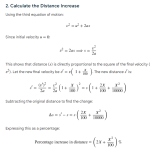
- Assuming at ISA, Su-57 with Iz-77 would push "installed" wet thrust 0.95 X 157 X 2 = 298.3 KN. Then -
-- wet T/MTOW = 298.3/9.8 /35 = 0.87,
-- with 10.3 tons internal fuel + 4x 190 Kg R-77M + 2x 10⁵ Kg R-74M2, AA-STOW (Air-Air Stealth Take Off Weight) = 29.27 tons, wet T/STOW = 298.3/9.8 /29.27 = 1.04
- Comparing with F-22 at ISA, "installed" thrust of 0.95 X 156 X 2 = 296.4 KN, then -
-- wet T/MTOW = 296.4/9.8 /38 = 0.79
-- with 8.2 tons internal fuel + 6x 162 kg AIM-120 + 2x 85 Kg AIM-9X, AA-STOW = 29.04 tons, wet T/STOW = 296.4/9.8 /29.04 = 1.04
- Both jets config look equal at ISA with AA-STOW. But if Su-57 has higher lift then its T/o distance will be shorter.
- Google search says that under ideal conditions F-22 with MTOW can t/o in 500m & Su-57 in 350-400m.
- On YT videos, F-22 with 2 EFTs have been seen to t/o in 8-10 sec, for example at RAF Lakenheath, quite near ISA conditions. So Su-57 with 2 EFTs at identical airfield could do it slightly better if more lift.
Coefficient of friction for rolling tyre & runway = 0.03
Assumed Drag coefficient Cd = 0.035
Assumed cross section area = 5m2
Air density at ISA = 1.225 Kg/m3
Assumed T/o V=165 knots = 85 m/s, U = 0
Equation : Thrust - ground friction force - air drag-force = M.a
T- u.M.g - 1/2 p.v^2.Cd.A = M.a
312 KN - (0.03*38,000*9.8) - (0.5*1.225*85^2*0.035*5) = 38*a
38,000.a = 312,000 - 11,172 - 774.43
a = 7.9 m/s/s in ISA.
t = V/a = 10.76 seconds in ISA.
S = 1/2 at^2 = 457.32 m in ISA.
- So if no thrust loss compensation by intakes, spools RPM, AB then in 20% less dense air -
-- F-22 could t/o with MTOW in 1.5625*457 = 714.5m
-- Su-57 with Iz-177 engines could t/o with MTOW within 1.5625*400 = 625m.
- But if loss compensation is there then T/o distance will reduce, probably around ISA distance.
This is good news for
@Rajput Lion & other Su-57 lovers to celebrate & party.


> Su-57 has R-100/KS-172 LR-AAM with 300-400 Kms range.
- it has to be carried externally. Even if stealthy Su-57s are kept in front & those with R-100 few 10s of Kms behind, that distance & hence range benefit is deducted & unstealthy pylons & AAMs'll still endanger the jet.
- R-37M with folding fins also has 300-400 Kms range & better option.
- Recently tested AIM-260 JATM is expected to have 200-300 Kms range, will be armed to many western jets including its possible export variant.
- No matter how much AAM range is increased, A/c RCS + radar efficiency will decide detection, locking & breaking the lock.
> Su-57 data-link with S-400, which F-22 doesn't.
- Link-16 issues have been solved.
- Option of indirect linking also there via high altitude flying A/c (project Hydra).
> Inadequately curved intake duct & exposed fan blades in YF-23, X-32, Su-57, dependent totally on RF blocker & YF-23 said to be more stealthy than F-22.
- In 1990s documentaries this point should have been raised & clarified to public.
But then this means that RAM, RAS, EW, blocker, etc made by different companies & countries obviously have different efficiency.
- F-22's intake gaping hole leads to S-duct with RAM lining & RF blocker.
- Ultimately it is the RCS value. In every product domain lagging companies have excuses.
- Mig-29, Yak-130 can close main intakes due to aux intakes to avoid FOD (Foreign Object Debris) damage at low speeds, but they're 4gen, so no geometry, RAM, RAS.
> RCS Vs physical CS.
- RCS can be more than physical CS, that's why the new term RCS, otherwise PCS would've sufficed.
- Curved, bent surfaces, gaps, bumps amplify the RCS.
- It depends also on wavelength/frequency as per back-scaterring formula 4.pi.A^2/wavelength^2
> What about previous gen smaller jets with smaller RCS detecting bigger jets 1st with bigger RCS?
- it depends on source radar efficiency + target's RCS return, not just range & size.
- Radars have power, gain, resolution, noise filtering, etc. Compared to today, early Radars were poor to average. Basically more power means more range.
- So in every gen's era, RCS was relevant & engineers, pilots talked about it while making radar, planning combat plan - which jet would see & launch 1st.
- There're countless videos, articles, not all can be covered, we can miss the particular concern. if media doesn't cover some tech aspect doesn't mean it's not a tech concern.
> Modern/future military avionics Vs best consumer electronics.
- these 2 cannot be compared at all based on just clock frequency, # of cores, cache memory, RAM, memory lanes, etc.
- There're efficiency difference of code, connection topologies, S/w protocols, etc.
- 5/6gen avionics are even beyond civilian industrial rack servers.
- Only technically qualified &/or experienced people understand architectural differences & effect on performance.