PAK-FA / Sukhoi Su-57 - Updates and Discussions

But isn't the CFM-56 superior in terms of efficiency than Russian engines. It's so ironic that US ,France and China have there entire aerospace industry based on this one single engine.

How are they inferior? We know that Chinese mtbf is between 300-600 hours as compared to rd-33's 3000-4000 hrs.
It's a joke—nothing but industrial garbage.
The WS-10“太行”, codenamed 'Tai-hang' after the famous mountain range, earned itself a far more infamous moniker among military enthusiasts back in the golden era of Chinese defense forums: WS-10“太行”'Tai-Bu-Xing' (meaning 'Too Incapable' or 'Total Failureand'Premature Ejaculation'").
Back when those online military forums were still thriving, no matter which site you visited, the Air Force board was invariably split into three predictable camps:
one-third of the threads were actively cursing out the WS-10;
one-third were locked in a relentless, 20-year-long grand debate over whether the Su-27 or the F-15 reigned supreme(Whether it was weaponizing raw engineering data or trash-talking each other's ancestors and privates—this vicious circle was the undying soul of the Chinese web, right up until the 2017 government crackdown that wiped every single domestic military forum off the face of the internet.);
and the remaining third covered everything else.

The WS-10 had an abysmal reliability rate and a painfully narrow flight envelope—meaning that the moment the pilot pulled a high-g combat maneuver, the engine was highly prone to compressor surges and stalls.
It wasn't even fit to carry the water for the Russian AL-31F very far, especially when it came to mid-to-high altitude kinetic performance.
Furthermore, the American F110 itself is fundamentally inferior to the authentic AL-31F.

In terms of operational lifespan, even when the WS-10B fully matured and received its production certification by 2017, it only managed to match the performance of the absolute baseline version of the AL-31F, lagging 15%~20% behind the AL-31FP.

As for the CFM56, the WS-10 is merely a fighter engine derivative kludged together by reverse-engineering the CFM56 core and marrying it to an AL-31F-cloned low-pressure section.
Beyond that, China did a direct carbon-copy of the knockoff CFM56 for the Y-20—which is that piece of junk known as the WS-20, currently rebranded as the AEP-1200 and originally designated as the FWS-10-118. Domestic military fanboys spent years hyping its thrust up to 16 tons, only for last year’s defense exhibition to slap them in the face with a static display boldly labeling it as a '12-ton thrust' engine. Think about the implications: the Chinese spent over 30 years reverse-engineering the CFM56, yet using the exact same frame size and fan diameter, they ended up with a total flop that cannot even match the raw thrust of the ancient D-30KP-2. From that,
it's blindingly obvious what kind of garbage the WS-10 is, given that it shares the exact same knockoff core lineage.

AEP‑1200 is to CMF‑56 as WS‑10 is to F110 — this is called dialectical thinking.

How are they inferior? We know that Chinese mtbf is between 300-600 hours as compared to rd-33's 3000-4000 hrs.
People love hyping up that trash WS-10, while completely ignoring that total failure of a engine, the WS-13—which even our own air force won't look twice at.

Just ask yourself: would Pakistan ever dare to put that hot garbage inside their FC-1? For a single-engine jet, that's not a flight risk, it's straight-up suicide.


The Chinese use the al 31FM2 and used for atleast 4+ years. From what I know the initial versions of the ws-10 were trash so the al-31 has been reliably used for atleast a full decade for j-20 testing and production. The rd-33 very similar(slightly bigger) than the ge-414. Let's not forget that ge-414 is not a stealth engine either.View attachment 52515
Now for all purposes it is good enough especially the sea wasp Rd-33mk. Both the AMCA and TEDBF can be built on the rd-33mk. Apart from the f-22's f-119 there's not a single engine that is truly fifth gen or aircraft that is fifth gen.
Also we are not US, China or Russia. We are stuck at 2000-3000$ gdp per capita. Our baseline capabilities don't allow us to make a fifth gen engine. War is fought on economics we don't have the money of technical capabilities right now. Even Iran is a richer economy than us so is Turkey and SoKo.
Use the rd-33 mk till Kaveri 2 or ge-414 gets online you can make TD's based on both Kaveri and Ge-414 once the deliveries start.
Modern Air warfare basically is having the biggest radar and the longest range missile that you can lob into enemy airspace. We saw the same in Russia-Ukraine we saw the same in Op Sindoor and the same thing has happened in Iran.
When Iran can use f-5's to bomb American airbases what is stopping us from using rd-33mks to make AMCA or MCA or TEDBF.
The mig 29 pretty much has the best kinematics in the IAF after the MKI. The IAF kebabkhors actually think they will get top of the line American tech to shove in the AMCA and take 2 decades to pump one aircraft out of the production line per year.
Having the rd-33 mk allows us to lower cost and speed up or delivery speed. In fact the rd-33mk has fadec like the ge-404(which was the primary reason IAF didn't want Russian engines the mig 29upg RD-33 series 3 doesn't have fadec but the IN mig 29k rd-33mk has fadec)
What kind of silo the IAF is living in only God knows.
We are an enemy state for the Americans. It must now become a priority to de link every major defence program from the Americans.

Most of the stuff on this table doesn’t exist—it’s made up, so its credibility is in the negative.

J-20
2011:AL-31F
2015:AL-31F-M2

2019-Now:WS-10x(The specific designation has not been announced, but there is no such thing as a B‑3. To this day, it has always been the WS‑10. As for whether the WS‑15 has been installed and tested, there is no evidence whatsoever, nor can it be determined by looking at the exhaust nozzle, since the nozzle can be swapped out.)
But the likelihood of the WS-15 officially entering service with the J-20 is extremely, extremely low—just as laughable as the claim that the Chinese internet keeps repeating every single day: 'the H‑20 will make its maiden flight this year.' This assertion has persisted for 20 years, unchanged year after year.
 
Last edited:
After repeated arm twising for decades by USA with engines, oil, visa, jobs, etc & separating with PAKFA long back but not doing anything be self, it's time India with millions of techies, 8000+ AICTE approved Engg.colleges, should show confidence in making its own chips, consumer devices, Dataceneter equipment, engines & a heavy class combat airframe.
If not cleansheet design then at least either -
- inflate AMCA with Iz-177 engine (not 117),​
- or check if Russia will allow modifying Su-57 airframe. For example modifying round reflective areas into planform shaping, etc-​

1782452290076.png

Russia, China didn't stop R&D just bcoz western engines & components are better quality. Their forces have survived well & it won't be easy at all for West/NATO to beat them.
🥛The glass is half empty or half full.
> Many nations into R&D = multiple R&D ways/doctrine as per their geography, geopolitics, economics, etc = different efficiency techniques, products.
> Leader enjoys market 1st, laggers catch & become competitor or remain consumer. Excuses, cursing don't help at all.
> Human DNA, potential same everywhere but some nations constrained by resources, over-population, sanctions, war, corruption, climate, etc.
> In an alternate timeline whichever nation(s) led R&D of certain tech H/w, S/w then world would have gone there for education, job & be called as their fanboy, fangirl, fanman.👦👧👨 :LOL:So coincidentally in this timeline, West has taken lead. Indian IT industry & home appliances mostly westernized. This is how West funds its R&D.
> Now Russia, China, India jumping into chip business, lets see situation after 5/10/15 years.

> At any point in time 2000/2010/2020/2030/2040 what matter is what global products can do.
> With time & new gen, priorities change, there're trade-offs like -
- lesser stealth payload, internal fuel Vs beast mode, to maintain ATWR, agility.​
- lesser installed thrust due to more drag of S-duct for stealth.​
- more avionics/sensors internally for sensor fusion Vs external attachments.​

> Above tradeoffs can be compensated if maker -
- has better RAM, RAS, EW then payload, fuel, avionics can be increased.​
- supported by powerful engines, then again payload, fuel, avionics can be increased.​
- LR-IR detection & effective networked RF targeting increases BVR Pk.​
- Gunfight needs super-agility/TVC, but LOAL mode CCMs can reduce TVC dependency.​

> Better follow cardinal characteristics like Stealth (self visibility on outside) in RF & IR bands. So good jet = good in + out.
> Now the same passive IR detection + indirect networked active RF detection can be implemented on both sides. So the more visible object gets engaged 1st.
> Costly LR-AAM can be fired 1st only if target is visible 1st directly or indirectly & confirmed a genuine target, not decoy, low value object.

> Some references here based on which i condensed my points on RCS.
> RCS Vs physical CS.
- RCS can be more than physical CS, that's why the new term RCS, otherwise PCS would've sufficed.
- Curved, bent surfaces, gaps, bumps amplify the RCS.
- It depends also on wavelength/frequency as per back-scaterring formula 4.pi.A^2/wavelength^2
> What about previous gen smaller jets with smaller RCS detecting bigger jets 1st with bigger RCS?
- it depends on source radar efficiency + target's RCS return, not just range & size.
- Radars have power, gain, resolution, noise filtering, etc. Compared to today, early Radars were poor to average. Basically more power means more range.

- So in every gen's era, RCS was relevant & engineers, pilots talked about it while making radar, planning combat plan
- which jet would see & launch 1st.- There're countless videos, articles, not all can be covered, we can miss the particular concern. if media doesn't cover some tech aspect doesn't mean it's not a tech concern.

The 1st ranked website in Google search list took abstract from -
- MIT Lincoln Laboratory,
- NOAA National Severe Storms Laboratory,
- NASA
All other sites & articles have similar stuff bcoz radar theory is same. It's not possible & feasible to quote all of them here.

> BTW, in India, please share your experience if better search engine than Google, like MS Bing, DuckDuckGo, PerplexityAI, Brave search, Ecosia, etc.

> (What is RCS (Radar Cross Section)? Beginner Guide)

"The beginner mistake is thinking RCS means physical size. It does not. A physically small object can sometimes look surprisingly large to radar"
"Several factors affect radar cross section -

  1. Shape,
  2. Aspect angle,
  3. Material,
  4. Frequency and wavelength,
  5. Polarization and scene conditions"
"RCS changes with:
  • viewing angle,
  • frequency,
  • polarization,
  • configuration,
  • and even motion or structural details."
"If two targets are at the same distance but one has much lower effective radar visibility, the radar will usually need more help to detect it:
  • cleaner geometry,
  • lower clutter,
  • better processing,
  • or a shorter range."
"RCS value often hides assumptions about:
  • the observation angle,
  • the radar frequency,
  • the polarization used,
  • and whether the number represents a typical case, a peak case, or a simplified reference model."
"RCS value often hides assumptions about:
  • the observation angle,
  • the radar frequency,
  • the polarization used,
  • and whether the number represents a typical case, a peak case, or a simplified reference model."
"Actual radar performance also depends on:
  • waveform and processing,
  • antenna behavior,
  • clutter conditions,
  • propagation,
  • and tracking logic."

> (What is Detection Range? Beginner Guide)

" Detection range changes with things such as:
  • the target’s radar cross section,
  • transmit power and antenna gain,
  • frequency and waveform,
  • receiver sensitivity,
  • signal processing,
  • clutter conditions,
  • weather and propagation,
  • and line-of-sight geometry."
"detection range improves when the system has:
  • stronger effective signal return,
  • better antenna performance,
  • better receiver sensitivity,
  • better processing gain,
  • and cleaner target-background separation."
"Detection range is influenced by the whole sensing chain:
  • antenna,
  • waveform,
  • receiver,
  • processing,
  • track logic,
  • and site geometry."
> Hence ultimately all global makers of stealth jets are not getting rid of stealth design principles.
Some day Russian R&D will definitely catch up & their RCS will also be in 4 decimals.🤞
Their 6gen with some rumored pics also look tail less.

1782297839269.png
1782298021664.png
IDK if these are 1st concept images or just fan art, but if real then RCS reduction attempt is evident & SU-57 would look like a bad dream in front of it.
How much Su-57 could be MLUed towards this 6gen is debatable.
J-20, J-35 would have their MLUs in 2030s/40s.
Kaan, AMCA better be prepared.
F-22, F-35 getting their MLUs.
> All gen MLUs 1.5gen, 2.5gen, 3.5gen, 4.5gen & now 5,5gen, have penalties hence next gen leap is needed. So cursing MLU doesn't help. 🤷‍♂️

> Although F-22 certainly had -ve points like range, limited ground capability, communications, etc, but -
- some limits have been addressed in 2010s, 2020s so far, no point in raising them repeatedly in 2026.​
- After MLU its RCS & drag will increase but can afford that bcoz it has led in RAM, RAS, IRS, engine power, supercruise.​
- Its EFTs & IRST pods are made stealthy to minimize increase in RCS, still expected very low overall.​

> So nobody stopping any nation to quote public-level intel on reference RCS, comparison with objects.
- India can quote & compare AMCA.​
- Turkey can quote & compare Kaan.​
- China can quote & compare J-20/35/36/50.​
- Russia can quote & compare Su-57, Su-75.​


> Modern/future military avionics Vs best consumer electronics.
- these 2 cannot be compared at all based on just clock frequency, # of cores, cache memory, RAM, memory lanes, etc.
- There're efficiency difference of code, connection topologies, S/w protocols, etc.

- 5/6gen avionics are even beyond civilian industrial rack servers.
- Only technically qualified &/or experienced people understand architectural differences & effect on performance.

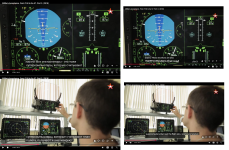
- Like i said, it can observed from both 1990s F-22 documentaries & 2010s Russian ones on Su-57 by Zvesda TV channel that both F-22 & Su-57 computers are at level of average Supercomputers or powerful Mainframe, modular, periodically updated, needed for real-time, redundant, fault tolerant processing, sensor fusion, MUMT, etc.
- They obviously disclose capability only in a generic way or old specs to avoid enemies guessing current capability.

1782465626657.png

1782479368714.png

1782489113203.png

Hence some more points w.r.t. 2 different segments designs Military Vs Consumer -

> All 5gen jets have modular avionics bay/racks & are upgradable, after approval, within budget decided.
- But the proposal, review, approval,implementation time is quite long.​
- Hence bcoz jet's computers are not upgraded as fast as consumer electronics due to consumer conditioning & exploitation, military budget, approval & SOPs, that's 1 more reason why they have to be launched looking overkill & the upgrade also have to be a big leap.​

> Like ISO, Military also have their H/w & S/w standards.
- Avionics have to be made strong to handle high G forces, temperature, pressure. This kicks up their R&D time, cost, replacement time.​
- Today in mid 2020s, 5gen jets, new like J-20, J-35, Kaan, future AMCA or older with MLU like Su-57 & F-22, are expected to be testing MUMT,​
operational in 2030s, act like a bi-directional hub or WiFi for the UCAVs & then interface to SatCom, other air & ground assets.​
- This is a redundant, mission critical, real time, fault-tolerant system, not consumer electronics.​

> In 1965 Late Mr. Gordon Moore put his observed "law" but he's American, co-founder of Intel, an American company. As per search -
- Today, budget friendly devices have CPUs in 4-10 NM range.​
- 3 NM found in industrial or top-tier, premium, costliest consumer devices, meant for industry, genuine productivity professionals with good ROI &/or high income group.​
- 2 NM in experimental stage.​
- Shrinking transistors down much further (toward 1nm) starts to cause quantum tunneling, where electrons literally leak out of their intended paths.​
- 3D stacking is being explored.​

> But Consumer electronics (except productivity devices) although multi-core doesn't have robust needs like military, can still hang many times, with latency.
> Hence only pure computing power doesn't matter alone but also architecture & other aspects as per usage.

> Consumer electronics industry has been exploiting Moore's law & emotions of citizens with marketing gimmicks, especially middle income group, by over-priced products with lesser utility than needed, often treated as status symbols.
- Since 2000s freshers buying these costly stuff on EMIs, lined up for hours in front of stores hours before opening.​
- I wish i had a good pc for 3D CAD & MMO gaming in FHD/2K ☹️ but no job security & pension in private sector jobs.​
- I bought new economical mid-range cell-phone but all showroom guys started giving demo of costliest phones with AI editing & since 2000s i've seen how much some my friends, colleagues have used their costly devices after few weeks-months. :LOL:
- These days many types of consumer scams going on where makers either intentionally degrading quality & design to increase revenue by replacement, or charging too much cost for long term quality.​

> Capitalist private military firms have also exploited situation in West, that's the aim of free market economy which can be said to backfire for F-22, F-35.🤑
> Communist & Socialist nations like Russia, China, India have jumped into chip business but bcoz West pioneered & dominates most computing tech, lithography machines, standards, protocols, market share, hence independence & catch-up will take time.

Ultimate questions are -
- How many citizens fund foreign R&D by falling prey to marketing gimmicks of over-priced appliances, having less utility to most people, standing for hours outside a store?
- With any nation making 6gen jet, what CPU capacity it needs in 6gen when some say it'ld be flying mini-datacenter & with 5gen MLU & why some people call it a gimmick but not their over-priced home devices with less daily utility?

Russian channel Zvesda TV showed avionics testing of Su-57 in lab on racks, but Su-57 avionics bay pics not available.

1782452797184.jpeg

1782452972296.jpeg


> Inadequately curved intake duct & exposed fan blades in YF-23, X-32, Su-57, dependent totally on RF blocker & YF-23 said to be more stealthy than F-22.
- In 1990s documentaries this point should have been raised & clarified to public.But then this means that RAM, RAS, EW, blocker, etc made by different companies & countries obviously have different efficiency.
- F-22's intake gaping hole leads to S-duct with RAM lining & RF blocker.

- Ultimately it is the RCS value. In every product domain lagging companies have excuses.
- Mig-29, Yak-130 can close main intakes due to aux intakes to avoid FOD (Foreign Object Debris) damage at low speeds, but they're 4gen, so no geometry, RAM, RAS.

Some more points w.r.t. intakes -
> Like said above - with each new gen there could be trade-offs, changing priorities, some compromises to increase survivability.
> Almost all 5+gen jets of all nations meant for production (J-20, J-35, AMCA, Kaan) seem to take the S-duct approach, even after thrust losses due to installed thrust (intake drag).

> LM with F-22 wanted both stealth & Supercruise.
- Supercruise depends not just on intake, duct & engine but on external design a lot too.​
- Sonic wave drag has to be reduced by area rule.​
- Those makers who's RAM, RAS, blocker are better will enjoy less bent ducts, lower loss in installed thrust.​
- F-35 getting ECU (Engine Core Upgrade). If F-22 also doesn't get one then it'll have to change its strategy & tactics.​

> In 1990s documentaries also, NG's YF-23 is said to be stealthier, flown faster than YF-22. So let's say -
- YF-22 couldn't match YF-23's RCS & speed.​
- Even after the S-duct drag penalty, other jets are yet to match F-22's RCS & speed.​
- But i believe at least Su-57 would catch up M 1.8 SuCr with AL-51 engines & 1 day Russians might finally get excellent RAM, RAS pulling RCS down to at least 2-3 decimals, hopefully modifying the multiple round surfaces across the air-frame.🤞🖖
 
  • Informative
Reactions: Photon Vish
Its around 40G for all modern BVR missiles. You can't change physics, and there is no breakthrough to maintain the structural integrity of missiles.
There are ways to push it beyond 40G using let say combination of PIF-PAF lateral thrust for High-G turns. Aster series can Pull 60G using that setup within Atmosphere.


  • Like
Reactions: Kiduva21
There are ways to push it beyond 40G using let say combination of PIF-PAF lateral thrust for High-G turns. Aster series can Pull 60G using that setup within Atmosphere.


This is not an air-to-air missile. Constrained by small size and low-efficiency airborne radar systems, air-to-air missiles simply cannot achieve... nor is there any need to achieve excessively high maneuverability.

If we're talking about other types of missiles, the A-135 terminal anti-ballistic missile system has a longitudinal overload of 200G and a roll overload of 100G... guided by a radar as big as a pyramid.
P60627-145233.jpg
 
  • Like
Reactions: Lolwa and Ashwin
We diss the Su-57 quite a bit for being non-VLO. But given that the Iranians managed to hit an F-35 recently (IR guided SAM reportedly) shows that it is not a 1st day of war wonder weapon either, esp at low altitude.

Unless next-gen engines like AETP/ADVENT (or AL-51F for that matter) can provide advanced thermal signature mgmt, long range IR/EOTS and VHF radar can provide high quality tracks of 5G jets. And if they can be detected, they can be countered.
 
We diss the Su-57 quite a bit for being non-VLO. But given that the Iranians managed to hit an F-35 recently (IR guided SAM reportedly) shows that it is not a 1st day of war wonder weapon either, esp at low altitude.
Its survivorship bias, F-35 dominated the airspace. One lucky shot doesnt mean much.
 
  • Like
Reactions: Lolwa
Its survivorship bias, F-35 dominated the airspace. One lucky shot doesnt mean much.
Based on the three laws of thermodynamics, as fighter jet thrust continues to increase, fuel consumption rises accordingly, the thermal energy released per unit of fuel grows stronger, and turbine inlet temperatures keep climbing. This makes the heat and infrared signatures of combat aircraft unavoidably and inexorably higher.

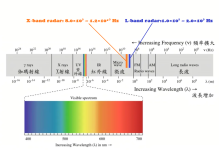
Meanwhile, as infrared detection technologies advance over time, their capabilities will only improve, and their effective ranges will increasingly approach those of radar. (In essence, both infrared and radio waves are merely different frequency designations of the same electromagnetic spectrum.)
Because the infrared signatures of fighter jets are gradually increasing, and the counter-fighter detection technologies are steadily improving, the two trends are converging toward each other.

Narrow and narrowly defined stealth performance, optimized only for the X-band, will be mercilessly outperformed by longer-wavelength and even infrared bands.
 
  • Like
Reactions: batman
Its survivorship bias, F-35 dominated the airspace. One lucky shot doesnt mean much.
It was not a one-off though. The Iranians also managed to shoot an F-15E (confirmed by US DoD) and narrowly missed getting an F-18. Can't be a mere coincidence.
Heck, some of their passive EO/IR guided SHORAD systems have been acquired by Armenia which were seen in a recent parade alongside our Akash mk1, Pinaka and MARG arty systems.
 
  • Like
Reactions: batman
It was not a one-off though. The Iranians also managed to shoot an F-15E (confirmed by US DoD) and narrowly missed getting an F-18. Can't be a mere coincidence.
Heck, some of their passive EO/IR guided SHORAD systems have been acquired by Armenia which were seen in a recent parade alongside our Akash mk1, Pinaka and MARG arty systems.
The F-15E is already an old familiar face. If I remember correctly, during the Gulf War, the Iraqis shot down two of them within three days – one by an S‑75 missile and the other by AA gun.

On one of those, the rear‑seat weapon systems officer (WSO) was the wing training officer
 
  • Like
Reactions: batman
The F-15E is already an old familiar face. If I remember correctly, during the Gulf War, the Iraqis shot down two of them within three days – one by an S‑75 missile and the other by AA gun.

On one of those, the rear‑seat weapon systems officer (WSO) was the wing training officer

Ha. Things don't appear to have changed much even today. Apparently, the F-15Es flying over Iran didn't have basic ew kit like MAWS which would've made them sitting ducks for IR manpads.

I thought only the IAF was an outlier in this regard.
 
Ha. Things don't appear to have changed much even today. Apparently, the F-15Es flying over Iran didn't have basic ew kit like MAWS which would've made them sitting ducks for IR manpads.

I thought only the IAF was an outlier in this regard.
Proponents of so-called stealth fighters are always rambling on when it comes to obscure radar-wave shielding theories and those manufacturer-claimed RCS values with endless leading zeros. Capitalizing on the public’s unfamiliarity with the subject, they spin endless fantasies backed by video games and Western propaganda.
image-16.png
Yet, the moment you ask them, 'What about the infrared spectrum?',“Are you counting on infrared energy dissipation and some magical annihilation to just make it vanish, or are you betting that the world's infrared detection tech will remain stagnant forever?”, they completely play dead—because that finally hits a nerve with the fundamental laws of physics known to the general public.
 
Let’s take advantage of this free time to further critique the J-20 in this thread.
China possesses a vast territory, and its core historical military threat originated from the southeastern maritime vector. The primary threats included cruise missiles launched from bombers via optical/guided flight vectors, submarine-launched cruise missiles, and cruise missiles fired from the direction of Japan and the Philippines. Note that I say 'historical
'; today, the greatest vulnerability is actually the fragile maritime energy supply lines, though this is not something military hardware alone can salvage. The outcome of the Cold War thoroughly proved that even the US Navy—the most powerful maritime force on earth—cannot break a blockade enforced by Iran’s cheap, land-based guided weapons. But that’s a separate topic, so let’s not diverge.

Because of these maritime threats, China's fighter development has always prioritized the 'interceptor' doctrine—from the J-8 and J-10 all the way to the J-20. High-speed, high-altitude interception has consistently occupied the absolute top priority.
In the 1990s, when buying blueprints from a collapsing Soviet Union, a fatal error was made due to extreme budget constraints. Russia was actually willing to export the MiG-31 interceptor back then. However, crippled by severe fiscal hardship, the military ultimately chose to import the Su-27, primarily prioritizing its massive payload capacity as a crucial asset for taking Taiwan. Later, as China's economy improved, Russia's economy also recovered, and the window of opportunity to acquire the MiG-31 closed forever.
Thus, lacking a dedicated MiG interceptor in the inventory, China’s so-called fourth-generation fighter (classified under the framework modeled entirely after the US) was mandated from its inception to possess formidable interception capabilities. This aligns with the core, traditional mission assigned to the PLAAF since its decades-long inception—a deeply ingrained institutional mindset. Consequently, the aircraft was never designed for dogfighting. This explains why close-in combat configurations—such as internal cannons or thrust-vectoring engines—are practically non-existent. Even the IRST is mounted underneath the nose, creating a total blind spot for close-in dogfights. The reason for this downward placement is glaringly simple: it is optimized for high-altitude flight above 10,000 meters to look down and detect low-flying Tomahawk missiles over the sea. Furthermore, the PLAAF historically never trains for within-visual-range (WVR) dogfights anyway.
The J-20's fuselage is also noticeably more elongated than its spiritual predecessor, the MiG 1.44. This structural elongation deliberately sacrifices maneuvering agility to gain higher cruise and top speeds—a necessary compromise given that it was saddled with obsolete powerplants like the AL-31F or WS-10. Official narratives boast that it can achieve supersonic cruise. If so, it was undoubtedly bought at a catastrophic cost. Otherwise, why didn't the Russians achieve this with the AL-31F, or the Americans with the F110 (which is effectively the authentic version of the WS-10)?
In a genuine air-to-air engagement, there are ample grounds to suspect that the J-20 would lose to a Su-35. Once the four medium-range air-to-air missiles in its main belly bay are depleted without securing a definitive kill, the J-20 will inevitably find itself in a nightmare scenario: its escape velocity will be inferior to the Su-35's, leaving it to be hunted down, while in close-in maneuvering, it remains at an absolute disadvantage. Its downward-facing IRST will be completely useless in a dogfight, rendering the pilot functionally blind. To make matters worse, the Su-35 carries a far larger missile loadout than the J-20, This discussion assumes the Su-35S is not equipped with the R-37.


An aircraft like the J-20 is utterly suppressed by the Su-57. In the face of Russia's authentic, high-performance engines and straight-through intakes, raw kinetic dominance crushes all sophisticated gimmicks. All the desperate design compromises the J-20 made just to compensate for its woefully lagging powerplants will be exposed as a complete joke.
Compared to the Su-57, the J-20 suffers from the following fatal weaknesses:
1. Impoverished Sensor Suite: Its detection methods are far too limited, and it completely lacks L-band arrays.
2. Inferior Beyond-Visual-Range (BVR) Engagement: In a long-range missile duel, the J-20's four PL-15s are comprehensively overwhelmed by the Su-57's four R-37Ms. Beyond the well-known disparity in kinematics and range, the more critical vulnerability stems from the missile caliber, which dictates both terminal hit probability and seeker lock-on distance. Missile radar seekers follow the exact same physics rules: assuming identical electronic capabilities and detection thresholds, doubling the radar seeker’s aperture area increases the theoretical tracking range against the same target by 41%. Consequently, the 380mm diameter of the R-37M yields a staggering 260% increase in theoretical seeker tracking range compared to the 203mm diameter of the PL-15.
3. Defenceless Close-In Combat: It cannot win in a close-range dogfight.
4. Zero Escape Velocity: If it tries to run, it simply cannot escape.
5. Lacking Multi-Role Versatility: The Su-57’s robust anti-ship and land-attack strike capabilities are entirely beyond the J-20's reach.
6. Inferior Operational Readiness: In terms of daily sortie rates, the Su-57 will naturally reign supreme.


If you dare to say these things on Chinese forums, you’ll be labeled a "dog raised by the Russians"、"5-ruble dog" (analogous to China's "0.5-RMB dog"—referring to the 5-ruble wage earned for each post).
or "Gangyi’s house slave" (Gangyi刚毅----referring to a well-known Chinese fan of the Russian military).
You still haven't answered my question about it range, you say Su57 has better combat range than J20 while online sources say different, care to elaborate on that?
 
You still haven't answered my question about it range, you say Su57 has better combat range than J20 while online sources say different, care to elaborate on that?
Any Chinese sources contradicting my description are fabrications; official Chinese information is merely the product of propaganda warfare—such as the exaggerated claims that the Type 99A’s armor-piercing rounds boast 1,000mm of penetration and its armor offers 1,000mm of protection, or that the C919 flies at supersonic speeds. Their track record is notorious.
 
  • Like
Reactions: batman
We diss the Su-57 quite a bit for being non-VLO. But given that the Iranians managed to hit an F-35 recently (IR guided SAM reportedly) shows that it is not a 1st day of war wonder weapon either, esp at low altitude.

Let's wonder which 5gen jet is wonder weapon.🤔:rolleyes: Perhaps Wonder Woman's jet 🦸‍♀️:ROFLMAO:
Like everybody got 4gen jets today, but who gets something 1st, dominates for few decades, maintains the gap by continious R&D is the whole game.🤷‍♂️
- Imagine AMCA in 2030s attacked near border like this. What RF+IR measure we need in it? We don't wan't more incidents like with Group Captian Nachiketa🤕, Group Captain Abhinandan🤕, or worse like with Squad Leader Ajay Ahuja.☠️
- With improving tech & mobile SAMs, VShoRADS, MANPADS, it's always challenging to infiltrate territory of an average nation also.

Unless next-gen engines like AETP/ADVENT (or AL-51F for that matter) can provide advanced thermal signature mgmt, long range IR/EOTS and VHF radar can provide high quality tracks of 5G jets. And if they can be detected, they can be countered.

Ultimately every jet (Su-57, F-22/35/47, J-20/35/36/50, AMCA, Kaan, etc) would like to detect enemy with their IR/UV sensors (IRST, EOTS, DAS).
- BUT try to hide their own jet as much as possible.
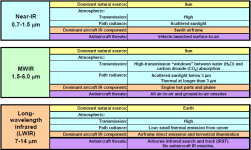
- Search says IR bands cannot penetrate through thick clouds, but L, C, X, Ka, W RF bands can. So both IR+RF stealth important.
- R&D of sword & shield aspects will never ever stop, it's continuous trial & error thing. All makers have worked & still working on their IR sensors as well as IR suppression in IOC/MLU/FOC. Everybody with affordable budget is racing to make/import surface & air-borne platforms with direct/indirect/networked RF+IR detection systems.
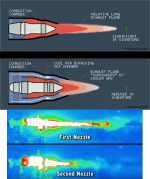
- 1st let's see IR suppression methods data available for some jets so far-
NOTE - All/most of these points, pics, diagrams may have been shared on other threads long back.
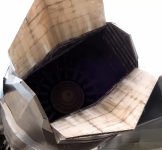
After searching, Su-57 & Su-75 cooling system diagrams are not found. But nozzle pics are there. The holes & gaps could be for transpiration cooling.

1782623495653.png

1782623645944.png

1782624708149.jpeg


Some diagrams & pics of F-22, F-35 systems, nozzle, exhaust vents -

1782621908634.png

1782623166043.jpeg

1782621927620.jpeg

1782654594861.png

1782624915948.png

1782623181466.jpeg


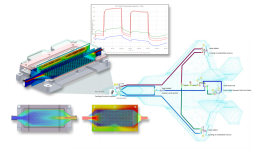
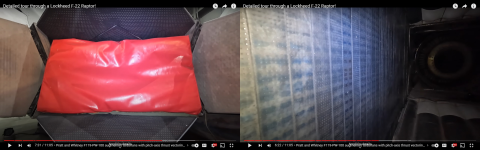
So as we can see from pics & diagrams of Su-57, Su-75, F-22, F-35 -
- Air cooled ECS (Environmental Control System) for cockpit & equipment has been basic need in every jet.
- 5gen jets are expected to address thermal management in certain ways in addition to usual air-cooling, like -
= thermal tiles like used in YF-23, B-2 exhaust.​
= transpiration nozzle cooling to reduce plume size, similar to blade film cooling.​
= body & equipment cooling by liquid. PAO (Poly Alpha Olefin) is 1 such synthetic hydrocarbon oils as a specialized dielectric heat-transfer fluid.​
= Avoiding AB by pushing the dry thrust per unit air mass as far as possible, in engine design.​
~ F119 dry/wet thrust = 116/156 = 74.36 %​
~ F135 dry/wet thrust = 128/191 = 67 %​
~ F110-GE-132 dry/wet thrust = 76/131 = 58 %​
~ AL-41F1 (Iz-117) dry/wet thrust = 88/147 = 60%​
~ AL-51F1 (Iz-30) dry/wet thrust = 108/167 = 64.7 %​
~ Iz-177 dry/wet thrust = 108/157 = 68.8 %​
= shielding hot parts of engine & fuselage by materials like Kevlar, etc. M-88 does this.​
= additional heat exchangers.​
= ECS exhaust vents & gaps shielded by mesh grills.​
- Bcoz all these system need extra electricity, they could be switched on/off as/when needed.
- Additional equipment increases weight & electricity needs, needing better engine.
- Hopefully any missing feature above will be implemented incrementally on all Stealth jets.

In future -
- Bcoz 5gen engines like F119, F135, apparently AL-51 too, have rear ceramic RF blockers tolerating high heat. So 6gen might introduce such RAS materials & RAM for exterior surface as well to reduce friction heat.
- BAe Adaptive camouflage demonstrated in 2011 uses panels which can change their IRS. Let's see if this tech or some derivative would be revealed for jets. This would again increase weight & electricity needs, means better engine.


- MLUs have cost & time attached + physical & design limits of a jet. Not everyting new can be updated on a jet, a new design is needed.
 
  • Like
Reactions: Kiduva21
We diss the Su-57 quite a bit for being non-VLO. But given that the Iranians managed to hit an F-35 recently (IR guided SAM reportedly) shows that it is not a 1st day of war wonder weapon either, esp at low altitude.

Unless next-gen engines like AETP/ADVENT (or AL-51F for that matter) can provide advanced thermal signature mgmt, long range IR/EOTS and VHF radar can provide high quality tracks of 5G jets. And if they can be detected, they can be countered.

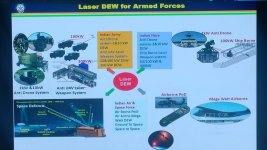
- In few decades, top few R&D nations might know each other's position all the time directly or indirectly by RF &/or IR methods. Then it'll be game of EVASION & DISORIENTATION, not detection. Hence DEW-CIWS is developed as part of 6gen. Even DRDO working on it. Destruction might need MW class DEW but disorientation would need few 100s of KW class DEW.

1782830104973.jpeg

- Till then, as we saw with F-35 over Iran, 5gen jets although using composites & other thermal methods, still unable to cheat friction-heat.
- It was engaged by short range AD-08 Majid IR SAM.
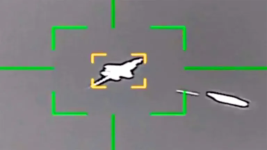
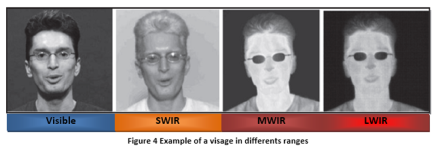
- Every jet at short distance in certain IR band (MWIR or LWIR) would look as a clear bright white object (hot white).

1782830959643.png

- The approaching SAM is also seen.
- Nobody uses Afterburner to intentionally reveal self IRS but It's a compelling & tricky situation for defeating enemy missiles.
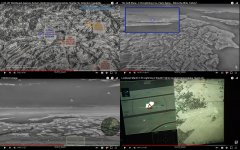
- We've seen publicly disclosed videos of ground objects detection by F-35 DAS sensors.
- For this engagement over Iran, the F-35's DAS must have detected the SAM & the pilot was probably trying to escape the SAM using AB.

1782828806068.jpeg

1782828880392.jpeg

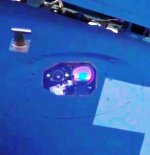
So F-35 DAS sensors are already powerful & multi-functional.
Su-57 DAS sensors have been upgraded to IR+UV bands.

1782828980026.jpeg


F-22 AN/AAR-56 MAWS will be upgraded by TacIRST sensor + under-wing IRST.

1782829056397.png

As mentioned in previous post - LWIR, MWIR, SWIR cannot prenetrate through thick clouds, heavy rain, but L, C, X, Ka, W RF bands can.
S, L bands can penetrate through heavy rain.
So both RF+IR sensors & stealth important.

1782829151627.jpeg

1782829159992.png

1782829800787.png
 
  • Like
Reactions: Kiduva21
- In few decades, top few R&D nations might know each other's position all the time directly or indirectly by RF &/or IR methods. Then it'll be game of EVASION & DISORIENTATION, not detection. Hence DEW-CIWS is developed as part of 6gen. Even DRDO working on it. Destruction might need MW class DEW but disorientation would need few 100s of KW class DEW.

View attachment 52653

- Till then, as we saw with F-35 over Iran, 5gen jets although using composites & other thermal methods, still unable to cheat friction-heat.
- It was engaged by short range AD-08 Majid IR SAM.
- Every jet at short distance in certain IR band (MWIR or LWIR) would look as a clear bright white object (hot white).

View attachment 52654

- The approaching SAM is also seen.
- Nobody uses Afterburner to intentionally reveal self IRS but It's a compelling & tricky situation for defeating enemy missiles.
- We've seen publicly disclosed videos of ground objects detection by F-35 DAS sensors.
- For this engagement over Iran, the F-35's DAS must have detected the SAM & the pilot was probably trying to escape the SAM using AB.

View attachment 52646

View attachment 52647

So F-35 DAS sensors are already powerful & multi-functional.
Su-57 DAS sensors have been upgraded to IR+UV bands.

View attachment 52648


F-22 AN/AAR-56 MAWS will be upgraded by TacIRST sensor + under-wing IRST.

View attachment 52649

As mentioned in previous post - LWIR, MWIR, SWIR cannot prenetrate through thick clouds, heavy rain, but L, C, X, Ka, W RF bands can.
S, L bands can penetrate through heavy rain.
So both RF+IR sensors & stealth important.

View attachment 52650

View attachment 52651

View attachment 52652
I'm gonna be honest bro and this is my opinion but plenty of times I do not get the point of your posts and just skim through it.
 
- In few decades, top few R&D nations might know each other's position all the time directly or indirectly by RF &/or IR methods. Then it'll be game of EVASION & DISORIENTATION, not detection. Hence DEW-CIWS is developed as part of 6gen. Even DRDO working on it. Destruction might need MW class DEW but disorientation would need few 100s of KW class DEW.

View attachment 52653

- Till then, as we saw with F-35 over Iran, 5gen jets although using composites & other thermal methods, still unable to cheat friction-heat.
- It was engaged by short range AD-08 Majid IR SAM.
- Every jet at short distance in certain IR band (MWIR or LWIR) would look as a clear bright white object (hot white).

View attachment 52654

- The approaching SAM is also seen.
- Nobody uses Afterburner to intentionally reveal self IRS but It's a compelling & tricky situation for defeating enemy missiles.
- We've seen publicly disclosed videos of ground objects detection by F-35 DAS sensors.
- For this engagement over Iran, the F-35's DAS must have detected the SAM & the pilot was probably trying to escape the SAM using AB.

View attachment 52646

View attachment 52647

So F-35 DAS sensors are already powerful & multi-functional.
Su-57 DAS sensors have been upgraded to IR+UV bands.

View attachment 52648


F-22 AN/AAR-56 MAWS will be upgraded by TacIRST sensor + under-wing IRST.

View attachment 52649

As mentioned in previous post - LWIR, MWIR, SWIR cannot prenetrate through thick clouds, heavy rain, but L, C, X, Ka, W RF bands can.
S, L bands can penetrate through heavy rain.
So both RF+IR sensors & stealth important.

View attachment 52650

View attachment 52651

View attachment 52652
Unlike AMCA, the F-35 has a bulky airframe built around 1 massive F-135 engine which outputs more power than older gen jets. The downside ofc was a relatively large IR signature.

LM was forced to make several design compromises to come up with a common base design for the 'joint' strike fighter program. The engine thermal mgmt system is another problem area.

The ADVENT/AETP prog was meant to solve these issues. However, this new engine won't be available for the foreseeable future.

Given the situation, I'd say US F-35 pilots were asking for trouble by flying at low altitudes over Iran (or the threat assessment provided by US intel on Iranian AD was not up to the mark.)

They were supposedly using MQ-9s for close-in recon, weren't they? Perhaps they should've sent in a few A-10s instead.
 
I'm gonna be honest bro and this is my opinion but plenty of times I do not get the point of your posts and just skim through it.
There's diff. b/w IIT AIR-1 & others too so don't worry. Ask more explanation on point not clear, like in school, college, office training. I try to use bulleted points, pics, vids, diagrams, calculations, tables, etc.
So in this case, Speedster mentioned thermal signature management, so i elaborated on its methods & limits of IR.