After repeated arm twising for decades by USA with engines, oil, visa, jobs, etc & separating with PAKFA long back but not doing anything be self, it's time India with millions of techies, 8000+ AICTE approved Engg.colleges, should show confidence in making its own chips, consumer devices, Dataceneter equipment, engines & a heavy class combat airframe.
If not cleansheet design then at least either -
- inflate AMCA with Iz-177 engine (not 117),
- or check if Russia will allow modifying Su-57 airframe. For example modifying round reflective areas into planform shaping, etc-
 Russia, China didn't stop R&D just bcoz western engines & components are better quality. Their forces have survived well & it won't be easy at all for West/NATO to beat them.

The glass is half empty or half full.
> Many nations into R&D = multiple R&D ways/doctrine as per their geography, geopolitics, economics, etc = different efficiency techniques, products.
> Leader enjoys market 1st, laggers catch & become competitor or remain consumer. Excuses, cursing don't help at all.
> Human DNA, potential same everywhere but some nations constrained by resources, over-population, sanctions, war, corruption, climate, etc.
> In an alternate timeline whichever nation(s) led R&D of certain tech H/w, S/w then world would have gone there for education, job & be called as their fanboy, fangirl, fanman.


So
coincidentally in this timeline, West has taken lead. Indian IT industry & home appliances mostly westernized. This is how West funds its R&D.
> Now Russia, China, India jumping into chip business, lets see situation after 5/10/15 years.
> At any point in time 2000/2010/2020/2030/2040 what matter is what global products can do.
> With time & new gen, priorities change, there're trade-offs like -
- lesser stealth payload, internal fuel Vs beast mode, to maintain ATWR, agility.
- lesser installed thrust due to more drag of S-duct for stealth.
- more avionics/sensors internally for sensor fusion Vs external attachments.
> Above tradeoffs can be compensated if maker -
- has better RAM, RAS, EW then payload, fuel, avionics can be increased.
- supported by powerful engines, then again payload, fuel, avionics can be increased.
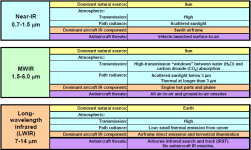
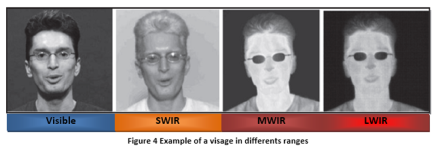
- LR-IR detection & effective networked RF targeting increases BVR Pk.
- Gunfight needs super-agility/TVC, but LOAL mode CCMs can reduce TVC dependency.
> Better follow cardinal characteristics like Stealth (self visibility on outside) in RF & IR bands. So good jet = good in + out.
> Now the same passive IR detection + indirect networked active RF detection can be implemented on both sides. So the more visible object gets engaged 1st.
> Costly LR-AAM can be fired 1st only if target is visible 1st directly or indirectly & confirmed a genuine target, not decoy, low value object.
> Some references here based on which i condensed my points on RCS.
> RCS Vs physical CS.
- RCS can be more than physical CS, that's why the new term RCS, otherwise PCS would've sufficed.
- Curved, bent surfaces, gaps, bumps amplify the RCS.
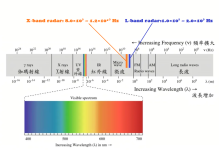
- It depends also on wavelength/frequency as per back-scaterring formula 4.pi.A^2/wavelength^2
> What about previous gen smaller jets with smaller RCS detecting bigger jets 1st with bigger RCS?
- it depends on source radar efficiency + target's RCS return, not just range & size.
- Radars have power, gain, resolution, noise filtering, etc. Compared to today, early Radars were poor to average. Basically more power means more range.
- So in every gen's era, RCS was relevant & engineers, pilots talked about it while making radar, planning combat plan
- which jet would see & launch 1st.- There're countless videos, articles, not all can be covered, we can miss the particular concern. if media doesn't cover some tech aspect doesn't mean it's not a tech concern.
The 1st ranked website in Google search list took abstract from -
- MIT Lincoln Laboratory,
- NOAA National Severe Storms Laboratory,
- NASA
All other sites & articles have similar stuff bcoz radar theory is same. It's not possible & feasible to quote all of them here.
> BTW, in India, please share your experience if better search engine than Google, like MS Bing, DuckDuckGo, PerplexityAI, Brave search, Ecosia, etc.
> (
What is RCS (Radar Cross Section)? Beginner Guide)
"The beginner mistake is thinking RCS means physical size. It does not. A physically small object can sometimes look surprisingly large to radar"
"Several factors affect radar cross section -
- Shape,
- Aspect angle,
- Material,
- Frequency and wavelength,
- Polarization and scene conditions"
"RCS changes with:
- viewing angle,
- frequency,
- polarization,
- configuration,
- and even motion or structural details."
"
If two targets are at the same distance but one has much lower effective radar visibility, the radar will usually need more help to detect it:
- cleaner geometry,
- lower clutter,
- better processing,
- or a shorter range."
"
RCS value often hides assumptions about:
- the observation angle,
- the radar frequency,
- the polarization used,
- and whether the number represents a typical case, a peak case, or a simplified reference model."
"
RCS value often hides assumptions about:
- the observation angle,
- the radar frequency,
- the polarization used,
- and whether the number represents a typical case, a peak case, or a simplified reference model."
"Actual radar performance also depends on:
- waveform and processing,
- antenna behavior,
- clutter conditions,
- propagation,
- and tracking logic."
> (
What is Detection Range? Beginner Guide)
" Detection range changes with things such as:
- the target’s radar cross section,
- transmit power and antenna gain,
- frequency and waveform,
- receiver sensitivity,
- signal processing,
- clutter conditions,
- weather and propagation,
- and line-of-sight geometry."
"detection range improves when the system has:
- stronger effective signal return,
- better antenna performance,
- better receiver sensitivity,
- better processing gain,
- and cleaner target-background separation."
"Detection range is influenced by the whole sensing chain:
- antenna,
- waveform,
- receiver,
- processing,
- track logic,
- and site geometry."
> Hence ultimately all global makers of stealth jets are not getting rid of stealth design principles.
Some day Russian R&D will definitely catch up & their RCS will also be in 4 decimals.

Their 6gen with some rumored pics also look tail less.


IDK if these are 1st concept images or just fan art, but if real then RCS reduction attempt is evident & SU-57 would look like a bad dream in front of it.
How much Su-57 could be MLUed towards this 6gen is debatable.
J-20, J-35 would have their MLUs in 2030s/40s.
Kaan, AMCA better be prepared.
F-22, F-35 getting their MLUs.
> All gen MLUs 1.5gen, 2.5gen, 3.5gen, 4.5gen & now 5,5gen, have penalties hence next gen leap is needed. So cursing MLU doesn't help.

> Although F-22 certainly had -ve points like range, limited ground capability, communications, etc, but -
- some limits have been addressed in 2010s, 2020s so far, no point in raising them repeatedly in 2026.
- After MLU its RCS & drag will increase but can afford that bcoz it has led in RAM, RAS, IRS, engine power, supercruise.
- Its EFTs & IRST pods are made stealthy to minimize increase in RCS, still expected very low overall.
> So nobody stopping any nation to quote public-level intel on reference RCS, comparison with objects.
- India can quote & compare AMCA.
- Turkey can quote & compare Kaan.
- China can quote & compare J-20/35/36/50.
- Russia can quote & compare Su-57, Su-75.
> Modern/future military avionics Vs best consumer electronics.
- these 2 cannot be compared at all based on just clock frequency, # of cores, cache memory, RAM, memory lanes, etc.
- There're efficiency difference of code, connection topologies, S/w protocols, etc.
- 5/6gen avionics are even beyond civilian industrial rack servers.
- Only technically qualified &/or experienced people understand architectural differences & effect on performance.
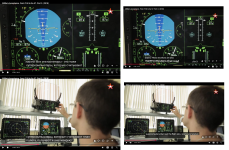
- Like i said, it can observed from both 1990s F-22 documentaries & 2010s Russian ones on Su-57 by Zvesda TV channel that both F-22 & Su-57 computers are at level of average Supercomputers or powerful Mainframe, modular, periodically updated, needed for real-time, redundant, fault tolerant processing, sensor fusion, MUMT, etc.
- They obviously disclose capability only in a generic way or old specs to avoid enemies guessing current capability.


Hence some more points w.r.t. 2 different segments designs Military Vs Consumer -
> All 5gen jets have modular avionics bay/racks & are upgradable, after approval, within budget decided.
- But the proposal, review, approval,implementation time is quite long.
- Hence bcoz jet's computers are not upgraded as fast as consumer electronics due to consumer conditioning & exploitation, military budget, approval & SOPs, that's 1 more reason why they have to be launched looking overkill & the upgrade also have to be a big leap.
> Like ISO, Military also have their H/w & S/w standards.
- Avionics have to be made strong to handle high G forces, temperature, pressure. This kicks up their R&D time, cost, replacement time.
- Today in mid 2020s, 5gen jets, new like J-20, J-35, Kaan, future AMCA or older with MLU like Su-57 & F-22, are expected to be testing MUMT,
operational in 2030s, act like a bi-directional hub or WiFi for the UCAVs & then interface to SatCom, other air & ground assets.
- This is a redundant, mission critical, real time, fault-tolerant system, not consumer electronics.
> In 1965 Late Mr. Gordon Moore put his observed "law" but he's American, co-founder of Intel, an American company. As per search -
- Today, budget friendly devices have CPUs in 4-10 NM range.
- 3 NM found in industrial or top-tier, premium, costliest consumer devices, meant for industry, genuine productivity professionals with good ROI &/or high income group.
- 2 NM in experimental stage.
- Shrinking transistors down much further (toward 1nm) starts to cause quantum tunneling, where electrons literally leak out of their intended paths.
- 3D stacking is being explored.
> But Consumer electronics (except productivity devices) although multi-core doesn't have robust needs like military, can still hang many times, with latency.
> Hence only pure computing power doesn't matter alone but also architecture & other aspects as per usage.
> Consumer electronics industry has been exploiting Moore's law & emotions of citizens with marketing gimmicks, especially middle income group, by over-priced products with lesser utility than needed, often treated as status symbols.
- Since 2000s freshers buying these costly stuff on EMIs, lined up for hours in front of stores hours before opening.
- I wish i had a good pc for 3D CAD & MMO gaming in FHD/2K

but no job security & pension in private sector jobs.
- I bought new economical mid-range cell-phone but all showroom guys started giving demo of costliest phones with AI editing & since 2000s i've seen how much some my friends, colleagues have used their costly devices after few weeks-months.
- These days many types of consumer scams going on where makers either intentionally degrading quality & design to increase revenue by replacement, or charging too much cost for long term quality.
> Capitalist private military firms have also exploited situation in West, that's the aim of free market economy which can be said to backfire for F-22, F-35.

> Communist & Socialist nations like Russia, China, India have jumped into chip business but bcoz West pioneered & dominates most computing tech, lithography machines, standards, protocols, market share, hence independence & catch-up will take time.
Ultimate questions are -
- How many
citizens fund foreign R&D by falling prey to marketing gimmicks of over-priced appliances, having less utility to most people, standing for hours outside a store?
- With any nation making 6gen jet,
what CPU capacity it needs in 6gen when some say it'ld be flying mini-datacenter & with 5gen MLU & why some people call it a gimmick but not their over-priced home devices with less daily utility?
Russian channel Zvesda TV showed avionics testing of Su-57 in lab on racks, but Su-57 avionics bay pics not available.

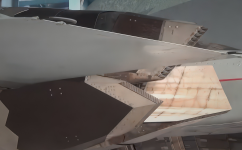
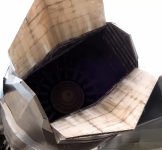
> Inadequately curved intake duct & exposed fan blades in YF-23, X-32, Su-57, dependent totally on RF blocker & YF-23 said to be more stealthy than F-22.
- In 1990s documentaries this point should have been raised & clarified to public.But then this means that RAM, RAS, EW, blocker, etc made by different companies & countries obviously have different efficiency.
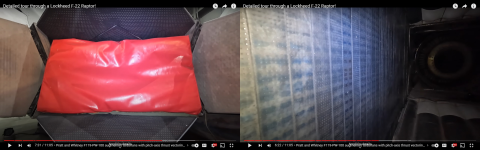
- F-22's intake gaping hole leads to S-duct with RAM lining & RF blocker.
- Ultimately it is the RCS value. In every product domain lagging companies have excuses.
- Mig-29, Yak-130 can close main intakes due to aux intakes to avoid FOD (Foreign Object Debris) damage at low speeds, but they're 4gen, so no geometry, RAM, RAS.
Some more points w.r.t. intakes -
> Like said above - with each new gen there could be trade-offs, changing priorities, some compromises to increase survivability.
> Almost all 5+gen jets of all nations meant for production (J-20, J-35, AMCA, Kaan) seem to take the S-duct approach, even after thrust losses due to installed thrust (intake drag).
> LM with F-22 wanted both stealth & Supercruise.
- Supercruise depends not just on intake, duct & engine but on external design a lot too.
- Sonic wave drag has to be reduced by area rule.
- Those makers who's RAM, RAS, blocker are better will enjoy less bent ducts, lower loss in installed thrust.
- F-35 getting ECU (Engine Core Upgrade). If F-22 also doesn't get one then it'll have to change its strategy & tactics.
> In 1990s documentaries also, NG's YF-23 is said to be stealthier, flown faster than YF-22. So let's say -
- YF-22 couldn't match YF-23's RCS & speed.
- Even after the S-duct drag penalty, other jets are yet to match F-22's RCS & speed.
- But i believe at least Su-57 would catch up M 1.8 SuCr with AL-51 engines & 1 day Russians might finally get excellent RAM, RAS pulling RCS down to at least 2-3 decimals, hopefully modifying the multiple round surfaces across the air-frame.




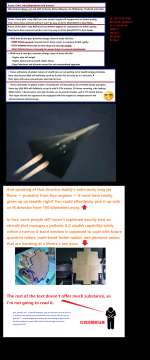





 Perhaps Wonder Woman's jet

 , Group Captain Abhinandan