Indian Navy hunt for Mine Counter-Measures (MCM) Vessel: Discussion


Mine warfare

A potentially more strategically significant agreement has been signed between Exail Belgium and Larsen & Toubro, which is bidding for India’s mine-countermeasure vessel programme.

Under the agreement, Exail will supply the autonomous systems or “toolboxes” used to detect, identify and neutralise naval mines.

The first phase of India’s programme involves 12 vessels, although the requirement could eventually expand to as many as 59 vessels, the Belgium government said.

Belgium sees maritime security as one of the most promising areas of future cooperation with India, including mine countermeasures, autonomous maritime systems, underwater robotics, advanced sensors and protection of critical infrastructure such as ports, pipelines and subsea data cables.​
 

Mine warfare

A potentially more strategically significant agreement has been signed between Exail Belgium and Larsen & Toubro, which is bidding for India’s mine-countermeasure vessel programme.

Under the agreement, Exail will supply the autonomous systems or “toolboxes” used to detect, identify and neutralise naval mines.

The first phase of India’s programme involves 12 vessels, although the requirement could eventually expand to as many as 59 vessels, the Belgium government said.

Belgium sees maritime security as one of the most promising areas of future cooperation with India, including mine countermeasures, autonomous maritime systems, underwater robotics, advanced sensors and protection of critical infrastructure such as ports, pipelines and subsea data cables.​
Imo, the IN pivoted to the present 2500t mcm mothership concept mainly to sidestep ToT issues for FRP tech (Both Intermarine and Kangnam Corp refused to sell).

If we can secure the tech from other suppliers like Japan then NHQ might just stick with smaller 600t-700t hulls. This will give us the numbers we need without draining the budget.

The other alternative could be to develop mcm usv based on local designs like the Matangi from Sagar Defence.
 
  • Like
Reactions: YoungWolf
Imo, the IN pivoted to the present 2500t mcm mothership concept mainly to sidestep ToT issues for FRP tech (Both Intermarine and Kangnam Corp refused to sell).

If we can secure the tech from other suppliers like Japan then NHQ might just stick with smaller 600t-700t hulls. This will give us the numbers we need without draining the budget.

The other alternative could be to develop mcm usv based on local designs like the Matangi from Sagar Defence.

IN acquisition of MCMV has coincided with shift away from traditional FRP ships with onboard sensors to autonomous and robotic systems that are deployed from stand off distance. This seems to have delayed the program.

Arguably the new model is a better and safer method for MCM
 
IN acquisition of MCMV has coincided with shift away from traditional FRP ships with onboard sensors to autonomous and robotic systems that are deployed from stand off distance. This seems to have delayed the program.

Arguably the new model is a better and safer method for MCM
MCM mothership CONOPS is still evolving though. Only Euro navies are doing it atm. The IN will also need to revise the ops manual/doctrine for it which takes time. At a time when we have exactly 0 operational hulls, its a luxury we can't afford.
 
MCM mothership CONOPS is still evolving though. Only Euro navies are doing it atm. The IN will also need to revise the ops manual/doctrine for it which takes time. At a time when we have exactly 0 operational hulls, its a luxury we can't afford.
We already decided to go with mothership concept. Approvals has gone through. In the long run its the good path irrespective of short term pain.

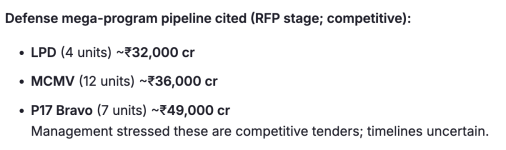
1789384664830.png

Already reached RFP stage.
 
  • Like
Reactions: Speedster1