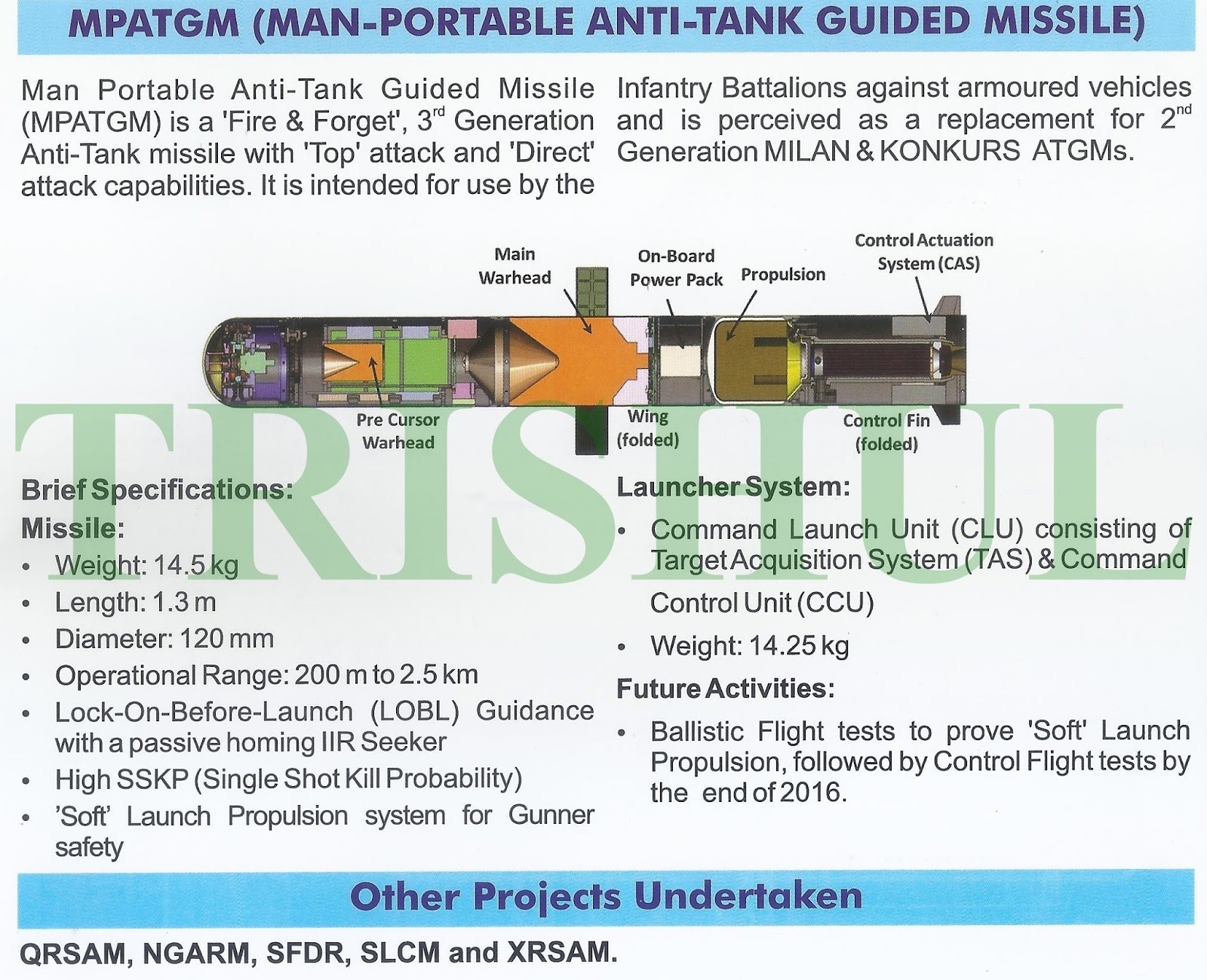
Man Portable Anti-Tank Guided Missile (MPATGM) Developments : Updates & Discussions

ni8mare

Well-Known member
Dec 7, 2017
254
730
India
By Ajit K Dubey

First Published 15, Sep 2018, 9:56 PM IST

HIGHLIGHTS

The DRDO today successfully carried out the first test of Portable- Anti-tank Guided Missile (MP-ATGM), supposed to be the anti-tank missile of the Army for future. The government had withdrawn an earlier tender for buying around 5,000 Spike missiles.

New Delhi: In a major boost to Prime Minister Narendra Modi's 'Make in India' initiative in defence, the DRDO today successfully carried out the first test of the indigenously designed and developed Man Portable-Anti-Tank Guided Missile (MP-ATGM), which would help the Army destroy enemy tanks during a war.

The first test of the missile was successfully completed in the Ahmednagar district of Maharashtra. A few more tests of the indigenous weapon system need to be carried out before it is offered to the Army for user trials, government sources told MyNation.

The MP-ATGM is supposed to be the anti-tank missile of the Army for future as the force needs close to 75,000 such missiles for future battles. The homegrown missile would help in this direction in a big way, the sources said.

For meeting the emergency requirements of the Army, the government is looking to buy around a couple of thousand Spike anti-tank guided missiles from Israel while the majority of the requirements would be fulfilled by indigenous missiles.

The requirements of the Army are so huge that they will be met with the missile systems supplied by the Israelis along with the ones to be produced by DRDO in future as it is also developing the man-portable ATGMs, sources said.

The Army needs third-generation ATGMs, with a strike range of over 2.5 km and fire-and-forget capabilities, to equip all its 382 infantry battalions and 44 mechanised infantry units.

Sources said this combination of buying arms and equipment from abroad and allowing indigenous makes at the same time will balance the need for taking care of national security requirements along with the need to promote the indigenous industry.

The Ministry of Defence has been in talks with Israel and the US for a long time to get the third generation anti-tank missiles. The ministry had ultimately zeroed in on the Spike missiles under an old deal, which is likely to cost around Rs 3,000 crore.

The government had also withdrawn an earlier tender for buying around 5,000 Spike missiles after finding the price of the deal too high.

An American missile system on offer was rejected too — after the terms and conditions of procuring it were not found to be compliant to the Indian defence procurement procedure guidelines.
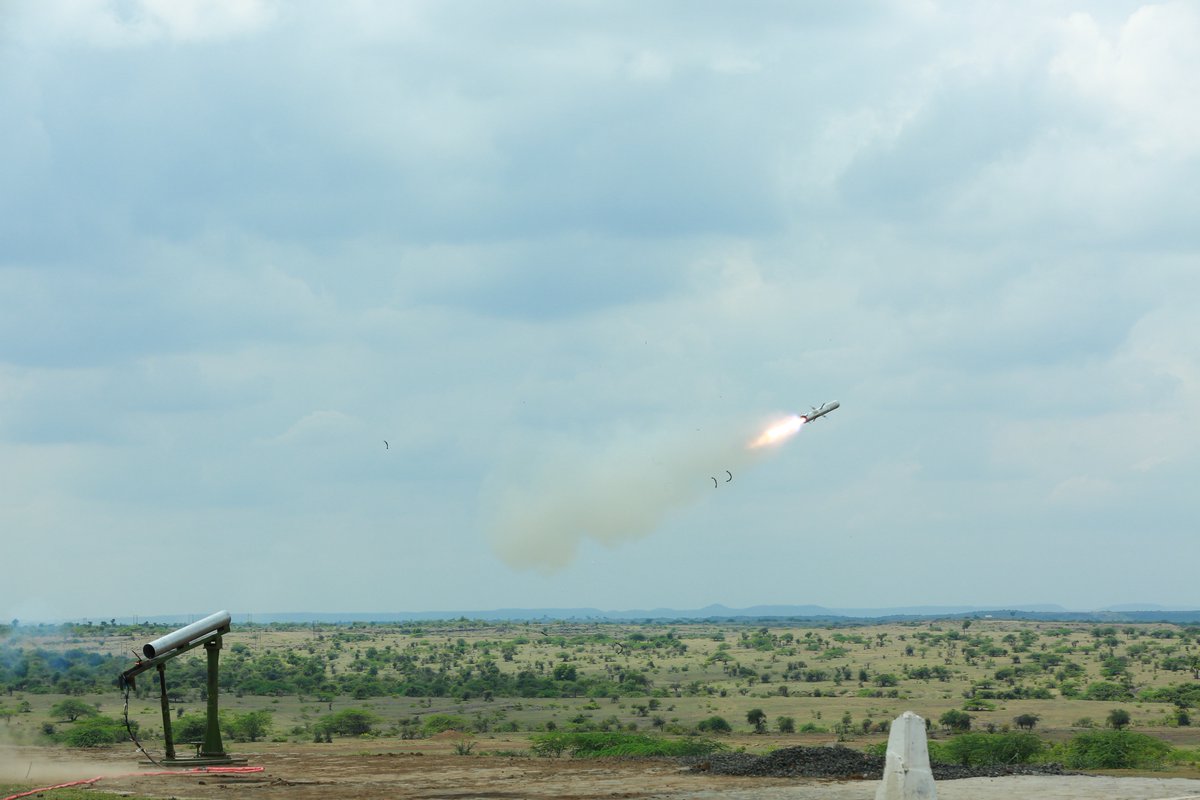
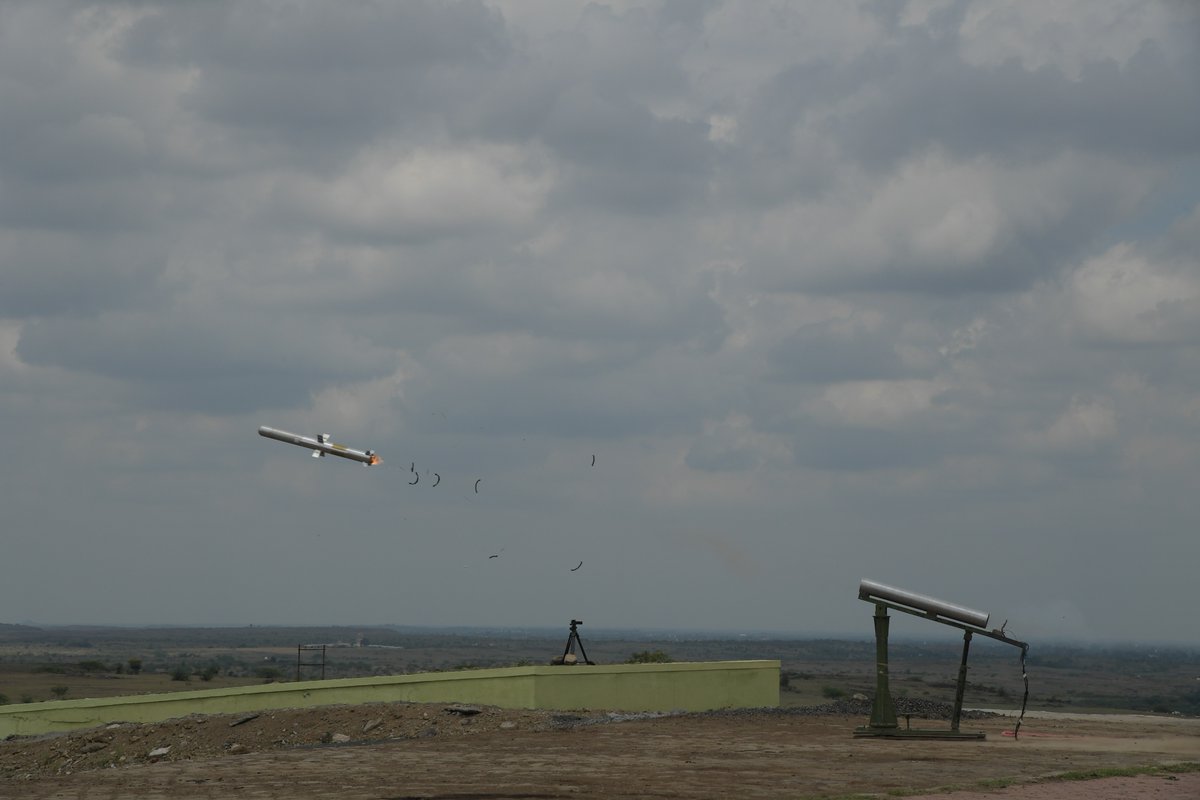
DnNe3WVV4AA53Qz.jpg
DnNe5jsU8AAqA8s.jpg
 
DnNi5HjXsAAfvFH.jpg

India Just Conducted The 1st Test Of A Shoulder Launched Anti-Tank Missile
Shiv Aroor
Sep 16 2018 1:55 pm

An Indian weapons development team from the Defence R&D Organisation has conducted the first ever test-firing of a man-portable shoulder launched anti-tank guided missile (MPATGM) system, reports say. Livefist can confirm the test took place last evening at the KK ranges in Maharashtra’s Ahmednagar, with a second launch this morning.

In a brief statement today, the Indian MoD said, “Indigenously developed Man Portable Anti-Tank Guided Missile (MPATGM), was successfully flight tested for the second time from the Ahmednagar range today. All the mission objectives have been met. The two missions on 15 and 16 September 2018 have been successfully flight tested for different ranges including the maximum range capability.”

While undeclared at present, the MPATGM’s maximum range is expected to be 4 km.

The man-portable missile is said to be a derivative of the NAG weapon system, and will be the third iteration of the missile following the baseline vehicle-launched version and air-launched version HELINA. The Indian Army finally opened its doors to the baseline NAG missile earlier this year after the MoD cleared an inaugural $70 million deal for 300 NAG missiles across 25 tracked launcher vehicles.

The MPATGM program was sanctioned in January 2015, envisaging modifications to the NAG missile along with a launch tube and launcher system. Design configurations were frozen by the end of 2015. In 2016, the DRDO conducted eight static tests of the rocket motor to monitor ballistic performance for shoulder launch. With fabrication of the launch unit complete the same year, the team aimed for test in the latter half of 2017. The two debut test-firings will be followed by more.

India has a large requirement of anti-tank guided missiles running into more than 40,000 missiles for its hundreds of infantry and mechanised Army units. It has in the past turned down offers of the U.S.-built Javelin system and has oscillated over the Israeli SPIKE system. The indigenous MPATGM is finally off the ground, but has a journey ahead, including an unforgiving user trial phase (that endlessly bedeviled the original NAG system) following the current phase of development launch tests.

The DRDO has been involved in researching man-portable anti tank infantry weapons for years now. In 2009, it unveiled a separate light-weight 84mm anti-tank system.
 
We won't see this inducted before another 15 years. Nag was making lots of noise in late 90s from what I have read. Only very recently it has made it to the Army hands.
 
  • Agree
Reactions: Sathya
Irrespective of how good it is, inducting it to the force will be a herculean task. Expect spike to get at least a smaller order.
 
We won't see this inducted before another 15 years. Nag was making lots of noise in late 90s from what I have read. Only very recently it has made it to the Army hands.
Wanted to say that..
We can celebrate when orders are placed like Akash..

Nag had some very special problems to deal with- especially a sensor that distinguishes between top and other parts of the tank. Since those issues are solved and those same technologies are used over here you can expect a rapid induction here. This is like the difference betweek Agni 4 and Agni 5.
 
  • Agree
Reactions: vstol Jockey
We won't see this inducted before another 15 years. Nag was making lots of noise in late 90s from what I have read. Only very recently it has made it to the Army hands.
Nope, This will reach LSP in a few years. Along with SAAW, QRSAM, and NGARM. Unlike in the past, we have the entire ecosystem ready to support.

For example, MP-ATGM's lead integrator is VEM Technologies. We have come a long way from the days of early Nag.
 
  • Like
Reactions: BlackOpsIndia
We won't see this inducted before another 15 years. Nag was making lots of noise in late 90s from what I have read. Only very recently it has made it to the Army hands.
Guess what its 2018!! DRDO is now almost comparable to Israel in terms of ATGMs, in few years they will be better.

Nope, This will reach LSP in a few years. Along with SAAW, QRSAM, and NGARM. Unlike in the past, we have the entire ecosystem ready to support.

For example, MP-ATGM's lead integrator is VEM Technologies. We have come a long way from the days of early Nag.
DRDO earlier said production in 3-4 yrs, next i'm waiting for arjun atgm maiden test.
 
The Special Forces and Infantry Battalions of Army while operating in an environment characterized by a high density of mechanized threats need an effective antitank guided missile (ATGM) platform to counter the prevailing threat. To cater for the above need, Indian Army specified the qualitative requirements to design, develop and demonstrate the third generation Man Portable Anti-Tank Guided Missile (MPATGM).

Project MPATGM was sanctioned to DRDO on 27 January 2015 with the scope work that included design and development of a third generation ATGM with a Launch Tube (LT) and Launcher and a Command Launch Unit (CLU), and demonstration of the system performance through ground testing and flight testing. DRDO entrusted the developmental work to Defence Research and Development Laboratory (DRDL)–one of its Hyderabad-based laboratories–as the nodal agency with the support of sister DRDO laboratories; RCI, HEMRL, TBRL, ARDE and IRDE.

MPATGM weapon system
MPATGM Weapon System consists of three major separate elements: (i) Missile in a LT called the weapon
round, (ii) the CLU including Thermal Sight (TS), Gunner Display, Command Control Unit and Battery and (iii) the Launcher or Tripod. Launcher System was specified to be light and user-friendly with following functionalities:
System power and health checks; missile seeker cooling; provision to display TAS and missile seeker images;display controls; target acquisition through thermal/day sight; and thermal battery and launch motor firing. A preliminary design of the MPATGM was carried out to arrive at an aerodynamic configuration along with different sub-systems specifications and salient features. The guidance and control system designing was carried out to meet the mission performance and robustness. The design was reviewed by an expert committee chaired by Shri SK Roy, former Director RCI, and cleared for flight implementation.

Dq5bGpUVsAAzLR4.jpg


Technological Challenges

Some of the critical technologies realized during the project are:
IIR Seeker : The third-generation ATGM having fire and forget capability works on the homing signal provided by a miniature Image Infrared Seeker (IIR) housed in its front end for guidance. Configuring the optical module to focus the image on the detector and realization of the signal processing electronics to achieve the 2.5 km range with the available space within a missile of 120 mm diameter was really a challenging task.
Propulation System: The propulsion system for the missile necessitated the design of a complex system with a launch motor for ‘soft launch’ of the missile from the launch tube followed by firing of the main motor in flight at a safe distance of around 10 meters from the launcher to provide safety to the operator. To arrest the large roll rates experienced by the missile while coming out of the launch tube, a jet vane mechanism has been configured in the nozzle end of the blast tube to exercise the thrust vector control in the launch phase.

Main motor of this miniaturized missile comprises a dual thrust rocket motor with a boost phase and a sustainer phase to achieve top attack capability against a maximum range trajectory of 2.5 km.

Control Actuation System: The jet vane mechanism was driven by the precision servo control actuation system, which drives the tail fins of the missile for exercising aerodynamic control through the rest of the trajectory. This demanded the design of a precision servo mechanism consisting of miniature electromechanical actuators and the digital servo controllers to house the space around the blast tube to drive each fins. Fins in turn drive the jet vanes through a linkage mechanism having 1:1 transmission ratio with sufficient linear operating range.

Tandem Warhead : In the available small volume inside a missile of man portable class, to design a tandem warhead with a precursor warhead and a main warhead with a RHA penetration > 650 mm

Development Partners

Missile system studies, control and guidance design and the aerodynamic and structural design and testing, etc., for the MPATGM were carried out in DRDL. The design of blast tube-based dual thrust propulsion system with jet vane mechanism for thrust vectoring was also carried out in DRDL. The propellant for Launch Motor and Flight Motor was carried out by HEMRL. Design and development of most of the electronic sub-systems such as IIR Seeker and associated Integral Electronics (INEL), electromechanical actuation system and onboard signal conditioning package and telemetry transmitter, etc., was undertaken by RCI.

The Target Acquisition System (TAS) based on thermal sighting principle is part of the launcher and is being developed by IRDE. Preliminary design review of TAS has already been completed and a prototype unit is ready. The mechanical parts of the tripod launcher are being designed at DRDL. Its preliminary design is complete and fabrication is under progress. Tandem Warhead of the missile is being developed at TBRL and is in final stages of realisation and testing. Bharat Dynamics Ltd (BDL) is the industrial development partner.

Performance Evaluation

The missile has undergone the following stringent laboratory- and ground-level tests during realization of the various sub-systems prior to flight testing: Control and guidance design testing in wind tunnel; aerodynamic data and performance were evaluated by six DOF simulation study; propulsion system performance was evaluated in number of static tests conducted at 100 t test bed at DRDL; five POP out tests were carried out at DRDL to evaluate launch phase dynamics and safety
where in propulsion system consistent performance is achieved; integrated mode testing of the propulsion system along with jet vane mechanism and control actuation system at 100 t test bed at DRDL and Hardware- in-Loop testing and evaluation of control algorithm incorporating sensor package, control actuation system and integrated electronics hardware at RCI. The missile being developed by DRDO will be comparable to the best ATGM systems in the world, viz., Javelin by US and Spike-MR by Israel.

Milestones

Two pre-programmed control missions have been executed to prove vehicle controllability as well as manoeuvrability with realistic guidance command. The missile was successfully tested at KK Ranges, Ahmednagar for maximum range trajectory in top attack mode on 15 September 2018 and for minimum range trajectory in top attack mode on 16 September 2018. The successful missions proved the controllability of the missile aero- configuration along with major sub- systems, viz., propulsion, control system and onboard integrated electronics hardware.

Way Ahead

All the DRDO workcentres are geared up for realization of further units for forthcoming guidance mission with IIR Seekers. Guidance missions with IIR Seekers have been planned for November 2018 to prove the final configuration with seeker hardware. The missiles in final configuration could be offered for user assisted flight trials in the first quarter of 2019.

Source: DRDO

MPATGM.jpg


@Parthu @Abingdonboy @R!cK @randomradio @Himanshu @Sancho @Volcano @GuardianRED @Amal @Nilgiri @ni8mare @Harsh Bardhan @kurup
 
Army Eyes 3,000 Tank-Busting Missiles From France For Infantry: Report – Indian Defence Research Wing

Plan Milan 2T missiles ..


WTH

Are we planning to buy outdated / scrap missiles ?

After Igla S now milan 2T ?

Is it some sort of camouflage ?
 
Army Eyes 3,000 Tank-Busting Missiles From France For Infantry: Report – Indian Defence Research Wing

Plan Milan 2T missiles ..


WTH

Are we planning to buy outdated / scrap missiles ?

After Igla S now milan 2T ?

Is it some sort of camouflage ?

Stopgap.
 
  • Like
Reactions: Sathya
Army Eyes 3,000 Tank-Busting Missiles From France For Infantry: Report – Indian Defence Research Wing

Plan Milan 2T missiles ..


WTH

Are we planning to buy outdated / scrap missiles ?

After Igla S now milan 2T ?

Is it some sort of camouflage ?
The Milan 2T is ready to be produce in India. It has nearly 3km range, and a very effective warhead.

After that, if you want a last gen anti tank missile, France can sell MMP. At least the same powerfull warhead, twice the range.
 
  • Like
Reactions: Sathya
The Milan 2T is ready to be produce in India. It has nearly 3km range, and a very effective warhead.

After that, if you want a last gen anti tank missile, France can sell MMP. At least the same powerfull warhead, twice the range.

We are developing our own 3rd gen man portable ATGM. We may not may not get Spikes in the meanwhile.

MBDA may jump into a next gen ATGM program with L&T in the future though.
 
Here is to hoping that the MPATGM doesn't spray burning gasses onto the user's face.
It doesn't. It has a soft launch mechanism. Main motor fires only after missile reach a safe distance from the user.


Javelin:

 
It doesn't. It has a soft launch mechanism. Main motor fires only after missile reach a safe distance from the user.


Javelin:

I have seen the videos sir, but what worried me is the 1st and 3rd picture that i posted previously.
In the 1st pic you can see some serious amount of fragments as the missile is fired
In the 3rd pic you have literally Diwali firecrackers as the missile takes off.
I suppose the soft launch thing is still somewhat of a work in progress or were they trying out different launch modes. Do we have any other videos of the missile launch from previous tests ?
 
I have seen the videos sir, but what worried me is the 1st and 3rd picture that i posted previously.
In the 1st pic you can see some serious amount of fragments as the missile is fired
In the 3rd pic you have literally Diwali firecrackers as the missile takes off.
I suppose the soft launch thing is still somewhat of a work in progress or were they trying out different launch modes. Do we have any other videos of the missile launch from previous tests ?
You feel that because its night launch pictures. Check the day launch video it's not the case.