SAAB Gripen : Updates and Discussions

You won't get such kill ratios from mixed fleet combat. Without the scenario in question, it's just numbers without meaning.
It has a meaning, which that is MKI is superior to M-2000 UPG. in both BVR & WVR.
MKI defeated the Tyhoon in WVR combat, the reported kill ratio there was 12:0. Typhoon's not designed for that fight, while the MKI is.
Typhoon is indeed designed for dogfight. Difference is that it is designed for "rate fight" while MKI is designed for "angles/high-alpha fight". Typhoon would be more effective with guns only dogfight while MKI will prevail in IR missile based WVR fight. Anyways, MKI gave such an a** whooping to Typhoons that literally 2015 was the last Indradhanush between IAF & RAF.
And to reduce the reliance on EW to determine the outcome, BVR combat saw the Typhoons carrying EFTs so it's easily visible on radar and no EW was used by either side. The IAF already knows the Typhoon has the first look and first kill advantages against MKI.
With CAPTOR-M it doesn't have first look or first shot advantage. EFTs would be dropped when entering WVR, as they are not supposed to be dropped from very far, where BVR tracking takes place.

MKI defeating both M-2000 UPG & Typhoons in BVR is ultimate tsstimony of its air-dominance. We all read @vstol Jockey's insider report of last year's skirmish and know for a fact that MKI even bested Rafale as a combat system.
Again, that's not how combat works. It's about the effectiveness of the avionics relative to the adversary's capabilities.

Spec-for-spec, Su-57 is superior. But you don't need to have superior baseline specs to make a kill, you need the right weapon, tactics, and circumstances. Like Javelin against a tank.

Su-57 is designed to defeat an adversary "air force," Gripen E is designed to defeat the "Su-57." That's the logic, it makes a huge difference. The only way Su-57 survives is if its own weaknesses that the Gripen's planning to exploit are not vulnerabilities against the Gripen.

Like how Javelin's top attack makes a tank vulnerable. If the tank's top armor can stop Javelin, then you need a new weapon. So if the Su-57's weakness cannot be exploited by Gripen, then they would need a new jet. That's how this works.
Gripen E is indeed designed to defeat Su-57 but you are again missing an important point is that, it's designed to defeat Su-57 through collaborative engagement, fighting behind its IADS using both on-board(IRST/ESM/ECM) and off-board data(from AWACS, GBAD, Sat-Feed etc.).

It is the same way, how IAF is preparing to fight J-20 via MKI UPG. behind our IADS cover. In a neutral or inside enemy territory, both MKI UPG. and Gripen E would lose against J-20 and Su-57 in a head-to-head fight.
 
The answer is, Who has the better radar and missiles
This is very good answer. Comparing 4th/4.5 gen jets that who has better RCS when most of them would be carrying a minimum of 2 EFTs along with carrying their weapons on external pylons is a fools errand. With modern Radars, a jet with 0.5m2 has literally no advantage versus a jet with 3m2, especially when the latter employs a far more powerful radar and very long-range BVRs.
 
  • Like
Reactions: PhotonVish
It has a meaning, which that is MKI is superior to M-2000 UPG. in both BVR & WVR.

No, because it's fake. The only ones capable of releasing such information is the IAF and they don't release such information at all.

And there's another simple reason, the WVR kill ratio should have overwhelmingly favored the MKI. It wouldn't just be 1.5 or 2:1. So it's made up.

Typhoon is indeed designed for dogfight. Difference is that it is designed for "rate fight" while MKI is designed for "angles/high-alpha fight". Typhoon would be more effective with guns only dogfight while MKI will prevail in IR missile based WVR fight. Anyways, MKI gave such an a** whooping to Typhoons that literally 2015 was the last Indradhanush between IAF & RAF.

But WVR is not what we are talking about.

With CAPTOR-M it doesn't have first look or first shot advantage. EFTs would be dropped when entering WVR, as they are not supposed to be dropped from very far, where BVR tracking takes place.

MKI defeating both M-2000 UPG & Typhoons in BVR is ultimate tsstimony of its air-dominance. We all read @vstol Jockey's insider report of last year's skirmish and know for a fact that MKI even bested Rafale as a combat system.

Captor-M's radar range is the same as Bars, 160 km against 5 sqm. So the Typhoon does have first look against MKI. Standard clean RCS ranges, MKI is picked up at 220 km, Typhoon is picked up at 90 km. Add 6 missiles, the ranges are unlikely to change much. Still half the range compared to MKI.

EFTs are dropped before the first BVR missile is fired when up against another BVR fighter. No one fights with drop tanks equipped against an equal enemy.

In fact, standard interception profile has only 1 centerline tank that's dropped as soon as the aircraft takes off and is at level flight. Even MMRCA RFP required only 1 centerline tank for interception.

Gripen E is indeed designed to defeat Su-57 but you are again missing an important point is that, it's designed to defeat Su-57 through collaborative engagement, fighting behind its IADS using both on-board(IRST/ESM/ECM) and off-board data(from AWACS, GBAD, Sat-Feed etc.).

Um, yes. That's the point. Su-57 will also use all that, it's not a penetrating fighter. Russian doctrine expects Su-57 to fight within Russian airspace under the protection of Russian IADS too.

Gripen was designed to prevent Su-27s from breaching Swedish air space, and Gripen E was designed to do the same against Su-57. It has a secondary function of supporting ground troops with CAS and interdiction, while deep strike is handled by standoff missiles. LCA Mk1/A and Mk2 are meant to do the same things against the J-20 and J-35.

It is the same way, how IAF is preparing to fight J-20 via MKI UPG. behind our IADS cover. In a neutral or inside enemy territory, both MKI UPG. and Gripen E would lose against J-20 and Su-57 in a head-to-head fight.

Yes. That's why we don't need the Su-57 to do this job. The MKI MLU, Rafale, and LCA Mk2 will hold the line until AMCA and later SCAF/GCAP come in. Rafale has the extra job of penetration strike, but even that will soon become a limited ability in Tibet, while remaining effective against the PAF for many decades.

Nobody today cares about head-to-head fights. It's all about the network. Even the Americans are working on using networked warfare instead of relying on brute specs alone.
 
  • Like
Reactions: YoungWolf
No, because it's fake. The only ones capable of releasing such information is the IAF and they don't release such information at all.
Fake? Didn't you endorse the news coming from same channel about Rafale having total superiority over MKI in BVR? He is not the only insider. BRF over the years had many and all revealed one thing over the years, i.e., MKI >> M-2000(legacy or upgraded) in all domains of air-combat.
And there's another simple reason, the WVR kill ratio should have overwhelmingly favored the MKI. It wouldn't just be 1.5 or 2:1. So it's made up.
1.41: 1 or 1.92: 1 is a very realistic combat number especially regarding BVR combat.
But WVR is not what we are talking about.
Of course, but you made a claim that Typhoon is not designed for dogfight, which I proved wrong. Typhoon has one of the best sustained rate of turn than any other 4.5 gen fighter and it validated that during og MMRCA evaluation as well. They are also about to approve AMK package to improve its high-alpha performance.
Captor-M's radar range is the same as Bars, 160 km against 5 sqm. So the Typhoon does have first look against MKI. Standard clean RCS ranges, MKI is picked up at 220 km, Typhoon is picked up at 90 km. Add 6 missiles, the ranges are unlikely to change much. Still half the range compared to MKI.
All refuted by MKI dominating Typhoons during BVR, LFE during ID 2015, which completely counters your brochure claim quoting radar figures in real-world combat exercise.
EFTs are dropped before the first BVR missile is fired when up against another BVR fighter. No one fights with drop tanks equipped against an equal enemy.
Sometimes you would get tracked by AWACS or other fighter jets in TWS mode without alerting your RWR. There is no way to separate from drop-tanks at that point. At WVR, sure they would get dropped.
In fact, standard interception profile has only 1 centerline tank that's dropped as soon as the aircraft takes off and is at level flight. Even MMRCA RFP required only 1 centerline tank for interception.
Lol, that's why all of our Rafales fly with "standard two EFT load"? All these small, medium sized twin-engined jet need EFTs to complete their mission.
Um, yes. That's the point. Su-57 will also use all that, it's not a penetrating fighter. Russian doctrine expects Su-57 to fight within Russian airspace under the protection of Russian IADS too.

Gripen was designed to prevent Su-27s from breaching Swedish air space, and Gripen E was designed to do the same against Su-57. It has a secondary function of supporting ground troops with CAS and interdiction, while deep strike is handled by standoff missiles. LCA Mk1/A and Mk2 are meant to do the same things against the J-20 and J-35.


Yes. That's why we don't need the Su-57 to do this job. The MKI MLU, Rafale, and LCA Mk2 will hold the line until AMCA and later SCAF/GCAP come in. Rafale has the extra job of penetration strike, but even that will soon become a limited ability in Tibet, while remaining effective against the PAF for many decades.

Nobody today cares about head-to-head fights. It's all about the network. Even the Americans are working on using networked warfare instead of relying on brute specs alone.
But the point is Gripen E won't be able to do jack against Su-57 in Ukrainian combat theatre. And future versions of Su-57, with better all-aspect stealth and dedicated MUM-T are going to wipe the floor with both Gripen E or Rafale.

Yes, MKI UPG., Rafale and MK2 are all good enough to hold PLAAF attack behind our IADS cover. But Su-57 is required to completely finish off PLAAF OCA sweep.
 
  • Like
Reactions: PhotonVish
Fake? Didn't you endorse the news coming from same channel about Rafale having total superiority over MKI in BVR? He is not the only insider. BRF over the years had many and all revealed one thing over the years, i.e., MKI >> M-2000(legacy or upgraded) in all domains of air-combat.

I don't know about that, but the IAF confirmed the Rafale's superiority over MKI.

Here's an example.
“The operational capabilities of the Sukhoi-30 in terms of capability and range are far superior than that of the MiG-29 while the range of the Rafale is 2.5 times that of the Su-30MKI in the same role,” top IAF sources told ANI here.

“The Sukhoi-30, MiG-29 and Mirage-2000 are not MMRCA… None of these meet the Air Staff Qualitative Requirements of the Indian Air Force specified for MMRCA in 2007 for its requirements of 126 combat jets,” the sources said.


Engagement farmers are not reliable, especially with details the IAF themselves don't release.

Of course, but you made a claim that Typhoon is not designed for dogfight, which I proved wrong. Typhoon has one of the best sustained rate of turn than any other 4.5 gen fighter and it validated that during og MMRCA evaluation as well. They are also about to approve AMK package to improve its high-alpha performance.

Rafale pilot:
Typhoon is a joke, very easy to shoot.

That's also why the MKI had a 12:0 victory against it.

Nothing was mentioned about turn rates during MMRCA.

All refuted by MKI dominating Typhoons during BVR, LFE during ID 2015, which completely counters your brochure claim quoting radar figures in real-world combat exercise.

No one confirmed anything of the sort. All news was focused on WVR.

When it came to LFEs, there were losses on both sides. BVR ranges were below 27 nm. Nothing else was mentioned.

Sometimes you would get tracked by AWACS or other fighter jets in TWS mode without alerting your RWR. There is no way to separate from drop-tanks at that point. At WVR, sure they would get dropped.

Lol, that's why all of our Rafales fly with "standard two EFT load"? All these small, medium sized twin-engined jet need EFTs to complete their mission.

It's desirable to be tracked by AWACS to show presence before disappearing. It forces the OPFOR to go on the backfoot 'cause they can't tell how many there are.

Drop tanks are always dropped before engagement, hence the name. When running away, all stores are dropped. Nobody gets into a BVR fight with drop tanks. RAF reported operating with drop tanks during exercises, but that's likely to equalize things because the LFE was for training, not a showdown.

Rafale carries out missions with drop tanks 'cause there are no serious threats to defeat.

But the point is Gripen E won't be able to do jack against Su-57 in Ukrainian combat theatre. And future versions of Su-57, with better all-aspect stealth and dedicated MUM-T are going to wipe the floor with both Gripen E or Rafale.

It will perform the same as Su-57 against a J-20 within a networked airspace.

Yes, MKI UPG., Rafale and MK2 are all good enough to hold PLAAF attack behind our IADS cover. But Su-57 is required to completely finish off PLAAF OCA sweep.

The first statement contradicts the second. Both need to achieve that in order to defend the airspace.

All these 4.5th gen jets have been designed to protect the airspace from superior enemy 5th gen jets when under the protection of IADS.
 
I don't know about that, but the IAF confirmed the Rafale's superiority over MKI.

Here's an example.
“The operational capabilities of the Sukhoi-30 in terms of capability and range are far superior than that of the MiG-29 while the range of the Rafale is 2.5 times that of the Su-30MKI in the same role,” top IAF sources told ANI here.

“The Sukhoi-30, MiG-29 and Mirage-2000 are not MMRCA… None of these meet the Air Staff Qualitative Requirements of the Indian Air Force specified for MMRCA in 2007 for its requirements of 126 combat jets,” the sources said.


Engagement farmers are not reliable, especially with details the IAF themselves don't release.


Rafale pilot:
Typhoon is a joke, very easy to shoot.

That's also why the MKI had a 12:0 victory against it.

Nothing was mentioned about turn rates during MMRCA.


No one confirmed anything of the sort. All news was focused on WVR.

When it came to LFEs, there were losses on both sides. BVR ranges were below 27 nm. Nothing else was mentioned.


It's desirable to be tracked by AWACS to show presence before disappearing. It forces the OPFOR to go on the backfoot 'cause they can't tell how many there are.

Drop tanks are always dropped before engagement, hence the name. When running away, all stores are dropped. Nobody gets into a BVR fight with drop tanks. RAF reported operating with drop tanks during exercises, but that's likely to equalize things because the LFE was for training, not a showdown.

Rafale carries out missions with drop tanks 'cause there are no serious threats to defeat.


It will perform the same as Su-57 against a J-20 within a networked airspace.


The first statement contradicts the second. Both need to achieve that in order to defend the airspace.

All these 4.5th gen jets have been designed to protect the airspace from superior enemy 5th gen jets when under the protection of IADS.
A lot of stuff IAF said about Rafale was to change the public and GOI perception. Its range on internal fuel is no where near MKIs. And yes, MKI did whoop Typhoon in BVR as well.

Su-57 deal is locked now. It's a far superior combat system over any of our 4.5 gen jets in both OCA & DCA.
 
  • Like
Reactions: PhotonVish
Typhoon surpasses the Su-35 by a wide margin in terms of kinematics for BVR; climb, acceleration, supercruise etc. And the Typhoon's baseline RCS, airframe design, and advanced avionics also give it a significant leg up against the Su-35's. It's effectively a generation ahead in all three areas.

The Su-35's only advantage is range.

Payload is entirely up to the type of weapons you integrate with the jets, so that's up for grabs using whatever your budget allows.

Weaker engine sure, there are advantages to have with Su-35's more powerful engines, but they haven't given the Su-35 any real advantages over the Typhoon specifically. Decent engines, but old gen airframe and avionics.

Su-35 definitely surpasses the Gripen E in kinematics though, but still suffers from lack of advanced airframe and avionics tech.

Regarding Radar:​

The Su-35 utilizes the Irbis-E hybrid phased array radar. It is worth noting that this is neither a standard PESA nor an AESA; its specific architecture groups every four T/R (transmit/receive) elements together, containing one transmit-and-receive unit alongside three receive-only units.

During testing in China, under full-power staring mode, its tracking performance achieved:
0.01㎡》100km
0.1㎡》160km
1㎡》270km
(Knowing that this analysis originated from Institute 14 personnel heavily validates the highly specific engineering data and the brutal)

When augmented by its L-band leading-edge flap radars, its overall performance is completely beyond anything the French and UK hardware can compete with.

Regarding RCS (Radar Cross Section):​

Radar detection range scales with the fourth root of the RCS area The fourth-power relationship. Consequently, once an RCS falls below 0.5㎡, any further reduction yields diminishing returns and becomes practically worthless.

For instance, if a given radar detects a target with a $10\text{ m}^2$ RCS at a range of $100\text{ km}$, its detection ranges scale as follows:
10㎡》100km
5㎡》84km
3㎡》74km
1㎡》56km
0.5㎡》47km
0.1㎡》32km
0.05㎡》27km

Furthermore, fighter jet RCS evaluations must rely on uniform statistical baselines, rather than the inflated figures marketed by individual manufacturers. According to the Russian standard established by the Gagarin Air Force Academy for R-27 missile launch calculations—which serves as a highly rigorous and precise practical field manual regulating every step of a missile engagement—the RCS values in the forward hemisphere at 0° alignment (head-on conditions) are rated as:
E-3A=50㎡
C-130/F-15=20㎡
F111/Panavia Tornado=10㎡
Panavia Tornado、F16=3㎡

Correlating this with subsequent Russian data, both the Su-7 and the F-22 should be estimated at $0.4\text{ m}^2$ under this exact same standard. Thus, the Dassault Rafale, despite its extensive use of composite materials, likely sits at a level between $1\text{ to }3\text{ m}^2$. While the Su-35 features a slightly larger frontal silhouette, it is outfitted with a phased array radar, radar blockers, and composite skin structures, ensuring its RCS does not exceed $5\text{ m}^2$.

Therefore, the detection range gap between the Rafale and the Su-35 resulting purely from RCS—when painted by the same radar—will not exceed the disparity between $5\text{ m}^2$ and $1\text{ m}^2$. A pessimistic estimate places this at $84\text{ km}$ versus $56\text{ km}$, while an optimistic projection yields a gap between $5\text{ m}^2$ and $3\text{ m}^2$, or $84\text{ km}$ versus $74\text{ km}$.

Considering that the Su-35’s radar aperture power and frequency band advantages far eclipse those of Dassault, any edge gained by the Rafale's smaller RCS is effectively neutralized. In reality, during past engagements between the massive F-4 Phantom II (RCS >15㎡) and the MiG-21 (RCS <3㎡), no one obsessed over how these differing signature sizes affected missile hit probabilities. The only reason people fixate on this in 4.5-generation fighter debates today is due to manufacturers blowing their own trumpets.

Additionally, regarding the sheer performance of the Su-35's radar, it stands as the longest-range fighter radar in the world. Naturally, this is achieved under a high-gain staring mode; during wide-angle volume searches, it is prone to missing targets. However, it is undeniable that once a target's approximate bearing is cued by early warning assets or ground-controlled interception (GCI), switching to staring mode leaves the target with nowhere to hide.

The R-37M missile guided by this system serves as the perfect footnote to the radar's immense tracking capability. The logic is simple: as a dual-mode active/passive homing missile, its mid-course guidance architecture requires the launch aircraft to continuously track the rear aspect of the speeding R-37M to calculate its exact positioning and velocity for data-link corrections. Being able to lock onto a target as minuscule as the tail-end of an R-37M at distances of $200\text{ to }300\text{ km}$ is definitive proof of this radar's raw power.

Ultimately, to guide a longer-range missile, you fundamentally require a more powerful radar. It is that simple. For the F-22, developing a larger missile was likely constrained by the physical limits of its internal weapons bay. However, for an externally carried aircraft like the Rafale and Typhoon, the fact that it has not developed an analogue to the R-37 proves that its radar's absolute performance is inherently inferior to the Su-35's—otherwise, a missile with such an eye-catching, massive engagement range would undoubtedly be exploited as a primary marketing gimmick.

 
Last edited:

Regarding Radar:​

The Su-35 utilizes the Irbis-E hybrid phased array radar. It is worth noting that this is neither a standard PESA nor an AESA; its specific architecture groups every four T/R (transmit/receive) elements together, containing one transmit-and-receive unit alongside three receive-only units.

During testing in China, under full-power staring mode, its tracking performance achieved:
0.01㎡》100km
0.1㎡》160km
1㎡》270km
(Knowing that this analysis originated from Institute 14 personnel heavily validates the highly specific engineering data and the brutal)

When augmented by its L-band leading-edge flap radars, its overall performance is completely beyond anything the French and UK hardware can compete with.

Regarding RCS (Radar Cross Section):​

Radar detection range scales with the fourth root of the RCS area The fourth-power relationship. Consequently, once an RCS falls below 0.5㎡, any further reduction yields diminishing returns and becomes practically worthless.

For instance, if a given radar detects a target with a $10\text{ m}^2$ RCS at a range of $100\text{ km}$, its detection ranges scale as follows:
10㎡》100km
5㎡》84km
3㎡》74km
1㎡》56km
0.5㎡》47km
0.1㎡》32km
0.05㎡》27km

Furthermore, fighter jet RCS evaluations must rely on uniform statistical baselines, rather than the inflated figures marketed by individual manufacturers. According to the Russian standard established by the Gagarin Air Force Academy for R-27 missile launch calculations—which serves as a highly rigorous and precise practical field manual regulating every step of a missile engagement—the RCS values in the forward hemisphere at 0° alignment (head-on conditions) are rated as:
E-3A=50㎡
C-130/F-15=20㎡
F111/Panavia Tornado=10㎡
Panavia Tornado、F16=3㎡

Correlating this with subsequent Russian data, both the Su-7 and the F-22 should be estimated at $0.4\text{ m}^2$ under this exact same standard. Thus, the Dassault Rafale, despite its extensive use of composite materials, likely sits at a level between $1\text{ to }3\text{ m}^2$. While the Su-35 features a slightly larger frontal silhouette, it is outfitted with a phased array radar, radar blockers, and composite skin structures, ensuring its RCS does not exceed $5\text{ m}^2$.

Therefore, the detection range gap between the Rafale and the Su-35 resulting purely from RCS—when painted by the same radar—will not exceed the disparity between $5\text{ m}^2$ and $1\text{ m}^2$. A pessimistic estimate places this at $84\text{ km}$ versus $56\text{ km}$, while an optimistic projection yields a gap between $5\text{ m}^2$ and $3\text{ m}^2$, or $84\text{ km}$ versus $74\text{ km}$.

Considering that the Su-35’s radar aperture power and frequency band advantages far eclipse those of Dassault, any edge gained by the Rafale's smaller RCS is effectively neutralized. In reality, during past engagements between the massive F-4 Phantom II (RCS >15㎡) and the MiG-21 (RCS <3㎡), no one obsessed over how these differing signature sizes affected missile hit probabilities. The only reason people fixate on this in 4.5-generation fighter debates today is due to manufacturers blowing their own trumpets.

Additionally, regarding the sheer performance of the Su-35's radar, it stands as the longest-range fighter radar in the world. Naturally, this is achieved under a high-gain staring mode; during wide-angle volume searches, it is prone to missing targets. However, it is undeniable that once a target's approximate bearing is cued by early warning assets or ground-controlled interception (GCI), switching to staring mode leaves the target with nowhere to hide.

The R-37M missile guided by this system serves as the perfect footnote to the radar's immense tracking capability. The logic is simple: as a dual-mode active/passive homing missile, its mid-course guidance architecture requires the launch aircraft to continuously track the rear aspect of the speeding R-37M to calculate its exact positioning and velocity for data-link corrections. Being able to lock onto a target as minuscule as the tail-end of an R-37M at distances of $200\text{ to }300\text{ km}$ is definitive proof of this radar's raw power.

Ultimately, to guide a longer-range missile, you fundamentally require a more powerful radar. It is that simple. For the F-22, developing a larger missile was likely constrained by the physical limits of its internal weapons bay. However, for an externally carried aircraft like the Rafale and Typhoon, the fact that it has not developed an analogue to the R-37 proves that its radar's absolute performance is inherently inferior to the Su-35's—otherwise, a missile with such an eye-catching, massive engagement range would undoubtedly be exploited as a primary marketing gimmick.
Good points but Su-35S doesn't use any radar blockers but RAM in inlet vanes and inside intakes. This formula was tested way back in 2003 by ITAE and they reduced Su-27M's fully loaded(with 12 AAMs) RCS from 12m2 to 4m2. Then this same formula was used for our Su-30MKI(with even better results than before;) ) then later further refined and utilised in Su-27BM or Su-35S. Su-35S' clean frontal RCS is just 0.7m2 to 1m2 in X-Band.

Rest, yes the inclusion of R-37M in Su-35S and Su-30SM2 meant that no matter whichever 4.5 gen fighter Ukraine procures from Europe, they won't be able to match Russian Super Flankers. You also have a growing fleet of Su-57S(now over 50), which complicates matter for Ukraine even further. Another problem is Russia deploying its LRADS in forward areas pushing the BARCAP of UkrAF even further.

The bottom line is, they need F-35s to counter Russian IADS and VVS 4.5/5th gen fleet.
 
  • Like
Reactions: Hyperactive ADD
Good points but Su-35S doesn't use any radar blockers but RAM in inlet vanes and inside intakes. This formula was tested way back in 2003 by ITAE and they reduced Su-27M's fully loaded(with 12 AAMs) RCS from 12m2 to 4m2. Then this same formula was used for our Su-30MKI(with even better results than before;) ) then later further refined and utilised in Su-27BM or Su-35S. Su-35S' clean frontal RCS is just 0.7m2 to 1m2 in X-Band.

Rest, yes the inclusion of R-37M in Su-35S and Su-30SM2 meant that no matter whichever 4.5 gen fighter Ukraine procures from Europe, they won't be able to match Russian Super Flankers. You also have a growing fleet of Su-57S(now over 50), which complicates matter for Ukraine even further. Another problem is Russia deploying its LRADS in forward areas pushing the BARCAP of UkrAF even further.

The bottom line is, they need F-35s to counter Russian IADS and VVS 4.5/5th gen fleet.
Exactly, that's precisely what I meant. The previous disconnect was likely just a translation issue
 
  • Agree
Reactions: Rajput Lion
A lot of stuff IAF said about Rafale was to change the public and GOI perception. Its range on internal fuel is no where near MKIs. And yes, MKI did whoop Typhoon in BVR as well.

With 2 hours on-station, the MKI has a combat range of only 500 km versus over 1200 km for Rafale.

The 2.5 times range is 'cause of drop tanks. If they add drop tanks on MKI, then it will catch up. Can't do much about supercruise, but drop tanks do the most to reduce the gap.
 

Regarding Radar:​

The Su-35 utilizes the Irbis-E hybrid phased array radar. It is worth noting that this is neither a standard PESA nor an AESA; its specific architecture groups every four T/R (transmit/receive) elements together, containing one transmit-and-receive unit alongside three receive-only units.

During testing in China, under full-power staring mode, its tracking performance achieved:
0.01㎡》100km
0.1㎡》160km
1㎡》270km
(Knowing that this analysis originated from Institute 14 personnel heavily validates the highly specific engineering data and the brutal)

When augmented by its L-band leading-edge flap radars, its overall performance is completely beyond anything the French and UK hardware can compete with.

Regarding RCS (Radar Cross Section):​

Radar detection range scales with the fourth root of the RCS area The fourth-power relationship. Consequently, once an RCS falls below 0.5㎡, any further reduction yields diminishing returns and becomes practically worthless.

For instance, if a given radar detects a target with a $10\text{ m}^2$ RCS at a range of $100\text{ km}$, its detection ranges scale as follows:
10㎡》100km
5㎡》84km
3㎡》74km
1㎡》56km
0.5㎡》47km
0.1㎡》32km
0.05㎡》27km

Furthermore, fighter jet RCS evaluations must rely on uniform statistical baselines, rather than the inflated figures marketed by individual manufacturers. According to the Russian standard established by the Gagarin Air Force Academy for R-27 missile launch calculations—which serves as a highly rigorous and precise practical field manual regulating every step of a missile engagement—the RCS values in the forward hemisphere at 0° alignment (head-on conditions) are rated as:
E-3A=50㎡
C-130/F-15=20㎡
F111/Panavia Tornado=10㎡
Panavia Tornado、F16=3㎡

Correlating this with subsequent Russian data, both the Su-7 and the F-22 should be estimated at $0.4\text{ m}^2$ under this exact same standard. Thus, the Dassault Rafale, despite its extensive use of composite materials, likely sits at a level between $1\text{ to }3\text{ m}^2$. While the Su-35 features a slightly larger frontal silhouette, it is outfitted with a phased array radar, radar blockers, and composite skin structures, ensuring its RCS does not exceed $5\text{ m}^2$.

Therefore, the detection range gap between the Rafale and the Su-35 resulting purely from RCS—when painted by the same radar—will not exceed the disparity between $5\text{ m}^2$ and $1\text{ m}^2$. A pessimistic estimate places this at $84\text{ km}$ versus $56\text{ km}$, while an optimistic projection yields a gap between $5\text{ m}^2$ and $3\text{ m}^2$, or $84\text{ km}$ versus $74\text{ km}$.

Considering that the Su-35’s radar aperture power and frequency band advantages far eclipse those of Dassault, any edge gained by the Rafale's smaller RCS is effectively neutralized. In reality, during past engagements between the massive F-4 Phantom II (RCS >15㎡) and the MiG-21 (RCS <3㎡), no one obsessed over how these differing signature sizes affected missile hit probabilities. The only reason people fixate on this in 4.5-generation fighter debates today is due to manufacturers blowing their own trumpets.

Additionally, regarding the sheer performance of the Su-35's radar, it stands as the longest-range fighter radar in the world. Naturally, this is achieved under a high-gain staring mode; during wide-angle volume searches, it is prone to missing targets. However, it is undeniable that once a target's approximate bearing is cued by early warning assets or ground-controlled interception (GCI), switching to staring mode leaves the target with nowhere to hide.

The R-37M missile guided by this system serves as the perfect footnote to the radar's immense tracking capability. The logic is simple: as a dual-mode active/passive homing missile, its mid-course guidance architecture requires the launch aircraft to continuously track the rear aspect of the speeding R-37M to calculate its exact positioning and velocity for data-link corrections. Being able to lock onto a target as minuscule as the tail-end of an R-37M at distances of $200\text{ to }300\text{ km}$ is definitive proof of this radar's raw power.

Ultimately, to guide a longer-range missile, you fundamentally require a more powerful radar. It is that simple. For the F-22, developing a larger missile was likely constrained by the physical limits of its internal weapons bay. However, for an externally carried aircraft like the Rafale and Typhoon, the fact that it has not developed an analogue to the R-37 proves that its radar's absolute performance is inherently inferior to the Su-35's—otherwise, a missile with such an eye-catching, massive engagement range would undoubtedly be exploited as a primary marketing gimmick.

If we assume the baseline frontal RCS as 1-3 sqm for the Rafale, then it's gonna lose to the Su-35, no doubt.

But we have an Air Marshal claiming Rafale is a "semi-stealth" design. We have a Dassault engineer claiming a frontal RCS that's 10-20 times smaller than the Mirage 2000's, which we already know is 0.8 sqm.

We also have the Koreans confirming the Typhoon's frontal RCS at "0.1m2 class" through official releases.

In India, ADA confirmed LCA Mk1's RCS to be 3 times smaller than the M2000's followed by a recent confirmation that LCA Mk2's RCS is 4 times smaller than the Mk1's, effectively 12 times smaller than the M2000's, placing it in the same category as Typhoon and Rafale.

Meteor and MICA have RCS significantly below 0.1 sqm, much closer to 0.01 sqm. ASRAAM goes even below that. So the contribution of missile RCS to the aircraft is negligible.

These jets were from the ground-up designed to maintain a frontal RCS of 0.1 sqm while carrying AAMs.

In any case, the numbers you quoted for the Irbis-E were for combat search mode in 10x10 deg cone. It wasn't using standard search mode. So it's not really that impressive today. And the L band radar is not going to be effective due to the relative superiority of the Eurocanards' RCS and the Su-35's inability to hide itself (2 sqm). All the Su-57 has to do is match the RCS of the Eurocanards to regain the Su-35's original competitive advantage, which it easily manages to do.

Since the Eurocanards can get closer to the enemy, they never bothered to get longer ranged missiles. It's also why the F-22 was fine with the AMRAAM for so long.
 
  • Like
Reactions: YoungWolf
If we assume the baseline frontal RCS as 1-3 sqm for the Rafale, then it's gonna lose to the Su-35, no doubt.

But we have an Air Marshal claiming Rafale is a "semi-stealth" design. We have a Dassault engineer claiming a frontal RCS that's 10-20 times smaller than the Mirage 2000's, which we already know is 0.8 sqm.

We also have the Koreans confirming the Typhoon's frontal RCS at "0.1m2 class" through official releases.

In India, ADA confirmed LCA Mk1's RCS to be 3 times smaller than the M2000's followed by a recent confirmation that LCA Mk2's RCS is 4 times smaller than the Mk1's, effectively 12 times smaller than the M2000's, placing it in the same category as Typhoon and Rafale.

Meteor and MICA have RCS significantly below 0.1 sqm, much closer to 0.01 sqm. ASRAAM goes even below that. So the contribution of missile RCS to the aircraft is negligible.

These jets were from the ground-up designed to maintain a frontal RCS of 0.1 sqm while carrying AAMs.

In any case, the numbers you quoted for the Irbis-E were for combat search mode in 10x10 deg cone. It wasn't using standard search mode. So it's not really that impressive today. And the L band radar is not going to be effective due to the relative superiority of the Eurocanards' RCS and the Su-35's inability to hide itself (2 sqm). All the Su-57 has to do is match the RCS of the Eurocanards to regain the Su-35's original competitive advantage, which it easily manages to do.

Since the Eurocanards can get closer to the enemy, they never bothered to get longer ranged missiles. It's also why the F-22 was fine with the AMRAAM for so long.
When discussing Radar Cross Section (RCS), everything must be evaluated under the same baseline criteria. The U.S. once claimed that the B-1B Lancer’s RCS was only one-tenth that of an F-15—a marketing rhetoric highly reminiscent of France claiming the Rafale's RCS is 10 to 20 times smaller than the Mirage 2000. Today, no serious engineer takes these figures at face value. If we look at Russian missile engagement manuals, which benchmark a standard F-15 at 20㎡, a B-1B would absurdly compute to just 2㎡—smaller than a Rafale. By RUS standards, the F-22A’s frontal RCS is evaluated at 0.4, making the official marketing claims from South Korea or the Eurofighter consortium virtually meaningless. They might as well boast a ridiculous figure like 0.0025 like the F-117 or F-35. While American exaggerations may hold slightly more engineering credibility than French ones,
then,those aircraft are still destined to be downed by legacy missile systems in real combat.In terms of pure physics,
South Korea officially claims the KF-21 Boramae has an RCS of 0.75㎡. If they genuinely believe the French Rafale sits at 0.1㎡, then the logical coherence of their entire marketing narrative completely collapses. I honestly don't even know how one would begin to rationalise this.

Under the cold, hard laws of radar physics, if the Rafale—a conventional 4.5-generation fighter with exposed, unshielded engine fan blades and a bolt-on fixed refueling probe—somehow achieves a stealth signature of $0.1\text{ m}^2$, it would mean the Rafale's stealth performance is a staggering 7.5 times superior to the KF-21. Yet, the KF-21 was engineered from day one with an explicitly low-observable airframe, utilizing aligned edge geometries, internal weapon bays (reserved for Block 2), and serpentine inlets specifically designed to mask the engine face. For a meticulously shaped, quasi-stealth airframe to be mathematically outclassed by a traditional 1980s delta-wing design reveals the sheer absurdity of Western marketing metrics. It proves once again that these self-proclaimed RCS figures are purely arbitrary numbers conjured up for political public relations and export sales,

reducing RCS by a factor of 10 only translates to a mere 44% reduction in detection range for the exact same radar. And that is strictly within the X-band. In the L-band, such 'stealth' shaping yields negligible results. Cross-referencing L-band and X-band returns to filter suspicious tracks, and then slaving the N035 Irbis-E radar to stare and discriminate that specific sector—this is the exact tactical doctrine of the Su-35.

European nations can certainly master niche components, like specialized fasteners or relays, but it is mathematically impossible for them to surpass the United States or Russia at the macro-engineering level—whether in missile physics, radar aperture scale, advanced composites, or overall fighter jet system integration. Lest we forget, the entire theoretical foundation of stealth aircraft was pioneered by a Soviet physicist. People buy European hardware merely as a vehicle for 'geopolitical horse-trading.' However, by 2026, even this sole political luxury has completely evaporated.

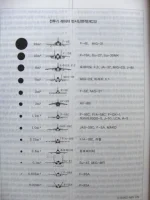
Below are the radar cross-sections (RCS) of aircraft under various metrics. Any cross-comparison or evaluation must strictly rely on data from the same institution and the same baseline standard. You cannot take a '10x reduction' claim from Institution A and overlay it onto an '8x reduction' standard from Institution B.
 

Attachments

  • 9e154d2c882ee226a97298e1096ce24fbc68c9d7.jpeg
    9e154d2c882ee226a97298e1096ce24fbc68c9d7.jpeg
    107.3 KB · Views: 5
  • a0a25ca3ly1hyun7ad8dpj20kg0jjahk.jpg
    a0a25ca3ly1hyun7ad8dpj20kg0jjahk.jpg
    147.8 KB · Views: 5
  • QQ拼音截图20260603102724.png
    QQ拼音截图20260603102724.png
    172.8 KB · Views: 5
  • 31f33555191763.webp
    31f33555191763.webp
    34.9 KB · Views: 5
When discussing Radar Cross Section (RCS), everything must be evaluated under the same baseline criteria. The U.S. once claimed that the B-1B Lancer’s RCS was only one-tenth that of an F-15—a marketing rhetoric highly reminiscent of France claiming the Rafale's RCS is 10 to 20 times smaller than the Mirage 2000. Today, no serious engineer takes these figures at face value. If we look at Russian missile engagement manuals, which benchmark a standard F-15 at 20㎡, a B-1B would absurdly compute to just 2㎡—smaller than a Rafale. By RUS standards, the F-22A’s frontal RCS is evaluated at 0.4, making the official marketing claims from South Korea or the Eurofighter consortium virtually meaningless. They might as well boast a ridiculous figure like 0.0025 like the F-117 or F-35. While American exaggerations may hold slightly more engineering credibility than French ones,
then,those aircraft are still destined to be downed by legacy missile systems in real combat.In terms of pure physics,
South Korea officially claims the KF-21 Boramae has an RCS of 0.75㎡. If they genuinely believe the French Rafale sits at 0.1㎡, then the logical coherence of their entire marketing narrative completely collapses. I honestly don't even know how one would begin to rationalise this.

Under the cold, hard laws of radar physics, if the Rafale—a conventional 4.5-generation fighter with exposed, unshielded engine fan blades and a bolt-on fixed refueling probe—somehow achieves a stealth signature of $0.1\text{ m}^2$, it would mean the Rafale's stealth performance is a staggering 7.5 times superior to the KF-21. Yet, the KF-21 was engineered from day one with an explicitly low-observable airframe, utilizing aligned edge geometries, internal weapon bays (reserved for Block 2), and serpentine inlets specifically designed to mask the engine face. For a meticulously shaped, quasi-stealth airframe to be mathematically outclassed by a traditional 1980s delta-wing design reveals the sheer absurdity of Western marketing metrics. It proves once again that these self-proclaimed RCS figures are purely arbitrary numbers conjured up for political public relations and export sales,

reducing RCS by a factor of 10 only translates to a mere 44% reduction in detection range for the exact same radar. And that is strictly within the X-band. In the L-band, such 'stealth' shaping yields negligible results. Cross-referencing L-band and X-band returns to filter suspicious tracks, and then slaving the N035 Irbis-E radar to stare and discriminate that specific sector—this is the exact tactical doctrine of the Su-35.

European nations can certainly master niche components, like specialized fasteners or relays, but it is mathematically impossible for them to surpass the United States or Russia at the macro-engineering level—whether in missile physics, radar aperture scale, advanced composites, or overall fighter jet system integration. Lest we forget, the entire theoretical foundation of stealth aircraft was pioneered by a Soviet physicist. People buy European hardware merely as a vehicle for 'geopolitical horse-trading.' However, by 2026, even this sole political luxury has completely evaporated.

Below are the radar cross-sections (RCS) of aircraft under various metrics. Any cross-comparison or evaluation must strictly rely on data from the same institution and the same baseline standard. You cannot take a '10x reduction' claim from Institution A and overlay it onto an '8x reduction' standard from Institution B.

There's average RCS and frontal RCS. Average RCS is just a measure of what the jet has been designed for.

An average RCS below 1 sqm would imply it's been designed for LO/VLO. So a 0.3 sqm figure for F-22 or 0.5 sqm for Su-57, as per Pogosyan, and even 0.75 sqm for KF-21, imply LO/VLO designs.

Rafale and Typhoon's average RCS is 1-2 sqm 'cause of higher RCS from the sides. But frontal RCS is marble sized for aircraft like the F-22 and F-35 and baseball/cricket ball sized for Rafale/Typhoon. This implies KF-21 exceeds the frontal RCS of the Typhoon by a large degree. It's likely in the 0.01 sqm class when clean. With more refinements and an internal bay, it should become VLO.

They have taken Typhoon's RO design as a benchmark to make an LO 4.5th gen design for an eventual 5th gen VLO transition with the Block 3. I speculate the frontal RCS is at least 5 times smaller than the Typhoon's 0.05-0.1 sqm.

L band is not enough for early warning against Rafale/Typhoon either. It's too small for search. Rather Su-35 gets long range, long wavelength capabilities from offboard sensors.
 
  • Like
Reactions: PhotonVish
There's average RCS and frontal RCS. Average RCS is just a measure of what the jet has been designed for.

An average RCS below 1 sqm would imply it's been designed for LO/VLO. So a 0.3 sqm figure for F-22 or 0.5 sqm for Su-57, as per Pogosyan, and even 0.75 sqm for KF-21, imply LO/VLO designs.

Rafale and Typhoon's average RCS is 1-2 sqm 'cause of higher RCS from the sides. But frontal RCS is marble sized for aircraft like the F-22 and F-35 and baseball/cricket ball sized for Rafale/Typhoon. This implies KF-21 exceeds the frontal RCS of the Typhoon by a large degree. It's likely in the 0.01 sqm class when clean. With more refinements and an internal bay, it should become VLO.

They have taken Typhoon's RO design as a benchmark to make an LO 4.5th gen design for an eventual 5th gen VLO transition with the Block 3. I speculate the frontal RCS is at least 5 times smaller than the Typhoon's 0.05-0.1 sqm.

L band is not enough for early warning against Rafale/Typhoon either. It's too small for search. Rather Su-35 gets long range, long wavelength capabilities from offboard sensors.
An aircraft with the RCS of a mosquito, a marble, or a sparrow simply does not exist in the real world. Such dimensions already fall well below the minimum detection threshold of seeker heads on missiles like the AIM-120 or R-77—to say nothing of their terminal tail-chase tracking capabilities. Assertions to the contrary completely violate the basic laws of physics.
 
There's average RCS and frontal RCS. Average RCS is just a measure of what the jet has been designed for.

An average RCS below 1 sqm would imply it's been designed for LO/VLO. So a 0.3 sqm figure for F-22 or 0.5 sqm for Su-57, as per Pogosyan, and even 0.75 sqm for KF-21, imply LO/VLO designs.

Rafale and Typhoon's average RCS is 1-2 sqm 'cause of higher RCS from the sides. But frontal RCS is marble sized for aircraft like the F-22 and F-35 and baseball/cricket ball sized for Rafale/Typhoon. This implies KF-21 exceeds the frontal RCS of the Typhoon by a large degree. It's likely in the 0.01 sqm class when clean. With more refinements and an internal bay, it should become VLO.

They have taken Typhoon's RO design as a benchmark to make an LO 4.5th gen design for an eventual 5th gen VLO transition with the Block 3. I speculate the frontal RCS is at least 5 times smaller than the Typhoon's 0.05-0.1 sqm.

L band is not enough for early warning against Rafale/Typhoon either. It's too small for search. Rather Su-35 gets long range, long wavelength capabilities from offboard sensors.
Whether a manufacturer claims an RCS of 0.5 or 0.0005, these figures are evaluated purely from the specialized perspective of 'aerodynamic shape design' to establish a theoretical baseline. Different baseline metrics, different institutions, and different calculation coefficients will naturally yield entirely different orders of magnitude. Yet, their common denominator is that they all assume an identical, idealized material composition under their respective reporting standards.
Therefore, these numbers only reflect the degree of optimization—or compromise—made within the domain of aircraft shaping and aerodynamic layout for radar signature reduction.
It is merely a necessary condition—and certainly not the primary one, let alone a sufficient condition, and absolutely not a sufficient and necessary condition (if and only if).
Consider this: a B-52 bomber has a baseline cross-section weighting of 100㎡. If you were to build an inflatable mock-up of the exact same size and geometry out of basic radar-absorbent materials, its actual RCS could easily be lower than that of a Rafale—even though its geometric baseline evaluation remains categorized at 100㎡
The factory-quoted value bears absolutely no correlation to the actual RCS generated by the physical aircraft in the real world. In the physical universe, that massive radar system packed inside the nose cone creates such a chaotic mess of radar echoes that its RCS will never drop below 1㎡ on its own—to say nothing of the engine inlets or the resin cockpit canopy. To the naked eye, the airframe looks perfectly smooth, but to an enemy radar sensor, it is completely 'transparent.'
The only accurate method of measurement is to place an F-22 on the ground, park a Su-57 exactly 100 meters in front of it with its radar active, and measure what the actual return signal is. Outside of the manufacturer’s own classified vaults, no one possesses this exact value; it remains a supreme state secret. However, one thing is mathematically certain: it is absolutely not the 0.3㎡ benchmark claimed by Yuri Pogosyan—in reality, it is highly unlikely to be anywhere below 1.5㎡……..And this holds true for every single aircraft. The Russians are never going to reveal the true RCS of the Su-57; the 0.5㎡ figure they throw around is just as much of a fiction
 
Whether a manufacturer claims an RCS of 0.5 or 0.0005, these figures are evaluated purely from the specialized perspective of 'aerodynamic shape design' to establish a theoretical baseline. Different baseline metrics, different institutions, and different calculation coefficients will naturally yield entirely different orders of magnitude. Yet, their common denominator is that they all assume an identical, idealized material composition under their respective reporting standards.
Therefore, these numbers only reflect the degree of optimization—or compromise—made within the domain of aircraft shaping and aerodynamic layout for radar signature reduction.
It is merely a necessary condition—and certainly not the primary one, let alone a sufficient condition, and absolutely not a sufficient and necessary condition (if and only if).
Consider this: a B-52 bomber has a baseline cross-section weighting of 100㎡. If you were to build an inflatable mock-up of the exact same size and geometry out of basic radar-absorbent materials, its actual RCS could easily be lower than that of a Rafale—even though its geometric baseline evaluation remains categorized at 100㎡
The factory-quoted value bears absolutely no correlation to the actual RCS generated by the physical aircraft in the real world. In the physical universe, that massive radar system packed inside the nose cone creates such a chaotic mess of radar echoes that its RCS will never drop below 1㎡ on its own—to say nothing of the engine inlets or the resin cockpit canopy. To the naked eye, the airframe looks perfectly smooth, but to an enemy radar sensor, it is completely 'transparent.'
The only accurate method of measurement is to place an F-22 on the ground, park a Su-57 exactly 100 meters in front of it with its radar active, and measure what the actual return signal is. Outside of the manufacturer’s own classified vaults, no one possesses this exact value; it remains a supreme state secret. However, one thing is mathematically certain: it is absolutely not the 0.3㎡ benchmark claimed by Yuri Pogosyan—in reality, it is highly unlikely to be anywhere below 1.5㎡……..And this holds true for every single aircraft. The Russians are never going to reveal the true RCS of the Su-57; the 0.5㎡ figure they throw around is just as much of a fiction

Are you trying to say aircraft with RCS below 1.5 sqm do not exist?

You can't just dismiss reality to make it fit your worldview.

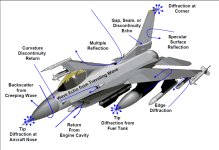
Stealth aircraft are not transparent, the radar beam is just diverted away from the source.

1.jpg

Treat the surface for each of these to make the radar beam bounce off elsewhere. That's how simple the concept it.
 
Are you trying to say aircraft with RCS below 1.5 sqm do not exist?

You can't just dismiss reality to make it fit your worldview.

Stealth aircraft are not transparent, the radar beam is just diverted away from the source.

View attachment 51966

Treat the surface for each of these to make the radar beam bounce off elsewhere. That's how simple the concept it.
Sure, an aircraft with an RCS under 1.5 square meters is totally possible—if we're talking about a paper airplane folded out of an A4 sheet. But a real-world military nose cone, stuffed with a giant, messy radar system, having an RCS that small? It doesn't exist. At the end of the day, radio waves are just a specific frequency of light. Unless you've built your fighter jet out of a black hole, it’s going to reflect.Whether it was the F-117 in the past or the F-35 more recently, both have been shot down. What did the adversaries use to achieve this, if not radar waves?

In the end, a stealth fighter's outer shaping only optimizes against a highly narrow band of microwave frequencies; it is entirely powerless against the wider spectrum of physics.
 
Sure, an aircraft with an RCS under 1.5 square meters is totally possible—if we're talking about a paper airplane folded out of an A4 sheet. But a real-world military nose cone, stuffed with a giant, messy radar system, having an RCS that small? It doesn't exist. At the end of the day, radio waves are just a specific frequency of light. Unless you've built your fighter jet out of a black hole, it’s going to reflect.Whether it was the F-117 in the past or the F-35 more recently, both have been shot down. What did the adversaries use to achieve this, if not radar waves?

In the end, a stealth fighter's outer shaping only optimizes against a highly narrow band of microwave frequencies; it is entirely powerless against the wider spectrum of physics.
A radar may have enough power to detect a target under ideal conditions. But in actual combat, it must detect the target, stabilize the track, classify it, maintain lock-on, resist jamming, avoid false targets, avoid being fooled by the environment, and produce a usable fire solution. If the EW suite or tactics break this chain, the target survives.
 
A radar may have enough power to detect a target under ideal conditions. But in actual combat, it must detect the target, stabilize the track, classify it, maintain lock-on, resist jamming, avoid false targets, avoid being fooled by the environment, and produce a usable fire solution. If the EW suite or tactics break this chain, the target survives.
Exactly. Most people today are so brainwashed by Hollywood and video games that they lack a fundamental understanding of the physical world. They think air combat is like a video game: you get a lock, fire the missile, and the enemy instantly turns into fireworks. In reality, missile hit probabilities are incredibly low. Air combat is an exceptionally complex scientific athletics tournament, dictated by formations, wind speeds, situational awareness, energy management, remaining fuel, airframe maintenance status, illumination angles, and a myriad of unpredictable probabilistic events. This is precisely why fighter jets carry so many missiles.

I recall a textbook from the Gagarin Air Force Academy regarding the Su-27. In a scenario where an interceptor fleet of 12 Su-27Ps engages an attack force of 6 F-15Es escorted by 6 F-15Cs, the statistical kill expectation under ideal combat conditions was only about 2 enemy aircraft, with an expected loss of around 1 on their own side. I’d need to dig up the book to double-check the exact metrics, but the bottom line is that the actual kill probability for both sides is remarkably low compared to popular perception.