Again, this should have been shared long back.
Some selected points from 787 CBT videos - Engines chapters -
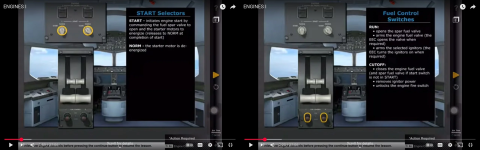
> Overhead engine start switch START/NORM
- open fuel spar valve
- energize ignitors
- FMC moves knob back to NORM after start completion & ignitors de-energized.
> Fuel switch CUTOFF/RUN behind throttle -
- opens/closes spar fuel valve.
- arms/closes engine fuel valve (EEC opens the valve when needed)
- arms/switch-offs ignitors (EEC turns on ignitors when needed)
- Cutoff unlocks fire handle.
> For initial power the EEC uses plane's electrical system then switches to PMA. If PMA is INOP then AC bus will be used again.
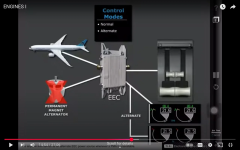
> EEC modes -
-
Normal - TPR is used as reference, based on thrust lever position.
Max TPR = Max rated thrust as per temperature & pressure at any altitude.
The buttons will show NORM only.
-
Alternate - N1 is used as reference
Auto-switch to Alternate mode if required signals not avaiable in Normal mode.
No Thrust protection in this mode.
--
Soft Alternate - if the start mode nob is in NORM position. Last known ambient data is taken to calculate max N1 data. The buttons will show both NORM & ALTN.
--
Hard Alternate - if EECbuttons pushed. EEC sets thrust using N1 & pre-programmed thrust shedule. The buttons will show ALTN only.
If auto-throttle is on the 2 thrust levers could be staggered as per ambient situation. If ony 1 engine is in ALT mode then selecting other in ALT mode by pushing button will eliminate throttle lever stagger & assymetrical thrust.
Since
thrust protection absent, the max rated thrust will be reached before max thrust lever position which can cause
over-boost if put to full position, this should be
used in emergency only like approaching terrain, etc.
> Overspeed protection is provided on N1 & N2 spools, indirectly for N3 also.
> N1 & N2 red line protection still available in ALT mode. If N1 or N2 RPM approaches red line limit then
EEC reduces fuel flow. If RPM limting fails & red line crossed & overspeed condition persists then EEC shuts off fuel valves & ENG FAIL message is displayed with aural alarm.
>
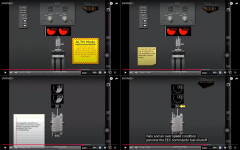
TCMA (Thrust Control Malfunction Accomodation) works at assymetrical idle power on ground.
EEC shuts down higher RPM engine when plane is on ground, thrust lever at idle, engine is above idle RPM not decelerating normally.
>
TAP (Thrust Assymetric protection) reduces thrust of operating engine on failure of other,
to have proper yaw control. It reduces thrust when air speed decreases below V2 on T/o or below Vref on G/a. Once speed increase beyond V2/Vref then TAP increases thrust. It doesn't affect thrust on engine-out ops at or above V2/Vref, unless G/a at less than 152,273 Kgs then thrust is reduced at Vref.
> EEC idle modes -
- minimum idle - for ground ops & most phases of flight.
- approach idle - higher than min. idle. This decreases acceleration time for go-around.
It is selected when flaps are 25 degrees or more & gears are down.
After touch down EEC goes to min. idle.
- icing idle - selected when engine anti-ice is on.
- ice crystal idle - selected when ambient air temp. is b.w ISA & ISA+29 C, or altitude b/w 35k & 5K ft.
======================================================
View: https://www.youtube.com/watch?v=qdnfqMOSndo
> There are 2 ignitors. The EEC selects appropriate one for ground start.
Both are used for in-flight restarts.
> DC power is the normal power source, with backup also.
> 2x Starter motors per engine are connected to N2 spool via gear box. They're operated by overhead start knobs. APU or GPU can provide power to starters.
>
Simultaneous engine start is only allowed when APU is running & both APU generators are operational.
if both engines are commanded to start via knobs, but
adequate power not there, then 2nd engine start is ignored & delayed.
> Autostart sequences fuel & ignition with no i/p from pilot.
> On ground the overhead start knobs & fuel switches behind throttles are operated.
> For
in-flight windmill restarts, the autostart is initiated by moving fuel switch to RUN.
> So
EEC will operate Fuel valves instructed by start knobs &/or fuel switches based on ground or flight mode.
> There will be
load-shedding during engine start.
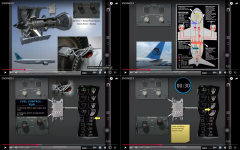
> For ground start, EEC monitors start & attempts to correct -
- compressor stall
- hot start
- hung start
- loss of 1 starter
- no EGT rise
- start time exceeds starter duty cycle timer.
> If any of above happens then EEC will -
- turn off fuel & ignition
- motor for 20-30 seconds
- make 2nd start attempt using reduced fuel flow & both ignitors.
> If 2nd attempt fails then -
- auto start is cancelled by EEC.
- Fuel & ignition shut off.
- engine is motored to clear residual fuel.
- starters de-energized.
- start knobs return to NORM.
- EICAS error message displayed.
> Only 2 start attempts allowed on ground.
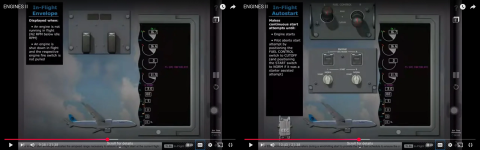
> In-flight envelope info is displayed on EICAS when -
- Engine is not running in flight (N2 below ilde RPM).
- Engine is shut down in flight but fire handle is not pulled.
- Envelope info shows flight level & airspeed range.
- If airspeed is below windmill start threshold then starter-assisted indication is displayed.
> Secondary indications are automatically displayed when -
- Engine is not running in flight (N2 below ilde RPM with fuel switch in RUN).
- or Fuel switch CUTOFF
> In-flight auto-start will continue re-attempts until -
- engine starts
- pilot aborts start by fuel switch CUTOFF (& start switch to NORM in case of starter-assisted)
>
EEC monitors engine parameters during windmill start to provide best fuel schedule to ensure shortest start time.
>
Auto-relight is activated for flameout or engine at/below idle RPM with fuel switch in RUN position.
EEC activates both ignitors.
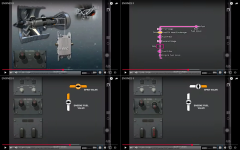
> Spar valve is opened when -
- fire handle is down
- either start knob to START or fuel switch to RUN
> Engine fuel valve is opened when fire handle is down & fuel switch is set to RUN.
> Both valves are shut off when -
- fire handle is pulled.
- or fuel switch is CUTOFF
------------------------------------------------------------------------------------------------------------------------------------------------------
DERIVATIONS (not colclusions) -
>
FSOVs can be manually closed by fuel switches or fire handle, but the
EEC is said to monitor engine parameters.
> Somewhere i read that
fire handle is activated only when fuel switch is off, if true then this is safety feature.
> Thrust limit in FMC's CDU should be carefully set.
>
In low altitude emergency, only 1 engine at a time might get supported to restart by RAT, as APU N/a.
> Lone survivor said that there was flickering of lights, so that's expected during power failure, switch-over, engine relight, etc.
>
20-30 seconds needed in auto mode to ventilate engine of residual fuel before relight.
QUESTIONS -
> Is there any S/w protection against inappropriate switch operation, short circuit, S/w bug, etc?
> Combined with sensor error, can there be a glitch in-
- N1/N2 RPM limiting?
- overspeed protection?
> Can problem with LP/HP pumps, filters, valves cause 1 engine shutdown & then TAP feature shutting other as well?