Ghatak and Rustom Indigenous UAV Programs

@Gautam We saw quite a few concepts around in Aero India 2019. Some were viable and some were not. Some were 'revolutionary' but without the existing technology, not much viable in present times.
 
I thought about I max Jaguar with swarm drones.. ( Hal poster )

Any development on that side..


Jags are going to be out. There is at present, no firm logic or plan to upgrade it's capabilities beyond what is required economically to bridge the time lag till introduction of the next generation of inductions.
 
  • Like
Reactions: Sathya
The Indian private sector is far, far more advanced than you believe. They are just not getting enough media attention because the Indian pop is not sophisticated enough to absord such information where people will get paid to report everything.

Google TAAL. That's Taneja Aerospace.

There are now more than a dozen private companies with clearance to manufacture UAVs. There are even companies that are designing their own turbofan engines. There's a company called Poeir Jets which has already finished development of a small engine and are working on a family of bigger engines. Kalyani is also designing a family of turbofan engines.
I specifically said 'Rustom-1 class' of UAVs. There are at least 5 companies which do make quad copters in Bangalore area alone. Does that qualify them to make wingman UAVs? No. Have any of the private company made a certifiable aircraft from scratch? (maybe with Mahindra aero's Australian buy)
Does even the HAL have the R&D expertise from the development of Rustom or nishant? No its ADA, DRDO and NAL.
Only UAV offering which weights more than 10 kg from HAL is rebranded Skylark from Elbit systems.

Now they are going to make 1-ton loyal wingman :cautious:
 
Jags are going to be out. There is at present, no firm logic or plan to upgrade it's capabilities beyond what is required economically to bridge the time lag till introduction of the next generation of inductions.

At least Honey well engines for 66 Jaguars?
 
Could you elaborate on this part?

We got no money.. To buy 2 additional contracted P8i.

Just purchased emergency stocking of Russian missiles. 750 million $
Spice bombs for 300cr
Anti tank missiles for Mi helicopter for 200cr
Astra missiles 50 nos.
 
We got no money.. To buy 2 additional contracted P8i.

Just purchased emergency stocking of Russian missiles. 750 million $
Spice bombs for 300cr
Anti tank missiles for Mi helicopter for 200cr
Astra missiles 50 nos.
We're getting 10 additional P-8i. 2 less doesn't make much of a difference.
 
I specifically said 'Rustom-1 class' of UAVs. There are at least 5 companies which do make quad copters in Bangalore area alone. Does that qualify them to make wingman UAVs? No. Have any of the private company made a certifiable aircraft from scratch? (maybe with Mahindra aero's Australian buy)
Does even the HAL have the R&D expertise from the development of Rustom or nishant? No its ADA, DRDO and NAL.
Only UAV offering which weights more than 10 kg from HAL is rebranded Skylark from Elbit systems.

Now they are going to make 1-ton loyal wingman :cautious:

Of course. Taneja is one of the main private companies involved in the development of Rustom class UAVs. All of its test flights were conducted from Taneja's airstrip. TAAL is one of ADE's Creative Partners for the development of UAVs.
https://www.drdo.gov.in/drdo/pub/newsletter/2010/dec_10.pdf

AFAIK, TAAL is going to be the lead integrator for the Rustom class UAVs/UCAVs.
 
Of course. Taneja is one of the main private companies involved in the development of Rustom class UAVs. All of its test flights were conducted from Taneja's airstrip. TAAL is one of ADE's Creative Partners for the development of UAVs.
https://www.drdo.gov.in/drdo/pub/newsletter/2010/dec_10.pdf

AFAIK, TAAL is going to be the lead integrator for the Rustom class UAVs/UCAVs.
Again deliberately misleading. The question is about capability about making wingman like UAVs for HAL/NewSpace. Which I explained how improbable it is. If your point is about private sector capability my question was specific.
Have any of the private company made a certifiable aircraft from scratch?
 
Don't worry too much about it. Now, stuff's gonna really take off in the govt's new term. It's gonna be really impressive.
What can revive India’s GDP growth — consumption and investment

By: Sunil Jain | Updated: June 24, 2019 2:44:32 AM

Budget 2019-20: Cutting corporate taxes, or RBI cutting repo, won’t help much if the government’s policies are seen to be hitting investments.
1-1150.jpg

Budget 2019: How sweeping the reforms will be depends on whether prime minister Modi thinks India is in a crisis.

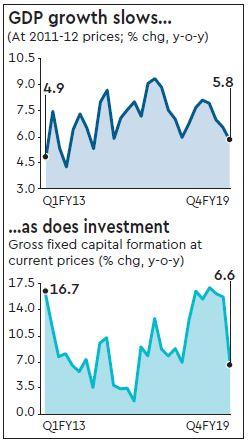
Budget 2019: Though government economists have done a comprehensive job of demolishing ex-CEA Arvind Subramanian’s argument that India has overestimated its GDP growth by as much as 2.5 percentage points, what is worrying is that while average growth for FY19 may be a little over 6.8%, that for the January to March quarter (Q4) has fallen to a mere 5.8% versus 8.1% a year ago. It is this growth level that India has to pull itself up from, and the prospects aren’t good, which is why some forecasts are looking at an FY20 growth that is lower than that in the previous year.

While growth in private consumption levels have remained at the same 7% level in both Q1 and Q4 of FY19 (they fell from 12% to 10% in terms of current prices), investment growth has collapsed from 13% to 4% (and from 17% to 7% in current prices). In such a scenario, the only way GDP growth can pick up is if investment levels or government consumption rises dramatically—it grew from 7% in Q1 to 13% in Q4 in constant prices, and from 12% to 16% in current prices—but with the government quite cash-strapped, that isn’t a possibility; in any case, since government expenditure is just 9-10% of GDP, there is just that much it can achieve. Indeed, given the NBFC crisis, and its impact on credit growth, the downside pressure on GDP growth is even higher.

Some argue that, along with a sharp cut in corporate tax rates—India’s are amongst the highest in the world—a sharper cut in repo rates by RBI will do a lot to stimulate investment; so, while finance minister Nirmala Sitharaman can do the first in the budget, RBI Governor Shaktikanta Das will do the rest in the next credit policy. Both moves will help, but how much is not clear. Even if RBI cuts repo, this may not translate into lower rates for a variety of reasons, including the fact that the government-mandated savings rates on ‘small deposits’ puts a floor to bank-deposit rates and, in turn, lending rates. And tax cuts can’t help if the investment climate is poor.

Capture-11.jpg


If an investor in a power plant can’t get enough coal to run it because the public sector monopolist Coal India isn’t producing enough, or if a bankrupt state electricity board can’t either buy the power or pay for it on time, how will a lower interest rate or a tax cut help?

Though these are not strictly budget issues, traditionally budgets are used to make larger policy announcements that will be followed through during the year; so, apart from the actual numbers on deficits etc, Sitharaman’s budget will be watched for whether the government uses it to shed its anti-industry image.

In the case of telecom, as this newspaper has catalogued regularly, the investment climate turned hostile even before RJio’s entry with its very low tariffs; while the government used to charge industry a revenue-share at the time it gave out spectrum almost free, it carried on with this even after it started charging an arm and a leg for the spectrum. It was relatively easy for prime minister Narendra Modi to fix this, but Congress president Rahul Gandhi’s suit-boot-ki-sarkaar jibe seemed to have given him cold feet.

In the oil and gas sector, despite Modi’s professed aim to lower import dependence, oilcos do not get the market price for all their output. In the case of natural gas, only that produced from new fields will get the market price; but if firms don’t make higher profits on their existing production, how will they invest to find new gas? And while firms are free to get market prices in the case of oil, if the government specifies which buyers are to get how much oil, this ensures there is no real price discovery. Nothing exemplifies this anti-investor attitude better than the government’s treatment of UK firm Cairn Energy which, within a few years, produced a fourth of India’s oil output. It was slapped with a retrospective tax, its shares worth $1bn were confiscated and dividends etc worth $300-400mn were appropriated; indeed, when Cairn (by then sold to Vedanta) wanted an extension of its lease—so that it could add to India’s oil production—the government agreed only if Cairn raised the revenue it would share by a whopping 10 percentage points (bit.ly/2OZUy2r).

In the case of minerals like coal and iron ore—even without oil, they comprise 25% of India’s imports, and 55% with oil—hardly 10% of India’s geology has been explored even though doubling this can create another 5 million jobs. Apart from unconscionable delays in getting environment clearances, as in the telecom sector, rapacious government levies are a big problem; as compared to 8-12% levels globally, Indian levies on most non-oil minerals work out to around 30% of top-line revenues. The government is focused on increasing the country’s overall exports—this can’t be done if taxes and interest rates aren’t slashed and rigid labour laws abolished—but if imports of minerals fall due to higher local production, the forex impact is the same.

If investment levels have fallen dramatically due to poor government policy, so has FDI, from 1.9% of GDP in FY16 to 1.6% in FY19. If the government changes it policy on e-commerce after Walmart spent $16bn to buy Flipkart, for instance, it is difficult to see how foreign investors are going to remain enthused.

Certainly, PE funds and others will bring in money to take advantage of the bargains available at the NCLT, but greenfield investment requires a more predictable regime.

Much like in 1991, the budget will be watched for whether it unleashes a slew of reforms, the new industrial policy that President Ram Nath Kovind spoke of on Thursday. How sweeping the reforms will be depends on whether prime minister Modi thinks India is in a crisis. Given the state of the fisc, the falling investment levels and the rising joblessness, the crisis is apparent even if no one is mortgaging their gold.


What can revive India’s GDP growth — consumption and investment

 
Again deliberately misleading. The question is about capability about making wingman like UAVs for HAL/NewSpace. Which I explained how improbable it is. If your point is about private sector capability my question was specific.

The private sector is now quite accomplished when it comes to this. A lot of technology input will come from DRDO anyway, like sensors, datalink, engine and even FBW. If you are a private sector company, then all you need is design expertise, everything else you can just buy from DRDO in the form of ToT.

The private sector is already designing engines for UAVs, so that should already tell you what they are aiming for.

If I had a large private sector company, it will be very easy for me to design and build UAVs. Tata, L&T, Taneja etc can design their own stuff. The problem is even if my design is better than anything else in the country, DPSUs will put a stop to it, that's why you do not see any independent designs. Or else the expertise is already there.
 
  • Like
Reactions: Shekhar Singh
The private sector is now quite accomplished when it comes to this. A lot of technology input will come from DRDO anyway, like sensors, datalink, engine and even FBW. If you are a private sector company, then all you need is design expertise, everything else you can just buy from DRDO in the form of ToT.
Exactly. And this is not even an active project under DRDO or HAL.

If I had a large private sector company, it will be very easy for me to design and build UAVs. Tata, L&T, Taneja etc can design their own stuff. The problem is even if my design is better than anything else in the country, DPSUs will put a stop to it, that's why you do not see any independent designs. Or else the expertise is already there.
Chicken egg problem. So in the current setup very improbable.

Realistically not happening, but for the optimist, they can build whatever they wanted to because somehow 'expertise' is already there. (Although it's unproven!)
 
Exactly. And this is not even an active project under DRDO or HAL.

Whatchu talking about? UAVs are one of the most active projects under DRDO. That's one of the main reason why Challakere was built.

Chicken egg problem. So in the current setup very improbable.

Realistically not happening, but for the optimist, they can build whatever they wanted to because somehow 'expertise' is already there. (Although it's unproven!)

Lol, one company has already finished development of an engine. And I have given you two companies that are now working on more advanced engines.

And then DRDO itself is developing more engines for UAVs with private sector contractors.

And then, we aren't even talking about the IUSAV, which is going to be a pretty big project.
 
Whatchu talking about? UAVs are one of the most active projects under DRDO. That's one of the main reason why Challakere was built.
What are we talking about here? If you don't recall or the train of thought is lost you can always go back and read the thread. Try to understand the context before jumping in and giving your valuable opinion.