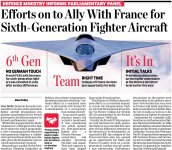
India eyes 6th generation FCAS, looks at tying up with France for possible collaboration

My vote is on SCAF. The train for GCAP left the station quite a few years ago.

SCAF Pros: Excellent relations with France, improving with Germany and stable with the Spain. The Airbus proposal of 2 different airframes (heavyweight, long-range fighter for DE and ES, middle-weight carrier & n-capable for FR) works in our favour, should it come to pass. The heavyweight can be a perfect replacement for Su-30 2040+, and the middle-weight will spearhead the carrier combat aviation (& n-delivery, if AMCA MK2 isn't already doing it by then). We can contribute towards the development of VLO CCAs, MUM-T, radar & EW suite, combat cloud, computing and fibre-optic architecture for flight n sensor fusion. And of course, scale. Indian participation should complement the existing trilateral partnership, and not come at the cost of German n Spanish participation.

SCAF Cons: France wants around 80% of workshare and overall over the entire project for less than 40% of R&D cost-split. India won't bite that, having learned our lessons from the FGFA saga. If India's participation comes at the cost of the Germans n Spanish, then we'll be bearing 50% of R&D with around ~20% of workshare, which is the last thing the Indian side wants, an FGFA redux.

GCAP Pros: Smooth sailing programme (for now at least), comes online earlier (2035-40 timeframe), will make for an excellent stop-gap 6th gen purchase 10-15years from now, if the IAF finds itself in that situation. We offer the scale which reduces the costs drastically for all involved parties. UK would definitely love that, haha.

GCAP Cons: Smooth sailing programme (so far), meaning there's isn't much of a workshare pie left for us. Whatever we can contribute towards, the current trio can do it too. With Canada joining as an observer (can't rule out a full-blown participation) and Poland next in line, it doesn't leave much, if any, room for us. Too many chefs spoil the broth.

The two-airframe design is definitely a plus for SCAF in terms of airframe workshare for India.

My bet is on the French airframe due to potential IN involvement and the nuclear strike role versus Germany's heavier Typhoon-esque design. We may get limited to no involvement in avionics though, too many cooks already. But yeah, good point, I didn't think of India working on the airframe with the French while the Germans and Spaniards do their own thing. This meets my expectation of limited financial contribution and appropriate workshare within the limits of our budget without affecting ADA's next gen.

The real fruit would be if AMCA's engine design can be updated to 6th gen right off the bat and use that to power the airframe we choose. This way we get as many as 4 airframes on a common engine.

It's unclear why the French do not want the two-airframe design though. My guess is if the German program is delayed, they may place hurdles on the French program due to the shared avionics. The financial burden of the French airframe and engine will be much larger for France to bear alone, both R&D and production scale (although that's where India comes in). And you have a third European export competitor (although India's participation may make the French version far more enticing for export.). But if the IAF chooses the German design, it gets way worse for the French in every scenario imaginable.

India will have to wait until 2045 to get SCAF relative to GCAP. That's about the only advantage I can think of for GCAP.

Anyway, good catch.
 
  • Like
Reactions: YoungWolf

frankly i dont know if India can even afford to become part of the FCAS program. We have to finance the rafale, the AMCA, the tejas mk1a, the tejas mk2 and the sukhoi upgrade. This is excluding the MTA or MALE drones or any other contract.

The rafale is the major sticking issue here with a 32 B USD deal. If not for the rafale we could use he same money for FCAS. the others are all indigenous deals which should be much cheaper than the rafale deal.
 

frankly i dont know if India can even afford to become part of the FCAS program. We have to finance the rafale, the AMCA, the tejas mk1a, the tejas mk2 and the sukhoi upgrade. This is excluding the MTA or MALE drones or any other contract.

The rafale is the major sticking issue here with a 32 B USD deal. If not for the rafale we could use he same money for FCAS. the others are all indigenous deals which should be much cheaper than the rafale deal.

No need to be part of GCAP or FCAS.

All this 6th gen is brain rot. If needed, we can buy GCAP.

Fund MK2, AMCA, Aero engines.
 
Whilst Trappier refers to the 114 Indian Rafales as a contract due to be signed before the end of 2026, and goes on to say that he is still hoping for further contracts in India, this suggests that he no longer views India as merely an export customer, but as the Rafale’s second sustainable industrial pillar after France. India had already entered into high-level aerospace cooperation with France, whilst the UAE has ordered 80 Rafales; they are therefore the two most natural foreign partners for the economic expansion of the Rafale ecosystem.

Rafale F5 under French control

France retains control of the overall architecture, sovereign functions, sensitive electronic warfare systems, the nuclear component and the management of future upgrades. However, India and the UAE could finance or co-develop certain exportable components:
  • engines and power upgrades;
  • sensors and optronics;
  • sovereign data links;
  • tactical artificial intelligence;
  • new weaponry;
  • escort drones;
  • simulation and collaborative combat infrastructure.
This fits perfectly with the doctrine set out by Trappier: cooperation is possible, but with a single architect, responsibilities based on expertise, and no paralysing co-governance.

Formation of a ‘Rafale F5 club’

India would simultaneously contribute:
  • significant volume;
  • a production line;
  • engineering capabilities;
  • demanding operational requirements in the face of China and Pakistan;
  • the prospect of a significant volume of aircraft in the long term.
The UAE, on the other hand, would contribute:
  • funding;
  • a modern fleet of 80 aircraft;
  • high operational demands;
  • experience with American and French systems;
  • potentially investments in drones, AI and weaponry.
The roles would therefore not be identical. India would be the potential industrial partner; the UAE would be more of a financial partner, a partner specialising in specific technologies and a launch customer.

Then, a gateway to the future French aircraft
Participating in the F5 programme would be a way for these countries to build credibility before seeking a place in the future French NGF programme.

But Trappier would likely set a very clear boundary. They could become partners in the programme, without becoming co-designers of the aircraft. In other words:

French prime contractor + international funding + allocated technology packages + guaranteed contracts

India would be much more than just a financial backer

India has an advantage that potential European partners do not necessarily have: it can guarantee a large domestic market.

If the 114 are added to the IAF’s 36 Rafales and the 26 Rafale Marines, India would already have 176 Rafales, even before the subsequent orders mentioned by Trappier. It could then, in the long term, become the leading operator of the Rafale alongside France, depending on the pace of deliveries and future French orders.

And the additional contracts could cover:
  • a second batch for the Air Force;
  • more Rafale Marine aircraft;
  • the gradual replacement of other Indian fleets;
  • the combat drone associated with the F5;
  • and an export version of the future French aircraft.
Under these circumstances, it makes sense to offer India a stake in the development, because it would not merely be funding the design studies: it would provide the production volumes needed to recoup the programme’s costs

A major challenge: India’s demands for self-reliance
The sticking point will be the sharing of technology and design authority. India will probably want to:
  • carry out a large proportion of production on its own territory;
  • integrate certain indigenous weapons systems;
  • have autonomy over maintenance and upgrades;
  • gain access to more technical data;
  • employ its own design offices.
Dassault may accept a very extensive localisation of the industrial system, but certainly not relinquish control over the aerodynamic configuration and overall architecture. The compromise could be the one Trappier describes for the nEUROn: an undisputed prime contractor and partners responsible for complete sub-assemblies corresponding to their actual areas of expertise.

As regards Ukraine, as of 1 July 2026, the Gripen is no longer merely a proposal: on 30 June 2026, Saab signed a contract for 16 Gripen E aircraft, worth approximately 24.6 billion Swedish kronor, with deliveries scheduled for 2029–2030. Gripen C/D aircraft are also due to arrive earlier.

As for the Rafale, the matter is still at an earlier stage legally, but is far more serious than a mere rumour. In November 2025, France and Ukraine signed a declaration paving the way for the acquisition of up to 100 Rafale F4s by 2035, complete with armaments, radars and the possibility of local manufacturing in Ukraine. In March 2026, Zelensky announced that advance payments were being prepared for both the Gripen and the Rafale.

The previous Gripen deal illustrates precisely the possible sequence:
  • letter of intent → European financing solution → deposit → firm contract
The Rafale could follow the same path, albeit with a delay due to its cost, the industrial burden on Dassault and the need to put together a more substantial financing package.

Ukraine could become not only an additional Rafale customer, but a major European partner in the Rafale F5 programme, with:
  • a potential requirement of up to 100 aircraft;
  • exceptional combat experience against Russian air defences;
  • a genuine aerospace and missile industry;
  • advanced expertise in drones, electronic warfare, communications and the rapid adaptation of weaponry;
  • strong justification for receiving European defence funding.
Ukraine could contribute very substantial technological expertise, particularly in escort drones, long-range effectors, resilient tactical links and operational feedback.

One could therefore envisage a credible core:
  • France: architecture and project management
  • Greece: nEUROn structures and experience
  • Ukraine: drones, electronic warfare, weapon systems and combat feedback
Then, outside the European framework:
  • India and the UAE: production volumes, funding and targeted industrial cooperation
Ukraine is even potentially significant in this arrangement for securing European funding, as its involvement would undermine the argument that the programme is being artificially ‘Europeanised’. With France, Greece and Ukraine, this would genuinely be a European programme bringing together a lead designer, a former industrial partner of the nEUROn, and the country with the most up-to-date operational experience of high-intensity air warfare.

From an industrial perspective, the available information indicates that around 90 to 96 of the 114 aircraft would be manufactured or assembled in India, depending on the formula ultimately adopted, with the remainder being delivered directly from France. An Indian final assembly line is being considered, with a gradual increase in local subcontracting; Safran has also declared itself ready to set up an M88 engine assembly line in India.

Above all, the industrial infrastructure is already being established independently of the 114-aircraft contract:
  • Tata is set to manufacture complete sections of the Rafale fuselage in India, including for global markets, with an announced capacity of up to two fuselages per month;
  • DRAL in Nagpur is already developing a fully-fledged Dassault supply chain centred on the Falcon;
  • the proposed Indian Rafale production line is sometimes estimated to have a potential capacity of around 24 aircraft per year.
India would therefore likely be keen to produce beyond its own requirements. It is specifically seeking to become an aerospace export hub, not merely a workshop tasked with fulfilling a domestic order.

Two complementary production lines
An arrangement of this type could be achieved:
  • France → French aircraft, highly sensitive aircraft, first export models, F5s and development
  • India → Indian orders, certain export orders, fuselages and sub-assemblies for the entire fleet
This would free up the French production line for French, Emirati, Ukrainian or European orders, whilst allowing India to take on other customers with Dassault’s agreement.

The Indian production line would therefore not merely be a means of fulfilling the ‘Make in India’ initiative. It would become a second industrial source for the Rafale.

The real constraints would be political and contractual
India would not be able to freely sell Rafales in the same way it would sell a domestically produced aircraft. Dassault and the French government would likely retain control over:
  • the configuration;
  • sensitive software;
  • sovereign equipment;
  • export licences;
  • and final certification.
However, there is nothing to prevent a Rafale intended for a third country from being assembled in India, using French engines, radars and equipment, or those produced under French supervision.

This is already implicitly included in the Dassault–Tata agreement: Indian production of fuselages is intended for India and other global markets.

Implications for Ukraine

This makes the prospect of a large Ukrainian order much less of an obstacle. The first aircraft could come from France or be drawn from a priority production line, whilst subsequent batches could be partly produced in India.

One could even envisage, in the long term:
  • France: development and final integration
  • India: large-scale production
  • Ukraine: heavy maintenance, operational adaptations and drones
In this scenario, the 114 Indian Rafales would not necessarily tie up Dassault’s capacity: on the contrary, they would justify the creation of additional industrial capacity that would enable the company to serve other markets.

This is also why Trappier can hope for further Indian contracts beyond the 114. Once a production line capable of handling around twenty aircraft per year is in place, it becomes economically sensible to maintain it with:
  • additional Indian batches;
  • the Indian Navy’s requirements;
  • modernisation programmes;
  • and possibly aircraft intended for export.
India could then become for the Rafale what Italy or Japan are expected to become for the GCAP: not merely a customer, but a major industrial production hub — with Dassault, however, retaining control over the product’s architecture and development.

Russia is gradually ceasing to be a credible aerospace supplier for the region. Sanctions, support difficulties, the priority given to Russian requirements and the loss of equipment in Ukraine are causing lasting damage to the Russian offering. A recent analysis even estimates that the war has virtually eliminated Russia as a viable arms supplier in South-East Asia.

This opens up opportunities for France and India.

Indonesia has already joined the Rafale ecosystem with 42 aircraft and began taking delivery of its first planes in 2026. It could further increase its order.

Malaysia and the Philippines present greater challenges, as their budgets are smaller and they are also considering lighter solutions such as the FA-50. But their need for fleet renewal is very real, and regional military modernisation is accelerating rapidly. The Philippines, in particular, has embarked on a particularly significant multi-year modernisation programme.

But precisely because of this, the Rafale fits well with this culture of non-alignment. It allows countries to purchase a high-performance Western aircraft without becoming entirely dependent on the United States. This is probably its major commercial advantage in the region: replacing the Russian offering without imposing the political and IT dependence associated with the F-35.

Thus, Indonesia, Malaysia and the Philippines could gradually become a second Asian ‘Rafale arc’, complementing India, even if Indonesia is currently the only truly established pillar.

 
Reading the F-35 Iran Incident as a Chinese-Enabled Multi-Sensor Kill Chain

https%3A%2F%2Fsubstack-post-media.s3.amazonaws.com%2Fpublic%2Fimages%2Fe57a08fb-96fe-4cdb-88f3-1c7f62297e68_1536x1024.png


This article is worth reading because it moves the discussion beyond the simplistic question of whether a single IRST, radar, or missile system “detected the F-35.”

Its central argument is that the relevant issue is the kill chain as a whole.

A stealth aircraft may remain difficult to detect and track for any individual sensor, but a distributed network can gradually reduce uncertainty by combining several imperfect sources:
  • low-frequency and over-the-horizon radars for initial cueing;
  • satellites for wide-area surveillance and change detection;
  • passive ESM/ELINT systems for emission detection and geolocation;
  • UAVs or loitering sensor nodes for local track refinement;
  • conventional air-defence radars for acquisition and fire control;
  • infrared sensors or missile seekers for terminal engagement;
  • data-fusion and command nodes to correlate all of the above.
The point is not that every sensor produces a weapons-quality track. Most do not. The point is that one sensor may indicate that something is present, another may narrow the search volume, another may classify it, and a final sensor may provide the accuracy required for engagement.

That is how a low-observable aircraft can become vulnerable without ever becoming “clearly visible” to one radar in the traditional sense.

The article is careful enough to distinguish plausibility from proof. It does not conclusively demonstrate that a complete Chinese-enabled network was responsible for the reported F-35 incident. Some of the claimed radar performances remain uncertain, and the exact operational state of the Iranian network is not publicly known. But the broader doctrinal lesson is convincing:

stealth remains valuable, but survivability increasingly belongs to the entire combat system rather than to the aircraft alone.

This has direct implications for the Rafale F5.

The objective should not be to turn the Rafale into a French imitation of the F-35. The more coherent approach is to build a system in which each component performs the role for which it is best suited:
  • the Rafale F5 as the heavily armed, long-range, sovereign command and combat platform;
  • SPECTRA and future electronic-warfare systems for detection, protection, deception and threat geolocation;
  • a stealth combat drone for penetration, forward sensing, decoy missions and operations inside the most dangerous air-defence zones;
  • distributed airborne, ground, naval and space sensors;
  • resilient combat-collaborative links;
  • long-range weapons able to attack the air-defence system without placing the crewed aircraft unnecessarily close to it;
  • algorithms that correlate tracks, classify threats and assign sensors and effectors in real time.
This is also why the expression “combat cloud” can be misleading. A cloud is not a capability by itself. What matters is a concrete operational chain:
  • detect → track → identify → locate → decide → engage
The network must connect real sensors to real weapons under conditions of jamming, cyberattack, deception and partial loss of communications.

For Rafale F5, the decisive advantage may therefore come not from maximizing passive stealth on the crewed aircraft, but from combining:

Rafale F5 + SPECTRA + stealth combat drone + distributed sensors + long-range weapons

Such an architecture could be more flexible than relying on a single highly specialized stealth platform. It would preserve payload, range, sovereignty, electronic warfare capability and upgrade freedom, while placing the most expendable or most stealthy assets closest to the threat.

The article’s most important lesson is therefore not that stealth is obsolete. It is that stealth must now be understood as one layer within a multi-sensor, multi-platform and multi-effect combat architecture.


That is precisely the direction in which Rafale F5 and its accompanying combat drone appear to be moving
 
  • Like
Reactions: screambowl
It doesn't matter what aircraft it was, from an A-10 to a F-22, It was low and flying within visual range and got ground fire, They got too confident in their degradations of ground threats

Now that FCAS is dead-------Time to say the Rafale F5 is the best in the world

But France does have it's begging bowl out looking for investors in their 6th gen , If someone is silly enough, then Stealth will be great again
 
Last edited:
It doesn't matter what aircraft it was, from an A-10 to a F-22, It was low and flying within visual range and got ground fire, They got too confident in their degradations of ground threats

Now that FCAS is dead-------Time to say the Rafale F5 is the best in the world

But France does have it's begging bowl out looking for investors in their 6th gen , If someone is silly enough, then Stealth will be great again
You want to Makee Stealth Great Again? :ROFLMAO:
 
  • Haha
Reactions: Photon Vish
You want to Makee Stealth Great Again? :ROFLMAO:
Now that FCAS and the dream of a stealthy 6th gen is dead,
It's sour grapes* for the fanboys that france won't get a new car, It will keep polishing the old one, even as the wheels fall off

Poor French mother hubbard, went to the cupboard, to get her poor dog a FCAS, but when she came there, the cupboard was bare and the poor little dog had none **

*
" The Hungry Fox and the Sour Grapes. It was integrated into the Indian subcontinent's folklore through collections like the Panchatantra Tales and retellings of the Jataka Tales. [1, 2]
In the Indian versions, a clever and hungry jackal (or fox) spots juicy, ripe grapes high on a trellis. After repeatedly jumping but failing to reach them, the exhausted animal gives up, walking away while declaring: "These grapes are sour anyway." [1, 2, 3, 4]"


** "Khali bartan" (खली बर्तन): Literally translated as an "empty pot," it is a common Hindi phrase referring to a completely barren pantry. In many South Asian folktales, a destitute woman or "Gareeb Maa" (गरीब माँ) is depicted with empty bartans (vessels).
 
Last edited:
  • Like
Reactions: Innominate
After France burnt Germany again, both with Eurofighter and FCAS, it is looking for new victims that will let France Keep all of the cake they paid for

"Dassault can work with partners, even outside Europe, as long as the rules are set from the beginning. In his words: "We can do it alone, that's possible, or we can find partners." He added: "I'm not saying we necessarily have the financial means to do it alone."

Dassault, in the words of its CEO, does not refuse to cooperate. It rejects cooperation in which industrial leadership is diluted,"
 
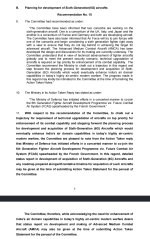
Screenshot_20260808_113711_Chrome.jpgthe recommendation of standing committee and the reply of Government from the 25th report.

Committee recommended that we look for partners and government says it has already chosen to pursue talks with the French.

Seems this might be connected to the Rafale procurement, AMCA engine development and maybe more stuff.
 
This is far more significant than the rumors from February: the Indian Ministry of Defence has officially informed a parliamentary committee that it has initiated steps to join the French sixth-generation program. This is no longer a case of a journalist extrapolating from a ministerial meeting.

And the timing is remarkable.

On August 6, Dassault submitted its detailed proposal for the 114 Rafale jets. On August 8, news broke that New Delhi had formally begun the process of joining the French sixth-generation program. In the interim—back in February—the Franco-Indian partnership had already been elevated to the status of a "special comprehensive strategic partnership," featuring an explicit commitment to strengthen the co-design, co-development, and co-production of advanced platforms and combat engines.

This is beginning to look less like a simple Rafale contract and more like a genuine, thirty-year Franco-Indian aerospace architecture.

The point that strikes me is this: India does not intend to replace the AMCA.

The report clearly distinguishes between the two. The AMCA remains India’s fifth-generation program. At the same time, the IAF does not want to repeat the delays experienced with the previous generation; it is therefore seeking to join a sixth-generation program right from the development stage. The parliamentary committee is even calling for a roadmap and a timeline to ensure India "does not fall behind."

The logic would therefore be:
  • 2020–2030: Tejas + modernized Su-30MKI + Rafale
  • 2030s: AMCA + Rafale F5
  • 2040s: Next-generation Franco-Indian aircraft + associated combat system.
And that is far smarter than waiting until 2040 to buy a foreign sixth-generation aircraft off the shelf.

This is exactly the kind of partner Dassault needed.

It brings us back to Trappier’s statement:

Technically, France is capable of doing it alone; financially, that is another matter. India brings precisely what a purely French solution lacks:
  • tens of billions of euros in long-term financing capacity;
  • an immense operational requirement;
  • a potential market far larger than France’s needs alone;
  • engineers and an aerospace industry ready to upskill;
  • a political drive for sovereignty;
  • and, above all, no Airbus Defence & Space stepping in to claim prime contractor status for the aircraft.
The boxed text in the clipping—"NO GERMAN TOUCH"—is blunt but captures the French interest quite well.

Naturally, the issue of work-sharing with India would be challenging. The Indians are tough negotiators. But the nature of the dispute would differ from the one with Germany.

India wants to learn, manufacture, and acquire technology. It has no need to pretend that HAL already knows how to design a sixth-generation fighter jet better than Dassault.

That is a significant difference. And India knows exactly what it is looking for. It is likely not just "an aircraft."

The post-FCAS French system Bellanger discusses would specifically include:
  • the NGF or its French successor;
  • a stealth UCAV;
  • CCA (Collaborative Combat Aircraft);
  • swarms of expendable drones;
  • collaborative combat;
  • data fusion;
  • distributed electronic warfare;
  • a combat cloud or equivalent architecture;
  • long-range weapons;
  • a new engine.
Many of these technologies are of direct interest to India for its own AMCA ecosystem.

It could therefore participate in the French program while gaining access to technological building blocks useful for its national programs—much as France would benefit from:
  • Indian financing;
  • production run sizes;
  • Indian industrial capacity;
  • and potentially Indian expertise in software, AI, and electronics.
This looks far more like a systems partnership than a simple aircraft sale. The engine makes the whole concept even more coherent.

It is likely the piece that ties everything together. The Franco-Indian declaration from February explicitly mentions the intention to develop cooperation on combat aircraft engines, alongside the manufacturing of fighter jets.

If Safran and India do indeed see the 120 kN engine project for the AMCA Mk2 through to completion, India will progressively acquire expertise in:
  • compressor aerodynamics;
  • combustion chambers;
  • high-pressure turbines;
  • hot-section materials;
  • cooling systems;
  • FADEC;
  • testing and certification.
This engine would likely not be the one used for the future sixth-generation aircraft, but the skills acquired would form the foundation for participating in the development of the subsequent engine.

This could result in a remarkably coherent progression:

M88 / Rafale → Safran-GTRE engine / AMCA → new-generation Franco-Indian engine. For India, this would be precisely the way to eventually break free from the reliance on GE—a dependency criticized by some Indians. And for France, India is politically far more interesting than Germany.

France and India share a very similar objective in this regard: avoiding dependence on the United States, Russia, or China for their combat aircraft.
This does not mean their geopolitical interests will always align. However, their requirements regarding industrial sovereignty do converge. With Germany, Paris constantly had to explain why Dassault should hold the prime contractorship for the aircraft.

With India, the debate might instead center on:

"Which technologies do we develop jointly, which remain national, and what production capacity does India acquire?"

That is much more open to negotiation. Yet the newspaper headline is telling: "Ally With France"—not "join France, Germany, and Spain." Above all, the Indian ministry now speaks of a program "spearheaded by the French government."

This also changes how we view the 114 Rafale jets.

Until now, I thought the 114 jets would primarily serve to create a second industrial base for the Rafale. Now, I believe we need to consider a broader scope:

the 114 Rafales could represent the initial industrial step of a partnership designed to eventually lead to a sixth-generation aircraft.

The Indian Rafale production line would allow Dassault to evaluate—over a period of ten or fifteen years—several key factors:
  • industrial partners;
  • manufacturing quality;
  • working methods;
  • intellectual property protection;
  • the capabilities of Indian design offices;
  • the integration of Indian weaponry;
  • contractual relationships.
By the time development of the successor actually begins, Dassault would know exactly which tasks could be entrusted to which Indian industrial partners.

It is actually a very smart way to prepare for cooperation without repeating the mistake made with the SCAF program: starting by working together on an existing aircraft before sharing the design work for one that does not yet exist. When viewed together, the week’s news developments paint a striking picture: the Su-57 has been ruled out, the bid for 114 Rafales has been submitted, and official steps have been taken to join the French sixth-generation program.

Taken in isolation, each of these events might have its own explanation. Taken together, however, they begin to reveal a highly coherent Indian strategy.
 
Idk man, I think we are doing the same thing that we did with russia in the past and putting too many eegs in one basket with regards to the french. I would much rather join the GCAP today than the FCAS which is going to come years from the GCAP. I just don't know.

i get that going for the FCAS would solve a combined problem for both the IN and the IAF considering the FCAS is carrier capable but idk if it can do STOBAR and although India does want a CATOBAR and has taken a lot of steps in that direction it will take time.

China is not going to sit and wait(But tbf they're alr vastly outclassing us in terms of 5th gens(they have 500+ j20s alr) and are 5 times our economic size) and are also outpacing the US as well)

Might be something taken with a lot of vision for the future but could also backfire hard if the FCAS goes though anymore issues.
 
  • Like
Reactions: Batman
Idk man, I think we are doing the same thing that we did with russia in the past and putting too many eegs in one basket with regards to the french. I would much rather join the GCAP today than the FCAS which is going to come years from the GCAP. I just don't know.

i get that going for the FCAS would solve a combined problem for both the IN and the IAF considering the FCAS is carrier capable but idk if it can do STOBAR and although India does want a CATOBAR and has taken a lot of steps in that direction it will take time.

China is not going to sit and wait(But tbf they're alr vastly outclassing us in terms of 5th gens(they have 500+ j20s alr) and are 5 times our economic size) and are also outpacing the US as well)

Might be something taken with a lot of vision for the future but could also backfire hard if the FCAS goes though anymore issues.

Just like for the france, India too can increase its trust moving forward from Rafale to Engine deal to SCAF.
We are not abandoning AMCA, fall back is already there .
Only Naval plans will get setback. Probably Tedbf evolution will be there for fall back I think.

It's actually nice to move forward in any direction than wasting time. And in this direction we got many stepping stones to make use off.. rather than waiting long time for anything tangible.
 
This is far more significant than the rumors from February: the Indian Ministry of Defence has officially informed a parliamentary committee that it has initiated steps to join the French sixth-generation program. This is no longer a case of a journalist extrapolating from a ministerial meeting.

And the timing is remarkable.

On August 6, Dassault submitted its detailed proposal for the 114 Rafale jets. On August 8, news broke that New Delhi had formally begun the process of joining the French sixth-generation program. In the interim—back in February—the Franco-Indian partnership had already been elevated to the status of a "special comprehensive strategic partnership," featuring an explicit commitment to strengthen the co-design, co-development, and co-production of advanced platforms and combat engines.

This is beginning to look less like a simple Rafale contract and more like a genuine, thirty-year Franco-Indian aerospace architecture.

The point that strikes me is this: India does not intend to replace the AMCA.

The report clearly distinguishes between the two. The AMCA remains India’s fifth-generation program. At the same time, the IAF does not want to repeat the delays experienced with the previous generation; it is therefore seeking to join a sixth-generation program right from the development stage. The parliamentary committee is even calling for a roadmap and a timeline to ensure India "does not fall behind."

The logic would therefore be:
  • 2020–2030: Tejas + modernized Su-30MKI + Rafale
  • 2030s: AMCA + Rafale F5
  • 2040s: Next-generation Franco-Indian aircraft + associated combat system.
And that is far smarter than waiting until 2040 to buy a foreign sixth-generation aircraft off the shelf.

This is exactly the kind of partner Dassault needed.

It brings us back to Trappier’s statement:

Technically, France is capable of doing it alone; financially, that is another matter. India brings precisely what a purely French solution lacks:
  • tens of billions of euros in long-term financing capacity;
  • an immense operational requirement;
  • a potential market far larger than France’s needs alone;
  • engineers and an aerospace industry ready to upskill;
  • a political drive for sovereignty;
  • and, above all, no Airbus Defence & Space stepping in to claim prime contractor status for the aircraft.
The boxed text in the clipping—"NO GERMAN TOUCH"—is blunt but captures the French interest quite well.

Naturally, the issue of work-sharing with India would be challenging. The Indians are tough negotiators. But the nature of the dispute would differ from the one with Germany.

India wants to learn, manufacture, and acquire technology. It has no need to pretend that HAL already knows how to design a sixth-generation fighter jet better than Dassault.

That is a significant difference. And India knows exactly what it is looking for. It is likely not just "an aircraft."

The post-FCAS French system Bellanger discusses would specifically include:
  • the NGF or its French successor;
  • a stealth UCAV;
  • CCA (Collaborative Combat Aircraft);
  • swarms of expendable drones;
  • collaborative combat;
  • data fusion;
  • distributed electronic warfare;
  • a combat cloud or equivalent architecture;
  • long-range weapons;
  • a new engine.
Many of these technologies are of direct interest to India for its own AMCA ecosystem.

It could therefore participate in the French program while gaining access to technological building blocks useful for its national programs—much as France would benefit from:
  • Indian financing;
  • production run sizes;
  • Indian industrial capacity;
  • and potentially Indian expertise in software, AI, and electronics.
This looks far more like a systems partnership than a simple aircraft sale. The engine makes the whole concept even more coherent.

It is likely the piece that ties everything together. The Franco-Indian declaration from February explicitly mentions the intention to develop cooperation on combat aircraft engines, alongside the manufacturing of fighter jets.

If Safran and India do indeed see the 120 kN engine project for the AMCA Mk2 through to completion, India will progressively acquire expertise in:
  • compressor aerodynamics;
  • combustion chambers;
  • high-pressure turbines;
  • hot-section materials;
  • cooling systems;
  • FADEC;
  • testing and certification.
This engine would likely not be the one used for the future sixth-generation aircraft, but the skills acquired would form the foundation for participating in the development of the subsequent engine.

This could result in a remarkably coherent progression:

M88 / Rafale → Safran-GTRE engine / AMCA → new-generation Franco-Indian engine. For India, this would be precisely the way to eventually break free from the reliance on GE—a dependency criticized by some Indians. And for France, India is politically far more interesting than Germany.

France and India share a very similar objective in this regard: avoiding dependence on the United States, Russia, or China for their combat aircraft.
This does not mean their geopolitical interests will always align. However, their requirements regarding industrial sovereignty do converge. With Germany, Paris constantly had to explain why Dassault should hold the prime contractorship for the aircraft.

With India, the debate might instead center on:

"Which technologies do we develop jointly, which remain national, and what production capacity does India acquire?"

That is much more open to negotiation. Yet the newspaper headline is telling: "Ally With France"—not "join France, Germany, and Spain." Above all, the Indian ministry now speaks of a program "spearheaded by the French government."

This also changes how we view the 114 Rafale jets.

Until now, I thought the 114 jets would primarily serve to create a second industrial base for the Rafale. Now, I believe we need to consider a broader scope:

the 114 Rafales could represent the initial industrial step of a partnership designed to eventually lead to a sixth-generation aircraft.

The Indian Rafale production line would allow Dassault to evaluate—over a period of ten or fifteen years—several key factors:
  • industrial partners;
  • manufacturing quality;
  • working methods;
  • intellectual property protection;
  • the capabilities of Indian design offices;
  • the integration of Indian weaponry;
  • contractual relationships.
By the time development of the successor actually begins, Dassault would know exactly which tasks could be entrusted to which Indian industrial partners.

It is actually a very smart way to prepare for cooperation without repeating the mistake made with the SCAF program: starting by working together on an existing aircraft before sharing the design work for one that does not yet exist. When viewed together, the week’s news developments paint a striking picture: the Su-57 has been ruled out, the bid for 114 Rafales has been submitted, and official steps have been taken to join the French sixth-generation program.

Taken in isolation, each of these events might have its own explanation. Taken together, however, they begin to reveal a highly coherent Indian strategy.

India already bought half the (62) Rafales that too off the shelf , France also already tied up and set up production facilities for Rafale in India.
 
I think France has not withdrawn from the NGF, unlike Germany. I haven't seen any official French statement saying otherwise.


If that's the case, then the Indian document is particularly subtle. The Indians are effectively asking to join a programme that, as far as we know, only Germany has withdrawn from. (What about Spain?)


If so, it's also a rather clever move because it avoids long and tedious negotiations over who would be responsible for what. The document explicitly states that the programme is spearheaded by the French Government. That also means France alone decides who is allowed to join the programme.


Incidentally, the speed of the Indian government's decision is striking. Such a decision must have required months of preparation. The fact that it became official only a few days after Germany's withdrawal makes Airbus look rather awkward. It suggests that New Delhi had already been preparing this option well before the public collapse of the Franco-German cooperation.


There is another consequence of Dassault remaining in the programme. If France has indeed continued the NGF while Germany has left, then only Airbus would need to negotiate the recovery or reuse of its intellectual property. Dassault, on the other hand, would still be part of the programme and would retain continuity.
 
  • Like
Reactions: _Anonymous_
These statements are not just domestic political messaging. They suggest that the decision had already been discussed and matured at government level.


Once again, what I find particularly subtle is that the document implicitly suggests that France has not withdrawn from the FCAS/NGF programme, unlike Germany. India is therefore asking to join a programme that, from its perspective, is still being led by France. Germany, having chosen to leave, would no longer be in a position to oppose the entry of a new partner.


If that interpretation is correct, it is also a very clever move because it avoids months of long and tedious negotiations over who does what. The document explicitly states that the programme is "spearheaded by the French Government." France therefore remains in the lead and decides who is allowed to join the programme.


India would not arrive empty-handed. It would bring DRAL with it, which effectively means Dassault's own industrial footprint in India. That would inevitably shift the industrial balance within the programme.


Airbus would then find it much more difficult to negotiate a return on the terms it previously sought. If India were willing to contribute financial and industrial resources comparable to Germany's, the centre of gravity would naturally move towards the French side of the programme. Dassault would remain the established prime contractor while India would reinforce that position.


The Indian move appears rapid precisely because of this. Such a government decision must have required extensive preparation well before it became public. The timing, only a few days after Germany's withdrawal, suggests that New Delhi had already been preparing this option rather than improvising it after the collapse of the Franco-German cooperation.
 
Sad Dissapointed GIF by STRAPPED!

This is a horrible mistake. France is a horrible partner. India is going to be milked so bad that it would make Russia look like a saint. Modi just keeps making disastrous decisions one after another. BJP needs to go!!! They've had power for too long.
 
  • Haha
Reactions: Jarvis