Indian Ballistic Missile Defence Programme - Updates and Discussions

Oh, I know. Honestly all defence forums are, few are objective. I hardly ever was serious, it wasn't worth the stress, though for some reason I am serious here where my natural inclination is to be whimsical. I blame the Swedes.

PDF really burnt me out though. Too much rubbish. Not enough quality. Anyone remember my user name on that forum:unsure:?
Technogianist or either freyja
 
I made the mistake of checking PDF and found a thread on that article... big f***ing mistake that was. It was filled with statements like "even the US and Russia don't claim this capability," which completely ignores that both countries DO claim that! Russia's current batch of interceptors are nuclear and those in development are able to discriminate between live warheads and decoys. Hell, they've had radars that are capable of distinguishing between the two for decades!

Pill_Box_ABM-system_radar.JPEG


As for the Americans, they've long had the ability to tell a decoy from a warhead. Their space-based assets measure IR signatures, how a real warhead distributes thermal energy versus a dummy-warhead that's made of a different, but dense material designed to fool radars. They measure acceleration, density, makeup, trajectory. Their land-based radars like Cobra Dane were designed to track Russian missiles and orbital objects, MIRVs included, and now HGVs as well.

150113-F-OT300-032.JPG


Cobra_Dane_radar_electrical_systems.jpg


I could go on and on about how SM-3 has already demonstrated a capability to intercept warheads versus decoys, or how it has a multi-object kill vehicle in development for destroying an entire MIRV deployment in a single shot, while leaving the decoys untouched, or about American ground sensors, but I'd probably just have an aneurysm for the stress of those fools ignorance.

Bloody idiots the lot of them.
That discrimination is done in space by satellites who pick Gamma ray emissions from the real warheads.
This can only be done in the emptiness of space.
Once the warhead and decoys enter Atmosphere they are covered by Plasma and no microwave penetrates Plasma,hence no way of differentiation between real and decoy.
Later in lower atmosphere it can be done as decoys being less dense and lighter, will slow down faster, and Warhead being heavy will slow down later. So speed difference between the two will be the marker.
Then actually hitting the real warhead will depend upon how much time is left before detonation, which by then is very little.
 
India conducts successful interceptor missile test at night

India successfully conducted an interceptor missile test off the Odisha coast Sunday night, achieving a major milestone in developing a two-layer Ballistic Missile Defence system, defence sources said.

The interceptor was launched from Abdul Kalam Island, earlier known as Wheeler Island of the Integrated Test Range (ITR), at about 8.05 pm, the sources said.

This Prithvi Defence Vehicle (PDV) mission is for engaging the targets in the exo-atmosphere region at an altitude above 50 km of the earth's atmosphere, a Defence Research and Development Organisation (DRDO) scientist said.

"Both the PDV interceptor and the target missile were successfully engaged," DRDO sources said.

In an automated operation, radar-based detection and tracking system detected and tracked the enemy's ballistic missile.

The computer network with the help of data received from radars predicted the trajectory of the incoming ballistic missile. The PDV that was kept fully ready took off once the computer system gave the command for lift-off.

The interceptor guided by high-accuracy Inertial Navigation System (INS) supported by a Redundant Micro Navigation System moved towards the estimated point of the interception, the sources said.

Once the missile crossed the atmosphere, the Heat Shield ejected and the IR Seeker dome opened to look at the target location as designated by the mission computer. With the help of Inertial Guidance and IR Seeker the missile moved for interception.

All events were monitored in real-time by the Telemetry/Range Stations, at various other locations.

Interceptor was successfully test fired last from the same base on February 11, 2017.
 
There are several things to note here:

  • PDV uses IIR seeker whereas AAD uses RF seeker
  • Incoming target missile simulated range is not known. Exo-atmosphere interception is really difficult as the incoming warhead will be very fast and will not slow down as it happens in endo-atmosphere due to friction with air. So, even 1500km MRBM will be too fats to intercept. This missile may be a SRBM target
  • Night testing of IIR seeker is easier than day testing. When looking up, the sun may come in the way at times and shield the incoming missile. So, night test helps in avoiding sun
It appears that PDV is not very successful as AAD is. Exo-atmospheric intercept requires hypersonic missiles with high degree of control and side-way thrusters. I am skeptical about PDV in general
 
  • Informative
Reactions: Sathya
India completes phase one of ballistic missile defence programme, nod for missiles awaited

Phase one of the programme will see Delhi and Mumbai being guarded against incoming ballistic missiles.

SNEHESH ALEX PHILIP Updated: 22 April, 2019 5:04 pm IST


DRDO-A-SAT-missile-696x392.jpg

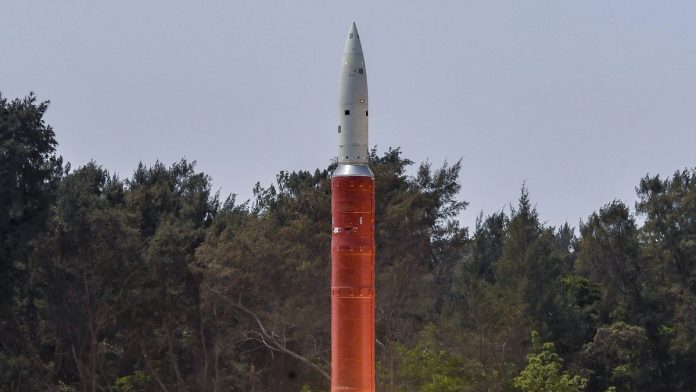
Ballistic Missile Defence (BMD) Interceptor missile being launched by DRDO in A-SAT missile test in Odisha | PTI

New Delhi: In a boost to India’s deterrence capabilities, the phase one of the ambitious Ballistic Missile Defence (BMD) programme has been completed and a formal nod for the deployment of active missiles is expected soon, top sources told ThePrint.

Phase one of the programme will cover Delhi and Mumbai, and guard them against incoming ballistic missiles.

“The phase one of the Ballistic Missile Defence programme has been completed. We have deployed two indigenous long-range radars as part of the programme. As and when we get an all-clear from the government, the specific missiles will be deployed,” a top source in the defence establishment told ThePrint.

Sources also said adequate arrangements have been made to ensure that missiles were produced in the required manner.

Asked by when the permission for the deployment of missiles is expected, another top source said, “soon” without getting into any time line.

‘Radars have higher range and capability’
Sources said the two radars that have been deployed are completely indigenous.

It was in the mid-2000s that India got Swordfish from Israel. The Swordfish is an active electronically scanned array (AESA) long-range tracking radar, specifically built to counter ballistic missile threat.

This radar is a derivative of the Israeli Green Pine long-range radar, which is the critical component of its arrow missile defence system. However, Swordfish uses a number of indigenous systems.

“After Swordfish, we have managed to make two indigenous radars with higher range and capability,” a defence source said.

BMD programme
India’s Ballistic Missile Defence programme was launched in 1999 in the wake of Pakistan’s maiden nuclear test in 1998 and China’s leaps in this sphere.

BMD works on two levels — endo-atmospheric (within Earth’s atmosphere) and exo-atmospheric (the space stretching beyond the Earth’s atmosphere).

While phase one deals with destroying incoming missiles at endo-atmospheric level, phase two deals with the same in exo-atmospheric level.

India’s BMD arsenal consists of a Prithvi Air Defence (PAD) missile to take out incoming missiles at a range of about 80 km in altitude and an Advanced Air Defence (AAD) missile for altitudes of 15-25 km.

In 2017, India had tested a new exo-atmospheric interceptor missile named the Prithvi Defence Vehicle (PDV), which reportedly intercepted a missile at an altitude of 100 km during trials.

The first missile test for a BMD system was conducted in November 2006, when a Prithvi-II missile was successfully intercepted by the PAD in the endo-atmospheric level at an altitude of about 48 km.

India completes phase one of ballistic missile defence programme, nod for missiles awaited
 
  • Like
Reactions: RATHORE
How many times will it be ready ?


India completes phase one of ballistic missile defence programme, nod for missiles awaited

Phase one of the programme will see Delhi and Mumbai being guarded against incoming ballistic missiles.

SNEHESH ALEX PHILIP Updated: 22 April, 2019 5:04 pm IST


DRDO-A-SAT-missile-696x392.jpg

Ballistic Missile Defence (BMD) Interceptor missile being launched by DRDO in A-SAT missile test in Odisha | PTI

New Delhi: In a boost to India’s deterrence capabilities, the phase one of the ambitious Ballistic Missile Defence (BMD) programme has been completed and a formal nod for the deployment of active missiles is expected soon, top sources told ThePrint.

Phase one of the programme will cover Delhi and Mumbai, and guard them against incoming ballistic missiles.

“The phase one of the Ballistic Missile Defence programme has been completed. We have deployed two indigenous long-range radars as part of the programme. As and when we get an all-clear from the government, the specific missiles will be deployed,” a top source in the defence establishment told ThePrint.

Sources also said adequate arrangements have been made to ensure that missiles were produced in the required manner.

Asked by when the permission for the deployment of missiles is expected, another top source said, “soon” without getting into any time line.

‘Radars have higher range and capability’
Sources said the two radars that have been deployed are completely indigenous.

It was in the mid-2000s that India got Swordfish from Israel. The Swordfish is an active electronically scanned array (AESA) long-range tracking radar, specifically built to counter ballistic missile threat.

This radar is a derivative of the Israeli Green Pine long-range radar, which is the critical component of its arrow missile defence system. However, Swordfish uses a number of indigenous systems.

“After Swordfish, we have managed to make two indigenous radars with higher range and capability,” a defence source said.

BMD programme
India’s Ballistic Missile Defence programme was launched in 1999 in the wake of Pakistan’s maiden nuclear test in 1998 and China’s leaps in this sphere.

BMD works on two levels — endo-atmospheric (within Earth’s atmosphere) and exo-atmospheric (the space stretching beyond the Earth’s atmosphere).

While phase one deals with destroying incoming missiles at endo-atmospheric level, phase two deals with the same in exo-atmospheric level.

India’s BMD arsenal consists of a Prithvi Air Defence (PAD) missile to take out incoming missiles at a range of about 80 km in altitude and an Advanced Air Defence (AAD) missile for altitudes of 15-25 km.

In 2017, India had tested a new exo-atmospheric interceptor missile named the Prithvi Defence Vehicle (PDV), which reportedly intercepted a missile at an altitude of 100 km during trials.

The first missile test for a BMD system was conducted in November 2006, when a Prithvi-II missile was successfully intercepted by the PAD in the endo-atmospheric level at an altitude of about 48 km.

India completes phase one of ballistic missile defence programme, nod for missiles awaited
 
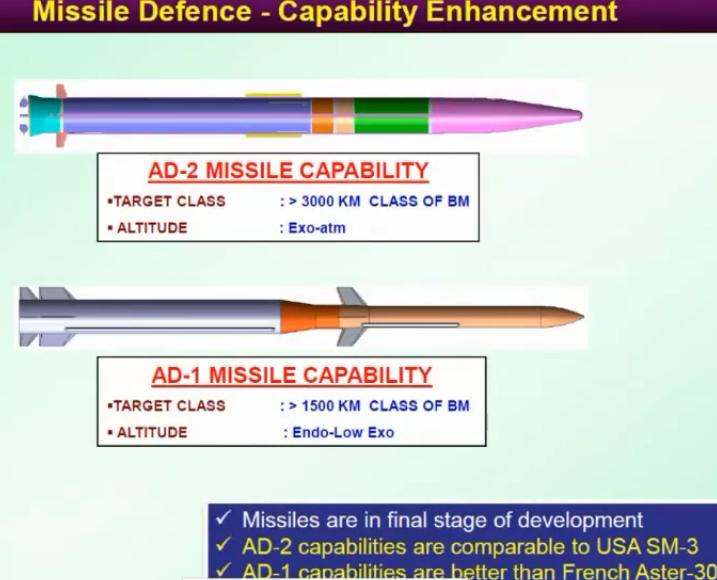
View attachment 17849

View attachment 17850

Basically, we are building/build PAC-3,THAAD,SM-3 and Aster-30. 🤷‍♂️

Meanwhile, we ordered $6 billion S400 from mother Russia!.

The AAD and PDV are being given the BMD mission specifically, whereas the S-400 also has an anti-air component, which is primary. Not to mention the S-400 is mature and proven, is standalone and can protect itself, whereas our BMD will need other SAMs to protect it, including perhaps the S-400.

Also, the S-400 is a tactical system meant to be used in a warzone, whereas the BMD system protects targets deep inside the country and does not face the same type and intensity of threats.

Btw, BMD Phase I is not comparable to Aster-30 though, only the AD-1 will be.
 
The AAD and PDV are being given the BMD mission specifically, whereas the S-400 also has an anti-air component, which is primary. Not to mention the S-400 is mature and proven, is standalone and can protect itself, whereas our BMD will need other SAMs to protect it, including perhaps the S-400.

Also, the S-400 is a tactical system meant to be used in a warzone, whereas the BMD system protects targets deep inside the country and does not face the same type and intensity of threats.

Btw, BMD Phase I is not comparable to Aster-30 though, only the AD-1 will be.
Not at all the point i was making.