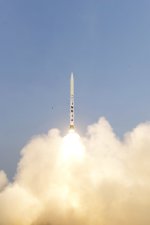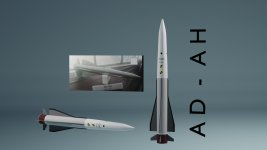
The vehicle buddy.No, this is a test launcher, even AAD used to be tested from this launcher earlier
+I am not sure AD-1 has been redesigned, the flared bit is simply obscured.
The vehicle buddy.No, this is a test launcher, even AAD used to be tested from this launcher earlier
I am also talking about the vehicle buddy.The vehicle buddy.
+I am not sure AD-1 has been redesigned, the flared bit is simply obscured.
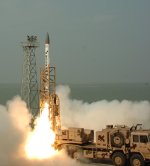
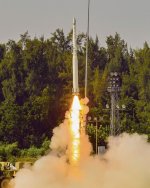
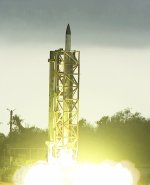
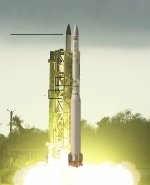
Yes, the diameter difference isn't that high, the corner plank and the wide metal plank in the centre can easily cover it.Tell me this much diameter difference can be just obscured
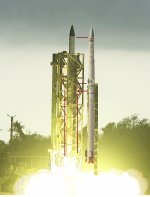
I am talking about the test launcher of AD-1 (alleged) and AAD being the same, no one's talking about NASM MR here. (Why would I talk about that on BMD thread)The truck from which the NASM-MR was launched was from is a very recent thing, this is the launcher that would be replacing the old trailer thing they used for ITCM/Nirbhay
Yes, the diameter difference isn't that high, the corner plank and the wide metal plank in the centre can easily cover it.
This is how AD-1 becomes "AAD"
View attachment 52224
Seeing is believing. I have produced a 1-to-1 scale (barring some camera distortion) superimposition of an old AD-1 photo, copied the launcher planks from the new photo on the scaled photo that perfectly supports my claim this it is only AD-1.If you believe that corner plank and metal bars can cover that much you can continue with your delusions

If this is what you call a 1-to-1 superimposition and you are presenting it as proof then good for you, but I will not entertain such fantasies and as such I will not engage with you any furtherSeeing is believing. I have produced a 1-to-1 scale (barring some camera distortion) superimposition of an old AD-1 photo, copied the launcher planks from the new photo on the scaled photo that perfectly supports my claim this it is only AD-1.
You haven't anything to show other than personal attacks.
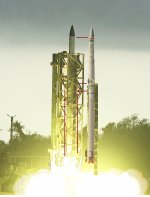
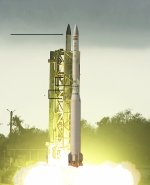
If AD-1 is actually modified then I think this is more likelyThe other possibility is that some major stride was made in solid-fuel chemical composition, resulting in lesser quantity of fuel needed to achieve same kinematics as before, hence a thinner & lighter booster is enough.

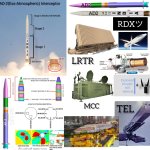
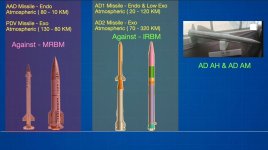
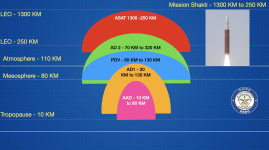
The BMD has been developed in two phases. A third phase has also been initiated. While phase one deals with destroying incoming missiles at the endo-atmospheric level, phase two works in the exo-atmospheric level.
ThePrint had reported in 2019 that the first phase of BMD had been completed.
Phase 1 consisted of Prithvi Defence Vehicle (PDV) and Advanced Air Defence (AAD) interceptor systems. The second phase of the BMD consists of two interceptors known as the AD-1 and AD-2.
The Phase III, which has been initiated by the DRDO, will see the development of two new interceptor missiles, which are internally called AD-AH and AD-AM.
They will take down hypersonic weapons, glide vehicles that can change trajectory mid-flight, making them highly unpredictable targets, and also the Multiple Independently Targetable Re-entry Vehicle (MIRV) technology that allows a single ballistic missile to carry several nuclear warheads, each capable of being released to strike completely different targets spread over a wide geographical area.
I rendered that "Exposed Kinetic Kill Vehicle" photo in 2019 after the Shakti test. It's incorrect. The missile only jettisons its nose cone to expose the sensor. It was modelled after the SM-3 KKV which later turned out wasn't the case and the entire second stage itself was the KKV.
These pics are sufficient to prove what is up. You can keep your ignorance to yourself.If this is what you call a 1-to-1 superimposition and you are presenting it as proof then good for you, but I will not entertain such fantasies and as such I will not engage with you any further
View attachment 52228
Infact the 2nd image is proving my point,
View attachment 52231
If AD-1 is actually modified then I think this is more likely

AAD range once again mentioned in a September 2018 DRDO NewsletterAAD missile capable of intercepting incoming targets at an altitude of 15 to 25 km says an old 2018 PIB Press Release
View attachment 51675