Indian semiconductor ecosystem: News, Updates & Discussions.

What if the next pillar of the global semiconductor industry isn't built in one country — but three?

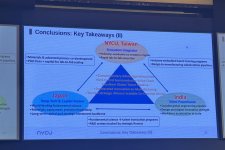
That was the animating question at the MUFG × NYCU Semiconductor Seminar in Hsinchu, where industry executives, policy financiers, and academic leaders converged on February 24, 2026, to sketch out a division of labor that could reshape chip geopolitics: Japan as the capital anchor, Taiwan as the ecosystem integrator, and India as the talent powerhouse.

The seminar, held in the heart of Taiwan's "Silicon Valley" with the support of the India-Taipei Association, also marked the signing of a memorandum of understanding (MOU) between MUFG Bank and National Yang Ming Chiao Tung University (NYCU) to formalize their industrial cooperation — setting the tone for what followed.

The "ideal model" for trilateral cooperation​

The panel focused on a proposed division of labor designed to stabilize and grow the global chip ecosystem. YC Tseng, a professor at NYCU overseeing international semiconductor talent development, outlined what he called the "ideal model" for the three-way partnership: Japan as the "capital anchor," Taiwan as the "ecosystem integrator," and India as the "talent powerhouse."

Tseng suggested that India could replicate Taiwan's successful model of using public research institutions, such as the Industrial Technology Research Institute (ITRI), to "derisk" early technology development. He also emphasized that Japan could leverage its mature financing capabilities to provide long-term capital for advanced packaging and training infrastructure.

Gujarat rolls out the welcome mat​

Rohit Naik, representing the Gujarat State Electronic Mission (GSEM), detailed the aggressive measures the state of Gujarat is taking to attract semiconductor manufacturers. Naik noted that the government is planning for the next 20 to 30 years, aiming to build a hub comparable in scale to the Hsinchu Science Park.

To support this, the state provides real-time monitoring of electricity and water supplies to ensure uninterrupted service. Naik also highlighted significant financial incentives, noting that the government offers interest subsidies that can reduce a firm's effective interest rate from 7% to as low as 2%.

Japan's policy capital, ready to deploy​

Genki Kato, a director at the Japan Bank for International Cooperation (JBIC)—a policy-based institution 100% owned by the Japanese government—revealed that 60% of Japanese companies now view India as the most promising investment destination.

Kato added that JBIC is prepared to provide "gigantic" financing to support the ecosystem surrounding major Indian initiatives, such as the Tata semiconductor project. He pointed out that Japanese material and equipment suppliers hold substantial global market shares—50% and 30%, respectively—and are crucial to the Indian project's success.

Finding the missing piece​

The panel concluded with a call for synergy between Japanese and Taiwanese firms. Yuki "Brian" Saito of MUFG Bank suggested that Japanese companies currently operating in Taiwan are in a unique position to find partners who can fill "missing parts" in their strategy—whether in human resources, financing, or industrial technology—before entering the Indian market.

"The concept today is partnership," Saito said, noting that the Indian government is "very welcoming" of this trilateral approach.

The panel was one of several discussions held during the seminar, which highlighted the growing alignment of the three nations in securing the future of the global semiconductor supply chain.
4.jpg
 

A trade delegation from India visited the Dutch semiconductor hub of Eindhoven on ‌Wednesday to discuss investment opportunities as New Delhi accelerates its efforts to build a domestic chip industry.

Meanwhile, Dutch semiconductor firms are seeking new markets and geographical diversification amid ⁠export controls and trade restrictions linked to U.S.-China technology rivalry.

“It’s clear there are opportunities for Dutch firms, in the first place for equipment exports,” and later as a base for manufacturing, given India’s large engineering workforce, said Michiel Smit of the Netherlands Enterprise Agency (RVO).

Manish Hooda, technology director at the India Semiconductor Mission said Dutch firms pursuing a “China-plus-one” manufacturing strategy should consider India as their production base outside China.

“We are quite open if they are interested in setting up operations in India,” Hooda said.

ASML disclosed last week it plans to open a support office in India. A spokesperson declined to give further details.

India’s subsidy program launched in 2021 covered up to 50% of project costs, with state ⁠governments offering an additional 20% to 25%, Hooda said. A second program slated for approval March 30 could be even larger, he added.

Smit said about 50 to 60 Dutch firms had requested meetings ⁠with the Indian delegation.

Indian engineers already form a significant part of the Dutch tech workforce. According to statistics agency CBS, the number of Indians in the Netherlands tripled to ⁠89,000 in 2024 from 2014, with more than 10,000 living in the Eindhoven region.

The two countries hope to announce a strategic partnership during a planned visit by Indian Prime Minister Narendra Modi later this year.
 
HDrsPSEasAA_qyr
 
Rohm eyes India as emerging hub for power semiconductor packaging and automotive supply

By Prasanth Aby Thomas
DIGITIMES Asia, Bangalore
Mar 18, 2026, 15:55
1773941138423.png
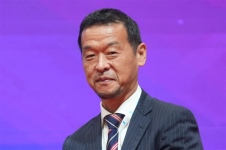
Makoto Terada, MD, ROHM Semiconductor India. Credit: ROHM.

Japanese semiconductor maker Rohm is expanding its engagement with India's nascent semiconductor manufacturing ecosystem, positioning the country as a potential future export base while initially targeting domestic automotive and industrial demand.

The company recently announced a strategic partnership with Indian OSAT firm Suchi Semicon aimed at developing backend semiconductor manufacturing capabilities in India. The initiative reflects a broader trend in which semiconductor firms are exploring localized manufacturing frameworks as supply chains evolve.

Makoto Terada, managing director at Rohm Semiconductor India, said the move was driven partly by shifting global dynamics around localized semiconductor production.

"Across many countries and regions, the concept of local production for local consumption has gained importance, and semiconductors in particular are increasingly regarded as strategic materials," Terada said. "In this context, building a stable supply and manufacturing framework for the Indian market became one of Rohm's key challenges."

The partnership follows Rohm's evaluation of India's emerging semiconductor manufacturing ecosystem. According to Terada, the company began assessing potential outsourcing partners around 2024 as part of its manufacturing strategy.

"Through this process, Rohm determined that Suchi Semicon and Tata Electronics each offered strong compatibility and complementary strengths, and entered into partnerships with them respectively," he said.

Although initial discussions centered on backend manufacturing collaboration, particularly assembly and testing processes, the partnership expanded to include joint marketing and business development efforts targeting the Indian market.

"As a result, Rohm and Suchi Semicon aligned on a shared vision, leading to an agreement to establish a strategic partnership," Terada said.

Automotive ramp expected in 2026

Within Rohm's global manufacturing network, India is expected to initially play a role in supporting domestic supply for local customers, particularly in automotive applications.

The company already established a design and development center in Pune in 2020, where products are developed based on the requirements of Indian customers.

"Looking ahead, Rohm's initial priority is to establish a stable product supply framework within India," Terada said.

The company is targeting automotive products this year.

"As a first step, Rohm aims to begin mass production shipments of automotive products in 2026," Terada said. "Over the longer term, Rohm also envisions the possibility of supplying products manufactured in India to global markets, depending on market demand and readiness," he added.

India push driven by domestic demand

Unlike some semiconductor supply chain diversification initiatives aimed at redistributing manufacturing risk across regions, Rohm's India strategy is primarily driven by local market demand.

"The primary objective of this partnership is not to rebalance Rohm's internal supply-chain risk across regions," Terada said. "Rather, it is to respond to the growing demand from Indian customers for locally manufactured products and to contribute to the development of India's semiconductor ecosystem."

Requests for locally produced components are currently coming largely from Indian customers, aligning with the country's "Make in India" policy, though Rohm is also building capabilities with potential global demand in mind.

"At present, many requests are coming from Indian customers who are seeking locally manufactured products in line with the 'Make in India' initiative," Terada said. "At the same time, Rohm is mindful of the potential for future demand from global customers and is building capabilities with a long-term perspective.

Talent pool seen as key structural advantage

Beyond policy incentives, Rohm sees India's engineering talent base as one of the country's strongest advantages for semiconductor manufacturing.

"Government incentives are certainly effective during the initial investment phase, but they were not the sole reason Rohm evaluated India positively," Terada said.

"One of India's greatest strengths is its large pool of highly trained engineers," he added, noting that semiconductor packaging, testing, and application engineering require specialized technical skills.

India's expanding domestic electronics demand and improving logistics connectivity also contribute to its long-term competitiveness.

"India offers advantages in terms of logistics connectivity, market access, and expanding domestic demand," Terada said. "As the local supply chain and related industries mature, Rohm expects these factors to further enhance India's longterm cost competitiveness."

Meeting global automotive quality standards

A key challenge in building semiconductor manufacturing capacity in India will be maintaining the stringent reliability and quality standards required for automotive and industrial applications.

"For companies like Rohm that supply power semiconductors for automotive and industrial applications, compliance with international standards such as AECQ certification and long-term reliability testing is essential," Terada said.

To ensure global consistency, Rohm is working closely with local partners, including Suchi Semicon and Tata Electronics, to align manufacturing processes with international quality benchmarks.

Broader ecosystem role emerging

Looking beyond manufacturing, Rohm sees opportunities to deepen its presence in India across engineering support, power electronics design collaboration, and ecosystem development.

"As the semiconductor ecosystem here continues to evolve, there are opportunities for deeper engagement across several areas," Terada said.

"Strengthening local application engineering teams could help us support Indian customers working in electric mobility, renewable energy systems, and industrial electronics."

The company has been investing heavily in next-generation power semiconductor technologies globally, particularly silicon carbide devices.

"Rohm has been making significant global investments in next-generation power semiconductor technologies, particularly silicon carbide devices, and we believe these technologies will play an important role in future energy and mobility systems," Terada said.

As India expands its electric vehicle and electronics manufacturing ecosystems, closer collaboration in power electronics design and local supplier development could help strengthen the country's semiconductor value chain.

"Over time, such engagement can help build a stronger semiconductor value chain in India while supporting Rohm's long-term growth in power electronics markets," Terada said.

Article edited by Jack Wu

Rohm eyes India as emerging hub for power semiconductor packaging and automotive supply
 
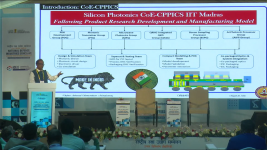
Some updates on Silicon Photonics chips, PCBs, ecosystem being developed in India:


Summary of the talk:
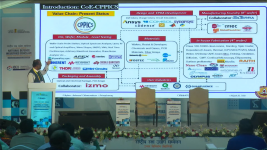
1. Photonics ecosystem is being developed & built in India completely from scratch under IIT-Madras' CoE-CPPICS umbrella. In the 1st phase of this program, they are focusing on chip/pcb design, testing, validation & certification. In the 2nd phase they will get a foundry.

2. The project is divided in teams described below:
Screenshot (1339).png

3. One particular area of interest is "Multi-protocol QKD chip". This would allow high throughput data transfer with QKD encryption.

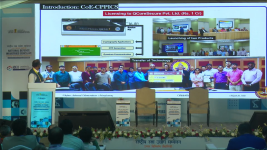
4. They had also developed a Quantum Random Number Generator (QRNG). The 1st generation of this product was delivered to DRDO. This technology has been transferred to a pvt. company for further development:
Screenshot (1340).png
The company has developed a 3rd gen version of this tech & will showcase the same at RSA conference in San Francisco.

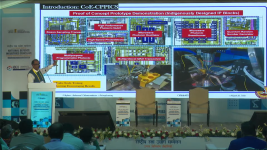
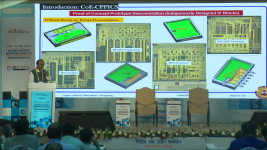
5. These are the various quantum chips & PCBs they have developed & tested so far. They have a wafer level testing facility. They are also working on various chip packaging technologies:
Screenshot (1341).png
Screenshot (1342).png
These chips & PCBs are for quantum comms, HPC applications, 5G/6G telephony etc.

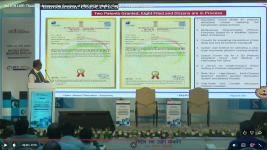
6. They have filed for dozens of patents:
Screenshot (1343).png

7. These are the various technology firms/products they depend on to do their work today. They are trying to reduce dependencies as much as possible & as quickly as possible:
Screenshot (1344).png

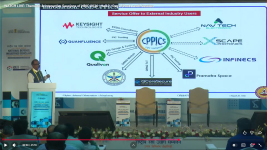
8. These are the various companies/customers they supply to/provide consultancy to:
Screenshot (1345).png

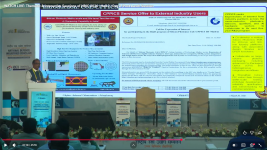
9. They are also opening up their wafer & die level test facilities to external industry users:
Screenshot (1346).png
 
Regarding the new rules that remove Chinese CCTV makers from Indian market:


News is focused on which camera brand replaces Hikvision. The more interesting story is who makes the chip inside the camera.

Until 2019, that answer was overwhelmingly HiSilicon, Huawei's semiconductor arm
that dominated surveillance SoCs globally. US sanctions killed that supply chain overnight and the entire industry moved to Ambarella, Novatek, and Sigmastar. India's CCTV ban accelerates the same logic one layer deeper. Not just who assembles the camera, but who designs the silicon.

And that story is already further along than most people realize. L&T Semiconductor Technologies has signed a deal with CP Plus to supply indigenously designed Vision SoCs for 9 million IP cameras over three years. These aren't concept chips. They support 8MP imaging and this is the first time surveillance cameras will be made using chips from an Indian company. CP Plus is the largest domestic brand by market share, so this isn't a token pilot.

Beyond L&T Semi, there are at least four more startups building surveillance SoCs under the government's Design Linked Incentive scheme. Mindgrove Technologies has the V2600, a surveillance-grade edge AI chip targeting late 2026 commercial launch. BigEndian Semiconductors raised $3M from Vertex Ventures and partnered with Cadence on Project VASU, a secure-boot SoC with encryption baked into the silicon. 3rdiTech and Netrasemi round out the group. Collectively these four have raised over ₹300 crore and taped out test chips in 2025.

Two years ago none of this existed. Now you have five separate Indian chip efforts targeting the same market, with the largest one already locked into a volume manufacturing agreement. India did the same thing in telecom: kicked out Huawei, filled the gap with allied vendors, then started building its own stack with Tejas Networks.

Surveillance silicon is following the same script, and hopefully moving faster.
 

FermionIC Founder in the attached clip confirmed that their chips have passed the tests for the next gen Radar being made for Su30MKI (Likely Virupaksa)
Listen from 40 sec....
So, Virupaksa will now likely have an Indian made Chip from FermionIC. If this is true It can't get better the Radar is already ~2400TRM GaN on Sic with Swashplate & now Indian chips
True #AtmanirbharBharat being aimed here

View attachment viripaksha chip.mp4