

So my question is with which configuration IAF is going here, KC-767 MMTT or KC-X2 specification? Are those old B-767 are 200/300/400?IAF moves for mid-air refuellers, Israel firm in partnership with HAL emerges as the frontrunner
India currently uses six Russian IIyushin-78 tankers for refuelling, first inducted in 2003, but they are facing maintenance and serviceability issues
New Delhi: The Indian Air Force (IAF) has issued a tender for six mid-air refuelling aircraft—all of which will be converted passenger jets—with Israel Aerospace Industries (IAI) and its Indian partner Hindustan Aeronautics Limited (HAL) emerging as early frontrunners, ThePrint has learnt.
Sources in the defence and security establishment said that the Request for Proposal (RFP) was sent out to multiple companies last month, including the original equipment manufacturers (OEMs) who have their own dedicated tanker line.
The IAF’s overall requirement is for around 12 refuellers, with procurement likely to be split into two programmes.
The current RFP, issued last month, covers six converted refuellers, under which a commercial passenger aircraft will be modified into a tanker. A separate RFP for brand-new refuellers is expected to follow.
The RFP comes with a 30 percent Make in India clause which industry sources explained will deter OEMs because the numbers are too small to meet such obligations.
India currently uses six Russian IIyushin-78 tankers, first inducted in 2003, but they are facing maintenance and serviceability issues.
India had last month got its first leased Boeing KC-135 Stratotanker mid-air refueller. This is a fully wet lease, as reported by ThePrint, the aircraft will be flown, manned and maintained by pilots and crew belonging to the lessor, American firm Metrea Management.
It was in April 2022 that HAL and IAI entered into an MoU to convert civil (passenger) aircraft into multi-mission tanker transport (MMTT) aircraft in India.
Under the pact, HAL will convert civil aircraft into mid-air refuelling aircraft with cargo and transport capabilities.
The aircraft that will be converted is the Boeing 767 passenger aircraft, which is also used by the Italian and Japanese militaries.
Boeing has a specialised tanker called KC-46 Pegasus, which is a variant of the Boeing 767. The conversion of passenger aircraft into cargo and tankers has been a lucrative business for IAI, which has emerged as a key player in this business.
Mid-air refuelling has been a critical capability gap for the IAF. This technology gives a fighter jet the ability to cover enhanced distances without having to land to refuel.
You are using an out of date browser. It may not display this or other websites correctly.
You should upgrade or use an alternative browser.
You should upgrade or use an alternative browser.

This is something new. There were no reports of any separate RFI/AoN let alone RFP for 06 brand new refuellers beside 06 converted ones.IAF moves for mid-air refuellers, Israel firm in partnership with HAL emerges as the frontrunner
India currently uses six Russian IIyushin-78 tankers for refuelling, first inducted in 2003, but they are facing maintenance and serviceability issues
New Delhi: The Indian Air Force (IAF) has issued a tender for six mid-air refuelling aircraft—all of which will be converted passenger jets—with Israel Aerospace Industries (IAI) and its Indian partner Hindustan Aeronautics Limited (HAL) emerging as early frontrunners, ThePrint has learnt.
Sources in the defence and security establishment said that the Request for Proposal (RFP) was sent out to multiple companies last month, including the original equipment manufacturers (OEMs) who have their own dedicated tanker line.
The IAF’s overall requirement is for around 12 refuellers, with procurement likely to be split into two programmes.
The current RFP, issued last month, covers six converted refuellers, under which a commercial passenger aircraft will be modified into a tanker. A separate RFP for brand-new refuellers is expected to follow.
The RFP comes with a 30 percent Make in India clause which industry sources explained will deter OEMs because the numbers are too small to meet such obligations.
India currently uses six Russian IIyushin-78 tankers, first inducted in 2003, but they are facing maintenance and serviceability issues.
India had last month got its first leased Boeing KC-135 Stratotanker mid-air refueller. This is a fully wet lease, as reported by ThePrint, the aircraft will be flown, manned and maintained by pilots and crew belonging to the lessor, American firm Metrea Management.
It was in April 2022 that HAL and IAI entered into an MoU to convert civil (passenger) aircraft into multi-mission tanker transport (MMTT) aircraft in India.
Under the pact, HAL will convert civil aircraft into mid-air refuelling aircraft with cargo and transport capabilities.
The aircraft that will be converted is the Boeing 767 passenger aircraft, which is also used by the Italian and Japanese militaries.
Boeing has a specialised tanker called KC-46 Pegasus, which is a variant of the Boeing 767. The conversion of passenger aircraft into cargo and tankers has been a lucrative business for IAI, which has emerged as a key player in this business.
Mid-air refuelling has been a critical capability gap for the IAF. This technology gives a fighter jet the ability to cover enhanced distances without having to land to refuel.
IAI has done conversions on 200 and 300 versions. It will likely be KC-767 MMTT. No aircraft's have been acquired yet so hard to say.So my question is with which configuration IAF is going here, KC-767 MMTT or KC-X2 specification? Are those old B-767 are 200/300/400?

If we can get some old 300s it would be pretty good.IAI has done conversions on 200 and 300 versions. It will likely be KC-767 MMTT. No aircraft's have been acquired yet so hard to say.

A cost negotiations committee (CNC) is being constituted to fix the price of the six refuellers from Israel Aerospace Industries (IAI), with the project estimated at ₹10,000 crore, the people cited above added. The DAC has accorded acceptance of necessity (AoN), and negotiations on the total project cost have begun with IAI, the sole contender. The proposal will move to the Cabinet Committee on Security for approval once the CNC completes its task.
India has operated six IL-76M Russian refuellers since 2003, but the fleet faces maintenance and turnaround issues.

Jets, mid-air refuellers, missiles: Indian Air Force to augment arsenal with vital acquisitions
The ministry will also expedite the acquisition of 114 multi-role fighter aircraft (MRFA) from France under the “Make in India” rubric, the people added. | India News
 www.hindustantimes.com

20 Years, Zero New Tankers, MoD Clears 5th Attempt - Livefist
The Indian Air Force’s (IAF) two-decade quest for mid-air refueling tankers may finally be moving past the stage of perennial disappointment. For years, the lack of progress on this front became a symbol of the bureaucratic inertia and inter-ministerial inability to decide, often associated with...
 www.livefistdefence.com
The Indian Air Force’s (IAF) two-decade quest for mid-air refueling tankers may finally be moving past the stage of perennial disappointment. For years, the lack of progress on this front became a symbol of the bureaucratic inertia and inter-ministerial inability to decide, often associated with major military acquisitions. However, the wait may be nearing an end as the Ministry of Defence (MoD) has begun 2026 by providing a pre-final push for a capability that has been on the IAF’s wishlist since the mid-2000s.
The MoD’s apex Defence Acquisition Council (DAC) has cleared a deal valued at approximately $900 million for six pre-owned Boeing 767 aircraft. These will be refurbished and converted into tankers by Israel Aerospace Industries (IAI) in partnership with Hindustan Aeronautics Limited (HAL). That’s if the deal closes. And in this procurement, the ‘if’ has two decades of uncertainty behind it.
A Quarter-Century of ‘Any Day Now’
“If we go into a war with China or Pakistan, you know what happens to these [leased] tankers? They fly home,” Vishnu Som warned. “This is just for training. When the balloon goes up, they disappear.”The IAI-HAL Solution: Pragmatism Over Perfection
Under this deal, six used Boeing 767s will be sourced from the commercial market. IAI, a global leader in aircraft conversions, will work with HAL to transform these civilian haulers into multi-mission tankers. IAI has committed to 30% local manufacturing, focusing on the refueling modules.“Six used Boeing 767s will be acquired… in a $900 million deal,” Som explained. “The air-to-air refueling system is not an extensive system… it’s a kind of a module.”
While some may scoff at the idea of “second-hand” aircraft for a frontline role, the hosts argue the logic is sound. The IAF needs a “flying gas tank” that works, not necessarily a platform with a zero-hour odometer. With the IL-78 fleet suffering from abysmal serviceability (publicly cited at less than 50%) the 767s offer a reliable, Western-standard alternative.
Conclusion: Capability First
The MoD’s decision to move forward with a “sole bidder” (IAI-HAL) is also a sign of maturing procurement rules. Following the legacy of former Defence Minister Manohar Parrikar, the government no longer views a single-bidder scenario as an automatic red flag for corruption.“There is now perhaps a realization… that a sole bidder doesn’t mean it’s corrupt,” Som noted. “It has to be capability first. It’s just common sense.”
As the IAF prepares to sign the deal by March 2026, the message is clear. The quest for tankers was never about a “fantasy birthday list.” It was about ensuring that when the next crisis hits, India’s air power isn’t left running on empty.
The 767s may be second-hand, but for an Air Force that has waited literally since 2006, they are a first-rate necessity. And won’t be arriving a moment too soon.
20 Years, Zero New Tankers, MoD Clears 5th Attempt - Livefist
The Indian Air Force’s (IAF) two-decade quest for mid-air refueling tankers may finally be moving past the stage of perennial disappointment. For years, the lack of progress on this front became a symbol of the bureaucratic inertia and inter-ministerial inability to decide, often associated with...
The Indian Air Force’s (IAF) two-decade quest for mid-air refueling tankers may finally be moving past the stage of perennial disappointment. For years, the lack of progress on this front became a symbol of the bureaucratic inertia and inter-ministerial inability to decide, often associated with major military acquisitions. However, the wait may be nearing an end as the Ministry of Defence (MoD) has begun 2026 by providing a pre-final push for a capability that has been on the IAF’s wishlist since the mid-2000s.
The MoD’s apex Defence Acquisition Council (DAC) has cleared a deal valued at approximately $900 million for six pre-owned Boeing 767 aircraft. These will be refurbished and converted into tankers by Israel Aerospace Industries (IAI) in partnership with Hindustan Aeronautics Limited (HAL). That’s if the deal closes. And in this procurement, the ‘if’ has two decades of uncertainty behind it.
A Quarter-Century of ‘Any Day Now’
“If we go into a war with China or Pakistan, you know what happens to these [leased] tankers? They fly home,” Vishnu Som warned. “This is just for training. When the balloon goes up, they disappear.”
The IAI-HAL Solution: Pragmatism Over Perfection
Under this deal, six used Boeing 767s will be sourced from the commercial market. IAI, a global leader in aircraft conversions, will work with HAL to transform these civilian haulers into multi-mission tankers. IAI has committed to 30% local manufacturing, focusing on the refueling modules.
“Six used Boeing 767s will be acquired… in a $900 million deal,” Som explained. “The air-to-air refueling system is not an extensive system… it’s a kind of a module.”
While some may scoff at the idea of “second-hand” aircraft for a frontline role, the hosts argue the logic is sound. The IAF needs a “flying gas tank” that works, not necessarily a platform with a zero-hour odometer. With the IL-78 fleet suffering from abysmal serviceability (publicly cited at less than 50%) the 767s offer a reliable, Western-standard alternative.
Conclusion: Capability First
The MoD’s decision to move forward with a “sole bidder” (IAI-HAL) is also a sign of maturing procurement rules. Following the legacy of former Defence Minister Manohar Parrikar, the government no longer views a single-bidder scenario as an automatic red flag for corruption.
“There is now perhaps a realization… that a sole bidder doesn’t mean it’s corrupt,” Som noted. “It has to be capability first. It’s just common sense.”
As the IAF prepares to sign the deal by March 2026, the message is clear. The quest for tankers was never about a “fantasy birthday list.” It was about ensuring that when the next crisis hits, India’s air power isn’t left running on empty.
The 767s may be second-hand, but for an Air Force that has waited literally since 2006, they are a first-rate necessity. And won’t be arriving a moment too soon.
Far better bang for the buck than leasing 1 KC-135 and 1 A330 MRTT, flown by foreign pilots . I'd say order 6 more and be done with it.
Future requirements can be met by the KC-390 or whatever MTA we end up acquiring.

Automatic Air-to-Air Refuelling (A3R) capability
https://x.com/IXGguy/status/2048726609453355236
https://www.youtube.com/watch?v=6nd15A50wGk
With dwindling feedstocks of 767s available for conversion, IAI-Bedek is moving on to the A330 as its next mainstay for freighter conversions. When advertising its 767 MMTT conversion solutions, IAI always touted its prowess in 767 conversions as an added advantage in making extensive structural changes and modifications and being one of the very few MRO organisations with the capability to do so, something which enticed @SpokespersonMoD and @IAF_MCC into selecting it for a partnership to convert used 767's into Tankers.
But with the main organisation itself now moving away from 767's, how wise was this choice to begin with? Globally, the number of available 767's lying in storage keeps dwindling as they get parted out for scrap or spares to support existing 767 fleets, making the type much harder to sustain year after year. Even previously vocal operators of the type are now moving towards retiring their airframes as they realise how hard it is to source spares and maintenance support. And while one can argue that the USAF will continue to support the type through its KC-46 fleet, it ignores the main issue in that when the Americans went shopping for spares the last time around to support a legacy fleet, nearly every other operator found itself shut out because they began to hoard valuable spares for their own use.
Thus, it begs the question. Do we want a similar nasty surprise, or should it be a better idea to go back to IAI-Bedek and switch to the A330 instead to meet our tanker and ancillary airlift requirements? A food for thought.
767 MMTT for the IAF? A Dream or a Costly Folly?
https://www.youtube.com/watch?v=6nd15A50wGkWith dwindling feedstocks of 767s available for conversion, IAI-Bedek is moving on to the A330 as its next mainstay for freighter conversions. When advertising its 767 MMTT conversion solutions, IAI always touted its prowess in 767 conversions as an added advantage in making extensive structural changes and modifications and being one of the very few MRO organisations with the capability to do so, something which enticed @SpokespersonMoD and @IAF_MCC into selecting it for a partnership to convert used 767's into Tankers.
But with the main organisation itself now moving away from 767's, how wise was this choice to begin with? Globally, the number of available 767's lying in storage keeps dwindling as they get parted out for scrap or spares to support existing 767 fleets, making the type much harder to sustain year after year. Even previously vocal operators of the type are now moving towards retiring their airframes as they realise how hard it is to source spares and maintenance support. And while one can argue that the USAF will continue to support the type through its KC-46 fleet, it ignores the main issue in that when the Americans went shopping for spares the last time around to support a legacy fleet, nearly every other operator found itself shut out because they began to hoard valuable spares for their own use.
Thus, it begs the question. Do we want a similar nasty surprise, or should it be a better idea to go back to IAI-Bedek and switch to the A330 instead to meet our tanker and ancillary airlift requirements? A food for thought.


India signs $1.1b IAI tanker aircraft deal - report
 en.globes.co.il


Air-to-air refuelling pods: IAF plans indigenous upgrade for six IL-78 tankers - The Tribune
With the process of procuring new air-to-air refueling aircraft facing headwinds, the Indian Air Force (IAF) is looking at refurbishing its existing fleet of six ageing refuelers through the indigenous route.
With the process of procuring new air-to-air refueling aircraft facing headwinds, the Indian Air Force (IAF) is looking at refurbishing its existing fleet of six ageing refuelers through the indigenous route.
The Defence Research and Development Organisation (DRDO) has sought partners from the Indian industry to develop air-to-air refuelling pods (ARPs) through which fuel is transferred from the tanker aircraft to the receiving aircraft.
“The existing ARPs are aging and are based on foreign technologies and therefore facing obsolescence, low reliability and high sustenance costs. The replacement or upgradation of existing pods, to meet current operational needs and strategic autonomy, is critical requirement and time bound,” a request for proposal floated by the DRDO earlier this month states.
The IAF has a fleet of six Russian IL-78 MKI mid-air refuelers with the No.78 Squadron, nicknamed Mars, based at Agra. These aircraft, inducted into the IAF in 2003, are equipped with the Israeli ARP-3 refuelling pod. Each aircraft carried three pods, one under each wing and the third on the rear fuselage.
The replacement for the ARP-3, according to the RFP, likely to have additional sub-systems and sensors for operational and safety requirements, and a more advanced power system. Refuelling pods are highly technical, with their own inbuilt power generator, electrical systems, hose control, fire-detection alarms and other sensors.
A process is also underway to convert six pre-owned Boeing 767 twin-engine wide-body commercial aircraft into refuelling aircraft for the IAF, under a partnership between the Israel Aerospace Industries (IAI) and Hindustan Aeronautics Limited (HAL). The IAF has been seeking new tanker aircraft for over a decade.
The new refuelers, compatible with NATO standards, are expected to enter service by 2030. In the meantime, India has wet-leased the US KC-135 tanker, based on the Boeing 707 airframe for training and stop-gap arrangement.

Google translated from Hebrew:
$905 million: IAI on the verge of a mega deal in India
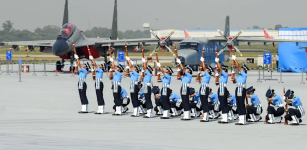
Indian Air Force / Photo: Reuters, Ankit Tyagi
IAI is on the verge of winning a $905.7 million contract in India to convert six passenger planes into refueling planes for the local air force. This is according to reports in the Indian media and on defense websites. The Israeli company, which is considered one of the world's leaders in the field of aircraft conversion, is the only one whose bid was approved as a candidate in a tender in New Delhi, which was also approached by Russian and European companies.
If the Indians do choose the Israeli proposal, IAI will convert six Boeing 767 planes, with a commitment that at least 30% of the work will be done in India. The Indian partner in the agreement, according to previous publications in the country, is expected to be HAL (Hindustan Aeronautics Limited).
IAI has accumulated extensive experience in operating in India, in line with the Make in India vision of Indian Prime Minister Narendra Modi. In March 2024, IAI launched an Indian subsidiary in New Delhi - Aerospace Services India (ASI). The company was established as part of the cooperation between IAI and DRDO, the Indian government's defense research and development body (the equivalent of MAFAT and IBAT). ASI employs 50 employees, 97% of whom are Indian nationals. The company is headquartered in New Delhi, but it has branches across the subcontinent.
ASI conducts transactions in the Indian currency, the rupee, and is the only company engaged in the Medium-Range Air Defense System (MRSAM). It is an advanced system that provides protection against a variety of aerial threats and is used by the Indian Army, Air Force and Navy of the country. The system includes a phased array radar, a command and control system, mobile launchers, and interceptors. The MRSAM system was developed in collaboration between IAI and DRDO for the Indian defense establishment.
First in the export chart
New Delhi sees the agreement as a strategic deal, because the Indian Air Force currently relies on six Ilyushin 78-II refueling planes, which do not meet its needs, both qualitatively and quantitatively. In recent years, the Indians have tried to purchase new refuelers but have encountered delays due to costs and technical difficulties, so they have turned to the possibility of converting aircraft. So far, the Indians have found an interim solution in the form of leasing refueling planes.
In any case, the differences between the Ilyushin 78-II and the Boeing 767 are great. The Russian plane is 47 meters long, the wingspan is 51 meters, and it includes a crew of six. It has a carrying capacity of 100 tons, and it is capable of pumping 2,000 liters per minute. It has a maximum speed of about 850 km/h and a range of about 7,200 km.
The 767, on the other hand, has five versions, with a length of 61 meters and a wingspan of 52 meters. Its crew is much smaller: two pilots, and the refueling operator. It has a carrying capacity of about 67.1 tons, and it is capable of pumping about 4,000 liters per minute. It has a maximum speed of about 920 km/h, and a range of about 12,000 km.
905 מיליון דולר: התעשייה האווירית על סף עסקת ענק בהודו
$905 million: IAI on the verge of a mega deal in India
- New Delhi has approved the Israeli company's bid as the only candidate in the tender, in which Russian and European companies also competed.
- As part of the deal, if it is implemented, six Boeing 767 planes will be converted to refuelers
- The deal may be one of the largest signed between the countries in the field of defense
Indian Air Force / Photo: Reuters, Ankit Tyagi
IAI is on the verge of winning a $905.7 million contract in India to convert six passenger planes into refueling planes for the local air force. This is according to reports in the Indian media and on defense websites. The Israeli company, which is considered one of the world's leaders in the field of aircraft conversion, is the only one whose bid was approved as a candidate in a tender in New Delhi, which was also approached by Russian and European companies.
If the Indians do choose the Israeli proposal, IAI will convert six Boeing 767 planes, with a commitment that at least 30% of the work will be done in India. The Indian partner in the agreement, according to previous publications in the country, is expected to be HAL (Hindustan Aeronautics Limited).
IAI has accumulated extensive experience in operating in India, in line with the Make in India vision of Indian Prime Minister Narendra Modi. In March 2024, IAI launched an Indian subsidiary in New Delhi - Aerospace Services India (ASI). The company was established as part of the cooperation between IAI and DRDO, the Indian government's defense research and development body (the equivalent of MAFAT and IBAT). ASI employs 50 employees, 97% of whom are Indian nationals. The company is headquartered in New Delhi, but it has branches across the subcontinent.
ASI conducts transactions in the Indian currency, the rupee, and is the only company engaged in the Medium-Range Air Defense System (MRSAM). It is an advanced system that provides protection against a variety of aerial threats and is used by the Indian Army, Air Force and Navy of the country. The system includes a phased array radar, a command and control system, mobile launchers, and interceptors. The MRSAM system was developed in collaboration between IAI and DRDO for the Indian defense establishment.
First in the export chart
New Delhi sees the agreement as a strategic deal, because the Indian Air Force currently relies on six Ilyushin 78-II refueling planes, which do not meet its needs, both qualitatively and quantitatively. In recent years, the Indians have tried to purchase new refuelers but have encountered delays due to costs and technical difficulties, so they have turned to the possibility of converting aircraft. So far, the Indians have found an interim solution in the form of leasing refueling planes.
In any case, the differences between the Ilyushin 78-II and the Boeing 767 are great. The Russian plane is 47 meters long, the wingspan is 51 meters, and it includes a crew of six. It has a carrying capacity of 100 tons, and it is capable of pumping 2,000 liters per minute. It has a maximum speed of about 850 km/h and a range of about 7,200 km.
The 767, on the other hand, has five versions, with a length of 61 meters and a wingspan of 52 meters. Its crew is much smaller: two pilots, and the refueling operator. It has a carrying capacity of about 67.1 tons, and it is capable of pumping about 4,000 liters per minute. It has a maximum speed of about 920 km/h, and a range of about 12,000 km.
905 מיליון דולר: התעשייה האווירית על סף עסקת ענק בהודו