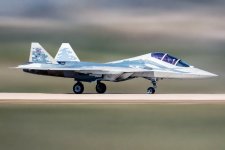
PAK-FA / Sukhoi Su-57 - Updates and Discussions

This isn't some uniquely Chinese path. Both American and Soviet jet aviation started out as copies of German designs — same goes for rocketry, right down to the V-2. The reason they eventually got the MiG-15 and the F-86, the Atlas and the R-7, was that they built up their own capabilities and invested heavily.

The reason China's copies are garbage is because China itself was weak. Of course a copy is garbage — but that garbage is irreplaceable. You've got to use what you've got. When the shooting starts, it's not going to be a case of three knock-offs somehow losing to two originals. This isn't like picking a wife — it doesn't have to be perfect, and there's no need for it to be.

The J-20, J-11, J-16 — they may be garbage, but they're still a damn sight better than the J-10.
Was the F-16A garbage? Ukraine keeps them tucked away in the rear, using them carefully, and they've survived a good long while.
The T-62 has been absolutely brilliant in Ukraine — light (something the M1A2 doesn't have), packing high-explosive shells (again, the M1A2 doesn't have that), and capable of lobbing shells out to 10 kilometers (the M1A2 doesn't do that either). Electronics a bit lacking? No problem — just correct with an FPV drone.

Is the WS-10 garbage? Absolute garbage. Two of them don't give enough thrust? Fine — stuff three of them into the JH-36. No one's going to pull a Cobra maneuver in that thing anyway. The common folk see it up there and cheer.

All industrial products — cars, motorcycles, phones, robot vacuums — technology is built on copying. We're all the same.


The Ukrainian liberation operations (the Dnieper crossing operation, the Cherkasy Pocket, Right-Bank Ukraine offensive) — casualties: 1.69 million (420,000 killed).
The Belarusian counter-offensive — casualties: 770,000 (180,000 killed).
East Prussia — casualties: 580,000 (130,000 killed).
The Battle of Berlin — casualties: 360,000 (80,000 killed).
From 1945 to 1955, the post-war suppression of bandits in Ukraine — 40,000 Soviet troops, police, and Party members sacrificed.
All of the above were sacrifices sustained under conditions of overwhelming and victorious momentum.

The Soviet military, and the current Russian military high command, clearly understand the intensity of war and the price of victory far better than the Western world does. By comparison, of course, the scale and impact of the current Russia-Ukraine war amount to little more than the intensity of playing house.

The political propaganda from the West, distorting the Russian General Staff's assessments of actual military force commitment, loss projections, and the war's duration — all to hype Russia up only to cut it down — is especially ludicrous. After all, from start to finish, there has been no announcement from the Russian side of a "quick victory," nor any declaration of an intention to "occupy Kyiv." It would seem as though fabricating a non-existent objective for Russia and then refuting it is somehow supposed to weaken Russia.
As for Russian aviation forces being severely restricted in Ukraine — I have seen no signs of this. Almost half the year has passed, and according to statistics compiled through Gemini:
On January 4th and 9th, one Su-30SM2 each suffered a single-engine malfunction and made emergency landings.
On January 12th, one Mi-8 crashed near the Arctic Circle.
On January 28th, one Su-34/30 was shot down by Ukraine.
On January 28th, one Su-34 crashed due to mechanical failure in Kursk.
On March 31st, one An-26 flew into a mountain.
On March 31st, one Su-34 was shot down.
On May 14th, one Mi-8 made an emergency landing in the Caucasus.
(I'm not sure how to count the incident from a couple of days ago, where a Ukrainian spy group attacked two decommissioned Tu-142 anti-submarine aircraft at a Russian aircraft repair plant — aircraft that originally belonged to Ukraine and were being used for spare parts stripping.)

Meanwhile, in 2025 alone, at least 14 Su-34s have been delivered, and Russia is simultaneously continuing to fulfill orders supplying aircraft, including the Su-57E, to other countries.
At Ukraine's pace, it would take several years to destroy just one year's worth of Russian aircraft production.
Take 2020 as an example: Russia produced 10 MiG-29Ms delivered to Egypt, 4 MiG-35s for its own use, 4 Su-30SMs for Belarus and 8 for Kazakhstan, and, additionally, equipped itself with 4 Su-34s and 10 Su-35S. It also manufactured 22 Su-35s destined for an Egyptian order (which were retained for domestic use and are now being prepared for transfer to Iran).
—And all of this was merely "peacetime production volume."
On Russia, I think you are mixing two different things: resilience and superiority.

The Russian Air Force is a good example. Counting aircraft losses alone is not the right metric. A force can lose few aircraft because it is operating cautiously, from stand-off ranges, under air-defence constraints. The massive use of glide bombs does not prove complete freedom of action; it proves adaptation to a contested airspace.

If Russian aviation had full freedom of action over Ukraine, it would not need to rely so heavily on stand-off glide bombs launched from safer airspace. The fact that it does so is evidence of constraint, not evidence of unrestricted dominance.

The same applies to T-62s. A T-62 can still be useful. Old weapons are not automatically useless. A cheap gun platform can fire HE, support infantry, or be corrected by drones. But saying that an old system remains useful is not the same as saying it is superior to a modern system. It only proves that in a long war, armies use everything that can still produce some effect.

That is also the lesson for India.

India should not blindly trust France, Russia, or the United States. India should build autonomy. But autonomy is not built only by crude reverse engineering. It can also be built by selecting the right partner, demanding industrial depth, integrating national weapons, and progressively taking control of the ecosystem.

That is why Rafale makes sense.

Not because Europe is perfect. Not because France gives everything. Not because India should depend on anyone.

It makes sense because it gives India a modern, combat-proven, maintainable, upgradable platform that can be progressively Indianised. It gives India immediate operational value while building the industrial base for future Indian systems.

So the real choice is not “foreign purchase” versus “self-reliance.”

The real choice is between:
  1. buying old systems and trying to copy them painfully;
  2. buying modern systems passively and remaining dependent;
  3. absorbing a mature system through local production, MRO, ICDs and national weapons integration.
The third path is the most rational one for India.
 
  • Like
Reactions: Rajput Lion
The MRFA contract is part of a competition that extends far beyond the subcontinent. By choosing to expand its fleet of Rafale fighters rather than diversify into the F-35 or the Su-57, India is sending a clear signal about the direction of its strategic partnerships – and about its determination to preserve its decision-making autonomy. Paris, which has been banking on this special relationship for years, sees this as confirmation of an Indo-French axis that extends far beyond the aerospace sector.

On an operational level, Operation Sindoor has taught its own lesson: air superiority remains decisive, and an army lacking it suffers the consequences. Striking from a distance, with precision, without crossing a border or triggering nuclear escalation – this is an advantage that requires a large number of aircraft. The skies over Punjab have provided the proof.
 
On Russia, I think you are mixing two different things: resilience and superiority.

The Russian Air Force is a good example. Counting aircraft losses alone is not the right metric. A force can lose few aircraft because it is operating cautiously, from stand-off ranges, under air-defence constraints. The massive use of glide bombs does not prove complete freedom of action; it proves adaptation to a contested airspace.

If Russian aviation had full freedom of action over Ukraine, it would not need to rely so heavily on stand-off glide bombs launched from safer airspace. The fact that it does so is evidence of constraint, not evidence of unrestricted dominance.
Standoff strike capability is a foundational requirement of modern warfare. Yet, when the Russian Su-27 and Su-25 fleets conducted low-altitude strikes and unguided rocket runs over Kyiv in 2022(Furthermore, they fabricated the psycho-operational myth of the 'Ghost of Kyiv'—allegedly piloting a legacy Su-27P in a heroic, high-intensity kinetic engagement against a superior Su-35S over the airspace of Kyiv—solely to project a false narrative of tactical heroism), Western pundits dismissed it as obsolete air tactics. Fast forward to 2026, when the Russian Aerospace Forces implemented comprehensive standoff strikes using glide bombs, the Western narrative shifted again, claiming it proved Russia’s failure to achieve air superiority and its fear of over-the-target bombing.

By this same logic, utilizing artillery and FPV drones to destroy the enemy must mean infantry lacks the courage for bayonet combat, thereby impeding the deployment of army formations.
Similarly, equipping the F-22 with the AIM-120 AMRAAM becomes a desperate measure born out of an inability to best the Su-35 in close-quarters dogfights.
Following this rationale, anti-ship operations should continue to rely on obsolete, 1980s-era Maverick missiles and TV-guided bombs, rather than cutting-edge systems like the BrahMos and Zircon.

Furthermore, while the T-62 may not necessarily be deemed a success, Western main battle tanks are unequivocally a failure.
-----They suffer from a larger silhouette and cross-section (particularly their side and top armor, which are as thin as paper—since Western designers only focus on armor-versus-projectile physics within a narrow 25-degree frontal arc), higher thermal signatures, terrible trafficability, inferior capability in neutralizing infantry and fortified structures, exorbitant production costs, and fragile propulsion systems.
 
  • Like
Reactions: Rajput Lion
The MRFA contract is part of a competition that extends far beyond the subcontinent. By choosing to expand its fleet of Rafale fighters rather than diversify into the F-35 or the Su-57, India is sending a clear signal about the direction of its strategic partnerships – and about its determination to preserve its decision-making autonomy. Paris, which has been banking on this special relationship for years, sees this as confirmation of an Indo-French axis that extends far beyond the aerospace sector.

On an operational level, Operation Sindoor has taught its own lesson: air superiority remains decisive, and an army lacking it suffers the consequences. Striking from a distance, with precision, without crossing a border or triggering nuclear escalation – this is an advantage that requires a large number of aircraft. The skies over Punjab have provided the proof.
Not saying you're wrong but MRFA is a different requirement from FGFA. Eventually both Rafale(in huge numbers) and Su-57D/60MKI are/will be part of IAF.

We've already chosen Su-57 after last year's skirmish and the deal has advanced to its final structuring. Once we proceed with Rafale deal with France, signing Su-57 deal would be next in line.
 
Bigger canopy, more reflecting surface,
It won't as we have already developed transparent meta-material based RAM that absorbs over 90% RF waves.

Look at this: IIT Kanpur researchers develop new Protective Layer for Microwave Metamaterial Absorbers | IIT Kanpur
may be we wont gate al51. Yet still su57mki will be more stealthy.
Either 177 or Type 30. Both have stealthy serrated flat-nozzles which reduces both EM & IR signature.
I wonder Why people loves to say something which seems illogical to normal mind yet they dont explain their logic.
I just did.
 
  • Like
Reactions: PhotonVish
The side-looking cheek active electronically scanned arrays (AESA) for the F-22 Raptor were fully conceptualized during the initial design phase; however, they were ultimately descoped and omitted from the actual production airframes due to fiscal constraints
But i'm talking about latest MLU.
IDK what exactly are those Band 2,3,4 antennas, so i've to assume that after all these the cheek radar may not be needed.
Anyways they have good networked system, satellites, drones, C2/3/4 jets, so may be they can further omit cheek radars.
Time will tell soon.

This directly exposes yet another foundational operational paradox within fifth-generation fighter doctrine.
On one hand, the premise dictates that universal low-observability (stealth) design significantly compresses mutual detection ranges. On the other hand, it asserts that supercruise capabilities drastically reduce the temporal window required to close the vector into the battle space. When synthesized, the mathematically inevitable outcome of these two coexisting parameters is that peer-level engagements between opposing fifth-generation platforms will see a massive escalation in the probability of close-quarters dogfights and visual-range kinetic combat.
Or are we to assume that fifth-generation platforms are structurally immune to mutual peer-level conflict—that their operational paradigm is akin to early modern musketeers conducting colonial expeditions in Africa, operating under the assumption that every sortie is merely an asymmetric turkey shoot?
Evidently, this is a simulated fantasy scenario reliant on mutually contradictory unilateral projections. It simultaneously presupposes that one's own offensive spear is universally irresistible, while assuming that one's own defensive shield is completely impenetrable. Yet, within the rigorous framework of military operational analysis, when an irresistible spear encounters an impenetrable shield, the entire conceptual architecture collapses into a systemic paradox
No one dares to subject this to empirical scrutiny. Consequently, the singular, underlying explanation becomes distinctly clear: because the foundational tenets of these doctrines are systemically amplified by the hegemonic media apparatus of the primary Western patron, they remain structurally immune to critical skepticism

I don't think Supercruise & mutual stealth reducing the detection range are paradox, contradiction of 5gen.
- While stealth is important to hide, SuCr can be used to reach the conflict zone faster & for launching weapons adding KE/range to them.
- The best jet engine would push the dry thrust per unit air+fuel, what we call "specific dry thrust", as far as possible.
- In mutual stealth BVR, the side with indirect/networked detection will win. All maker nations are doing R&D with their own RAS, RAM, EW, so only real battle'll truely test the efficiency, it's a trial & error thing, like Tom & Jerry.🐱🐭
This is like a soldier with a camouflage combat uniform, a long range gun, a pistol & big knife.
 
On the other hand, you take MiG fighters plus a carrier, throw in the modification costs and the follow-up secondary retrofits, and the total comes in under 2.5 billion. Now that's an incredible bargain—a deal so good you couldn't find another one if you searched with a lantern.

Operational usefulness is the only thing that can justify the cost of a platform. Modern carriers are usually at sea for atleast 6 months in a year. Most navies in the West publicize the deployment cycles of their CBGs in national media.

In India, you'd hardly anything about Vikram going out on a goodwill visit/exercise. For a carrier that's been in service for over 12 years, it cannot be mere coincidence.

The INs carrier doctrine is rooted in British colonial traditions centered on a 3 carrier force. The INs eventual goal is a CATOBAR CVN of over 65,000t w/EMALS on the same lines as the PLANs upcoming Type 004. But we are up against serious tech and cost constraints which are unlikely to be resolved anytime soon. Until then, we will make do with medium STOBAR carriers.

Also, carrier based airpower in still relevant in our context. In 1971, the INs carrier based jets played a key role in the surrender of the Pak garrison in Bangladesh.

Medium carriers can also be used to support amphibious landing ops across the IOR. This is the concept behind the Italian Cavour carrier on which the INS Vikrant's design is partly based.
 
But i'm talking about latest MLU.
IDK what exactly are those Band 2,3,4 antennas, so i've to assume that after all these the cheek radar may not be needed.
Anyways they have good networked system, satellites, drones, C2/3/4 jets, so may be they can further omit cheek radars.
Time will tell soon.


I don't think Supercruise & mutual stealth reducing the detection range are paradox, contradiction of 5gen.
- While stealth is important to hide, SuCr can be used to reach the conflict zone faster & for launching weapons adding KE/range to them.
- The best jet engine would push the dry thrust per unit air+fuel, what we call "specific dry thrust", as far as possible.
- In mutual stealth BVR, the side with indirect/networked detection will win. All maker nations are doing R&D with their own RAS, RAM, EW, so only real battle'll truely test the efficiency, it's a trial & error thing, like Tom & Jerry.🐱🐭
This is like a soldier with a camouflage combat uniform, a long range gun, a pistol & big knife.
Assuming both parties detect each other simultaneously at a range of 70 kilometers while supercruising at Mach 1.4, their head-on closure rate would reach approximately 840 meters per second. Consequently, they will enter the dogfight envelope within roughly 60 seconds. With virtually zero margin for error or tactical maneuvering during this window, the probability of transitioning into a visual-range (WVR) merge is significantly higher than that of fourth-generation fighter engagements.

Looking at it abstractly, aircraft carriers—especially this type of medium aircraft carrier—are nothing more than miniature mobile offshore airstrips carrying a usable fleet of 20 fighters, with an abysmal sortie rate, and whose runway becomes irreparable after any single strike. A combat example from 1971 (half a century ago) can no longer illustrate anything. Recently, in the face of the Houthis and Iran, they have demonstrated an exceedingly feeble level of combat capability. If we are to look for other examples, the United States had far more aircraft carriers back in the day yet still lost its shirt in Korea and Vietnam. For India, its primary military adversary, Pakistan, lies entirely within the strike range of land-based aviation, so it is hardly short of those 20 naval fighters. And the supplies that need to be delivered along its vast borders (much like Ukraine’s) are certainly not something an aircraft carrier could play a role in.
By the same logic, when I look at China 001 through 004, I cannot help but laugh out loud.
Russian aircraft-carrying cruisers, on the other hand, have a different purpose. They were derived from the Moskva-class anti-submarine (helicopter) cruisers. In essence, they are anti-submarine cruisers with the addition of 20 fixed-wing interceptor aircraft meant to neutralize U.S. carrier-based S-3 anti-submarine planes, while the 20 anti-submarine helicopters remain the core mission asset. The anti-ship missiles, likewise, are there to "expel" the adversary's large surface combatants. From the very beginning, maritime search and destruction of enemy surface warships or striking land targets were never its primary duties. The emergence of this type of warship is understandable within the context of the Cold War "offensive anti-submarine warfare" doctrine that arose after the 1970s.
 
Last edited:
Operational usefulness is the only thing that can justify the cost of a platform. Modern carriers are usually at sea for atleast 6 months in a year. Most navies in the West publicize the deployment cycles of their CBGs in national media.

In India, you'd hardly anything about Vikram going out on a goodwill visit/exercise. For a carrier that's been in service for over 12 years, it cannot be mere coincidence.

The INs carrier doctrine is rooted in British colonial traditions centered on a 3 carrier force. The INs eventual goal is a CATOBAR CVN of over 65,000t w/EMALS on the same lines as the PLANs upcoming Type 004. But we are up against serious tech and cost constraints which are unlikely to be resolved anytime soon. Until then, we will make do with medium STOBAR carriers.

Also, carrier based airpower in still relevant in our context. In 1971, the INs carrier based jets played a key role in the surrender of the Pak garrison in Bangladesh.

Medium carriers can also be used to support amphibious landing ops across the IOR. This is the concept behind the Italian Cavour carrier on which the INS Vikrant's design is partly based.
Given India's geographical conditions and overwhelming land power, whether or not it possesses an aircraft carrier is of no substantive significance to the dismemberment of Pakistan. Even if the carrier Vikrant had belonged to the Pakistani military at the time, it could not have averted the fate of Bangladesh. Several hundred years ago, the Netherlands earned the title of the "Coachman of the Seas," with 70% of the world's ships under its flag—its maritime supremacy was unmatched before or since. Yet it collapsed in an instant under the iron heel of France. The same thing played out again in 1940, only with the roles reversed: the French Navy produced virtually no value whatsoever against Germany.
 
  • Like
Reactions: PhotonVish
Given India's geographical conditions and overwhelming land power, whether or not it possesses an aircraft carrier is of no substantive significance to the dismemberment of Pakistan. Even if the carrier Vikrant had belonged to the Pakistani military at the time, it could not have averted the fate of Bangladesh. Several hundred years ago, the Netherlands earned the title of the "Coachman of the Seas," with 70% of the world's ships under its flag—its maritime supremacy was unmatched before or since. Yet it collapsed in an instant under the iron heel of France. The same thing played out again in 1940, only with the roles reversed: the French Navy produced virtually no value whatsoever against Germany.
I've drifted off topic. For India, it's perfectly fine to keep an aircraft carrier symbolically and use it for parades. Buy 300 Su-57s, load them up with Zircon missiles and external fuel tanks, and conduct long-range maritime patrols. As I mentioned earlier, indigenize the AL-31F or PS-90 engine, then build 1,000 fighters on that basis, complement them with 30 nuclear submarines plus 50 lithium-battery conventional submarines, and stockpile 20,000 Honda-Yamaha outboard motors for suicide boats—wouldn't that be just delightful? Best of all, follow the Iranians' lead and get some tunnel boring machines, dig a 3,000-kilometer tunnel 600 meters underground.
Moving with the times, aircraft carriers and fighter jets have only been in their ascendancy for a mere hundred years or so. The form of warfare will not remain fixed on them forever.
 
  • Like
Reactions: PhotonVish
Assuming both parties detect each other simultaneously at a range of 70 kilometers while supercruising at Mach 1.4, their head-on closure rate would reach approximately 840 meters per second. Consequently, they will enter the dogfight envelope within roughly 60 seconds. With virtually zero margin for error or tactical maneuvering during this window, the probability of transitioning into a visual-range (WVR) merge is significantly higher than that of fourth-generation fighter engagements.

That's why there's a race for passive IR & indirect/networked targeting & new longer range AAMs are surfacing,🤷‍♂️
otherwise potentially both can fire CCMs & end in mutual death.🤦‍♂️:LOL:
Then they should carry more CCMs, flares, DIRCMs than BVR-AAMs. Imagine F-22 with 2 AIM-120/260 & 6 AIM-9X. Imagine Su-57 with 2 R-77M/37M & 4-6 R-73 CCMs. :ROFLMAO:

So SuCr won't be engaged just anywhere by default. Need to conserve fuel for loitering, repeated launches & repositioning.
If it's 1st strike then subsonic cruise'll be done.
SuCr can be engaged when -
- If it's scramble
- target position is known directly or indirectly so weapon can be launched
- tactical evasion from SAM/AAM
- rapid repositioning
- fast egress

Looking at it abstractly, aircraft carriers—especially this type of medium aircraft carrier—are nothing more than miniature mobile offshore airstrips carrying a usable fleet of 20 fighters, with an abysmal sortie rate, and whose runway becomes irreparable after any single strike. A combat example from 1971 (half a century ago) can no longer illustrate anything. Recently, in the face of the Houthis and Iran, they have demonstrated an exceedingly feeble level of combat capability. If we are to look for other examples, the United States had far more aircraft carriers back in the day yet still lost its shirt in Korea and Vietnam. For India, its primary military adversary, Pakistan, lies entirely within the strike range of land-based aviation, so it is hardly short of those 20 naval fighters. And the supplies that need to be delivered along its vast borders (much like Ukraine’s) are certainly not something an aircraft carrier could play a role in.
By the same logic, when I look at China 001 through 004, I cannot help but laugh out loud.
Russian aircraft-carrying cruisers, on the other hand, have a different purpose. They were derived from the Moskva-class anti-submarine (helicopter) cruisers. In essence, they are anti-submarine cruisers with the addition of 20 fixed-wing interceptor aircraft meant to neutralize U.S. carrier-based S-3 anti-submarine planes, while the 20 anti-submarine helicopters remain the core mission asset. The anti-ship missiles, likewise, are there to "expel" the adversary's large surface combatants. From the very beginning, maritime search and destruction of enemy surface warships or striking land targets were never its primary duties. The emergence of this type of warship is understandable within the context of the Cold War "offensive anti-submarine warfare" doctrine that arose after the 1970s.

From where AC dropped into Su-57 thread? Is Russia producing naval Su-57?🤔:rolleyes:
 
Our Su-57/60MKI variant would be far better in-terms of stealth from all-aspects, especially rear than current Su-57S/E. Rest assured about that.
How? I'll say it would be worse because of it's bigger canopy for the twin seat version.
HIhfiIzX0AAUmA9.jpeg
Seems like they took the cockpit from the Su30 and put it on one of the prototypes, the serial version will probably be flatter.

Side Note: Russian fighter tend to look even better on their twin seat versions while American one look worse on theirs.
 
That's why there's a race for passive IR & indirect/networked targeting & new longer range AAMs are surfacing,🤷‍♂️
otherwise potentially both can fire CCMs & end in mutual death.🤦‍♂️:LOL:
Then they should carry more CCMs, flares, DIRCMs than BVR-AAMs. Imagine F-22 with 2 AIM-120/260 & 6 AIM-9X. Imagine Su-57 with 2 R-77M/37M & 4-6 R-73 CCMs. :ROFLMAO:

So SuCr won't be engaged just anywhere by default. Need to conserve fuel for loitering, repeated launches & repositioning.
If it's 1st strike then subsonic cruise'll be done.
SuCr can be engaged when -
- If it's scramble
- target position is known directly or indirectly so weapon can be launched
- tactical evasion from SAM/AAM
- rapid repositioning
- fast egress


From where AC dropped into Su-57 thread? Is Russia producing naval Su-57?🤔:rolleyes:
Logically, if integrated surface-to-air defense ecosystems struggle to achieve reliable anti-ballistic or counter-missile interception, the proposition of executing such interceptions via air-to-air platforms remains operationally and technically even more untenable.
It is historically accurate, however, that the Su-57 platform is integrated with a Directional Infrared Countermeasures (DIRCM) suite, which computes the kinematics of incoming missiles and subjects their seeker heads to targeted laser illumination. Should this architecture eventually transition to utilizing a High-Energy Laser (HEL) weapon effector, the capability to inflict permanent structural or functional degradation on an incoming missile's electro-optical guidance and focal-plane array systems remains a distinct technical possibility
 
Logically, if integrated surface-to-air defense ecosystems struggle to achieve reliable anti-ballistic or counter-missile interception, the proposition of executing such interceptions via air-to-air platforms remains operationally and technically even more untenable.

Both things are different. BMs will fly at supersonic to hypersonic speed always, not a jet. For another generation or decades, every nation can't afford a military satellite constellation, many costly AWACS, S-500 like IADS, etc. So when a target is confirmed not a decoy but genuine expected target via any asset in air, surface, space, a LRM can be launched which'll switch to active guidance later.

It is historically accurate, however, that the Su-57 platform is integrated with a Directional Infrared Countermeasures (DIRCM) suite, which computes the kinematics of incoming missiles and subjects their seeker heads to targeted laser illumination. Should this architecture eventually transition to utilizing a High-Energy Laser (HEL) weapon effector, the capability to inflict permanent structural or functional degradation on an incoming missile's electro-optical guidance and focal-plane array systems remains a distinct technical possibility

DIRCM is technically a laser just enough to disorient IR seeker.
If Su-57 RF+EO sensors can maintain continious lock on enemy jet or missile then they just have to replace the DIRCM with DEW in future. Some airframe modifications'll be needed.
USA has tested pods on Apache helo, advertised in animations. DEW-CIWS is counted as 6gen characteristics inbuilt in airframe.
With time 100s of KW laser will improve to MW class. Hence it'll be suicidal for manned jets, hence AI-UCAVs are ultimate future. 7gen could/would be 100% UCAVs.
 
Both things are different. BMs will fly at supersonic to hypersonic speed always, not a jet. For another generation or decades, every nation can't afford a military satellite constellation, many costly AWACS, S-500 like IADS, etc. So when a target is confirmed not a decoy but genuine expected target via any asset in air, surface, space, a LRM can be launched which'll switch to active guidance later.


DIRCM is technically a laser just enough to disorient IR seeker.
If Su-57 RF+EO sensors can maintain continious lock on enemy jet or missile then they just have to replace the DIRCM with DEW in future. Some airframe modifications'll be needed.
USA has tested pods on Apache helo, advertised in animations. DEW-CIWS is counted as 6gen characteristics inbuilt in airframe.
With time 100s of KW laser will improve to MW class. Hence it'll be suicidal for manned jets, hence AI-UCAVs are ultimate future. 7gen could/would be 100% UCAVs.
I'm saying that even ground-based radars and combat teams launching large missiles have such a low hit rate against incoming missiles (like the 48N6), so a fighter jet (with only 1 to 2 crew members) that has even weaker guidance capabilities would be far less reliable at intercepting incoming air-to-air missiles using lower-overload missiles like the AIM-9X.
 
DIRCM is technically a laser just enough to disorient IR seeker.
If Su-57 RF+EO sensors can maintain continious lock on enemy jet or missile then they just have to replace the DIRCM with DEW in future. Some airframe modifications'll be needed.
USA has tested pods on Apache helo, advertised in animations. DEW-CIWS is counted as 6gen characteristics inbuilt in airframe.
With time 100s of KW laser will improve to MW class. Hence it'll be suicidal for manned jets, hence AI-UCAVs are ultimate future. 7gen could/would be 100% UCAVs.
Regarding the second question, I have actually argued in other posts that if the minimum energy direct confrontation and the demise of value-based aircraft come to pass, the world will no longer need air superiority fighters. I believe future fighter aircraft will become super-large and land-based, capable of ultra-high speeds. Most ground attack missions will return to artillery, FPVs, and large suicide drones like the Geranium. A small number of concrete structures requiring destruction by glide bombs will have to be attacked by unmanned flying wings such as the S70. And this will be won by quantity rather than individual platform performance. With the further development of networks, the method of aircraft carrying air-to-air missiles for secondary launch will be replaced by aircraft guiding surface-to-air missiles...
 
Bigger canopy, more reflecting surface, may be we wont gate al51. Yet still su57mki will be more stealthy.

I wonder Why people loves to say something which seems illogical to normal mind yet they dont explain their logic.
just saying, having a bigger surface does not mean neccessarily worse stealth, in some cases it could even help in the higher bands like L bands.
stealth is a lot more complex than that.
 
  • Agree
Reactions: Rajput Lion
IMHO, @Parthu provided the most damning testimony that settled the Su57 stealth debate long ago: if the designers cared about stealth/RCS, it would have a luneberg lens. It is paraded nakedly at air shows all over the world.

Heard of the expression "lipstick on a pig"?