It's a bloated boat aerodynamically. If it becomes a knife fight the j-20 will lose to both the su-57 and f-22 and even the f-35. The thing that is going for it is it's huge range and huge aesa radar and BVR capability.
Well modern warfare isn't designed around visual range dogfights but beyond visual range combat which was the priority behind its design. Even the F35 would be relatively weak in WVR against other jets, I also don't think guns will be very relevant in 2026 and their choice to use that space for better BVR capability is a sound one.
Even a mig 21 can take it down if it becomes a wvr fight.
However unlike the F22, there is no typical 1v1 situation where a Mig 21 would be able to get close enough to engage the J20 in wvr range combat before it gets blown to bits unless it's somehow able to sneak past it's radar blind spots using certain measures.
It is design as a long range sniper while the j-10 and j-11 get into the aerial knife fights. It's A2G capability is inferior to both the su-57 and f-22. The only thing going for it are pl-15/pl-16 missiles.
The J20 just like the F22 was designed to be an air superiority jet, the Su57 was designed to be a multi role jet. I also don't see how the F22 will do better strike roles than the J20 considering it wasn't designed for such roles and is outdated in many ways by today's standards.
On top of that it's ugly af with those canards.
Subjective
I feel the j-20 has a huge room for improvement even in its present state and when the Chinese are done with the design we will see a world beater
Reasonable
but it's still nowhere near su-57 and f-22 when it comes to basic of aerial combat.
J-36 follows the same philosophy. So it will be taken out in a very similar fashion to the j-20.
Except for it's raw kinematics and slightly better stealth profile at some profiles, how is the F22 a better jet?
The J20 has a bigger (it's the biggest nose mounted AESA radar currently operational in stealth jets) and a more advanced GAN radar versus the smaller and inferior GaA radar of F22.
PL-15 has estimated range of 200-300km, with a dual-pulse motor and AESA seeker. AIM-120D has estimated range of 130-160km. This overmatch is publicly recognised by US military planners and is not news.
The J20 has better supersonic performance while F22 has better subsonic performance.
The J20 has twice the combat radius of F22.
The outdated F22 also has no HMD, no IRST, no EOTS, obsolete processor, 90's era cockpit, limited data link capability etc
No jet is perfect, each will have it's share of flaws based on their design constraints.
I'll post a comment from a aviation expert on why the US wanted to retire the F22 in the first place,
"The USAF wants to retire the F-22 beginning around 2030 mainly due to two reasons: the F-22’s high operating costs, and the F-22’s obsolescence in a number of areas, with the latter being the primary reason,
‘With regards to high operating costs,
the F-22 fleet was not produced in sufficient quantities to replace the F-15, and therefore its logistics and supply chain do not benefit from economy of scale as much as jets like the F-16 and F-35. The
F-22 also uses legacy stealth materials that increase maintenance costs; properly retrofitting the F-22 with the F-35’s more durable full material stack is also not possible without replacing the
composite panels of every F-22. These composites are not the same, so the structural strength of the jet and possibly the thickness of its skin would be affected, requiring recertification of its life limit and likely some redesigns of panels and doors to accommodate altered geometry. There are also a number of other technological advances that allows fighters to be cheaper to maintain, but which would require redesigns of the F-22, some being quite deep.
‘In terms of obsolescence, the F-22’s biggest issues are its limited range, its outdated core avionics and its stealth design.’
Smith continues; ‘For range, the F-22 was designed primarily for fighting in Europe and turn of the millennium era threats, and so its combat radius of approximately 590 nautical miles (less with any use of supercruise) is not ideal for a war with China. This is because jets may need to be flying from locations
like Guam and relying on tankers only ~400 nautical miles (if F-22s are using supercruise) behind the F-22’s, which would then be threatened by new very long range missiles and enemy stealth fighters that may be able to slip sufficiently far past fighter screens to take those tankers out.
‘By comparison, the F-35A (land-based variant) has an air-to-air combat radius of 760 nautical miles, with a new engine being developed for it which would boost that to nearly 1000 nautical miles. The F-22’s NGAD successor is also anticipated to have an approximately 1000+ nautical miles combat radius.
‘For its core avionics the F-22 is considerably hampered by old ADA code with limited modularity, being run on old processors. Because the software isn’t very modular or open, adding a new sensor requires a lot of extra work. For the F-22 to outperform jets like the J-20 into the 2030s and beyond, it needs to keep up by getting a helmet mounted display, a panoramic cockpit display, updated electronic warfare systems, long range infrared sensors, updated communications systems, improved sensor fusion and combat ID systems, etc. Developing a clean sheet system based around an open architecture will take time and money, but from there it’ll be much easier to keep cutting edge, which will be critical as we enter into something resembling a second Cold War.
‘For stealth, the F-22 is quite stealthy, but its potential was compromised in order to make it very agile, which in this day and age is becoming a lesser and lesser priority as air-to-air missiles become more advanced.’
Smith concludes;
‘By creating a clean sheet fighter, you can make a jet better shaped to have highly effective stealth against both fire control radar bands like the X-band, and lower frequency “counter-stealth” search radars operating in the UHF and VHF bands, allowing jets like NGAD to escort B-21 bombers as they penetrate deep into enemy airspace.’ "



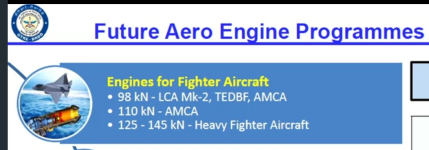
 we should negotiate for Iz-177, as per search it is meant for Su-57 & Su-75 export. The engine has better life span, better SFC, TVC nozzle, FADEC, etc. But we should clarify with Russia if/when it'll have rear ceramic RF blocker, transpiration cooling, flat TVC nozzle.

 It doesn't look bad but 1st time looking at it i also thought it's a flying boat. May be in future we'll see amphibious combat jets.




 is what we're reaping today.
 instead of


 , late retirement.