That’s not how the math works, kiddo.
First of all, let’s establish the baseline scenario: to satisfy the operational profile of
2 minutes at full afterburner plus 35 minutes at maximum dry thrust for a round-trip combat patrol, the fuel fractions required are highly specific.
Su-30MKI, it must carry
7,600 kg of fuel. Combined with an ordnance package of 4x R-77s and 2x R-73s totaling 980 kg, and an empty weight of 18.8 tons, we look at the official performance charts. Under these exact parameters:
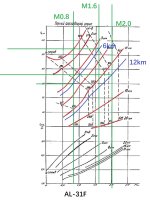
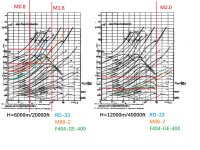
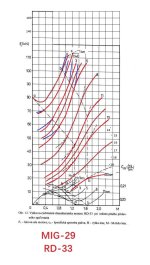
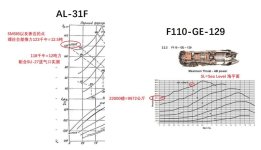
At 6,000 meters / Mach 0.8: The dual AL-31FP engines put out a combined
160 kN of thrust, yielding an overall thrust-to-weight ratio
(TWR) of 0.60.
At 6,000 meters / Mach 1.5: The ram effect spikes the total dual-engine thrust to
240 kN, pushing the TWR to
0.90.
At 12,000 meters / Mach 2.0: The thin air drops total thrust to
114 kN, leaving a TWR of
0.43.
Rafale C under the exact same operational profile. It demands
5,500 kg of fuel. Since its internal fuel capacity maxes out at only 4,700 kg, it is forced to bolt on a 115 kg supersonic drop tank. Factor in an air-to-air loadout of 4x MICA and 2x Magic II missiles totaling 1,152 kg, and cross-reference the exact same flight regimes. The Rafale C’s dual-engine thrust figures clock in at
116 kN, 170 kN, and 76 kN, yielding TWRs of
0.73, 1.07, and 0.48, respectively.
Tejas Mk1A. To fulfill this mission, it requires
3,200 kg of fuel. Given its abysmal internal fuel capacity of just 2,458 kg, even assuming it can magically integrate the Rafale's 115 kg supersonic drop tank, you must add that 115 kg penalty. Slap on 4x Astra Mk1s and 2x R-73s totaling 836 kg, and check the charts. Under the identical three test conditions, its total thrust collapses to
47 kN, 60 kN, and 20 kN, resulting in pathetic TWRs of
0.45, 0.57, and 0.19.
Keep in mind, these raw numbers don't even factor in Sukhoi’s massive aerodynamic advantages—such as its
Blended Wing-Body (BWB) lift generation and
thrust-vectoring superiority—nor do they account for the severe
parasitic drag and aerodynamic degradation inflicted on the Rafale and Tejas by forcing them to haul external drop tanks just to stay airborne.
Furthermore, why on earth are you using the Su-30MKI—a heavy, twin-seat strike fighter—as your baseline comparison?
If you look at a single-seat
Su-27SM3 paired with the
AL-31FM1 (which shifts the entire thrust curve upward by 5% to 10%), the aircraft's empty weight drops to just
16.X tons. Under the exact same mission profiles, its estimated TWRs rocket to
0.73, 1.06, and 0.51, completely obliterating the Rafale across the entire envelope.
Your version of 'armchair physics' is completely disconnected from actual aerospace engineering.
View attachment 52256
The root of the problem is that you lack even the most basic aviation common sense.
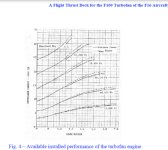
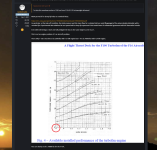
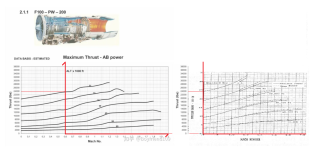
You take a few flat, isolated numbers off a Wikipedia page and forcefully shoehorn them into your own imaginary, fictionalized universe. You don't even grasp the elementary concept that an engine outputs entirely different thrust levels at varying altitudes and speeds, which means a fighter jet's thrust-to-weight ratio fluctuates constantly under different flight regimes. Instead, you just blindly copy-paste that worthless, sea-level, Mach 0.4 thrust data over and over again, sitting there looking utterly smug about your own ignorance
Are you honestly suggesting that the pathetic, underwhelming Rafale can achieved a thrust-to-weight ratio that outclasses the Su-27—the absolute gold standard of heavy-class supermaneuverability? Or that the F/A-18, that hilarious joke of a 'subsonic brick,' could have its engines ripped Half out and still seamlessly trade blows with a Su-30MKI?
To leap out and look so utterly proud of yourself after concocting such an absurdly bizarre conclusion is truly a sight to behold.
Before anything else, you might want to go back to school and learn how to comprehend the endless pile of PPTs you’re throwing around.