Project Kusha / Programme LRSAM / PGLRSAM
- Thread starter Fatalis
- Start date
You are using an out of date browser. It may not display this or other websites correctly.
You should upgrade or use an alternative browser.
You should upgrade or use an alternative browser.
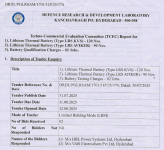
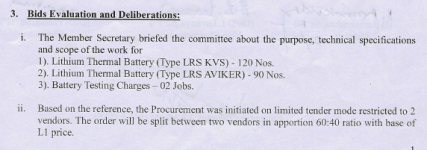
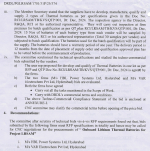


A minimum range of 60km to a maximum range of 350km.
Looks like Akash Mk2 will eventually get rolled into the Kusha system architecture. Same basic interceptor, after all.A minimum range of 60km to a maximum range of 350km.

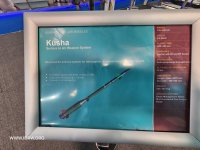
Total flight time of 200–450 seconds at a maximum range of 350 km implies an average speed of only 778 m/s, making the M3 interceptor & by extension other interceptors in the system far too slow for a long range air defence role. Max speed of Mach 5.5 is in all likelihood boost speed.
The two long range interceptors of the Kusha system are longer and thinner, carry smaller warheads, and appear to have lower boost energy and overall kinematic performance than 48N6E & 40N6E of S-400 System....... By comparison, the 40N6E achieves a 380 km maximum range with a stated average flight speed of 1190 m/s, despite being single stage, more compact, carrying a larger warhead & exhibiting higher boost energy & better energy retention.
Only thing going for Kusha long range interceptors appear to be greater maneuverability & potentially better low altitude engagement performance but thats a big if, while any ballistic missile defence capability would be limited..... more effective approach would be to cap system range at roughly 250 km Max with two faster interceptors, significantly improving no escape zones and making the system more credible threat across full range of aerial threat.

Ballistic Threats that can't be handled by kusha M3 are mrbm(and above).View attachment 49449
Total flight time of 200–450 seconds at a maximum range of 350 km implies an average speed of only 778 m/s, making the M3 interceptor & by extension other interceptors in the system far too slow for a long range air defence role. Max speed of Mach 5.5 is in all likelihood boost speed.
The two long range interceptors of the Kusha system are longer and thinner, carry smaller warheads, and appear to have lower boost energy and overall kinematic performance than 48N6E & 40N6E of S-400 System....... By comparison, the 40N6E achieves a 380 km maximum range with a stated average flight speed of 1190 m/s, despite being single stage, more compact, carrying a larger warhead & exhibiting higher boost energy & better energy retention.
Only thing going for Kusha long range interceptors appear to be greater maneuverability & potentially better low altitude engagement performance but thats a big if, while any ballistic missile defence capability would be limited..... more effective approach would be to cap system range at roughly 250 km Max with two faster interceptors, significantly improving no escape zones and making the system more credible threat across full range of aerial threat.
For that we already have/are developing.
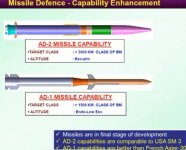
And for dedicated HGV and HCM interception AD-AH and AD-AM are also in development.
For kusha and its missiles, ballistic missile interception is more of a add on capability than a primary focus, in a way reminiscent of barak 8.

Not really. Kusha M3 interceptors will take on short range/tactical ballistic missiles. Great against Fatah-2 type guided ballistic rockets.Ballistic Threats that can't be handled by kusha M3 are mrbm(and above).
For that we already have/are developing.
View attachment 49450
And for dedicated HGV and HCM interception AD-AH and AD-AM are also in development.
For kusha and its missiles, ballistic missile interception is more of a add on capability than a primary focus, in a way reminiscent of barak 8.
I implied the same thing , that m3 will take on threats below mrbm, aka. srbm level upto 1000km range ballistic missiles.Not really. Kusha M3 interceptors will take on short range/tactical ballistic missiles. Great against Fatah-2 type guided ballistic rockets.
And design of kusha missiles is not primarily centred around only anti-ballistic capabilities, but a more versatile design against ballistic, cruise missiles, fighters, awacs, low flying targets etc.
even for non BM threat the Pk drop exponentially fast as distance increase. The interceptors are way to slow for such long range accurate engagement.For kusha and its missiles, ballistic missile interception is more of a add on capability than a primary focus, in a way reminiscent of barak 8.
The system need to be future proof...... Current capabilities specified doesn't provide that.Not really. Kusha M3 interceptors will take on short range/tactical ballistic missiles. Great against Fatah-2 type guided ballistic rockets.
M3 varient ain't gonna be used for 300km+ intercept of a non-ballistic high speed maneuvering target, it will mainly be used for intercept of Srbm's(upto to ~1000km range ballistic missiles) much closer &20+km above atmosphere. and awacs type targets.even for non BM threat the Pk drop exponentially fast as distance increase. The interceptors are way to slow for such long range accurate engagement.
M1 and m2 are gonna do heavy lifting in interception of high speed maneuvering ingressing targets, especially m1.
Future proofing in kinematics is AD-AH and AD-AM , against both Hypersonic glide vehicles and Hypersonic cruise missileseven for non BM threat the Pk drop exponentially fast as distance increase. The interceptors are way to slow for such long range accurate engagement.
The system need to be future proof...... Current capabilities specified doesn't provide that.
Kusha m1,m2,m3 combined are for subsonic cruise missiles, supersonic cruise missiles, fighter jets, awacs, tankers, SRBM's, etc kind of threats.
Last edited:
the kusha m3 also has a KV specifically for hypersonic stuff as far as i know so it should be capable of intercepting hypersonic targets as well. i mean its a stated goal to be able to intercept up till mach 8. But yea the real killers are going to be the AD-AH and the AD-AM since they will be for higher end hypersonics as well (man we really should use a new name for above mach 10)M3 varient ain't gonna be used for 300km+ intercept of a non-ballistic high speed maneuvering target, it will mainly be used for intercept of Srbm's(upto to ~1000km range ballistic missiles) much closer &20+km above atmosphere. and awacs type targets.
M1 and m2 are gonna do heavy lifting in interception of high speed maneuvering ingressing targets, especially m1.
Future proofing in kinematics is AD-AH and AD-AM , against both Hypersonic glide vehicles and Hypersonic cruise missiles
Kusha m1,m2,m3 combined are for subsonic cruise missiles, supersonic cruise missiles, fighter jets, awacs, tankers, SRBM's, etc kind of threats.
1,000 km range Short-Range Ballistic Missile (SRBM), which often sits at the upper limit of the SRBM category (300-1,000 km) and borders on Medium-Range Ballistic Missile (MRBM) classification, typically exhibits terminal speeds between Mach 6 and Mach 10+ (approximately 2,000 to over 3,500 meters per second)the kusha m3 also has a KV specifically for hypersonic stuff as far as i know so it should be capable of intercepting hypersonic targets as well. i mean its a stated goal to be able to intercept up till mach 8. But yea the real killers are going to be the AD-AH and the AD-AM since they will be for higher end hypersonics as well (man we really should use a new name for above mach 10)
Note the bit about Anti-Ship Ballistic Missile, the navy has been keen to acquire ABM capability - https://mod.gov.in/sites/default/files/DEFENCE AR 2022-23 LOW.pdfM3 varient ain't gonna be used for 300km+ intercept of a non-ballistic high speed maneuvering target, it will mainly be used for intercept of Srbm's(upto to ~1000km range ballistic missiles) much closer &20+km above atmosphere. and awacs type targets.
M1 and m2 are gonna do heavy lifting in interception of high speed maneuvering ingressing targets, especially m1.
Future proofing in kinematics is AD-AH and AD-AM , against both Hypersonic glide vehicles and Hypersonic cruise missiles
Kusha m1,m2,m3 combined are for subsonic cruise missiles, supersonic cruise missiles, fighter jets, awacs, tankers, SRBM's, etc kind of threats.
Attachments
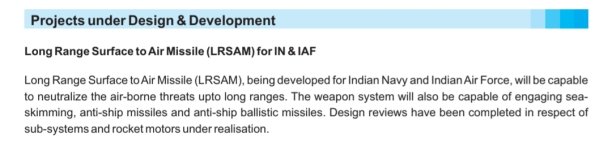
Again, General BMD capabilities upto SRBMs and some hybrids like Yj20 which uses marv KV to extend range and complicate the(at the cost of some kinetic performance)trajectory should be within intercept capabilities of M3Note the bit about Anti-Ship Ballistic Missile, the navy has been keen to acquire ABM capability - https://mod.gov.in/sites/default/files/DEFENCE AR 2022-23 LOW.pdf
For dedicated BMD shield navy has been making navalised and upgraded varients of land based BMD missiles.

India Conducts First Test of New Ship-Based BMD System - Naval News
India has become one of the few nations to test a sea-based Ballistic Missile Defense or BMD system. The test took place from INS Anvesh.
 www.navalnews.com
Don't jump to conclusions. How we declare our flight profile at which altitude, matters. The Russians often cherry pick the best data.View attachment 49449
Total flight time of 200–450 seconds at a maximum range of 350 km implies an average speed of only 778 m/s, making the M3 interceptor & by extension other interceptors in the system far too slow for a long range air defence role. Max speed of Mach 5.5 is in all likelihood boost speed.
The two long range interceptors of the Kusha system are longer and thinner, carry smaller warheads, and appear to have lower boost energy and overall kinematic performance than 48N6E & 40N6E of S-400 System....... By comparison, the 40N6E achieves a 380 km maximum range with a stated average flight speed of 1190 m/s, despite being single stage, more compact, carrying a larger warhead & exhibiting higher boost energy & better energy retention.
Only thing going for Kusha long range interceptors appear to be greater maneuverability & potentially better low altitude engagement performance but thats a big if, while any ballistic missile defence capability would be limited..... more effective approach would be to cap system range at roughly 250 km Max with two faster interceptors, significantly improving no escape zones and making the system more credible threat across full range of aerial threat.
Will be for all threats.Ballistic Threats that can't be handled by kusha M3 are mrbm(and above).
For that we already have/are developing.
View attachment 49450
And for dedicated HGV and HCM interception AD-AH and AD-AM are also in development.
For kusha and its missiles, ballistic missile interception is more of a add on capability than a primary focus, in a way reminiscent of barak 8.
There is a misconception that 40N6 can intercept BM at 400km, it's physically impossible for it to do so.
M3 would be able to do credible ABM if there's indeed KV involved. MF-STAR would require upgrades though.
M3 would be able to do credible ABM if there's indeed KV involved. MF-STAR would require upgrades though.
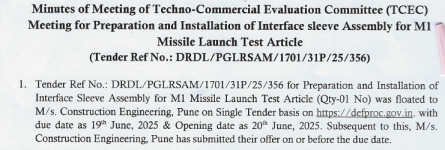
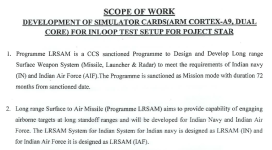
India’s long-awaited Project Kusha, officially known as the Extended Range Air Defence System (ERADS), appears to have crossed a critical milestone.
Defence Secretary RK Singh has confirmed that initial trials of Project Kusha have been successfully conducted, marking the programme’s transition from design and development into early validation.
Interestingly, just a couple of weeks earlier, officials from DRDO’s Defence Research and Development Laboratory (DRDL) had stated that preparations were underway for the maiden trials of the missile. If both statements are taken at face value, it is reasonable to assess that at least one test may have taken place recently without public disclosure—a practice not unusual for sensitive air defence programmes.
This quiet progress underscores the strategic importance of Project Kusha for India’s future air and missile defence architecture.

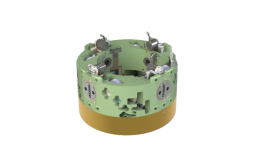
The KUSHA system is an indigenous rotary servo actuation system designed to provide precise aerodynamic control for advanced aerospace vehicles. The system consists of four rotary actuators arranged orthogonally (90° apart) and a quad-channel digital controller. Through a gear-train mechanism, rotary motion of the actuators is converted into accurate fin deflections, enabling the generation of control forces and moments required for vehicle maneuvering and stability.
Key Features :
Electro-Mechanical Actuators :
Four independently controlled rotary actuators, positioned at 90°.
Converts rotary actuator motion into angular fin deflection for aerodynamic control.
Low noise anti aliasing filter.
Software & Control :
Embedded DSP algorithms for adaptive PID-based control.
Supports re-programmability of algorithms and limits.
Custom GUI software for configuration, monitoring, and diagnostics.
System Specifications:
Max Linear Command Range: ±28 mm.
Mechanical Angular Limit: ±120 Nm.
Max Force per Fin (at 110 mm): 9600 N.
Max Angular Speed of Fin:
4000 °/sec @ No Load.
200 °/sec @ 100 Nm Load.
Bandwidth: 25 Hz (20 A, -90°).
Weight (w/o fins): < 10 kg.
Total Backlash (Motor–Fin shaft): ≤ 0.6° (±0.3°).
Max Overshoot: ≤ 20%.
Moment of Inertia of Fin: < 0.6 × 10&supmin;3 kg·m².
Actuator Load (Till Boost Phase): ~500 sec duration (simulation study ongoing).
Courtsey - Apollo microsystems
Key Features :
Electro-Mechanical Actuators :
Four independently controlled rotary actuators, positioned at 90°.
Converts rotary actuator motion into angular fin deflection for aerodynamic control.
Low noise anti aliasing filter.
Software & Control :
Embedded DSP algorithms for adaptive PID-based control.
Supports re-programmability of algorithms and limits.
Custom GUI software for configuration, monitoring, and diagnostics.
System Specifications:
Max Linear Command Range: ±28 mm.
Mechanical Angular Limit: ±120 Nm.
Max Force per Fin (at 110 mm): 9600 N.
Max Angular Speed of Fin:
4000 °/sec @ No Load.
200 °/sec @ 100 Nm Load.
Bandwidth: 25 Hz (20 A, -90°).
Weight (w/o fins): < 10 kg.
Total Backlash (Motor–Fin shaft): ≤ 0.6° (±0.3°).
Max Overshoot: ≤ 20%.
Moment of Inertia of Fin: < 0.6 × 10&supmin;3 kg·m².
Actuator Load (Till Boost Phase): ~500 sec duration (simulation study ongoing).
Courtsey - Apollo microsystems