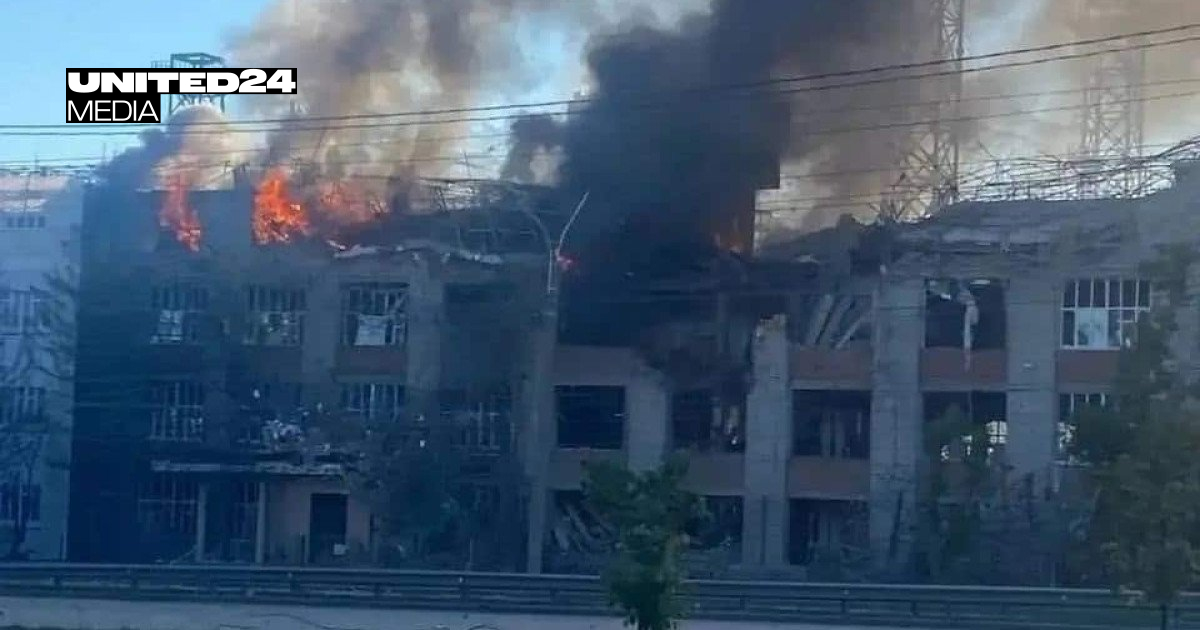

In any case, those who had doubts about the Flamingo’s operational capability can rest assured: it flies well. The Titan-Barrikady factory in Volgograd is reported to have been hit four times last night/this morning. This strike virtually removes any doubt as to the operational capability of the FP-5 Flamingo. Volgograd is not a nearby target: the Titan-Barrikady factory is located several hundred kilometres from the probable launch area, in the heart of a heavily defended region of Russia. Zelensky has confirmed the use of Ukrainian Flamingo missiles against the site, whilst the Russian authorities have acknowledged damage to the production facilities and ten people injured.
The target has been particularly well chosen. Titan-Barrikady manufactures, amongst other things, launchers and components for the Iskander-M systems and for Russian strategic missiles. A Flamingo carrying a payload of around one tonne is no longer merely a device designed to start a fire in a depot: it can cause severe damage to workshops, machine tools, assembly lines and industrial infrastructure that is difficult to replace.
The Ukrainian campaign is therefore changing in nature. Long-range drones saturate, identify and strike vulnerable targets; the Flamingo delivers a much heavier military payload against hardened installations or large industrial complexes. Even if the missile has not yet achieved the reliability of a mature Western system, it has moved beyond the demonstration prototype stage: it flies, occasionally penetrates Russian defences and produces significant effects deep behind enemy lines.
As for fuel, what is seen in the images is consistent with a crisis that has become geographically very widespread. As of 25 June, restrictions or rationing were reported in at least 55 to 56 Russian regions. In Siberia, particularly in the Irkutsk, Novosibirsk and Omsk regions, the authorities or distributors are prioritising essential services and are sometimes resorting to manual management of supplies. The Duma has even just authorised exceptional measures: the use of lower-grade fuels, support for imports and the postponement of certain obligations regarding refinery modernisation.
This is likely to remain a temporary situation at any individual filling station, as supply flows can be redirected. But the simultaneous and nationwide nature of the phenomenon is new. When shortages appear even in producing regions and in Siberia, it is no longer merely a local shortage: the refining and distribution system has lost its safety margins.
For Kerch, the direction of the queues speaks volumes politically: we no longer see crowds flocking to Crimea for their holidays; we see thousands of vehicles trying to leave, following power cuts, rationing and the cancellation of holiday camps.
There are therefore three interrelated images:
The target has been particularly well chosen. Titan-Barrikady manufactures, amongst other things, launchers and components for the Iskander-M systems and for Russian strategic missiles. A Flamingo carrying a payload of around one tonne is no longer merely a device designed to start a fire in a depot: it can cause severe damage to workshops, machine tools, assembly lines and industrial infrastructure that is difficult to replace.
The Ukrainian campaign is therefore changing in nature. Long-range drones saturate, identify and strike vulnerable targets; the Flamingo delivers a much heavier military payload against hardened installations or large industrial complexes. Even if the missile has not yet achieved the reliability of a mature Western system, it has moved beyond the demonstration prototype stage: it flies, occasionally penetrates Russian defences and produces significant effects deep behind enemy lines.
As for fuel, what is seen in the images is consistent with a crisis that has become geographically very widespread. As of 25 June, restrictions or rationing were reported in at least 55 to 56 Russian regions. In Siberia, particularly in the Irkutsk, Novosibirsk and Omsk regions, the authorities or distributors are prioritising essential services and are sometimes resorting to manual management of supplies. The Duma has even just authorised exceptional measures: the use of lower-grade fuels, support for imports and the postponement of certain obligations regarding refinery modernisation.
This is likely to remain a temporary situation at any individual filling station, as supply flows can be redirected. But the simultaneous and nationwide nature of the phenomenon is new. When shortages appear even in producing regions and in Siberia, it is no longer merely a local shortage: the refining and distribution system has lost its safety margins.
For Kerch, the direction of the queues speaks volumes politically: we no longer see crowds flocking to Crimea for their holidays; we see thousands of vehicles trying to leave, following power cuts, rationing and the cancellation of holiday camps.
There are therefore three interrelated images:
- Operation Flamingo is striking a blow against the Russian military industry in Volgograd;
- petrol stations are rationing fuel even deep in Siberia;
- and queues are stretching eastwards as people leave Crimea.