

Ukraine - Russia Conflict
- Thread starter randomradio
- Start date
You are using an out of date browser. It may not display this or other websites correctly.
You should upgrade or use an alternative browser.
You should upgrade or use an alternative browser.
Comment had nothing to do with oil sales. Any imbecile has figured out by now that Russia isn't paying for this war itself and there's only really one candidate for who is. Having trouble figuring it out? Let me help.Let me get this straight: are you implying India’s Russian oil imports are lower than China's?
Or are you just salty about India buying it?
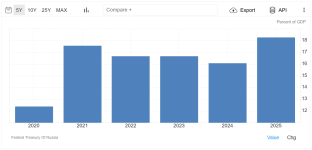
Russia Government Debt to GDP
Russia recorded a Government Debt to GDP of 18.30 percent of the country's Gross Domestic Product in 2025. This page provides - Russia Government Debt To GDP - actual values, historical data, forecast, chart, statistics, economic calendar and news.
 tradingeconomics.com
China Government Debt to GDP
China recorded a Government Debt to GDP of 99.20 percent of the country's Gross Domestic Product in 2025. This page provides - China Government Debt To GDP - actual values, historical data, forecast, chart, statistics, economic calendar and news.
tradingeconomics.com
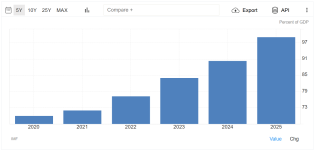
China's Debt-to-GDP is now higher than the UK's.
 So enjoy paying for everything Ukraine destroys. Pretty soon Xi will be renting your bottoms out to Cambodian pig farmers.
Last edited:
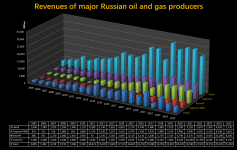
It’s just a fluctuation in the single digits, but I really love watching the pro-Western crowd seethe with rage.I would just point out that, in the first row of your table, Russian production accounts for 11.32 per cent of global production, whereas in the last row it is only 8.54 per cent
If the French want to show some backbone, they should stop using Russian natural gas and oil. You could import Ukrainian coal to fuel your Peugeot cars
—oh, I almost forgot: the Ukrainian coal mines now belong to Russia, so you could just buy that Ukrainian coal from Russia.

Comment had nothing to do with oil sales. Any imbecile has figured out by now that Russia isn't paying for this war itself and there's only really one candidate for who is. Having trouble figuring it out? Let me help.
View attachment 52555Russia Government Debt to GDP
Russia recorded a Government Debt to GDP of 18.30 percent of the country's Gross Domestic Product in 2025. This page provides - Russia Government Debt To GDP - actual values, historical data, forecast, chart, statistics, economic calendar and news.
View attachment 52554China Government Debt to GDP
China recorded a Government Debt to GDP of 99.20 percent of the country's Gross Domestic Product in 2025. This page provides - China Government Debt To GDP - actual values, historical data, forecast, chart, statistics, economic calendar and news.
China's Debt-to-GDP is now higher than the UK's.
I thought I was seeing things, so I checked it over and over again.
What gives Westerners the audacity to compare their government debt with Russia's?
It’s truly remarkable.
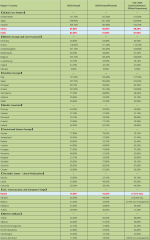
Who the hell are xxx to jump out and pick on Russia’s paltry 18% government debt ratio?
A die-hard fan of the West—where they rack up 100%, 150% debt and call it 'stimulus,'
but an 18% ratio sends you into a moral panic. The audacity.


I forgot to mention that before the founding of the People's Republic of China in 1949, the Soviet Red Army fought—and died—for the Chinese people on this very soil. The friendship between China and Russia is something the inhabitants of a colony could never understand.
Last edited:
Footage of X-39 LMUR missiles being used during combat operations in Ukraine. The video shows an M-28 helicopter attacking a temporary deployment point for drone operators of the 119th Separate Territorial Defense Brigade of Ukraine with an X-39 missile. The video captures the arrival of Ukrainian soldiers in the village of Krasnopolye in the Sumy region.

Crimea placed under ‘state of emergency’ following Ukrainian attacks
Moscow (AFP)
The annexed Crimea has been placed under a regional ‘state of emergency’, local Russian officials announced on Friday, a measure aimed at dealing with the consequences of recent Ukrainian strikes that have caused severe fuel and electricity shortages.
For several weeks, the Ukrainian army has been imposing an energy blockade on Crimea – which was seized by Russian forces in 2014 – by striking infrastructure and tanker lorries supplying the peninsula.
These bombardments have forced the authorities to suspend the sale of fuel to private individuals in Crimea, to impose power cuts, and also to cancel all summer camps scheduled to take place there this summer.
The introduction of the ‘state of emergency’ regime is intended to free up more resources and, in theory, also provides for the possibility of imposing restrictions on the local population.
“The legal framework of the state of emergency allows issues relating to the continued functioning of all essential sectors to be resolved as quickly as possible,” said the Moscow-appointed governor, Sergei Aksyonov, on Telegram on Friday.
In another statement, published on Thursday, he also acknowledged that Crimea was going through “a difficult period” and that “the fuel situation is the most critical”, remarks that contrast with the authorities’ usual assurances.
“I cannot say exactly how long this will take, nor can I publicly disclose the specific action plan. However, we are taking action,” he assured. “Unfortunately (...) there is no air defence system in the world that is absolutely perfect,” he added.
The Ukrainian Security Service (SBU) claimed on Friday that it had struck two Russian naval vessels providing logistical support to the army, as well as air defence systems in Kerch.
“The destruction of the air defence systems paves the way for further precision strikes, whilst the neutralisation of port infrastructure undermines the occupiers’ ability to resupply their troops,” the SBU stated.
“Unusual”
Since the launch of the large-scale offensive against Ukraine in February 2022, the Crimean peninsula, situated in the south of Ukrainian territory and bordered by the Black Sea, has been one of the areas of fighting between the two sides.
The peninsula, which is home to numerous Russian military bases, is regularly targeted by Ukrainian attacks, notably naval strikes that have forced Moscow to withdraw part of its fleet stationed in Crimea.
But this is the first time since 2022 that the peninsula has faced such energy shortages.
“There’s never been anything like this before; it’s not a normal season,” says Alexandre, a 72-year-old Muscovite currently living in Feodosia, in south-eastern Crimea, speaking to AFP remotely.
The man, who does not wish to give his surname, says that explosions and gunfire have been heard at night over the past few days.
Annexed by Russia in 2014, the peninsula is an important political symbol for President Vladimir Putin.
It was notably from Crimea that Russian troops launched their offensive in February 2022 at the start of the large-scale attack on Ukraine.
In recent months, thanks to technological advances in its drone production, Kyiv has stepped up its campaign of strikes against Russia and the Russian-controlled regions of Ukraine.
Russian air defences shot down 660 Ukrainian drones during the night from Thursday to Friday, the Defence Ministry in Moscow announced – one of the highest figures since the start of the conflict.
These drones were destroyed over more than a dozen regions, including the Moscow region, as well as in the annexed Crimean Peninsula, the Black Sea and the Sea of Azov, the ministry said.
Kyiv is targeting energy infrastructure in particular, in order to cut off the flow of hydrocarbon revenues that enable the Kremlin to finance its war effort.
Last week, a Ukrainian attack caused a massive fire at a refinery in south-east Moscow.
Meanwhile, Ukraine and Russia carried out a further exchange of prisoners of war on Friday, involving 160 people from each side, the Russian Defence Ministry announced. Prisoner exchanges are one of the last areas of cooperation between Kyiv and Moscow.
Moscow (AFP)
The annexed Crimea has been placed under a regional ‘state of emergency’, local Russian officials announced on Friday, a measure aimed at dealing with the consequences of recent Ukrainian strikes that have caused severe fuel and electricity shortages.
For several weeks, the Ukrainian army has been imposing an energy blockade on Crimea – which was seized by Russian forces in 2014 – by striking infrastructure and tanker lorries supplying the peninsula.
These bombardments have forced the authorities to suspend the sale of fuel to private individuals in Crimea, to impose power cuts, and also to cancel all summer camps scheduled to take place there this summer.
The introduction of the ‘state of emergency’ regime is intended to free up more resources and, in theory, also provides for the possibility of imposing restrictions on the local population.
“The legal framework of the state of emergency allows issues relating to the continued functioning of all essential sectors to be resolved as quickly as possible,” said the Moscow-appointed governor, Sergei Aksyonov, on Telegram on Friday.
In another statement, published on Thursday, he also acknowledged that Crimea was going through “a difficult period” and that “the fuel situation is the most critical”, remarks that contrast with the authorities’ usual assurances.
“I cannot say exactly how long this will take, nor can I publicly disclose the specific action plan. However, we are taking action,” he assured. “Unfortunately (...) there is no air defence system in the world that is absolutely perfect,” he added.
The Ukrainian Security Service (SBU) claimed on Friday that it had struck two Russian naval vessels providing logistical support to the army, as well as air defence systems in Kerch.
“The destruction of the air defence systems paves the way for further precision strikes, whilst the neutralisation of port infrastructure undermines the occupiers’ ability to resupply their troops,” the SBU stated.
“Unusual”
Since the launch of the large-scale offensive against Ukraine in February 2022, the Crimean peninsula, situated in the south of Ukrainian territory and bordered by the Black Sea, has been one of the areas of fighting between the two sides.
The peninsula, which is home to numerous Russian military bases, is regularly targeted by Ukrainian attacks, notably naval strikes that have forced Moscow to withdraw part of its fleet stationed in Crimea.
But this is the first time since 2022 that the peninsula has faced such energy shortages.
“There’s never been anything like this before; it’s not a normal season,” says Alexandre, a 72-year-old Muscovite currently living in Feodosia, in south-eastern Crimea, speaking to AFP remotely.
The man, who does not wish to give his surname, says that explosions and gunfire have been heard at night over the past few days.
Annexed by Russia in 2014, the peninsula is an important political symbol for President Vladimir Putin.
It was notably from Crimea that Russian troops launched their offensive in February 2022 at the start of the large-scale attack on Ukraine.
In recent months, thanks to technological advances in its drone production, Kyiv has stepped up its campaign of strikes against Russia and the Russian-controlled regions of Ukraine.
Russian air defences shot down 660 Ukrainian drones during the night from Thursday to Friday, the Defence Ministry in Moscow announced – one of the highest figures since the start of the conflict.
These drones were destroyed over more than a dozen regions, including the Moscow region, as well as in the annexed Crimean Peninsula, the Black Sea and the Sea of Azov, the ministry said.
Kyiv is targeting energy infrastructure in particular, in order to cut off the flow of hydrocarbon revenues that enable the Kremlin to finance its war effort.
Last week, a Ukrainian attack caused a massive fire at a refinery in south-east Moscow.
Meanwhile, Ukraine and Russia carried out a further exchange of prisoners of war on Friday, involving 160 people from each side, the Russian Defence Ministry announced. Prisoner exchanges are one of the last areas of cooperation between Kyiv and Moscow.

China's Debt to GDP is 99.2% currently (not 8X%) and rising fast.
tradingeconomics.com
As regards Russia's progress in Ukraine, the frontline has barely moved since the start of May. It's a standstill and daily casualties are consistently over 1200.
China Government Debt to GDP
China recorded a Government Debt to GDP of 99.20 percent of the country's Gross Domestic Product in 2025. This page provides - China Government Debt To GDP - actual values, historical data, forecast, chart, statistics, economic calendar and news.
tradingeconomics.com
As regards Russia's progress in Ukraine, the frontline has barely moved since the start of May. It's a standstill and daily casualties are consistently over 1200.
Unsourced garbage. All those figures are wrong.I thought I was seeing things, so I checked it over and over again.
What gives Westerners the audacity to compare their government debt with Russia's?
It’s truly remarkable.
View attachment 52558
It brings me great joy to see Western supporters looking so flustered. Here, let me tell you about a website—it's called the World Bank.Unsourced garbage. All those figures are wrong.
As regards Russia's progress in Ukraine, the frontline has barely moved since the start of May. It's a standstill and daily casualties are consistently over 1200.
These are the numbers and timing of the body exchanges: red for Russian soldiers, blue for Ukraine.
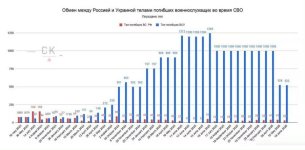
Rate of occupation of Ukraine:
2024: 4,339.26 square kilometers
2025: 6,740.17 square kilometers
There's your problem, AI is not a credible source. Links to original source please. My source was the IMF and you're countering with Google AI? What do you think this is a cartoon?This comes from "Daddy America's" AI, you know—not some stupid Chinese or Russian AI.
Meanwhile, here's something else for Chinese taxpayers to cover.
More false reporting form you. For 2024:View attachment 52579
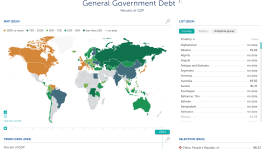
General government gross debt Percent of GDP
The Data of The International Monetary Fund(IMF) official website
It appears that the data show Russia’s debt level is far lower than that of the patron states of certain Western fans. On the map, greener shades indicate lower debt levels, while browner shades indicate higher debt levels.
Oh, what a coincidence — you use IMF data too.
Which IMF exactly are you talking about?
The one you founded?
In fact, refuting a lie full of loopholes does not require AI, the IMF database, or the World Bank database; a middle school student would suffice.


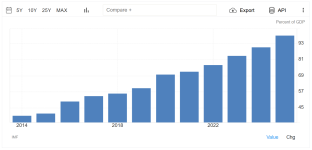
For 2026:
China Government Debt to GDP
China recorded a Government Debt to GDP of 99.20 percent of the country's Gross Domestic Product in 2025. This page provides - China Government Debt To GDP - actual values, historical data, forecast, chart, statistics, economic calendar and news.
tradingeconomics.com
China recorded a Government Debt to GDP of 99.20 percent of the country's Gross Domestic Product in 2025. Government Debt to GDP in China averaged 41.94 percent of GDP from 1995 until 2025, reaching an all time high of 99.20 percent of GDP in 2025 and a record low of 20.40 percent of GDP in 1997.
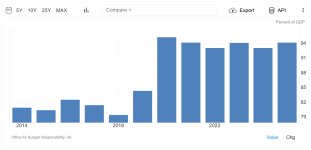
United Kingdom Public Sector Net Debt to GDP
The United Kingdom recorded a Government Debt to GDP of 94.30 percent of the country's Gross Domestic Product in 2025. This page provides - United Kingdom Government Debt To GDP - actual values, historical data, forecast, chart, statistics, economic calendar and news.
tradingeconomics.com
The United Kingdom recorded a Government Debt to GDP of 94.30 percent of the country's Gross Domestic Product in 2025. Government Debt to GDP in the United Kingdom averaged 70.73 percent of GDP from 1948 until 2025, reaching an all time high of 210.70 percent of GDP in 1948 and a record low of 21.60 percent of GDP in 1990.
According to the most recent International Monetary Fund Article IV Consultations in mid-2024, China’s general government borrowing rose rapidly to an estimated 60.5% of GDP in 2024 from 38.5% in 2019. Augmented debt, which includes LGFVs, has increased to 124% of GDP from 86.3%. The share of local government debt rose to more than 60% of GDP from close to 50%. The overall non-financial debt increased to 312% of GDP in 2024 from 245%, putting China among the most indebted countries.
Last edited:
Yes and everybody know debt doesn't stay low during a war. This is because China is funding Russia's war in exchange for a stake in their national assets, hence China's debt is increasing sharply. So, like I said enjoy paying for the damage on your own.It appears that the data show Russia’s debt level is far lower than that of the patron states of certain Western fans. On the map, greener shades indicate lower debt levels, while browner shades indicate higher debt levels.
Last edited:
So you’ve been holed up at home tinkering for ages, and this is the conclusion you’ve arrived at.
More false reporting form you. For 2024:
View attachment 52580
For 2026:
China Government Debt to GDP
China recorded a Government Debt to GDP of 99.20 percent of the country's Gross Domestic Product in 2025. This page provides - China Government Debt To GDP - actual values, historical data, forecast, chart, statistics, economic calendar and news.
View attachment 52586
United Kingdom Public Sector Net Debt to GDP
The United Kingdom recorded a Government Debt to GDP of 94.30 percent of the country's Gross Domestic Product in 2025. This page provides - United Kingdom Government Debt To GDP - actual values, historical data, forecast, chart, statistics, economic calendar and news.
View attachment 52581
Watching you slap your own face is an absolute feast for my kink.
Your Daddy America’s failed choices have left you utterly miserable. You fantasize that I occupy the same social in china role as you at India.
So in truth,
you’ve made three mistakes:
First, of course, you should never have shot your mouth off in front of me, only to get pinned down and schooled by me relentlessly.
Second, you misjudged my personal social position. You assumed I’d get angry at a high debt ratio just like you. Unfortunately for you, the opposite is true — I’m the one using the leverage. 80–90% feels far too low low low for me; China’s real situation stands at 170% to 180%, regardless of the IMF’s so-called 80, 90, 100, or 110... So I really don't know what he's trying to accomplish by just talking to himself and coping like that.ideally, and I am a merchant of death.200–250% would suit me much better For me.
Third, naturally, is the literal meaning. On the IMF chart, a beautifully green Russia and a sickly yellow Europe and America — how utterly delightful.
Last edited:

@Hyperactive ADD
Stop spamming the thread with random charts and uncomfortable fonts and colors. Bring source when possible.
Stop spamming the thread with random charts and uncomfortable fonts and colors. Bring source when possible.

It has already been provided, and I’m literally teaching that guy how to use the so-called IMF right now@Hyperactive ADD
Stop spamming the thread with random charts and uncomfortable fonts and colors. Bring source when possible.
It's called wrong - see sourced IMF graphs on trading economics for details.It brings me great joy to see Western supporters looking so flustered. Here, let me tell you about a website—it's called the World Bank.
Russia was advancing slowly, so bodies end up on their side of the line, so they can reclaim their own corpses.These are the numbers and timing of the body exchanges: red for Russian soldiers, blue for Ukraine.View attachment 52570
Rate of occupation of Ukraine:
2024: 4,339.26 square kilometers
2025: 6,740.17 square kilometers
Jan 2026

Russia’s Grinding War in Ukraine
Despite claims of success in Ukraine, new CSIS data shows that Russia is paying an extraordinary price for minimal gains, with over 1.2 million casualties. Russia is also in decline as a major economic power with slow growth, weak productivity, and declining manufacturing.
Russian battlefield casualties and fatalities are significantly greater than Ukrainian casualties and fatalities—with a ratio of roughly 2.5:1 or 2:1.
April 2026

1:5 kill ratio: Ukraine inflicts heavy Russian losses using drones, says Finnish president - Breaking Defense
Finnish President Alexander Stubb said during his visit to Washington that Ukraine is in a much better place than it has been at any stage of the war thus far.
“I think Ukraine is in a much better place than it has been at any stage in this horrific war — the killing ratio right now is 1:5, one Ukrainian soldier to five Russian soldiers. … The rate at which they’re going now is roughly 150 to 157 dead [Russian] soldiers per square kilometers,” Stubb said during a panel organized by the Brookings Institution on Monday while on an official visit to Washington.
In comparison, a report published in January by the Washington-based Center for Strategic and International Studies found that the ratio of Ukrainian combat casualties and fatalities to Russia’s was roughly half that at 1:2.5 or 1:2.
Russian rate of losses in Ukraine almost triples in one year

Russian rate of losses in Ukraine almost triples in one year
Territorially, Russia is at a standstill in 2026, assessments of its ground war reveal.
The ISW found that Russia advanced by a net 104 sq km (40 sq miles) between January 1 and May 26, 2026, compared to its seizure of 1,619 sq km (625 sq miles) during the same period last year.