After adjusting pixels of available diagrams of TEDBF & AMCA to their dimensions & comparing, we found that their fuselage height is almost same; span & cross section area values are nearby, AMCA's belly spans more for IWB.
The overlay of AMCA's IWB outline shows that TEDBF can be tweaked towards 5gen (which i made last year but couldn’t show yet) or a cleansheet delta-canard jet.
But as AMCA is not made yet, let's see comparison with existing similar tandem bi-plane medium category naval jet design - F-35-C, matching the pixels with dimensions. This can help in understanding transitioning from STOBAR jet design to CATOBAR & explore a STOBAR stealth design.
NOTE - This TEDBF 3D CAD is slightly different from official greyscale images not good resolution.
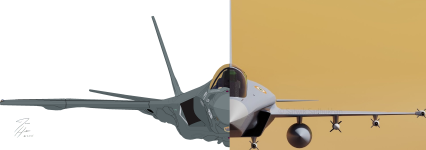
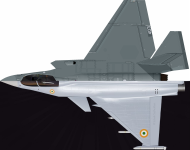
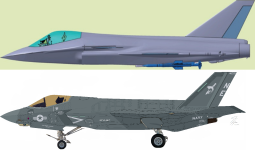
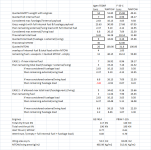
> From diagrams we can notice that -
- Like "Fat Amy", TEDBF looks chubby & voluminous too, but with smaller engines.
- height of both fuselages are near equal,
- From nose to exhaust, TEDBF seems to be longer,
- F-35's fuselage width & wingspan is more due to IWB,
- TEDBF nose is more tapered & drooped,
- F-35's canopy is already big. TEDBF's canopy is way too big.
- Rear half of F-35 packs cool stuff like cooling system, antennas, decoys, APU, counter-measures, etc. A 4gen jet may not have some of these things or not internally.
> Looking at numerical data -
- Total thrusts values look nearby,
- but empty, gross, max weights, IWB load, fuel of TEDBF less than F-35's, perhaps bcoz CATOBAR has the catapult assist not on STOBAR,
- hence the ATWR (A/c Thrust to Weight Ratio) of TEDBF is also more.
- Wing area of F-35-C is more, but its weights increase in bigger ratio, so wing loading is more.
More observations can be made.
> Take-off, gross weight, MTOW -
- Gross weight could be standard CAP config with certain fuel amount & minimum weapons. For my calculations i consider it as empty weight + full internal fuel + max fuselage load, analogous to a stealth jet.
- In peace time light AA, AG, mixed loads are taken, just enough for CAP, to deter aggressors. MTOW is a war time capability which pushes A/c structural limits.
- Common pattern in all fighter jets is observed that MTOW is roughly around or +/- of 2x empty weight.
- MiG-29-K empty weight is 12 tons, quoted MTOW is 24.5 tons. With 2x RD-33MK engine's 88.3 KN thrust, wet T/MTOW = 0.74
- Su-33 empty weight 18.4 tons, quoted MTOW 33 tons, < 2x empty weight. With 2x Al-31F3 engine's 125.5 KN thrust, wet T/MTOW = 0.78
- F-35-C empty weight 15.68 tons, quoted MTOW 31.8 tons. With 1x F135 engine's 190 KN thrust, wet T/MTOW = 0.61
- F-18-E empty weight 14.55 tons, quoted MTOW 29.93 tons, >2x empty weight. With 2x F414 engine's 117 KN thrust, wet T/MTOW = 0.67
- TEDBF empty weight 14 tons, quoted MTOW 26 tons, <2x empty weight, due to STOBAR perhaps. With 2x 414 engine's 117 KN thrust, wet T/MTOW = 0.77
- If aerial refuelling is available then T/o can be done with lesser fuel & more weapons.
- Rear/longer T/o position is suitable for heavier load configs.
> Landing & weight restrictions-
- On the deck side, arresting cables & deck itself are strong enough for stopping upto say 25-27 tons of aircrafts regularly. Structural limits are much higher with 50 tons C-130 landing tests in 1963 but risky & disruptive. Better cables are apparently designed for 6gen jets.
- On the A/c side, that 27 tons becomes red line. Although max "Carrier Landing Weight" CLW of jets range around 63-80% of MTOW depending upon situations & strength of jet structure & cables.
= Su-33 from searches appear to have CLW of 25 tons CLW, 75.75% of MTOW.
= MiG-29K seems to have max CLW of 19.5 tons, 79.59% of MTOW.
= F-35-C seems to have max CLW of 20.86 tons, 65.59% of MTOW.
= F-18E is said to have CLW of 19-22 tons, 63.48-73.5% of MTOW.
= If TEDBF CLW is also taken to be like F-18E then it is 16.5-19 tons.
- All naval jets have "Carrier Bring Back Payload" CBBP (fuel + weapons), calculated as CLW - empty weight.
= It has been observed to be in range of 13-30% of MTOW.
= If heavier beyond CLW, the weapons, especially smart ones are expensive to be jetissoned, so some fuel is dumped.
> Pattern noticed is that -
- While CATOBAR jets with catapult assist have ATWR range in 0.6X, or relatively more weight, less thrust.
- STOBAR jets need more ATWR in range of 0.7X, or more thrust, less weight.
- To tweak TEDBF into 5+G design this ATWR range & CLW range will have to be maintained.



 can be tabulated for comparison, which i tried to do in my AHCA thread. Later people can give whatever gen # they wish for their understanding, 4.1 to 4.9, 5.1 to 5.9


