Twin-Engine Deck Based Fighter (TEDBF)

It was a quite good french langage. Congrats.
Thanks.
I though it was "just" to gain our interest.
Well no , I took French lessons for 4 years in High School & also attended French language classes at Alliance Francaise Mumbai . Spent 3 months as an exchange student in Marseilles after my secondary school examinations .

Skipped out on getting a diploma coz I couldn't sit for the final certificate examinations as around the same time I got admission to an engineering college outside my state where no branch of Alliance Francaise existed.

Practically forgotten most of what I learnt but every time I get a chance to use my French language skills like read articles you guys post I try to read it in the original language just to check how much I recall.
 
5th gen is LM marketing. Use at the beginning for F22, with emphasis on stealth, supercruise, super agility. Then affordability.

Result : F35, a so called 5th gen, is short on supercruise and affordability. Even the agility is questionable.

So..... LM bull shit.

> But my post is on 4gen, not 5gen, forget F-22, F-35, LM in particular. I said clearly that 5gen TEDBF posts in future.
> I don't care about any company in particular. Most citizens (with exceptions) look at technology of a domain & the companies leading in that domain with the products. Like French have led West in Bullet Train with TGV, Leclerc in light western tanks, etc.
> We shouldn't go in circle bcoz everybody knows limits of F-35 & being exported JSF it was made since beginning like that, but F-22 with export ban.
> In my undestanding 5gen primarily or commonly mean stealth, sensor fusion in every 5gen jet, then other features. Beyond this it doesn't bother me if people don't call F-35 5gen but 4.8/4.9gen 🙏:ROFLMAO:
> I try to look at all jets +/- points & imagine a new future jet with all +ve points w/o the -ve points.
> However, like ISO standards, a common global scale of features📏 can be tabulated for comparison, which i tried to do in my AHCA thread. Later people can give whatever gen # they wish for their understanding, 4.1 to 4.9, 5.1 to 5.9 :LOL:

> But then do you mean that FCAS won't be 6gen, i mean better than MLUed F-22 & F-35? Should India leave expectations with FCAS & go towards GCAP?🤔
 
  • Like
Reactions: Rajput Lion
Rafale was never designed for STOBAR ops. TEDBF is being specifically designed for it. Add to that better range and endurance which is certainly desirable for a ship-based combat ac.

But at the end of the day, the overlap between the 2 in terms of capabilities is too great to justify the dev and logistics
cost, imo. Ultimately, it what's inside the airframe that matters.

It would've been a different matter had ADA adopted an incremental design approach (like the KF-21) in terms of fundamental shaping, control surfaces, etc.

But they seem to have regressed in terms of design thinking and adaptability, choosing instead to use the Rafale template.

I'd say a naval version of Ghatak/ISUAV could provide the same or similar capability as TEDBF at a far lower cost (~2 for 1 replacement). Heck, the Chinese are already deploying a GJ-12 UCAV variant at sea.


Imo, ADA could theoretically develop a 5G naval fighter design inside of 5 yrs But for that to happen, the IAF must approve the AMCA design, freeing the design team to concentrate on the naval prog.

We need a complementary system of systems approach, rather than trying to reinvent the wheel with the TEDBF as it is currently designed.

Choosing a Rafale type design was only to derisk the program while highlighting a lack of engine for the same. If we wanted the same capabilities as Rafale on a stealth design, we would need something like SCAF, and it would need 6th gen engines, so that was unrealistic.

The choice was between importing Rafale and designing a stealth jet from scratch or go for a two-step program for the same by eliminating Rafale from the navy's choice.

The IN is also more interested in indigenous jets over imports. They are picking 100 TEDBF over 100 Rafale Ms.
 
  • Like
Reactions: Rajput Lion
As said years ago by a french air force chief of staff : Rafale is not the best in any field, but very good in all.
When the goal is to replace 7 different types of jet of an air force you have to made compromises. And Dassault always made quite light jets so as to be affordable. Rafale is the result of that : an affordable jet, able to make all kind of jobs.
Not for USAF, but mainly for medium air forces. It is so good that even a big air force, IAF, choose it !

Yep.

Rafale comes with shortfalls, but the IAF will have multiple types operational that makes up for any shortfall. Like LCA for scramble time and interception and AMCA for higher order capabilities.

And with ADA pursuing USAF/USN type options, they are not affected by conflicting requirements. TEDBF will be far more suitable for meeting IN's requirements in comparison to Rafale.
 
  • Like
Reactions: Rajput Lion
Choosing a Rafale type design was only to derisk the program while highlighting a lack of engine for the same. If we wanted the same capabilities as Rafale on a stealth design, we would need something like SCAF, and it would need 6th gen engines, so that was unrealistic.

The choice was between importing Rafale and designing a stealth jet from scratch or go for a two-step program for the same by eliminating Rafale from the navy's choice.

The IN is also more interested in indigenous jets over imports. They are picking 100 TEDBF over 100 Rafale Ms.

Considering the INs stated goal of fielding a 5G jet by 2032, I'd say a 2 step solution would've been the logical choice.

If a partnership with France on co-developing the SCAF materializes a few yrs down the line, the IN will waste no time in scrapping TEDBF.
 
  • Like
Reactions: Rajput Lion
Considering the INs stated goal of fielding a 5G jet by 2032, I'd say a 2 step solution would've been the logical choice.

If a partnership with France on co-developing the SCAF materializes a few yrs down the line, the IN will waste no time in scrapping TEDBF.

There's no plan for 5G by 2032.

Even if IN pursues SCAF, TEDBF will go on, 'cause SCAF cannot be meaningfully operated from STOBAR.
 
1748515075765.jpeg

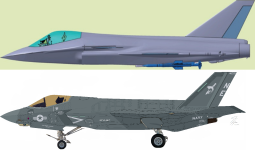
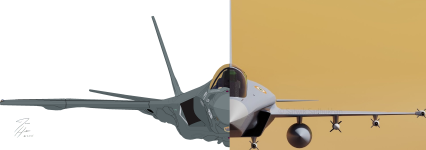
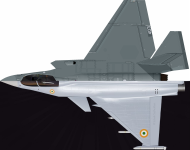
After adjusting pixels of available diagrams of TEDBF & AMCA to their dimensions & comparing, we found that their fuselage height is almost same; span & cross section area values are nearby, AMCA's belly spans more for IWB.

The overlay of AMCA's IWB outline shows that TEDBF can be tweaked towards 5gen (which i made last year but couldn’t show yet) or a cleansheet delta-canard jet.

But as AMCA is not made yet, let's see comparison with existing similar tandem bi-plane medium category naval jet design - F-35-C, matching the pixels with dimensions. This can help in understanding transitioning from STOBAR jet design to CATOBAR & explore a STOBAR stealth design.
NOTE - This TEDBF 3D CAD is slightly different from official greyscale images not good resolution.
1778085042631.png

1778085087195.png

1778085098646.png

1778085307472.png

> From diagrams we can notice that -
- Like "Fat Amy", TEDBF looks chubby & voluminous too, but with smaller engines.​
- height of both fuselages are near equal,​
- From nose to exhaust, TEDBF seems to be longer,​
- F-35's fuselage width & wingspan is more due to IWB,​
- TEDBF nose is more tapered & drooped,​
- F-35's canopy is already big. TEDBF's canopy is way too big.​
- Rear half of F-35 packs cool stuff like cooling system, antennas, decoys, APU, counter-measures, etc. A 4gen jet may not have some of these things or not internally.​

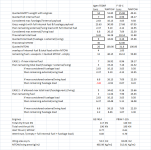
> Looking at numerical data -
- Total thrusts values look nearby,​
- but empty, gross, max weights, IWB load, fuel of TEDBF less than F-35's, perhaps bcoz CATOBAR has the catapult assist not on STOBAR,​
- hence the ATWR (A/c Thrust to Weight Ratio) of TEDBF is also more.​
- Wing area of F-35-C is more, but its weights increase in bigger ratio, so wing loading is more.​

More observations can be made.

> Take-off, gross weight, MTOW -
- Gross weight could be standard CAP config with certain fuel amount & minimum weapons. For my calculations i consider it as empty weight + full internal fuel + max fuselage load, analogous to a stealth jet.​
- In peace time light AA, AG, mixed loads are taken, just enough for CAP, to deter aggressors. MTOW is a war time capability which pushes A/c structural limits.​
- Common pattern in all fighter jets is observed that MTOW is roughly around or +/- of 2x empty weight.​
- MiG-29-K empty weight is 12 tons, quoted MTOW is 24.5 tons. With 2x RD-33MK engine's 88.3 KN thrust, wet T/MTOW = 0.74​
- Su-33 empty weight 18.4 tons, quoted MTOW 33 tons, < 2x empty weight. With 2x Al-31F3 engine's 125.5 KN thrust, wet T/MTOW = 0.78​
- F-35-C empty weight 15.68 tons, quoted MTOW 31.8 tons. With 1x F135 engine's 190 KN thrust, wet T/MTOW = 0.61​
- F-18-E empty weight 14.55 tons, quoted MTOW 29.93 tons, >2x empty weight. With 2x F414 engine's 117 KN thrust, wet T/MTOW = 0.67​
- TEDBF empty weight 14 tons, quoted MTOW 26 tons, <2x empty weight, due to STOBAR perhaps. With 2x 414 engine's 117 KN thrust, wet T/MTOW = 0.77​
- If aerial refuelling is available then T/o can be done with lesser fuel & more weapons.​
- Rear/longer T/o position is suitable for heavier load configs.​
> Landing & weight restrictions-
- On the deck side, arresting cables & deck itself are strong enough for stopping upto say 25-27 tons of aircrafts regularly. Structural limits are much higher with 50 tons C-130 landing tests in 1963 but risky & disruptive. Better cables are apparently designed for 6gen jets.​
- On the A/c side, that 27 tons becomes red line. Although max "Carrier Landing Weight" CLW of jets range around 63-80% of MTOW depending upon situations & strength of jet structure & cables.​
= Su-33 from searches appear to have CLW of 25 tons CLW, 75.75% of MTOW.​
= MiG-29K seems to have max CLW of 19.5 tons, 79.59% of MTOW.​
= F-35-C seems to have max CLW of 20.86 tons, 65.59% of MTOW.​
= F-18E is said to have CLW of 19-22 tons, 63.48-73.5% of MTOW.​
= If TEDBF CLW is also taken to be like F-18E then it is 16.5-19 tons.​
- All naval jets have "Carrier Bring Back Payload" CBBP (fuel + weapons), calculated as CLW - empty weight.​
= It has been observed to be in range of 13-30% of MTOW.​
= If heavier beyond CLW, the weapons, especially smart ones are expensive to be jetissoned, so some fuel is dumped.​

> Pattern noticed is that -
- While CATOBAR jets with catapult assist have ATWR range in 0.6X, or relatively more weight, less thrust.​
- STOBAR jets need more ATWR in range of 0.7X, or more thrust, less weight.​
- To tweak TEDBF into 5+G design this ATWR range & CLW range will have to be maintained.​
 
  • Like
Reactions: Fatalis
Yep.

Rafale comes with shortfalls, but the IAF will have multiple types operational that makes up for any shortfall. Like LCA for scramble time and interception and AMCA for higher order capabilities.

And with ADA pursuing USAF/USN type options, they are not affected by conflicting requirements. TEDBF will be far more suitable for meeting IN's requirements in comparison to Rafale.
I was not what he said.
There is no weakness (*) in Rafale. It is very good in all, even if it is not the best in one dedicated role.

(*) except in SEAD/DEAD role, but it is a choice of France not to developp and adapt a pure anti radar missile on Rafale, not a Rafale weakness. Hammer give a low end solution.... waiting new solution (RJ10).
 
  • Like
Reactions: Rajput Lion
I was not what he said.
There is no weakness (*) in Rafale. It is very good in all, even if it is not the best in one dedicated role.

(*) except in SEAD/DEAD role, but it is a choice of France not to developp and adapt a pure anti radar missile on Rafale, not a Rafale weakness. Hammer give a low end solution.... waiting new solution (RJ10).

Design compromises are weaknesses. Due to the need to make the jet suitable for replacing multiple types and multiple roles, some compromises were made that otherwise wouldn't have been made if multiple types were made for multiple roles.

What that means is if Rafale was a dedicated ASF design, it would have been superior to the current Rafale's air superiority capabilities. Similarly, a dedicated strike jet would have been superior to Rafale's strike capabilities.

So TEDBF is a more naval strike design than Rafale M. TEDBF adds a folded wing for smaller footfall and easier ride on elevators without having to make wingtip adjustments. Larger wing area and larger thrust means it will have more leeway for safer operations and likely a higher bringback load. It will have less focus on air superiority and more focus on strike than Rafale. Overall, it will have less design compromises than Rafale for the maritime strike role. So this is how TEDBF overcomes Rafale's weaknesses on STOBAR carriers.

France would have done an even better job designing the TEDBF for STOBAR performance.
 

With AMCA now in the spotlight and indigenous carrier aviation becoming a major focus area, how does the Navy see the long-term future of deck-based air power and where does TEDBF fit into that roadmap?

“The strategic necessity of Carrier Battle Groups (CBG) was aptly demonstrated during Operation Sindoor. The rapid deployment of a CBG enabled aggressive posturing that forced the adversary’s navy to remain confined to their ports or close to the Makran coast; they never ventured out. The immense, multidimensional combat power centred around the CBG was also recently witnessed by the Hon’ble Prime Minister during his overnight stay on board INS Vikrant.

Deck-based air power remains central to sea control and maritime deterrence. The Navy’s long-term view is that carrier aviation must evolve through a combination of near-term capability, medium-term transition and long-term indigenous development. Rafale Marine addresses our immediate requirement, but the future must be shaped by an indigenous carrier-borne fighter ecosystem to secure our national maritime interests “anytime, anywhere, anyhow.”

TEDBF is an important step towards sovereign carrier aviation capability. The Twin Engine Deck Based Fighter programme is the cornerstone of our long-term roadmap, being pursued as a 4++ generation carrier-borne fighter in close collaboration with the Aeronautical Development Agency (ADA). The niche technologies mastered during LCA (Navy) development, along with the robust industrial base established during that process, are being fully utilised to meet the challenging timelines for TEDBF’s first flight.

Future carrier air wings will increasingly involve the integration of manned fighters, unmanned systems, and multi-domain operational integration into unified operational grids.
 

With AMCA now in the spotlight and indigenous carrier aviation becoming a major focus area, how does the Navy see the long-term future of deck-based air power and where does TEDBF fit into that roadmap?

“The strategic necessity of Carrier Battle Groups (CBG) was aptly demonstrated during Operation Sindoor. The rapid deployment of a CBG enabled aggressive posturing that forced the adversary’s navy to remain confined to their ports or close to the Makran coast; they never ventured out. The immense, multidimensional combat power centred around the CBG was also recently witnessed by the Hon’ble Prime Minister during his overnight stay on board INS Vikrant.

Deck-based air power remains central to sea control and maritime deterrence. The Navy’s long-term view is that carrier aviation must evolve through a combination of near-term capability, medium-term transition and long-term indigenous development. Rafale Marine addresses our immediate requirement, but the future must be shaped by an indigenous carrier-borne fighter ecosystem to secure our national maritime interests “anytime, anywhere, anyhow.”

TEDBF is an important step towards sovereign carrier aviation capability. The Twin Engine Deck Based Fighter programme is the cornerstone of our long-term roadmap, being pursued as a 4++ generation carrier-borne fighter in close collaboration with the Aeronautical Development Agency (ADA). The niche technologies mastered during LCA (Navy) development, along with the robust industrial base established during that process, are being fully utilised to meet the challenging timelines for TEDBF’s first flight.

Future carrier air wings will increasingly involve the integration of manned fighters, unmanned systems, and multi-domain operational integration into unified operational grids.
man imma say this now

this is a paper project that is simply not going to happen. Its just tooo similar to the rafale for it to really matter and by the time India gets enough carriers to buy these at scale it will be the 2040s or even the 2050s by which time a cleansheet design if a lot easier to make.
 
We arent, the TEDBEF became a paper project the moment the rafale deal was signed. Some people here refuse to admit that fact.
Why can't both TEDBF and Rafale be possible? Makes sense to buy some rafale as a stop gap until TEDBF is developed and since this is a project by the Navy, there is more expectations of the project being a success.

We also have to factor in that our Navy currently only possess like 40-45 fighter jets all of it being the Mig 29 which are also known for it's fair share of issues which we either need to replace or fix at least. A common saying is that we need 2-3 aircraft for every continuously deployed aircraft and hence require like 90-120 aircrafts for a two carrier force and 150 if we are going with three carriers, even with 45 Mig 29 and 26 Rafale in the future, we will need more jets and with no other alternatives, the TEDBF might be a plausible solution if we play our cards right, although I do have mixed feeling about it's design.
 
Why can't both TEDBF and Rafale be possible? Makes sense to buy some rafale as a stop gap until TEDBF is developed and since this is a project by the Navy, there is more expectations of the project being a success.

We also have to factor in that our Navy currently only possess like 40-45 fighter jets all of it being the Mig 29 which are also known for it's fair share of issues which we either need to replace or fix at least. A common saying is that we need 2-3 aircraft for every continuously deployed aircraft and hence require like 90-120 aircrafts for a two carrier force and 150 if we are going with three carriers, even with 45 Mig 29 and 26 Rafale in the future, we will need more jets and with no other alternatives, the TEDBF might be a plausible solution if we play our cards right, although I do have mixed feeling about it's design.
TEDBEF in its current 4.5 gen form isnt happening imo. the rafale fulfills almost all the requirement and is available at the moment. Maybe you could argue about upgradability but a 4.5 gen aircraft is only so effective. the TEDBEF is just going to come sooo late that it doesnt matter now.

the vikrant has a max of about 30 aircraft and 5-8 of these will be helis so thats about 22 jets. we need approx 57 jets including spares to arm 2 vikrant class A/C.
the vishal class could probably carry approx 40 jets and 10-15 helis But by the time the vishal is made it would be a lot better to design a 5th gen naval fighter anyway. a 4th gen in the late 2030s or early 2040s is not going to cut it as a new PRIMARY fighter. as a secondary its fine if it gets a massive radar and what not but as a Primary it doesnt make sense.
 
5th gen Naval AMCA instead of 4.5 gen TEDBF?
Bcoz converting an air force design into a deck based fighter is a backside forward way of doing things. Plus, there was a time when IN wanted to join the AMCA but were rejected by the IAF precisely bcoz of that reason. This was before IAF went all-hands in for AMCA and before TEDBF was conceptualised.
TEDBF was conceptualised as a 4.5gen fighter bcoz ADA promised IN that it'll quicker to develop than a clean sheet 5th gen design, and that they'll deliver it by 2031-32. This was circa 2016 and they started the MRCBF tender (for Vikrant's air wing) in 2017. The original target for TEDBF was to replace the ever problematic MiG-29K 2032 onwards, roughly.

IN still needs TEDBF, make no mistake. Whether it'll still remain in its current guise when it meets it's new target for induction (2037-38) or evolves into a 5th gen fighter (the need for which IN explicitly stated last year in one of their seminars around the AI-25 timeframe) remains to be seen. Rafale-M is here to complement MiG-29K and later TEDBF, not replace it.
 
Last edited:
31 More Rafale-Ms? What It Could Mean for India's TEDBF Programme

The first flight of the TEDBF is now expected around 2029–30 due to revised timelines, whereas earlier projections had envisaged an earlier maiden flight. The aircraft is expected to enter service with the Indian Navy around 2038. Currently, the project is at the Cabinet Committee on Security (CCS) stage, with the design phase having been completed.

No idea how reliable this is
 
TEDBF was conceptualised as a 4.5gen fighter bcoz ADA promised IN that it'll quicker to develop than a clean sheet 5th gen design, and that they'll deliver it by 2031-32.
I agree with everything except this, was this really a good choice? I understand weaker countries having no other options but having to buy 4th gen jets or use their existing 4th gen ones for their Navy but when we have already developed a 4th gen jet and operate multiple other similar generation ones, was it the right choice to go for a 4.5 gen for the Navy when we had the capability to design a 5th gen one as evident of the AMCA for the Navy?

I understand that based on our lack of experience with indigenous fighter carrier operation, stealth fighters, engine and need to replace the Mig-29K back then, a 4.5 gen fighter was more realistic than a 5th gen carrier fighter however the timelines of this project is what really determines if this was a good decision or not, if TEDBF entered service in say 2031-32, it would have been a smart decision, if it enters service in say 2038-40 then it wouldn't be one.

One can only hope since Carrier Jets focus more on range, payload and reliability and less on stealth, the TEDBF wouldn't be outdated when it enters service.
 
  • Like
Reactions: PhotonVish
I agree with everything except this, was this really a good choice? I understand weaker countries having no other options but having to buy 4th gen jets or use their existing 4th gen ones for their Navy but when we have already developed a 4th gen jet and operate multiple other similar generation ones, was it the right choice to go for a 4.5 gen for the Navy when we had the capability to design a 5th gen one as evident of the AMCA for the Navy?

I understand that based on our lack of experience with indigenous fighter carrier operation, stealth fighters, engine and need to replace the Mig-29K back then, a 4.5 gen fighter was more realistic than a 5th gen carrier fighter however the timelines of this project is what really determines if this was a good decision or not, if TEDBF entered service in say 2031-32, it would have been a smart decision, if it enters service in say 2038-40 then it wouldn't be one.

One can only hope since Carrier Jets focus more on range, payload and reliability and less on stealth, the TEDBF wouldn't be outdated when it enters service.
Well, the 2nd para of your comment basically summarises the TEDBF programme till date. Given our tech/R&D base is a lot superior than it was in the last decade, the ADA may have had the good sense to evolve the design from a 4.5gen to 5gen design, with the change in timelines. IN always wanted a 5th gen design, so it'll work out in their favour. Too early to comment with certainty.

The range, payload n reliability shouldn't be a problem considering the last design we saw of this jet, it was just a larger Rafale with F-414 engines. Avionics will be borrowed from AMCA (no surprises) and the JV engine too at a later date.

Overall, it's still too early to comment given the lack of information surrounding this programme. All one can do is just wait and watch.
 
Well, the 2nd para of your comment basically summarises the TEDBF programme till date. Given our tech/R&D base is a lot superior than it was in the last decade, the ADA may have had the good sense to evolve the design from a 4.5gen to 5gen design, with the change in timelines. IN always wanted a 5th gen design, so it'll work out in their favour. Too early to comment with certainty.

The range, payload n reliability shouldn't be a problem considering the last design we saw of this jet, it was just a larger Rafale with F-414 engines. Avionics will be borrowed from AMCA (no surprises) and the JV engine too at a later date.

Overall, it's still too early to comment given the lack of information surrounding this programme. All one can do is just wait and watch.
Although no jet is invisible, the early phase of an air campaign would be the attempt to defeat and destroy enemy IADS. That's the primary mission aircrafts like F35 was designed to do, to open the skies for jets with other specialisation. Although radar's are getting more advanced and missiles are getting smarter and faster and a long range VHF radar will help detect jets earlier, the difference in providing accurate tracking and fire control will be significant.

Countries like US, UK, Italy and Japan operate the F35 while China the J35 soon for this very purpose, France and Russia operate the Rafale and Mig-29K + Su-33 for this very purpose while India operate the Mig-29K and Rafale soon, stealth jets these former nations possess will have a greater window to complete their operations than the later ones possess although no one knows the true degree of difference, so I would hope we go with a 5th gen design for the Naval TEDBF instead of the current one especially with the current timelines.

But I guess considering how detection would be difficult for radars when flying near sea levels and future radars being more advanced, there are more nuances we need to consider.
 
  • Like
Reactions: YoungWolf