Indian Ballistic Missile Defence Programme - Updates and Discussions

Depends on the trajectory.
The new ICBM was fired from the Sunan area in Pyongyang at 2:33 p.m. and fell at 3:44 p.m. in the waters after flying about 1,100 km in range and reaching an altitude of 6,200 km during its 71-minute flight, according to the Japanese and South Korean governments.

An ICBM launched by Pyongyang in November 2017 flew 53 minutes and reached an altitude of over 4,000 km.


1000-1200Km is merely the most optimum trajectory for an ICBM to achieve the longest range. But it's not necessary to use that trajectory. NoKo was just making a different point by using higher altitudes, but if a target is 8000Km away and you have a 16000Km missile, you're not necessarily gonna be using a regular trajectory.

What they tested for should cover for most possible applications though. Russian silos or mobile launch pads are typically far enough away that they rely on orbiting the RV bus to achieve range. Newer Chinese ICBMs are more of a problem but there are more than enough assets between PRC and US in the Pacific to take them out at Boost/Ascent phase anyway.

The currently-deployed Chinese deterrent (JL-2 and DF-31) are almost perfectly represented by the ICBM-T2.

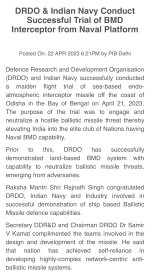
The exo-atmospheric intercept achieved at an altitude of 97 km...

Which means the TGT achieved an altitude of well above 100Km.

Furthermore:
...validated among other things, the improved guidance algorithm used for this test-mission, since the incoming missile target had deviated significantly from what would have allowed an intercept along a typical minimum energy trajectory (MET) for an ABM interceptor. Instead, the PDV test-vehicle had to slam into the target at the far end of its engagement boundary and at a lower altitude than what a ‘standard’ MET intercept would have entailed.

Which implies the intercept was actually planned for well above 100Km, but the TGT deviated.

Another test:
Indeed, the late April test involved a 'near miss' at an altitude of 120 km.

We are talking about an apogee of 150Km at least, if not more.

Anyway, you're on Twitter, just shoot a message to Jha and it will be solved.

The S-400 news there is fake news. Delivery is delayed, but not by years.

Interesting, never read these altitude reports before. Thanks for the links.

Yes, these altitudes should represent a Shaheen-I pretty well. The larger ones (Shaheen-II and above) are still a problem though as their longer range + relative proximity to Indian targets will mean they will have to boost to much higher apogees, and they'd have already achieved a good chunk of terminal velocity by the time they get to ~100km altitude.
 
What they tested for should cover for most possible applications though. Russian silos or mobile launch pads are typically far enough away that they rely on orbiting the RV bus to achieve range. Newer Chinese ICBMs are more of a problem but there are more than enough assets between PRC and US in the Pacific to take them out at Boost/Ascent phase anyway.

The currently-deployed Chinese deterrent (JL-2 and DF-31) are almost perfectly represented by the ICBM-T2.

Sure. I'll give you that. Current GMD capability seems to be focused on countering China, and the Chinese responded by building all those silos to saturate the GMD. I guess countering Russia is still some ways away.

Interesting, never read these altitude reports before. Thanks for the links.

Cheers.

Yes, these altitudes should represent a Shaheen-I pretty well. The larger ones (Shaheen-II and above) are still a problem though as their longer range + relative proximity to Indian targets will mean they will have to boost to much higher apogees, and they'd have already achieved a good chunk of terminal velocity by the time they get to ~100km altitude.

The PDV will obviously see new iterations, Mk1A, 1B etc. Last I heard, the PDV can approach altitudes of 200Km, which should be more than enough to defeat Shaheen II and III. Since THAAD could counter an IRBM with a similar altitude specification, I think PDV will also be a match.
 
The PDV will obviously see new iterations, Mk1A, 1B etc. Last I heard, the PDV can approach altitudes of 200Km, which should be more than enough to defeat Shaheen II and III. Since THAAD could counter an IRBM with a similar altitude specification, I think PDV will also be a match.

Could that be what they're waiting for? Cuz like I said its been nearly 3 years since that proposal to deploy P1 and nothing came of it, except an order for a small quantity of rounds which seems more in line as a replenishment of test articles.

Once you place a large enough production order, it would take a minimum of 2 years, perhaps more, to deliver a large portion of it at least.

But around the 2025 period, we'd already be testing AD-1 & AD-2 against the full range of BM threats, and more than likely an early form of ERADS (indigenous S-400 alternative) would have at least initial tests undergoing.
 
BMD ship

FjiGLB-agAAtCyH


Could that be what they're waiting for? Cuz like I said its been nearly 3 years since that proposal to deploy P1 and nothing came of it, except an order for a small quantity of rounds which seems more in line as a replenishment of test articles.

Once you place a large enough production order, it would take a minimum of 2 years, perhaps more, to deliver a large portion of it at least.

But around the 2025 period, we'd already be testing AD-1 & AD-2 against the full range of BM threats, and more than likely an early form of ERADS (indigenous S-400 alternative) would have at least initial tests undergoing.

P1 has already been deployed. P2 is now about to enter the construction stage, it will face China.

P1 is everything facing Pakistan. It's all there sitting on Google Maps for everybody to see.
 
BMD radar complex, wonder how much is the range. :unsure:

FkTnSr5aYAALOAJ


Range should be above 1500kms or even more than that. Also, despite the above it's amazing that some people still don't believe that Phase 1 is operational, lol.
So, AD-2 won't have any ground based launchers🤦‍♂️

What about missiles coming from over/across the Himalayas? How are they supposed to be intercepted by Indian Navy🤔
 
  • Like
Reactions: marich01
Maybe the Cmdr was saying from naval use pov, I mean its very hard to consider DRDO making only naval launch of AD-2 when we face that threat from the east exclusively. If exo-atmospheric ICBMs are needed to be shot down it will almost certainly come from both the eastern part & chinese subs maybe?
 
Maybe the Cmdr was saying from naval use pov, I mean its very hard to consider DRDO making only naval launch of AD-2 when we face that threat from the east exclusively. If exo-atmospheric ICBMs are needed to be shot down it will almost certainly come from both the eastern part & chinese subs maybe?
Exactly. US has both Naval plus Ground based BMD systems. Our Ad-1 and AD-2 should also be both ground and ship based. Only making it Navy specific doesn't make any sense, IMO.
 
It is just my hunch but I think all the P-15A/B and P-17A/AU will only get the Program LRSAM missiles coupled with MRSAM to provide 2-layered protection .

While the NGD will form and provide the naval BMD network.