Pralay and Shaurya: Conventional Strike Surface-to-Surface Missiles

^ That is from the PIB release ?

Unsure. I don’t see a corresponding PIB post for this. I am seeing this post:


Could be from an earlier post.

However, I found the jet vanes interesting. Will be interesting if we can find something similar for our Prithvi and Agni series. I have never seen test launch doing that trajectory change right at launch with any of our ballistic missiles so far (or at least I don’t remember seeing it)
 
Unsure. I don’t see a corresponding PIB post for this. I am seeing this post:


Could be from an earlier post.

However, I found the jet vanes interesting. Will be interesting if we can find something similar for our Prithvi and Agni series. I have never seen test launch doing that trajectory change right at launch with any of our ballistic missiles so far (or at least I don’t remember seeing it)


Another interesting post!
 
@marich01 @Rajput Lion @Ashwin how capable do you reckon Chinese HQ19 is in terms of intercepting our Pralays? As for HQ9B I doubt it can intercept even Prithvis flying in quasi ballistic trajectory.
Well it's hard to intercept such missile like pralay, the missile files within the atmosphere through it's entire flight path, also it changes it's trajectory which makes the SAM systems harder to lock on into it, and it flies in hypersonic speed which also gives less reaction time, and it has multiple guidance systems, so jamming it makes nearly impossible,
If we see it's similar counter part which is iskander-M, which is giving a very had time to nato sam systems to intercept it, it's interception rate is One of the lowest,
But this doesn't make the missile invisible, but to have higher sucessful interception rate, you need to have networked layered AD systems, simply relying on HQ19 won't always make it, and going by HQ series system performance in operation sindoor where it failed to intercept crystal maze & rampage, it's safe to say you need layered AD system to intercept it,
Well for the Chinese it will be a little concern as they have multiple asset to track & lock into it, but for pakistan it's a threatening missile system, they have to pray to be a good day
 
Last edited:
Another interesting post!
Difference is in the range, prithvi does it for 200-500km max, only the nuke prithvis maybe does shorter haul. Todays HGV is made for several thousands of km travel. Dhvani is for some 5k km min travel.

Prithvi had large control surfaces with electrohydraulic actuation system to control its trajectory shaping. That is what you test for every missile repeatedly (like K4 etc). Only way you can verify performance by analysing data post flight vs the expected. The algo that runs the flight in real time is also trialled via simulation with a lot of data point. Then real time data is verified with it to see where things did not work as planned due to bug in codes (program written based on result derived via Kalman filtering), failure of ema, subsystems etc.

The missiles we make are highly computation centric, which increases the complexity but differs from other general ballistic flight missiles. Western missiles relied upon less such coding, hence the pinpoint injection in the orbit is relied upon there for a dumb RV. That RV can still make minor course adjustment, it has to else cep is not acceptable. But the general idea is high precision is needed for proper pinpoint orbit injection in space for precise targeting on earth surface, then let the gravity do the work. Marv warhead need the guidance, they did that too but to a small scale. We did both feature of guided glide flight to beat enemy bmd.
 
Another interesting post!
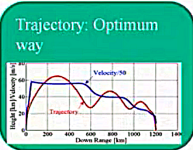
In addition to the above , likely one possible explanation (albeit in a much simplified form , less skip points) of the intended flight trajectory. This is why instead of a curved ballistic slope, it went up almost straight after initial tvc action to orient itself then control actuation engaged for a steep climb flight. I could be wrong as well btw, but such a flight profile is what you would expect from a quasi ballistic article.

1767283027328.png
 

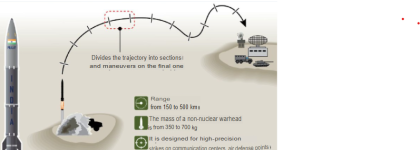
RussianArms(Russian telegram channel) has posted this infographic on Pralay tactical ballistic missile:

To quote Evgeny Damantsev:

"A key feature was the launch of two missiles in a row from a single launcher. Pralay missiles have two stages with solid-propellant rocket charges. The detachable independently targetable warhead has an inertial navigation unit, a GPS correction module, and can optionally be equipped with an active-passive homing homing system for engaging radio-contrast and radio-emitting targets.

The warhead can be controlled during the terminal phase of its trajectory using folding lattice aerodynamic control surfaces. The flight speed at the end of the boost phase reaches 6,480 km/h, while the maneuvering warhead can fly at 1,300-850 m/s. The warhead weight varies from 350 to 750-1,000 kg, which determines the missile's range."

1767459650553.png
My Comments:
From the Graphics and Information shared by Evgeny Damantsev
1. After launch Pralay follows a tailored hypersonic Mach 5 + speed , maneuvering mid-flight in trajectory to avoid getting intercepted by ABM system.
2. Hypersonic flight is atmospheric ,each section of flight trajectory is divided and maneuvers accordingly.
3. During terminal phase it dives into lower trajectory, Pralay then dives up and then does a 90-degree attack at the target possibly to avoid terminal defense system at high Mach 3-4 speed.
4. Range is variable according to the warhead weight it carries.

 

RussianArms(Russian telegram channel) has posted this infographic on Pralay tactical ballistic missile:

To quote Evgeny Damantsev:

"A key feature was the launch of two missiles in a row from a single launcher. Pralay missiles have two stages with solid-propellant rocket charges. The detachable independently targetable warhead has an inertial navigation unit, a GPS correction module, and can optionally be equipped with an active-passive homing homing system for engaging radio-contrast and radio-emitting targets.

The warhead can be controlled during the terminal phase of its trajectory using folding lattice aerodynamic control surfaces. The flight speed at the end of the boost phase reaches 6,480 km/h, while the maneuvering warhead can fly at 1,300-850 m/s. The warhead weight varies from 350 to 750-1,000 kg, which determines the missile's range."

View attachment 48775
My Comments:
From the Graphics and Information shared by Evgeny Damantsev
1. After launch Pralay follows a tailored hypersonic Mach 5 + speed , maneuvering mid-flight in trajectory to avoid getting intercepted by ABM system.
2. Hypersonic flight is atmospheric ,each section of flight trajectory is divided and maneuvers accordingly.
3. During terminal phase it dives into lower trajectory, Pralay then dives up and then does a 90-degree attack at the target possibly to avoid terminal defense system at high Mach 3-4 speed.
4. Range is variable according to the warhead weight it carries.

Very Interesting to See Russians discussing about PRALAY missile
 
RCI opened the dcpp option last year to more participants (we have seen the tender EOI) therefore certain projects can even have more than 2 vendors. Core aim was to have at least 2 dcpp between whom the contract would be split in current fashion.

Main mistake DRDO did with Prahaar is neglecting the need for higher payload. A military guy would have wanted more heavy hit option ie a higher payload. This is why Pralay got 370kg warhead from the start, which ideally should have been 400-450kg imo. But at that heavy payload, it is difficult for the rocket to fly in the quasi ballistic way keeping the same speed profile and maintain control all thru the flight path. You can guess it why, after fuel spent the casing ejected or not, the top section CG changes mid flight so there needs to be optimum balance wrt aerodynamic forces in action mid flight. If the payload is to make some designated maneuver, the penalty for course correction would be greater but no more active thrust possible. Therefore the design should consider certain limit imposed on payload mass.
Also the scientists, academic people would never be in tune with military about the need for higher explosives for destruction. A scientist is ok with 200kg HE laden warhead, where you got like 40-60kg HE with 90kg+ Ta cuboids. For sufficient land attack , it can not cause enough destruction.

User wants everything in its package without understanding the shortfall within the R&D sector, propellant class drdo used then was not up to it. They had better propellant but not to be used in tactical system because enemy would be able to guess about the strategic ones from it. They played it safe. Besides that, Prahaar 6 rockets in pod setup was abysmal, its like training a bloodhound for hunting then making it compete against hunting ability of a huge lion or tiger. That hound would be able to take out a smaller animal, but against a heavy gaur/bison type animal, the lion/tiger ability would dwarf that of the hound. If DRDO had make Prahaar as 3 or 4 in pod with 350-400kg payload each, that system might have had takers.
 
Discussion on Pralay with a brief introduction on Prahar as well:

This is the thing with older retired people, they manage to push every single scientific thing they have read about while doing own research into what they are explaining. The military aspect part he is correct about. But technology aspect, everything is fair game.
He explained digital scene matching, MaRV function, hypersonic scramjet propulsion everything wrt Pralay working method. Usually it is laser altimeter/radio altimeter which might be used in pralay case, instead of digital scene matching.
 
thats toooo low, we need like 10 a month. russia fires like 50 a month. if we can get our production to at least 10 a month with the ability to rapidly expand to 50-100 then it would be really nice. Dont need 50 a month rn cause peace time but we need the ability too rapidly expand.
That's because Solar Group isn't the primary DcPP for Pralay, BDL is.
Also they would need sustained and confirmed orders to scale up production.
 
You might scale up the production line, but would you find enough qualified manpower for the high skilled job part like propellant laying up layer by layer , static test , different qualitative testing, inspection etc ? You need to be explosives handling qualified via a course certificate before even getting into and that is just one of the process out of several dozen of other related mfg like precision machining, fuzing, pyro short, casing. So many things go into making one single article with a specific product code & batch no.

People wanting x nos or y nos naturally have not yet managed to set foot inside the factory or seen the process or the vendors supply chain involvement re the line items. Mere reading a Brahmos poster citing the 300+ vendors will not get you the grand scale measure, just like reading a book about the Himalayas can not be equal to visiting the places by yourself.
Stock is built up over a period of time , that sustained order is there, up to 50% can be given as follow up order every year should the user want it after the initial high volume big ticket contract. But the user need to build up the facilities that can keep the product safe under certain specified condition because rocket motor based missiles are highly sensitive to minute thing like static charge buildup , vibration and so and can go off. Therefore user needs proper facility building for upkeeping, that also takes time and effort to build or upgrade existing facilities , anywhere from 8 months to 42 months or more to just finish the infra work, all of which is done via tendering.
So keep this practical aspect in mind, people who are working in real life are not idle or idiot generally. Certain influence, decisions etc impact any major procurement both in numbers and timeline.
 
thats toooo low, we need like 10 a month. russia fires like 50 a month. if we can get our production to at least 10 a month with the ability to rapidly expand to 50-100 then it would be really nice. Dont need 50 a month rn cause peace time but we need the ability too rapidly expand.
10 a month is what they should do in 2-3 years. We need like 200-300 Pralays facing China ALONE to destroy all of their airbase runways, C2 C4 nodes and supply depots in the beginning stages of a war as well as to keep bombing them if China tries to repair them. Against Pakistan 75-100 Pralays are good, literally 50 precision strikes Pralays will bring them to their knees.
 
You might scale up the production line, but would you find enough qualified manpower for the high skilled job part like propellant laying up layer by layer , static test , different qualitative testing, inspection etc ? You need to be explosives handling qualified via a course certificate before even getting into and that is just one of the process out of several dozen of other related mfg like precision machining, fuzing, pyro short, casing. So many things go into making one single article with a specific product code & batch no.

People wanting x nos or y nos naturally have not yet managed to set foot inside the factory or seen the process or the vendors supply chain involvement re the line items. Mere reading a Brahmos poster citing the 300+ vendors will not get you the grand scale measure, just like reading a book about the Himalayas can not be equal to visiting the places by yourself.
Stock is built up over a period of time , that sustained order is there, up to 50% can be given as follow up order every year should the user want it after the initial high volume big ticket contract. But the user need to build up the facilities that can keep the product safe under certain specified condition because rocket motor based missiles are highly sensitive to minute thing like static charge buildup , vibration and so and can go off. Therefore user needs proper facility building for upkeeping, that also takes time and effort to build or upgrade existing facilities , anywhere from 8 months to 42 months or more to just finish the infra work, all of which is done via tendering.
So keep this practical aspect in mind, people who are working in real life are not idle or idiot generally. Certain influence, decisions etc impact any major procurement both in numbers and timeline.
Even with Brahmos complexity we have produced thousands already, Pralay is relatively simpler to produce, perhaps harder to store. We need to mass produce Pralays at the earliest.
 
Even with Brahmos complexity we have produced thousands already, Pralay is relatively simpler to produce, perhaps harder to store. We need to mass produce Pralays at the earliest.
500 pralay by 2030 is a need, as our premier short range ballistic? Missile.

The ability of our aerial vector being able to penetrate chinese defenses will diminish by a lot, due to their aerial superiority, forcing our jets to rely mostly on standoff munitions for any cross border attack,to compliment this land based rocket/missile force is essential.


Chinese have vast rocket/missile force along with supposed aerial superiority.
 
500 pralay by 2030 is a need, as our premier short range ballistic? Missile.

The ability of our aerial vector being able to penetrate chinese defenses will diminish by a lot, due to their aerial superiority, forcing our jets to rely mostly on standoff munitions for any cross border attack,to compliment this land based rocket/missile force is essential.


Chinese have vast rocket/missile force along with supposed aerial superiority.
We don't have to match their missile numbers, some of them such as DF15 are absolutely horrendous with 100 m CEP, many of them are quite accurate and capable as well. Our Pralays in good numbers will be enough to destroy their airbases in a pre emptive strike and negate their aerial advantage as they do not have 5th generation VTOL aircraft such as F35 which can take off and assertion air dominance without runaways. Their Hotan airbase only has 2 runways.

Our airbases will also likely get destroyed so the entire thing will become a ground war primarily and I have full confidence in the Indian Army to thwart the Chinese.