A booster by definition is meant to be discarded post launch. What's interesting is the reaction control system, suggesting a possible HTK role.
Project Kusha / Programme LRSAM / PGLRSAM
- Thread starter Fatalis
- Start date
You are using an out of date browser. It may not display this or other websites correctly.
You should upgrade or use an alternative browser.
You should upgrade or use an alternative browser.


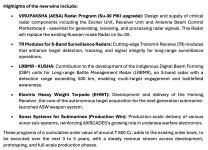

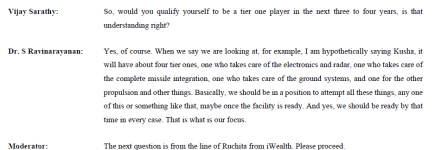
3-4 years for the Kusha orders per BEL , which is what we heard before. Maybe will take little more time unless they mean the M1 only in the first phase. All 3 versions to be ready for induction, it would take significantly longer time perhaps.


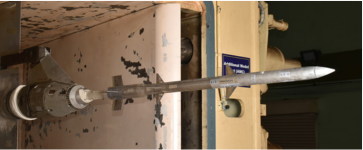
If that is M2 then what is the M1 ? we have seen full drawings of M1B and its parts right ? BDL also showed one model only, the bottom booster M1B part length is 1 meter, 1.1meter approx and 350mm dia which matches with the model in aero show and this, plus the empty casing from pvt co. Top KV is dual pulse 250mm motor casing both P1 and P2. So would be interesting if its the M2. Why would anyone skip M1 and show M2 in the first reveal display ?
below part is booster section or part of the wind tunnel ? I thought its the WT arm
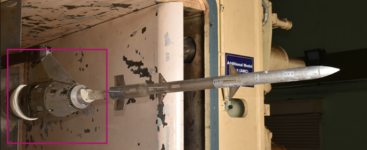
trying to understand from other pics
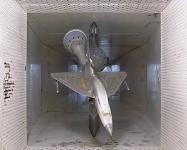
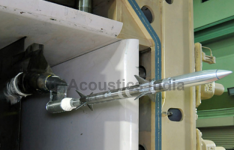

If that is M2 then what is the M1 ? we have seen full drawings of M1B and its parts right ? BDL also showed one model only, the bottom booster M1B part length is 1 meter, 1.1meter approx and 350mm dia which matches with the model in aero show and this, plus the empty casing from pvt co. Top KV is dual pulse 250mm motor casing both P1 and P2. So would be interesting if its the M2. Why would anyone skip M1 and show M2 in the first reveal display ?
below part is booster section or part of the wind tunnel ? I thought its the WT arm
View attachment 45618
trying to understand from other pics
View attachment 45619
View attachment 45620
That’s part of wind tunnel. It’s the arm holding the missile model.
Why do you think it’s M2 and not M1?
Can you post M1B pics here.
hence I asked why its being called M2 and not M1. Simple logic, only 1 design model is publicly shown and this model is same as that one shown by BDL. Plus to cover 150km vs 250km , there would be visible changes in the airframe.Why do you think it’s M2 and not M1?
First test of M1 missile is supposed to take place in this year.hence I asked why its being called M2 and not M1. Simple logic, only 1 design model is publicly shown and this model is same as that one shown by BDL. Plus to cover 150km vs 250km , there would be visible changes in the airframe.
Just 5 months left. Let’s see what happens.
main criteria was to validate the kv performance first, in this regard data from the akash ng tests are already there. next is increasing the engagement zone via the booster. Booster is already proven via brahmos somewhat. So a lot of tools are already proven and existing.First test of M1 missile is supposed to take place in this year.
Just 5 months left. Let’s see what happens.

What will be max altitude of these missiles, given drdo chief said they are s500 equivalent, i just don't see it in these missile.main criteria was to validate the kv performance first, in this regard data from the akash ng tests are already there. next is increasing the engagement zone via the booster. Booster is already proven via brahmos somewhat. So a lot of tools are already proven and exiexisting.
To me, Our s500 equivalent is ad1, ad2 and their guidance systems
frankly no idea until we see all versions. Obviously it is too much to ask a 250mm slim kv to intercept a much higher dia incoming BM akin to what some ABM system like S500 would do. Naval one we can guess as shown by the IN.What will be max altitude of these missiles, given drdo chief said they are s500 equivalent, i just don't see it in these missile.
To me, Our s500 equivalent is ad1, ad2 and their guidance systems

Even AD is smaller imo, perhaps our PDV is akin to S500 (beware this is a noobs assumption bcus I see S500s TEL having 2 canisters containing missiles of large size, in my mind it's similar to our PDV interceptor which is in a similar configuration wtr to TEL).What will be max altitude of these missiles, given drdo chief said they are s500 equivalent, i just don't see it in these missile.
To me, Our s500 equivalent is ad1, ad2 and their guidance systems
those russian missiles being large, also have to do with Russians cheaping out, instead of developing newer more compact missiles they modified/used as base missiles of s300 and s400.Even AD is smaller imo, perhaps our PDV is akin to S500 (beware this is a noobs assumption bcus I see S500s TEL having 2 canisters containing missiles of large size, in my mind it's similar to our PDV interceptor which is in a similar configuration wtr to TEL).
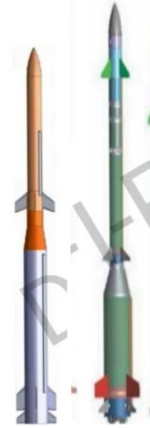
This is the size of ad1 missile
And here's the size comparision of ad1 and m2 missile.
While m2 missile will look longer, but ad1 has larger booster, and thicker KV, and is optimised for altitude over range.
Attachments
bmd ones are usually bigger stages. I forgot the dimension , have to look again. AD2 i think booster stage is more bulky than k4 missile. So AD1 stage is also likely bigger there.

It looks like in the future, technology will be faster with scramjet and more accurate with data link systems. we need to work on the 500 km of Project Kusha. We need to prepare for future missile systems, rather than catching up with the missile technologies of our adversaries. Also add more satellites for surveillance and imaging for military use.
problem with very long range system is that if used in congested airspace esp with air traffic available, it will be hard for the seeker to differentiate between a civil or minor aircraft and a target. Just because there is a blip on radar at very long detection range , you can not fire one straight away. Hence any AD systems detection range & engagement range are different and sometimes intentionally is bragged over.It looks like in the future, technology will be faster with scramjet and more accurate with data link systems. we need to work on the 500 km of Project Kusha. We need to prepare for future missile systems, rather than catching up with the missile technologies of our adversaries. Also add more satellites for surveillance and imaging for military use.
That's where your threat libraries come in, helping your radar or missiles to identify what each object is, and the evolution of data links with the aircraft or drone in the AIR will serve as guidance. We also need to find ways to get things done, and the evolution of scramjet technology needs to be developed further to make it throttleable—that is, to start and stop the engine to reduce the speed and do the trajectory correction.problem with very long range system is that if used in congested airspace esp with air traffic available, it will be hard for the seeker to differentiate between a civil or minor aircraft and a target. Just because there is a blip on radar at very long detection range , you can not fire one straight away. Hence any AD systems detection range & engagement range are different and sometimes intentionally is bragged over.
hence its relying on associated systems ie target tracking, classification, IFF and then decision on whether enemy vector. This associated or enabling technology chain is far bigger/vast than the actual AD missiles and its FCS. Finding that way to get things done is the hard part, it takes at least 15 years to build capability to operate flawlessly at such very long range past your own border & airspace. This includes the entire kill chain set up. Its very high cost to operate and maintain, than to use it in a conflict time.That's where your threat libraries come in, helping your radar or missiles to identify what each object is, and the evolution of data links with the aircraft or drone in the AIR will serve as guidance. We also need to find ways to get things done, and the evolution of scramjet technology needs to be developed further to make it throttleable—that is, to start and stop the engine to reduce the speed and do the trajectory correction.
Second point, its not just starting or stopping the engine and providing a course correction because your target is also highly dynamic high speed. Hence you got a full obc deciding on navigation to provide correct guidance to your vehicle all while keeping control despite making high G maneuver.
Simple example, you have to decide on how the nav & guidance need to work. Do you want a strapdown INS or a gimballed seeker. In both cases there will be separate guidance law involved. Why ? because one is a self-contained system with a very narrow field of view and the other is reliant on gimbal based seeker providing data to obc so a handover is done before the terminal phase.
For INS correct initiation is mandatory else miss distance is too great and almost certainly will miss target interception.
For gimballed seeker there is certain bias between the gimbal axis wrt the missile center axis, so high precision stabilisation is key again else bias is high enough for a large miss distance.
Both of these being done at ranges far beyond medium range 70-100km is extremely difficult on land obviously. So imagine the same for ranges > 250km. Hence its also step by step improvement and establishing each baseline correctly with all associated technology placeholder asset being present (land based, air based or space based). It is not the same as BMD because incoming vectors are not coming from space towards your zone, rather the incoming vectors are flying almost parallel to ground with the Earth curvature and within the atmosphere. Huge difference maker.