Indian Ballistic Missile Defence Programme - Updates and Discussions

Not at all. It is a proper program meant for operational use. It's been deployed operationally. At least the widespread deployment of TELs is starting this year (2022!!! :cool:). Until now it was all stuff developed for testing purposes. P1 even has its own MFCR.

Please do share the reports as this is news to me.

That infographic is misleading. It says AD-1 is more than 1500Km and AD-2 is more than 3000Km because AAD and PDV are below 1500Km and 3000Km respectively.

Also, BMD missiles are specific to the BM type. For example, AAD and PDV are more effective in countering SRBMs and MRBMs than AD-1 and AD-2, because the latter have been developed to operate against a different type. Now, while AD-1 might get away with shooting down an SRBM/MRBM because it's within the atmosphere, although it may struggle, AD-2 will be completely useless against SRBMs and MRBMs because its trajectory is meant for a whole different target.

For example, if you are trying to throw a ball from the ground to a friend on the third floor versus another friend on the first floor, you would need different amounts of force and throwing actions for both floors. Missiles are the same. But the difference between your throwing arm and the missile is you can make the adjustment necessary to use the right amount of force, but a missile using a solid rocket motor cannot do the same. It cannot throttle up or down, so you need a whole new missile to deal with a different target coming in at a different angle and speed.

Point being, P1 and P2 are complementary and both are necessary to protect a target. One protects a target from SRBMs and MRBMs and the other deals with IRBMs.

AD-1 and AD-2 together are designed to counter the entire range of theatre-level ballistic missile threats, all the way from SRBMs to IRBMs, with the AD-1 taking care of the lower-range threats and AD-2 being reserved for higher range ones.

The technologies of P1 are simply not sufficient enough to deliver operational capabilities. We only ever tested either of the AAD or PDV against liquid-fueled Prithvi-based SRBM targets. This type of missile (kinematic equivalent of early SCUDs) has already been phased out by the Chinese and replaced with higher-energy Solid-fuel types (equivalents of Iskander or our Pralay) and the only Pakistani liquid-fuel missile in service is the Ghauri, which anyway is a different class of missile (MRBM). The ascent or terminal characteristics of any of these missiles are vastly different to that of any Prithvi.

We simply never tested the P1 against the type of BM threats we actually face today. We cannot say on the basis of anything we tested that any BMD based on P1 has 'operational' capabilities. The only things we really tested were proofs-of-concept that we can actually track incoming target and guide the interceptor onto said target. Nothing else of operational consequence was really demonstrated,. And without any actual test data, P1 is basically useless against the types of BMs we will actually face.

In fact we will only gain the capability to test against full-range BM threats (all the way from Solid-fuel SRBMs to IRBMs) once we operationalize the DRDO Open Sea Test Range comprising the INS Anvesh with its on-board LRMFR radar (aka ship-based version of IAF's upcoming HPR) + missile launchers for both AD-1 & AD-2, alongside the INS Dhruv performing telemetry tracking to validate the results.

Without such tests being conducted, any claim of a BMD shield being 'operational' is a joke. Imagine if the US were to only test AEGIS/AEGIS Ashore BMD against something the likes of the old liquid-fueled MGM-52 Lance, but declaring it operational against likes of Iskander. Just doesn't work.

The S-400 has little to do with the BMD program, it's meant for a specific IAF requirement driven by the lack of fighter squadrons, Operation Copium-400. I'd say its BMD capability is complementary to the DRDO's as it features far greater tactical mobility and survivability, not necessarily capability. Plus it's proven. I guess the faster induction helps too. The S-400 is still the IAF's coping mechanism. It's primarily about transferring the small number of fighters left to offensive missions and employing a high-risk method of defence instead. If the USAF openly says they have lost conventional deterrence against China, then you can imagine how bad it is for us.

The LRTR meant for P1 was less capable. Due to delays, the LRTR meant for P2 became the main version for both phases.

P1 'deployment' is the coping mechanism. S-400 wasn't meant to deliver BMD capabilities, but the capabilities it does deliver are roughly equivalent if not superior to the AAD i.e. a similar stand-in for the lack of a dedicated system such as PAC-3/THAAD. It's little more than a "better than nothing" situation, not very different to the P1 in that regard.

China has already tested the S-400 in a simulated BMD application, which means more than likely it will be used against the likes of our Pralay SRBM.

 
  • Like
Reactions: Ashwin
Please do share the reports as this is news to me.


AD-1 and AD-2 together are designed to counter the entire range of theatre-level ballistic missile threats, all the way from SRBMs to IRBMs, with the AD-1 taking care of the lower-range threats and AD-2 being reserved for higher range ones.

The technologies of P1 are simply not sufficient enough to deliver operational capabilities. We only ever tested either of the AAD or PDV against liquid-fueled Prithvi-based SRBM targets. This type of missile (kinematic equivalent of early SCUDs) has already been phased out by the Chinese and replaced with higher-energy Solid-fuel types (equivalents of Iskander or our Pralay) and the only Pakistani liquid-fuel missile in service is the Ghauri, which anyway is a different class of missile (MRBM). The ascent or terminal characteristics of any of these missiles are vastly different to that of any Prithvi.

We simply never tested the P1 against the type of BM threats we actually face today. We cannot say on the basis of anything we tested that any BMD based on P1 has 'operational' capabilities. The only things we really tested were proofs-of-concept that we can actually track incoming target and guide the interceptor onto said target. Nothing else of operational consequence was really demonstrated,. And without any actual test data, P1 is basically useless against the types of BMs we will actually face.

In fact we will only gain the capability to test against full-range BM threats (all the way from Solid-fuel SRBMs to IRBMs) once we operationalize the DRDO Open Sea Test Range comprising the INS Anvesh with its on-board LRMFR radar (aka ship-based version of IAF's upcoming HPR) + missile launchers for both AD-1 & AD-2, alongside the INS Dhruv performing telemetry tracking to validate the results.

Without such tests being conducted, any claim of a BMD shield being 'operational' is a joke. Imagine if the US were to only test AEGIS/AEGIS Ashore BMD against something the likes of the old liquid-fueled MGM-52 Lance, but declaring it operational against likes of Iskander. Just doesn't work.


P1 'deployment' is the coping mechanism. S-400 wasn't meant to deliver BMD capabilities, but the capabilities it does deliver are roughly equivalent if not superior to the AAD i.e. a similar stand-in for the lack of a dedicated system such as PAC-3/THAAD. It's little more than a "better than nothing" situation, not very different to the P1 in that regard.

China has already tested the S-400 in a simulated BMD application, which means more than likely it will be used against the likes of our Pralay SRBM.

In your post you accept that AAD is equivalent to S-400 in BMD role. And then you showed how Chinese S-400
intercepted SRBM moving at almost mach 10. So if AAD= S400, as per you, then PDV is much better than S400 in dedicated BMD role.

Secondly, why would Indian government give orders to BDL worth 358 crores if Phase 1 was never meant to be opetational? Hence, in my opinion, BMD phase I of India is fully operational now and highly effective against Pak missile threat. Phase 2 would deal with China and ICBM thread.

PS: PDV MK2(ASAT) can also intercept an ICBM and it's fully operational as well. If you don't agree then lets just agree to disagree👍
 
Not at all. It is a proper program meant for operational use. It's been deployed operationally. At least the widespread deployment of TELs is starting this year (2022!!! :cool:). Until now it was all stuff developed for testing purposes. P1 even has its own MFCR.
BMD phase 1 is stepping stone towards real capabilities according to our requirements which is phase 2.

Phase 1 will be operational but in limited capacity. Like LCA mk1 order while it misses ASQR. AMCA and mk2 will be the real deal with each way significant orders.
 
  • Like
Reactions: Rajput Lion
In your post you accept that AAD is equivalent to S-400 in BMD role. And then you showed how Chinese S-400
intercepted SRBM moving at almost mach 10. So if AAD= S400, as per you, then PDV is much better than S400 in dedicated BMD role.

The Chinese BMD test was simulated, not real (at least as of yet).

When I say equivalent I mean in terms of kinematic capabilities i.e. range & altitude. The real juice of BMD lies in the software.

Secondly, why would Indian government give orders to BDL worth 358 crores if Phase 1 was never meant to be opetational? Hence, in my opinion, BMD phase I of India is fully operational now and highly effective against Pak missile threat. Phase 2 would deal with China and ICBM thread.

PS: PDV MK2(ASAT) can also intercept an ICBM and it's fully operational as well. If you don't agree then lets just agree to disagree👍

In the pic you posted of orders, the specific cost of AAD/PDV is not mentioned.

A single round of PAC-3 costs roughly $8 million, even if ours are only half that price per unit, with Rs. 358 Cr (~$40 million) you're talking about enough funds to buy about 10 of these missiles, let's say 5 AAD and 5 PDV rounds.

Do those numbers sound like something an operational BMD shield would be equipped with? Or do they sound like orders for additional rounds for continuing test launch programs?

For comparison, the Patriot system deployed in Saudi Arabia has an inventory of roughly 650 rounds of PAC-2.
 
Please do share the reports as this is news to me.

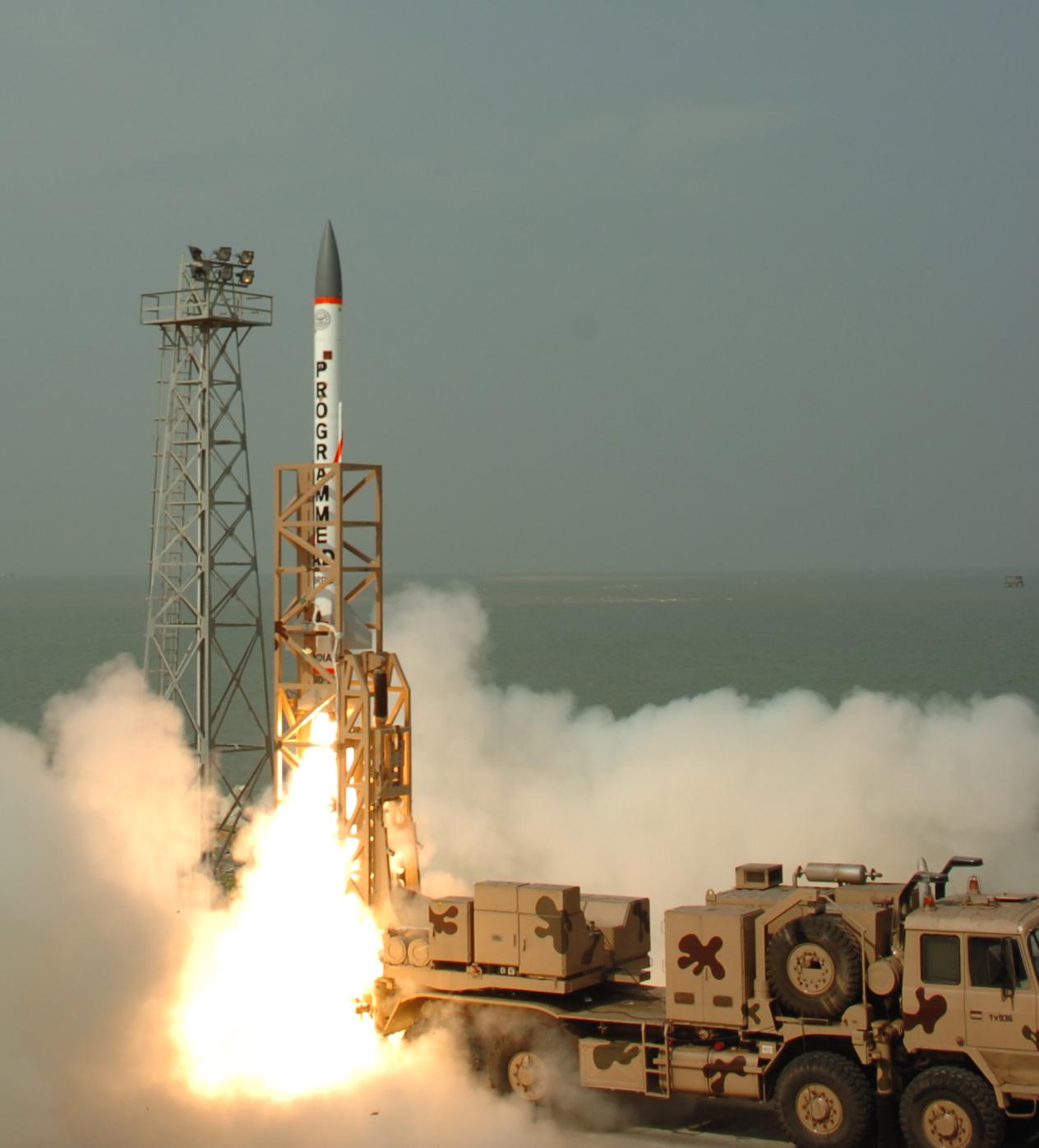
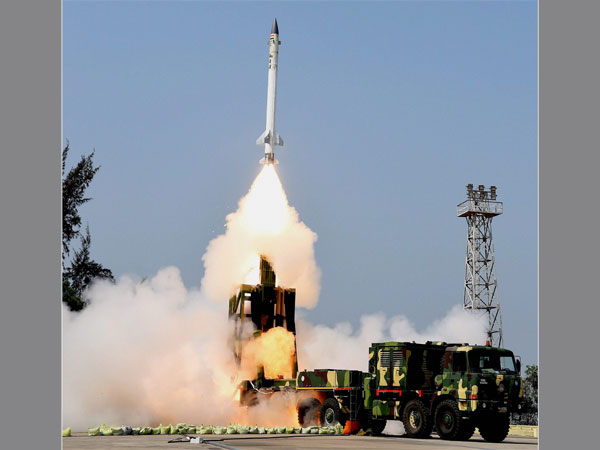
There's nothing in print. Right now, the best clue is missile tests were not conducted from test rigs, but from actual tactical vehicles painted in geography-specific camo.

AAD_Launch_Crop.jpg


aad-1523887332.jpg


It doesn't get any more obvious than this, mate, they are obviously user tests. In fact, the second truck is used to carry Prahar too.

AAD.png

Another clue is BDL getting the serial production orders for the missiles.

AD-1 and AD-2 together are designed to counter the entire range of theatre-level ballistic missile threats, all the way from SRBMs to IRBMs, with the AD-1 taking care of the lower-range threats and AD-2 being reserved for higher range ones.

The technologies of P1 are simply not sufficient enough to deliver operational capabilities. We only ever tested either of the AAD or PDV against liquid-fueled Prithvi-based SRBM targets. This type of missile (kinematic equivalent of early SCUDs) has already been phased out by the Chinese and replaced with higher-energy Solid-fuel types (equivalents of Iskander or our Pralay) and the only Pakistani liquid-fuel missile in service is the Ghauri, which anyway is a different class of missile (MRBM). The ascent or terminal characteristics of any of these missiles are vastly different to that of any Prithvi.

We simply never tested the P1 against the type of BM threats we actually face today. We cannot say on the basis of anything we tested that any BMD based on P1 has 'operational' capabilities. The only things we really tested were proofs-of-concept that we can actually track incoming target and guide the interceptor onto said target. Nothing else of operational consequence was really demonstrated,. And without any actual test data, P1 is basically useless against the types of BMs we will actually face.

In fact we will only gain the capability to test against full-range BM threats (all the way from Solid-fuel SRBMs to IRBMs) once we operationalize the DRDO Open Sea Test Range comprising the INS Anvesh with its on-board LRMFR radar (aka ship-based version of IAF's upcoming HPR) + missile launchers for both AD-1 & AD-2, alongside the INS Dhruv performing telemetry tracking to validate the results.

Without such tests being conducted, any claim of a BMD shield being 'operational' is a joke. Imagine if the US were to only test AEGIS/AEGIS Ashore BMD against something the likes of the old liquid-fueled MGM-52 Lance, but declaring it operational against likes of Iskander. Just doesn't work.

The target missile was highly modified to mimic a plethora of missiles with different trajectories. For example, the standard altitude of Prithvi is just 50Km, but the target missile has been intercepted at a height of 120Km.

As per DRDO, AAD/PDV can defeat not just existing missiles but even future missiles within the designed flight envelope.

P1 is expected to be fully operational in 2023 for the Western component. North and Northeast infrastructure will be built under P2.

Btw, I gotta clear a misconception people have. P1 and P2 are geography specific and not technology specific. P1 is meant to have radars and other capabilities facing Pakistan, whereas the Northern and Northeastern components are part of P2, meant to deal with China, yet to be built. So AAD/PDV are Pak-specific to the point that the threat faced from Pakistan can be dealt with these two missiles alone, which will allow us to make it operational faster, and it began this year. Otoh, the threats faced from China needs AAD/PDV and AD-1/AD-2, and we also needed to build new test sites for the P2 missiles.

P1 'deployment' is the coping mechanism. S-400 wasn't meant to deliver BMD capabilities, but the capabilities it does deliver are roughly equivalent if not superior to the AAD i.e. a similar stand-in for the lack of a dedicated system such as PAC-3/THAAD. It's little more than a "better than nothing" situation, not very different to the P1 in that regard.

China has already tested the S-400 in a simulated BMD application, which means more than likely it will be used against the likes of our Pralay SRBM.


The S-400's new 40N6 gives us superior capability to the AAD. But that's about the limit of its capabilities. If the S-400 gets exo-atmospheric interception capability, that's great, but I don't believe India has that yet or will get that. Even if it happens, it will still not replace P1 because of our need for volumes and also control over the production.

More importantly, we need full control over our BMD systems in order to deal with new threats. We can't go running to the Russians every time we need to change something. This is less of a problem with SAMs dealing with air threats 'cause air threats see constant use and a database is eventually created over time.
 
BMD phase 1 is stepping stone towards real capabilities according to our requirements which is phase 2.

Phase 1 will be operational but in limited capacity. Like LCA mk1 order while it misses ASQR. AMCA and mk2 will be the real deal with each way significant orders.

LCA Mk1 was effectively a pseudo-failure, hence Mk2. AMCA Mk1 and Mk2 are the same aircraft, it's more comparable to PAK FA's Stage 1 and 2 programs. Let's not get into this topic, it's no way related. I hope my post to Parthu will clear your misconception.

P1 will be fully operational next year. So, in a sense, it is only under limited operation today, as crews are trained and new SOPs are created. Like an IOC.
 
The Chinese BMD test was simulated, not real (at least as of yet).

When I say equivalent I mean in terms of kinematic capabilities i.e. range & altitude. The real juice of BMD lies in the software.


In the pic you posted of orders, the specific cost of AAD/PDV is not mentioned.

A single round of PAC-3 costs roughly $8 million, even if ours are only half that price per unit, with Rs. 358 Cr (~$40 million) you're talking about enough funds to buy about 10 of these missiles, let's say 5 AAD and 5 PDV rounds.

Do those numbers sound like something an operational BMD shield would be equipped with? Or do they sound like orders for additional rounds for continuing test launch programs?

For comparison, the Patriot system deployed in Saudi Arabia has an inventory of roughly 650 rounds of PAC-2.
In the screenshot I posted if you minus all other orders with total order(5198.10 crores), then the rest amount is around 358 crores. Yes, we won't get 100 missiles, may 10 or 20 or 30 max. But in my opinion this is LSP and this year they would ramp up production. The screenshot was of last financial years' order log.

@randomradio is damn right. Next year our Phase I BMD would become fully operational(may be even earlier). Anyways, partially it is already deployed.
 
There's nothing in print. Right now, the best clue is missile tests were not conducted from test rigs, but from actual tactical vehicles painted in geography-specific camo.

AAD_Launch_Crop.jpg


aad-1523887332.jpg


It doesn't get any more obvious than this, mate, they are obviously user tests. In fact, the second truck is used to carry Prahar too.

View attachment 25110

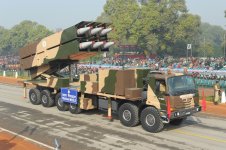
That's nothing to go on really. You have missiles complete with dedicated canisters & camouflaged trucks rolling down Rajpath for missiles like Prahaar, which everyone knows was never inducted or ordered. That doesn't necessarily imply anything.

1920px-Prahaar_Missile.jpg

Another clue is BDL getting the serial production orders for the missiles.

Like I said to Rajput Lion above, the supposed order worth 358 Cr. is barely enough for maybe a dozen rounds, single digits even. That's more than likely to replenish the various test articles that were fired up till now.

If that is a 'production order', then the plan is to shoot down maybe 3-5 Pakistani BMs at most (considering at least 2 ABMs are sent up for each threat to ensure high kill ratio). That's not a "deployment" by any metric.

The target missile was highly modified to mimic a plethora of missiles with different trajectories. For example, the standard altitude of Prithvi is just 50Km, but the target missile has been intercepted at a height of 120Km.

As per DRDO, AAD/PDV can defeat not just existing missiles but even future missiles within the designed flight envelope.

All ballistic missiles are capable of varying their parabolic trajectory depending on where the target coordinates are. The "standard altitude" for a BM is estimated based on its maximum range, but just because it can reach a max of say 300 km doesn't mean it will always only hit targets at that distance...it could be anywhere between 300 down to as low as 50 km. The closer the target, the higher the parabola goes, so higher apogee...pretty standard for a BM.

The point is, the 'special altitude' of Prithvi target doesn't necessarily mean it was simulating something else. As a single-stage missile, there's no way for Prithvi to escape the characteristics that come with being a liquid-fueled platform. It cannot simulate the higher energy & velocities of a solid-fuel counterpart.

If at all P1 ABMs were capable of handling the likes of Shaheen-I/II MRBMs (i.e. the main threat from Pak) it wasn't difficult for us to come up with a target platform based on the Agni-1 or Agni-2. But we never tested or validated P1 against such a target - why?

P1 is expected to be fully operational in 2023 for the Western component. North and Northeast infrastructure will be built under P2.

Btw, I gotta clear a misconception people have. P1 and P2 are geography specific and not technology specific. P1 is meant to have radars and other capabilities facing Pakistan, whereas the Northern and Northeastern components are part of P2, meant to deal with China, yet to be built. So AAD/PDV are Pak-specific to the point that the threat faced from Pakistan can be dealt with these two missiles alone, which will allow us to make it operational faster, and it began this year. Otoh, the threats faced from China needs AAD/PDV and AD-1/AD-2, and we also needed to build new test sites for the P2 missiles.


The S-400's new 40N6 gives us superior capability to the AAD. But that's about the limit of its capabilities. If the S-400 gets exo-atmospheric interception capability, that's great, but I don't believe India has that yet or will get that. Even if it happens, it will still not replace P1 because of our need for volumes and also control over the production.

More importantly, we need full control over our BMD systems in order to deal with new threats. We can't go running to the Russians every time we need to change something. This is less of a problem with SAMs dealing with air threats 'cause air threats see constant use and a database is eventually created over time.

If indeed we deploy a BMD shield, that is a major development on par with stuff like commissioning INS Arihant. It's not something that would/could be brushed under a rug. I don't see the need to extrapolate anything wrt possible deployment of these systems.

I'll stick to my guns in saying P1's purpose was largely technology demonstration and that it was never validated against the kind of missiles it would actually have to shoot down from Pakistan - probably because adequate capability wasn't yet developed at that point. So I fail to see the merit in 'deployment' of such an unproven system, and even if it were true, how it is anything but a knee-jerk coping mechanism due to neighbourhood getting heated all of a sudden and S-400 being delayed.
 
That's nothing to go on really. You have missiles complete with dedicated canisters & camouflaged trucks rolling down Rajpath for missiles like Prahaar, which everyone knows was never inducted or ordered. That doesn't necessarily imply anything.

View attachment 25111

Camo trucks for an official program is not the same as DRDO using the same camo truck for some other non-official program. Tank-Ex?

Like I said to Rajput Lion above, the supposed order worth 358 Cr. is barely enough for maybe a dozen rounds, single digits even. That's more than likely to replenish the various test articles that were fired up till now.

If that is a 'production order', then the plan is to shoot down maybe 3-5 Pakistani BMs at most (considering at least 2 ABMs are sent up for each threat to ensure high kill ratio). That's not a "deployment" by any metric.

We do not know the size of the BDL order. He's just guessing.

All ballistic missiles are capable of varying their parabolic trajectory depending on where the target coordinates are. The "standard altitude" for a BM is estimated based on its maximum range, but just because it can reach a max of say 300 km doesn't mean it will always only hit targets at that distance...it could be anywhere between 300 down to as low as 50 km. The closer the target, the higher the parabola goes, so higher apogee...pretty standard for a BM.

The point is, the 'special altitude' of Prithvi target doesn't necessarily mean it was simulating something else. As a single-stage missile, there's no way for Prithvi to escape the characteristics that come with being a liquid-fueled platform. It cannot simulate the higher energy & velocities of a solid-fuel counterpart.

If at all P1 ABMs were capable of handling the likes of Shaheen-I/II MRBMs (i.e. the main threat from Pak) it wasn't difficult for us to come up with a target platform based on the Agni-1 or Agni-2. But we never tested or validated P1 against such a target - why?

I'm going by what DRDO is saying. As per them, AAD/PDV can defeat any SRBM/MRBM in existence today.

There is no need to test it against an Agni class simply because the Prithvi class can simulate an Agni based on what you already mentioned, ie, changing trajectory. The test missile is based on the Prithvi III, so the second stage can be modified for a different use. The SM-2 and SM-3 use the same first and second stage. It's only the third stage that changes things for the SM-3, and you can see how much of a difference that makes.

If indeed we deploy a BMD shield, that is a major development on par with stuff like commissioning INS Arihant. It's not something that would/could be brushed under a rug. I don't see the need to extrapolate anything wrt possible deployment of these systems.

I'll stick to my guns in saying P1's purpose was largely technology demonstration and that it was never validated against the kind of missiles it would actually have to shoot down from Pakistan - probably because adequate capability wasn't yet developed at that point. So I fail to see the merit in 'deployment' of such an unproven system, and even if it were true, how it is anything but a knee-jerk coping mechanism due to neighbourhood getting heated all of a sudden and S-400 being delayed.

Phase 1 is just Pak-facing BMD infrastructure. Phase 2 is China-facing. You can see it on Google Maps. The radars are simply facing towards the Pak side.

Anyway, 2020.
Asked if the shield is not meant for Mumbai, the country’s financial capital, the top government official quoted above said, “BMD is for Delhi. It is up to the government to decide which other cities will get it.”

It's part of the Delhi Defence Plan, for now. Approval in 2020, with production in 2021 would mean some amount of inductions by now, not counting test articles that can be operationalised due to the emergency situation.
 
What about davidsling & Arrow series?

Israel's threatened by Iran's SR/MRBMs. They are both AAD/PDV equivalents. Both being newer designs should be more capable. Arrow-3 is said to be similar to PDV as well, ie, 100-150Km ceiling.
 
Camo trucks for an official program is not the same as DRDO using the same camo truck for some other non-official program. Tank-Ex?

The pic of AAD you posted before is actually from the system's first-ever test done in 2007. There's no way it was a 'user trial' just because it happened with a camo truck. Almost all developmental trials of tactical missiles launch from camo trucks, including latest Pralay on its maiden test.

I'm going by what DRDO is saying. As per them, AAD/PDV can defeat any SRBM/MRBM in existence today.

There is no need to test it against an Agni class simply because the Prithvi class can simulate an Agni based on what you already mentioned, ie, changing trajectory. The test missile is based on the Prithvi III, so the second stage can be modified for a different use. The SM-2 and SM-3 use the same first and second stage. It's only the third stage that changes things for the SM-3, and you can see how much of a difference that makes.

There is no BMD shield in the world that would be validated based on surrogate testing alone. That's good enough for proofs of concept, but not much else.


There's a reason we went for actual HTK against a satellite instead of resorting to a simple Point-in-Space test (which btw would have been so much easier to explain away at the international stage). If you want hard data on which operational systems can be built, you need to do real world testing.

You can bet there will be Pralay & Agni-series TGT missiles being shot out of the sky by AD-1 and AD-2 in the years to come. That's real capability demonstration.

Anyway, 2020.
Asked if the shield is not meant for Mumbai, the country’s financial capital, the top government official quoted above said, “BMD is for Delhi. It is up to the government to decide which other cities will get it.”

It's part of the Delhi Defence Plan, for now. Approval in 2020, with production in 2021 would mean some amount of inductions by now, not counting test articles that can be operationalised due to the emergency situation.

Like I said, I'm not seeing anything to suggest this wasn't a knee-jerk reactionary proposal. Still don't know if GoI actually approved it or not.

It still doesn't change that P1 never really demonstrated the kind of capabilities you need to definitively defend against likes of Shaheen-series though.
 
  • Like
Reactions: suryakiran
BMD is for Delhi. It is up to the government to decide which other cities will get it.”

Doesn't solve the purpose of BMD then if it is just for Delhi. Delhi will fall within minutes if rest of the nation falls. keep your BMD in your *** if no whole nation is protected. We don't need BMD. If they make these policies then Indian should rather side with the enemy to f*** these b*stards sitting in Delhi protecting only themselves.
 
Doesn't solve the purpose of BMD then if it is just for Delhi. Delhi will fall within minutes if rest of the nation falls. keep your BMD in your *** if no whole nation is protected. We don't need BMD. If they make these policies then Indian should rather side with the enemy to f*** these b*stards sitting in Delhi protecting only themselves.
I don't know why you are getting high, when our politician getting billion dollar private jet & while IAF is crying for AWACS, you guys were sleeping. Then why now?
 
I don't know why you are getting high, when our politician getting billion dollar private jet & while IAF is crying for AWACS, you guys were sleeping. Then why now?

Let these bureaucrats retire from their posts no one will help them and wherver they go people will ignore them. That should be their punishment. Exclude them from this society. More over Politicians of well, these jokers will be haunted by local gali ka gunda once they lose elections.
 
The pic of AAD you posted before is actually from the system's first-ever test done in 2007. There's no way it was a 'user trial' just because it happened with a camo truck. Almost all developmental trials of tactical missiles launch from camo trucks, including latest Pralay on its maiden test.

Yeah, that's the old PAD test.

Interceptor-takeoff-View-3.jpg

The above is apparently in the final configuration for deployment for AAD.

There is no BMD shield in the world that would be validated based on surrogate testing alone. That's good enough for proofs of concept, but not much else.


There's a reason we went for actual HTK against a satellite instead of resorting to a simple Point-in-Space test (which btw would have been so much easier to explain away at the international stage). If you want hard data on which operational systems can be built, you need to do real world testing.

You can bet there will be Pralay & Agni-series TGT missiles being shot out of the sky by AD-1 and AD-2 in the years to come. That's real capability demonstration.

The Americans test their BMD using a surrogate missile.

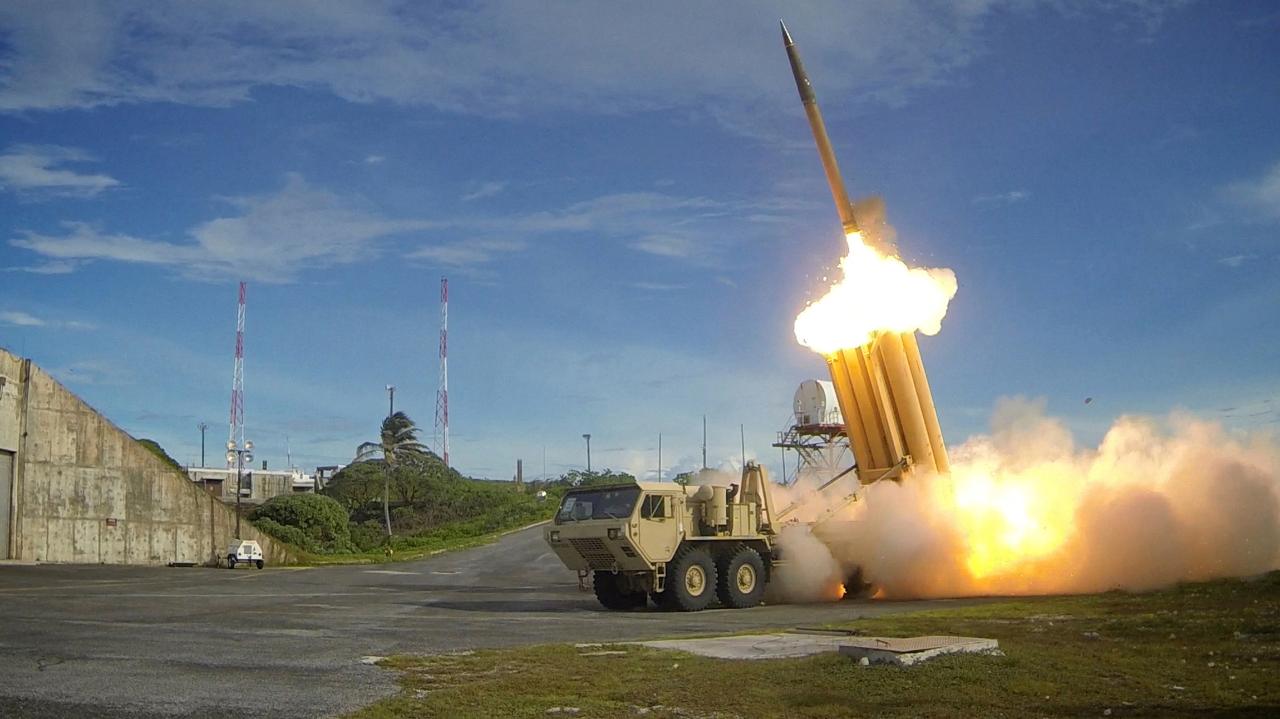
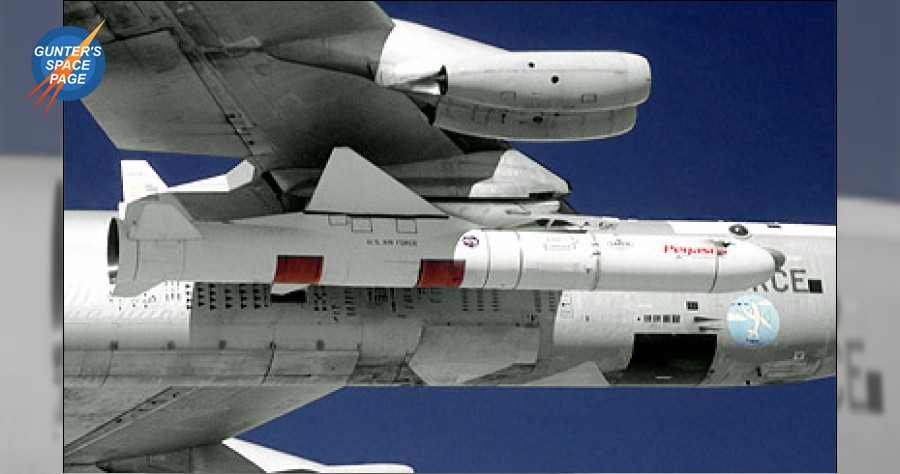
The U.S. on Tuesday test-fired its THAAD anti-ballistic missile system from Alaska that successfully intercepted a target missile launched from an Air Force Cargo plane north of Hawaii.

Never heard of an ICBM launched from a C-17.

Your link also says: "threat-representative Intercontinental Ballistic Missile (ICBM) target"
Yeah basically like LCA mk1.

Lol, no. LCA Mk1 is a failure, so there's Mk1A and Mk2.
 
Doesn't solve the purpose of BMD then if it is just for Delhi. Delhi will fall within minutes if rest of the nation falls. keep your BMD in your *** if no whole nation is protected. We don't need BMD. If they make these policies then Indian should rather side with the enemy to f*** these b*stards sitting in Delhi protecting only themselves.

For civilian targets, protecting metro cities is the most important. That's where all of our brain power and GDP comes from. Delhi and Mumbai are the topmost priority. Then comes ports, like Chennai and Kolkata, followed by money-makers like Bangalore, Pune and Hyderabad. Followed by some important industrial clusters. Everything else can be rebuilt.

If the leadership dies, the country falls. If the country falls, but the leadership survives, the country can be rebuilt. So protecting the leadership is the most important.

Also, deploying BMD is a politically-charged decision. An enemy can attack you pre-emptively simply for deploying one. So the decision has to be made carefully. It's why the US and SU had the ABM Treaty.
 
Yeah, that's the old PAD test.

View attachment 25130

The above is apparently in the final configuration for deployment for AAD.

I'm yet to see test launch of any tactical missile (i.e. anything that can fit on a 12x12 or smaller vehicle) that doesn't happen from a camo truck.

As you can see, the truck even in this pic of latest AAD config clearly has DRDO markings all over. This is not an Army truck, and this isn't a 'user trial' by any means.

The Americans test their BMD using a surrogate missile.

The U.S. on Tuesday test-fired its THAAD anti-ballistic missile system from Alaska that successfully intercepted a target missile launched from an Air Force Cargo plane north of Hawaii.

Never heard of an ICBM launched from a C-17.

THAAD isn't meant to intercept ICBMs and they never claimed it was.

"THAAD defends against short, medium, and intermediate-range ballistic missiles"


IRBMs is as high as it goes - and that's what the missile launched from C-17's cargo hold was, a solid-fuel IRBM class target missile built by OSC, Northrop & Orbital ATK (bottom row, second from right):


(It was either that or Northrop's own IRBM class target which is also of similar dimensions)

THAAD is a terminal-stage interceptor so the type of launch platform hardly matters - its just the kinematics of the missile during its terminal stage (where it's just the RV tumbling toward target) that matter.

Your link also says: "threat-representative Intercontinental Ballistic Missile (ICBM) target"

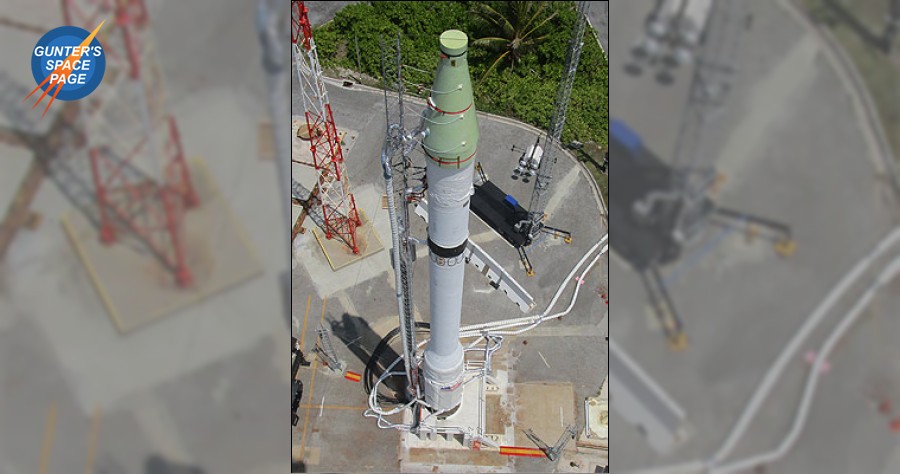
Yeah it was likely this:


Using a Trident-I ICBM boost stage, it can perhaps simulate too well missiles like the DF-31 or JL-2, which are among the longest-ranged types that an AEGIS ship would likely be tasked to intercept during ascent phase.

They didn't test against a 300-km ATACMS and claim it was representative of a Chinese/Russian IRBM or ICBM - which would have been akin to what we're doing.