Pralay and Shaurya: Conventional Strike Surface-to-Surface Missiles

IMO, its not worth to make "air launched" weapon with 1000km or more range.
Viability/utility of a weapon system is up to the user and designers. We can not tell from outside.
As i have explained before above, do not think about using over land area to pak/china etc, rather think about using the same over the IOR/BoB area vast south part upto the south pole. The more further you have standoff weapons for, the more away from harm you will be.
 
  • Like
Reactions: babablacksheep
Why did India use Air launched Bhramos instead of surface ? In operation sindhoor.
Because of its unique launch vector, BrahMos-A is very hard to intercept plus we didn't want Pak to get confused regarding any surface to surface missile launch being deemed nuke tipped.

In a full-scale war, BrahMos would be launched from all three domains be it terra, aqua or aura. But for a limited conflict, BrahMos-A was the right choice because of its launch vector, stealth and surprise effect along with wearing down P0rkies psychologically.
 
  • Like
Reactions: Sathya
No, I am saying if Pralay airframe is modified to create some 800km variant air launched LRSOW R4 then it is a possibility, it is feasible to make such a long range standoff weapon to hit a target from 800km away and launched from a jet which is a huge capability. Do not think about just in land attack mode ie Su30 with such a weapon system over the land area. Rather think about Su30 with such standoff weapon over the vast IOR area and you can understand the strategic force multiplier of such a capability.

This is just for the basic design part. How the missile is made to fly, in which trajectory, how fast , how target acquisition is done, ability to deceive enemy air defence and keeping datalink comm, long range navigation & guidance are where it would differentiate from another (plus the cost , utility etc) missile system. Then it is upto the mission commander to decide which choice is to use depending on battlefield situation. That part is what I can not tell because its a practical war use aspect I do not know much about.
Its a 5 ton missile. Don't think SU 30 can carry it on a single hard point?

Maximum single hard point carry capacity for SU 30 MKI is 2 5 tons , which is half of what a single Pralay weighs.
 
Rudram 4/LRSOW approval will mean "development will "start".
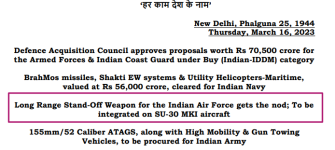
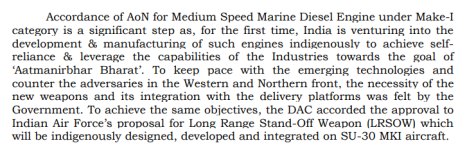
One thing I omitted before, LRSOW approval was granted by DAC back in 2023 as it was IAF proposal , and there only mentioned about Su30 integration. So there is a chance it might not be multi platform at first , which in turn increases the possibility of being a heavy standoff weapon Brahmos ALCM weight class possibly using the same launcher (who knows) and datalink.

link; https://mod.gov.in/sites/default/files/pre17323_1.pdf

1755408596401.png
1755408531909.png

This gives rise to many probable cases

==> a subsonic alcm , tech for which exist from Nirbhay and ITCM plus stfe derivative can be proven.
pro: long range achievable than other options , higher payload 300-500kg possible due to jet fuel use (less weight) , offer stealthy terrain hugging flight
con: mission time is very long compared to high speed vectors

==> a supersonic Brahmos derivative for 800km LR , which is already in the work as per DRDO (for the land/ship version initially)
pro: proven system , ER version already inducted, minimal training and sourcing needed
con: while much higher speed than subsonic, mission for 800km can be self defeating as enemy gets more time to react esp for air launched version case

==> the HCM , tech for which is in the works as scramjet dev.
pro: most suitable for long range mission
con: extremely difficult tech wise, first the ground launch version is made and proven then air launch version is made from that base so time consuming , very costly

==> an upgraded ramjet mode ALCM based on STAR , also on the work and can offer a higher speed compared to existing Brahmos
pro: some improvement over existing ER-Brahmos due to localised ramjet, higher speed
con: like the scramjet will need to be proven via ground based test firing first hence time consuming, no acknowledged test has taken place so far even if it is very close

==> a solid rocket motor based ballistic system , Rudram series is based on & the most mature tech base at drdo , highly likely
pro: already existing enabling tech base , control guidance law and incremental development possibility , introduction of 3 pulse/ multi pulse tech and airframe weight reduction measure being implemented
con: air launched version has limited weight increment option due to delivery platform load carrying capacity so high restriction apply , can not weigh more than 2.2-2.4 ton hard cap. Hence a limited but feasible scope exists.

==> a hybrid propulsion motor , HEMRL has been working to prove this for some time for the futuristic systems
pro: offers higher specific impulse so less fuel needed or range increased or payload increment , or all of the same.
con: still in development, no word on proven BEM firing , then matured tech cleared for product development

==> A new niche tech like pulse detonation engine, RDE or pulsejet application
pro; will expand the technology base available to formulate a new weapon system
con: all 3 tech are likely still in nascent stage, not much information is known except DRDL testing some rotating detonation module. Likely for future use and no immediate scope.
 
Its a 5 ton missile. Don't think SU 30 can carry it on a single hard point?

Maximum single hard point carry capacity for SU 30 MKI is 2 5 tons , which is half of what a single Pralay weighs.
Its also 10 meter long which is not feasible for air launch. Possibly the news story may be wrong and what can be done is a ship based version which can serve nearly the same purpose.
 
Its also 10 meter long which is not feasible for air launch. Possibly the news story may be wrong and what can be done is a ship based version which can serve nearly the same purpose.
Pralay is 9m long. Specifically 9060mm.
Brahmos A's length is quoted to be 8.4 meters.
 

Attachments

  • images (14) (4).jpeg
    images (14) (4).jpeg
    24.6 KB · Views: 9
  • Like
Reactions: TARGET
RudraM 4 seems the most likely ALBM currently in development, others (R2,R3) are reaching final stages of development.
IMO, R4 is probably based on the same Technologies from Pralay (Materials, propulsion etc). Ofc they will make changes in dimensions of airlaunched version.

If not this way, Maybe IAF want an ALBM that can be launched from IL-76, C130J like platforms.

It's still too early, we need more information.
 
  • Like
Reactions: babablacksheep
Pralay is 9m long. Specifically 9060mm.
Brahmos A's length is quoted to be 8.4 meters.
Yeah around that, a size that took considerable effort to being reduced and fit on su30 as jugaad by using 2 hardpoints together, extra load capable hardened and the launcher itself weigh 450kg. So while it was force multiplier, the development process was on need basis from scientific standpoint , somewhat unique case. This is due to no prior experience of making an air launched missile, hence everything was done in a fit for the occasion basis, not some uniform process that would cater for progressive development curve.

Here we are talking about reducing an even greater article that has complete different aerodynamics involved from stabilisation & CG point for a safe release from a moving jet.
 
One thing I omitted before, LRSOW approval was granted by DAC back in 2023 as it was IAF proposal , and there only mentioned about Su30 integration. So there is a chance it might not be multi platform at first , which in turn increases the possibility of being a heavy standoff weapon Brahmos ALCM weight class possibly using the same launcher (who knows) and datalink.

link; https://mod.gov.in/sites/default/files/pre17323_1.pdf

View attachment 45908
View attachment 45907

This gives rise to many probable cases

==> a subsonic alcm , tech for which exist from Nirbhay and ITCM plus stfe derivative can be proven.
pro: long range achievable than other options , higher payload 300-500kg possible due to jet fuel use (less weight) , offer stealthy terrain hugging flight
con: mission time is very long compared to high speed vectors

==> a supersonic Brahmos derivative for 800km LR , which is already in the work as per DRDO (for the land/ship version initially)
pro: proven system , ER version already inducted, minimal training and sourcing needed
con: while much higher speed than subsonic, mission for 800km can be self defeating as enemy gets more time to react esp for air launched version case

==> the HCM , tech for which is in the works as scramjet dev.
pro: most suitable for long range mission
con: extremely difficult tech wise, first the ground launch version is made and proven then air launch version is made from that base so time consuming , very costly

==> an upgraded ramjet mode ALCM based on STAR , also on the work and can offer a higher speed compared to existing Brahmos
pro: some improvement over existing ER-Brahmos due to localised ramjet, higher speed
con: like the scramjet will need to be proven via ground based test firing first hence time consuming, no acknowledged test has taken place so far even if it is very close

==> a solid rocket motor based ballistic system , Rudram series is based on & the most mature tech base at drdo , highly likely
pro: already existing enabling tech base , control guidance law and incremental development possibility , introduction of 3 pulse/ multi pulse tech and airframe weight reduction measure being implemented
con: air launched version has limited weight increment option due to delivery platform load carrying capacity so high restriction apply , can not weigh more than 2.2-2.4 ton hard cap. Hence a limited but feasible scope exists.

==> a hybrid propulsion motor , HEMRL has been working to prove this for some time for the futuristic systems
pro: offers higher specific impulse so less fuel needed or range increased or payload increment , or all of the same.
con: still in development, no word on proven BEM firing , then matured tech cleared for product development

==> A new niche tech like pulse detonation engine, RDE or pulsejet application
pro; will expand the technology base available to formulate a new weapon system
con: all 3 tech are likely still in nascent stage, not much information is known except DRDL testing some rotating detonation module. Likely for future use and no immediate scope.
How long we can use MKI for all these? What will be the case of MKI retirement?
We need a strategic bomber to carry these weapons in future.
 
Just put some in space. It's not like you have to announce it. Just make a satellite, in which their are 2-3 such weapons.

A bit of booster to get into atmosphere and heat resistant material during drop.

Only the initial boost might need complex engineering, rest of tech is already either deployed or in development.

Imagine, a satellite tearing apart and out comes 2 heavy warhead missiles. You can reduce the interception period. Maybe a glide vehicle or 2part system.

I doubt that USA and China already don't have some out in space. Maybe not nuclear but definitely, a massively destructive ones.

Or is there someone monitoring every satelite launched for its internal structure.
 
Yeah around that, a size that took considerable effort to being reduced and fit on su30 as jugaad by using 2 hardpoints together, extra load capable hardened and the launcher itself weigh 450kg. So while it was force multiplier, the development process was on need basis from scientific standpoint , somewhat unique case. This is due to no prior experience of making an air launched missile, hence everything was done in a fit for the occasion basis, not some uniform process that would cater for progressive development curve.

Here we are talking about reducing an even greater article that has complete different aerodynamics involved from stabilisation & CG point for a safe release from a moving jet.
Let's say instead of reducing the size, we create a 2.5 ton missile, with ~800km range, and flies in skip-glide/HCM kinda trajectory based on shaurya's base tech?
With midcourse speeds of mach5+.
Can we?
 
  • Like
Reactions: CATS @hunter
Just put some in space. It's not like you have to announce it. Just make a satellite, in which their are 2-3 such weapons.
Even the Rus is not willing to do that as of now, and us ? space weaponisation is still a no no for everyone including countries that are still friendly with us.
 
Let's say instead of reducing the size, we create a 2.5 ton missile, with ~800km range, and flies in skip-glide/HCM kinda trajectory based on shaurya's base tech?
With midcourse speeds of mach5+.
Can we?
The thing is, to have a certain flight profile you need to satisfy certain specific kinematics from the initial point of the trajectory shaping. Anything that is airborne, there are usually 3 phases of flight , ascent mid-course and then the terminal phase. Usually the mid course is the longest and this is where the glide mode , cruise mode etc are implemented.

Before implementing the same, lets say you want to shape trajectory on a boost glide path which is non-powered ie not propelled by an engine, no active thrust generated post burnout of booster, at the start of that boost glide phase, the flight vehicle needs to satisfy the boundary condition of having reached a specific altitude with specific kinetic impulse. Without which the glide trajectory optimisation will not work as you want to, and since precision is the core of this optimisation work if the flight vehicle do not reach its intended destination point, it is in vain.

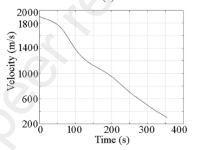
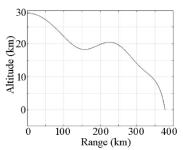
So lets look at the old graph once again ,

1755432870479.png1755432891478.png

when the FV is commanded by the obc to implement glide mode, it needs to satisfy the condition of having reached 30km altitude and at that point of time the Fv has a speed of almost 2000m/sec a very high acceleration but no more active thrust is available as the rocket motor is finished. The FV has laser altimeter so it knows its altitude and its own direction orientation and heading already fed to obc. So without obc command it would have gone in elliptic/parabolid ballistic curve trajectory and fall down way before its target.

But here we force it to go the way we want, it generates aerodynamic lift , now look at the altitude vs range graph, it starts losing altitude and acceleration as it goes, subsequently lift generated keeps increasing and the actuated control surfaces are engaged to keep control of the vehicle. At just below 20 km altitude lift is so great we can divert the FV from falling down to skip upwards via control surface engaging, the obc itself know altitude from laser alt data at every moment. So the Fv instead of falling , rely on aerodynamic lift to continue moving forward but upwards above 20 km altitude, thereby staying away from reach of enemy AD, even if a radar was locked onto it at that point, due to vector changed from downward at almost 60deg AoA , its now upward negative AoA so that radar lock is broken. Enemy can not engage your FV at that point again.

Now the FV has already crossed 200km + already and now on board sensor show velocity at around 1000-1200m/sec range so some kinetic thrust lost, but still enough high supersonic, and now again descending as your seeker need to fetch and lock on target. So between 240-300km downward curve phase it flies just below enemy radar horizon and acquires its target as its within seeker range so on board thermal battery activates seeker via electronic pulse command.

Once locked on it the terminal phse it does 2 different maneuvers , depending on target we know either anti rad role or ground attack, former need AoA of 40-50deg to acquire target among ground clutter, the other almost 80-85deg steep dive for fixed ground target. So obc command does handshake and handover to seeker and let it guide to target, or pull an S maneuver and the IIR seeker locking in to target and hit almost from top.

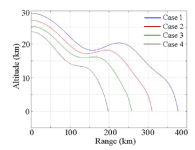
Now in this case we had initial constraint of range max 400 km. This same trajectory shaping can be done for lesser ranges too and it is like below, each range cluster 200 250 300 400 km we can shape trajectory accordingly per mission.

1755434331207.png

The above was for gliding unpowered flight. Now for HCM like powered flight the FV has continuous thrust available unless switched off, so it can be used for waypoint navigation ie the Fv change direction and go to another so enemy can not pinpoint where is it going to attack. The quicker the process the better and less time to react.

Since the FV rely on some motor, obviously the said motor capacity influence it. Some rocket mtor ~ 500mm dia class would of course generate way less thrust than say a rocket motor of ~ 750mm or 1000mm. But air launch has limitation of how much a jet can carry. So a compromise is done and best config is selected on engagement basis. Very quick launch to hit mission ie time sensitive get one kind, and some mission where stealthy movement matter more get another.
 
  • Like
Reactions: Sathya
I'd imagine if the IAF is looking out for an extended range SOW of 1000 kms + then the Nirbhay ALCM is a very strong contender for the job instead of the Pralay modified for AGM usage.

The amount of modifications required on the Pralay would make it a completely new missile whereas it was always understood the Nirbhay / ITCM would be adapted by all three forces for all the 4 dimensions .

Instead of an air launched Pralay it makes more sense to develop a HCM for such a role like what we're trialing right now in the SSM avatar.

Our problem in this domain doesn't pertain to the limitations of technology like it used to be the case in the past but rather is on account of the lack of a suitable platform which in turn is a function of our doctrine which flows directly from our national security requirements informed to a great extent by inputs from the MEA .

Put simply in lay man's terms - we didn't go in for a LR Strategic Bomber for China was never perceived to be a threat in spite of a 2 front war being part of our armed forces lexicon since the past 2 decades.

Why ? Coz even after Galwan our MEA probably didn't foresee anything more than a border war . Something transpired behind the scenes during Operation Sindoor which has spooked off our security managers resulting in a change to that doctrine whose manifestations we're seeing across domains now .

Since getting an LR Strategic Bomber at this stage is out of the question given there's only Russia we can turn to & which in turn will require heavy deployment of escorts , out comes the MRFA tender which is short hand for Rafales , talks of getting the F-35 or Su-57 & so on including now of developing this LR SOW.
 
  • Like
Reactions: Ironhide and Shan
Subsonic and Supersonic cruise missiles are the preferred long range land attack weapons. Let's get the LRLACM inducted. It should be cost effective and should add an additional package capable of striking all parts of west and forward bases of the east. I have ambivalent feelings on whether or not an air launched Pralay should be worked upon. Hypersonic LACM appear to be the next frontier so I would not focus on running this particular project as a priority.