Future Combat Air System (FCAS) - France/Germany

Su-57 has been made for permissive airspace. AMCA is being made for contested airspace. SCAF is being made for denied airspace.
That's not entirely accurate, Su57 is also built for heavily contested airspace. operating inside enemy IADS (S-400 level) using side radars, IRST passive hunting, networking with ground systems, and supermaneuverability to close and kill.
Su-57 has become largely irrelevant to us, they made the jet for a different set of requirements compared to us. And we can make-do with the AMCA until its direct successor comes in,
Russia is actively offering (and India is in advanced talks for) exactly the "MKI-ized" version you want: Su-57E two-seat with maximum Indian industry content, Indian avionics/weapons, full source-code access, license production on existing Su-30 lines, and twin-seat for enhanced C3/drone control. Not to mention its capabilities blowout any of our current jets out of the water. Its muti-role capability, long combat radius, large IWB capacity and other such capabilities most definitely doesn't make it irrelevant for us.
While the sensors are good, the sensor fusion is not yet up to par, it's currently only on the surface level. Plus their export grade sensors will be inferior anyway. So we can't simply import, we will have to MKIze it.
2026 production Su-57M batches already have upgraded "e-pilot" AI-assisted fusion, threat triage, and full 360° coverage via side X/L-band arrays + 101KS IRST. Combat feedback from Ukraine has driven real improvements. Secret Projects confirms the multi-spectral suite (X + L + IR) gives "superior awareness" beyond F-22/F-35 nose-only setups. With full Indian customisation (exactly like MKI), there is no export downgrade, we get source code and Indian processors.
Then there's the problem with the airframe. They have designed it for speed and long range when we want stealth and endurance.
All fixed in the Su-57M / Su-57E export version Russia is offering us;
  • New RAM coatings, stealthier Izdeliye 30 nozzles, >25–70% composites, reduced rear-aspect RCS.
  • Production models already fly without external tanks (Syria tests proved it).
  • Newer composites + electronic RAS (including metamaterial options India can add via DRDO).
  • Not to mention the airframe is stealth with its angeled body, flat shape, small vertical stabalizers, radar blockers, ram coating etc
Airframe technologies like multispectral, broadband stealth (tailless, blended wings, electronic RAS), morphing wings, advanced cooling systems, smart skins, internal DEW, self-healing nanomaterials, more optimized internal estate for new electronics hardware etc.
Talk about the pot calling the kettle black, we barely have a decent 4th gen fighter who America can cripple anytime they wish and you are talking about tech no country has even employed in their operational jets on the field. No one has an operational 6th-gen jet in 2026. The only real 6th-gen pillar already flying today is loyal-wingman drone control and Su-57 is the only fighter in serial production doing it.

The bottom line is that perfecting AMCA Mk2 + a heavily Indian-customised Su-57M two-seater (with full ToT, Indian systems, drone C3) pushes our R&D and industry forward and gives us real capability in the 2030s. Relying on a dying European program for a "stopgap" that doesn't exist is the opposite of smart.
 
  • Like
Reactions: Rajput Lion
That's not entirely accurate, Su57 is also built for heavily contested airspace. operating inside enemy IADS (S-400 level) using side radars, IRST passive hunting, networking with ground systems, and supermaneuverability to close and kill.

Unfortunately no. The F-35 is also headed in the same direction.

The side radars are for air-to-air combat, Su-57 does not have sufficient stealth for strike, which is why it carries an external targeting pod.

Russia is actively offering (and India is in advanced talks for) exactly the "MKI-ized" version you want: Su-57E two-seat with maximum Indian industry content, Indian avionics/weapons, full source-code access, license production on existing Su-30 lines, and twin-seat for enhanced C3/drone control. Not to mention its capabilities blowout any of our current jets out of the water. Its muti-role capability, long combat radius, large IWB capacity and other such capabilities most definitely doesn't make it irrelevant for us.

When I say "Su-57," I'm referring to the single-seat version.

Su-57 is the standard delivered in the previous years. Su-57M deliveries began this year. The two-seat version is called M2 for now, but may even receive its own designation. I generally call that Su-60, keeping with the nomenclature they have for more strike-optimized jets, ie, even numbers. Odd numbers are for dedicated ASFs. This is also why the current variants are not optimized for strike and operate in permissive environments.

So, yeah, the Su-60(?) may not be irrelevant to us. My bad for the semantics, but people who have been following my posts know this already.

2026 production Su-57M batches already have upgraded "e-pilot" AI-assisted fusion, threat triage, and full 360° coverage via side X/L-band arrays + 101KS IRST. Combat feedback from Ukraine has driven real improvements. Secret Projects confirms the multi-spectral suite (X + L + IR) gives "superior awareness" beyond F-22/F-35 nose-only setups. With full Indian customisation (exactly like MKI), there is no export downgrade, we get source code and Indian processors.

As I said, the sensors themselves are good. Maybe the radar is not up to par with what we currently have planned, but the Russians themselves claimed their sensor fusion is only on the surface level and does not go deep like the F-35.

The e-pilot does not perform sensor fusion, it's a pilot assistant meant to handle cockpit functions.

Sensor fusion is still WIP. We could see further changes over the next few years. So we are not talking about a long time, but definitely enough for the IAF to hold back on its decision until it's demonstrated. Unless of course, we decide to stick our own stuff on it, which means the decision is airframe and engine dependent.

All fixed in the Su-57M / Su-57E export version Russia is offering us;
  • New RAM coatings, stealthier Izdeliye 30 nozzles, >25–70% composites, reduced rear-aspect RCS.
  • Production models already fly without external tanks (Syria tests proved it).
  • Newer composites + electronic RAS (including metamaterial options India can add via DRDO).
  • Not to mention the airframe is stealth with its angeled body, flat shape, small vertical stabalizers, radar blockers, ram coating etc

We have to wait for Izd 30 to become operational first. We can't get into the program without knowing definitive outcomes. We don't care as much for external tanks on stealth jets, it's a non-issue in terms of procurement decision. We have to see new airframe materials prototyped or operational first. Yes, the Su-57 is stealthy, but not yet optimized for strike to the point FGFA was supposed to be.

That's why we have to wait for the twin-seat Su-60(?) to showcase everything you mentioned.

Remember, the Russians have only developed the Su-57E to date, and that's all they have shown to the export market. They are yet to create the Su-57M1E and show that off, never mind Su-60(?). So even the IAF has only brochure figures today.

The Su-57M1 is likely to meet unique Russian operational requirements, but it's still WIP for the export market.

Talk about the pot calling the kettle black, we barely have a decent 4th gen fighter who America can cripple anytime they wish and you are talking about tech no country has even employed in their operational jets on the field. No one has an operational 6th-gen jet in 2026. The only real 6th-gen pillar already flying today is loyal-wingman drone control and Su-57 is the only fighter in serial production doing it.

That post was in reference to what 6th gen capabilities SCAF will bring via the JV. It's obviously meant for 2040+.

The bottom line is that perfecting AMCA Mk2 + a heavily Indian-customised Su-57M two-seater (with full ToT, Indian systems, drone C3) pushes our R&D and industry forward and gives us real capability in the 2030s. Relying on a dying European program for a "stopgap" that doesn't exist is the opposite of smart.

A 6th gen import is definitely necessary. SCAF will easily take until 2045 to bring it up to spec. But we could still operate the Felon in 2035.

The choice right now seems to be between Su-57 and F-47 instead for the given timeframe, 2035. SCAF isn't a stopgap, it's a main capability. If it fails and we decide to go for the indigenous route, then we are going to need a stopgap import of F-47 or GCAP to bridge the gap between 2035 and 2055, considering both are likely to become available 5 years before SCAF.

And look at the Su-60's timeframe too; 2027 first flight expected, so decision + MKIzation will take us to 2035, the same time as F-47 and GCAP. The only difference being the Felon as a whole will be operationally proven. And you can bet both the Americans and British will try and persuade us out of cutting deals with Russia by then. Even more so if SCAF fails for us.
 
  • Like
Reactions: YoungWolf
Su-57S will be able to penetrate any heavily defended IADS with MUM-T, i.e., S-70 Okhotnik B. On its own, it's designed to fight under cover of Russian IADS, silently hunting for attacking VLO jets like F-22 or F-35.
 
  • Haha
Reactions: South block
Su-57S will be able to penetrate any heavily defended IADS with MUM-T, i.e., S-70 Okhotnik B. On its own, it's designed to fight under cover of Russian IADS, silently hunting for attacking VLO jets like F-22 or F-35.

S-70 is designed for denied airspace, but that's a different subject. That's the point of the stealth drones.

This even includes Rafale and even AMCA, not just Su-57. They have to use drones to extend reach.

Only 6th gen jets today can fly into denied airspace, and even that will end by 2050-60, replaced by jets with adaptive camouflage using the wave bending principles of metamaterials.

In case the IAF's interest in the Felon is primarily for OCA/DCA, then even M1E should be fine in small numbers. But that just limits their options.
 
  • Like
Reactions: Rajput Lion
S-70 is designed for denied airspace, but that's a different subject. That's the point of the stealth drones.
Su-57's frontal RCS is very close to -40dBsm, just like F-22 Raptor. So ingress attacks with S-70 is more likely to penetrate advance IADS bubble than any 4.5 gen doing the same. Plus S-70, right from its inception is designed to work with Su-57. It's a very potent deep-strike combo.
This even includes Rafale and even AMCA, not just Su-57. They have to use drones to extend reach.
AMCA yes, Rafale no, 'cause it isn't stealthy with external weapons.
Only 6th gen jets today can fly into denied airspace, and even that will end by 2050-60, replaced by jets with adaptive camouflage using the wave bending principles of metamaterials.
There are no 6th gen fighter today in existence. American, Chinese, European & Russian 6th gen would only hit operational service sometime between 2035-2040.
In case the IAF's interest in the Felon is primarily for OCA/DCA, then even M1E should be fine in small numbers. But that just limits their options.
What if I actually tell you that IAF's primary interest in Su-57M is in deep-strike mission apart from OCA/DCA? IAF wants a comprehensive weapons package with Su-57M, which includes internally carried smaller variant of Kh-47M2 Kinzhal and stealth-cruise missile Kh-59MK2/Kh-69. Along with these, they are also looking for internally carried anti-radiation missile Kh-58UShK for SEAD(though it is also part of OCA mission).
 
Last edited:
  • Like
Reactions: batman
Su-57's frontal RCS is very close to -40dBsm, just like F-22 Raptor. So ingress attacks with S-70 is more likely to penetrate advance IADS bubble than any 4.5 gen doing the same. Plus S-70, right from its inception is designed to work with Su-57. It's a very potent deep-strike combo.

The Su-57 is borderline VLO, not actual VLO. Even the F-22 is not at -40 dBsm. Supposed to be closer to -36 dBsm whereas Su-57 is well below -30 dBsm. It's between -20 and -30, and even that's been speculated to be something that will be achieved with newer models and not the vanilla Su-57, which is probably in the -10 to -20 range.

AMCA yes, Rafale no, 'cause it isn't stealthy with external weapons.

AMCA will only become available in the 2040s with its full capabilities, so I'm taking that into account.

There are no 6th gen fighter today in existence. American, Chinese, European & Russian 6th gen would only hit operational service sometime between 2035-2040.

Yeah, so as it stands today, ADS have become so good that 5th gen jets can no longer convincingly penetrate. That's why they are using long range precision fires for SEAD/DEAD. B-21 will be the first 6th gen designed to operate in denied airspace, followed by the F-47 and other Chini jets, followed by GCAP and SCAF.

What if I actually tell you that IAF's primary interest in Su-57M is in deep-strike mission apart from OCA/DCA? IAF wants a comprehensive weapons package with Su-57M, which includes internally carried smaller variant of Kh-47M2 Kinzhal and stealth-cruise missile Kh-59MK2/Kh-69. Along with these, they are also looking for internally carried anti-radiation missile Kh-58UShK for SEAD(though it is also part of OCA mission).

Even the Russians haven't advertised Su-57M1 for deep strike. They plan to use long range fires, ie, cruise missiles. That's not really deep srike. Your ability to drop a 1000-2000 lbs bomb at a significant distance behind enemy lines with very high pk would imply deep strike.

Even the Raptor has been designed primarily for OCA and DCA, hence the limited use. But the difference is the F-22 penetrates SAM rings and drops JDAMs from 40 km away on a SAM site, whereas the Felon cannot get close enough for that, not even to get a glide bomb off, forget JDAM. The Raptor too is losing value here.
 
Unfortunately no. The F-35 is also headed in the same direction.

The side radars are for air-to-air combat, Su-57 does not have sufficient stealth for strike, which is why it carries an external targeting pod.
The Su-57 (including current serial batches) is multirole from the start, internal bays carry Kh-69 stealth cruise missiles, Kh-58 anti-radiation for SEAD, and precision-guided bombs. Recent footage shows internal Kh-58 carriage for stealth SEAD, and ops in Ukraine include standoff strikes with Kh-69 without external pods compromising stealth. External targeting pods (like 101KS-N) are optional for non-stealth missions or integration, not a requirement for strike. Russian doctrine uses it in contested zones with ground/AWACS support, not "permissive." The two-seat variant (proposed as Su-57M or similar) enhances C3/drone control for deeper strikes, but the base is already strike-capable. Also, unless you can eyeball stealth or define the characteristics of the ram coating they used, your statements are nothing more than wild guesses. The Su57 have more than enough stealth for strike roles, especially more than anything we currently have in our arsenal. Not to mention it has better capability to counter and evade other missiles and jets than any jet America has in the arsenal. Lets also not forget how stealth is day by day becoming more less important of a factor in a real battlefield where enemy possess advanced radar, sam etc

I generally call that Su-60
Aint no way you created your own version and nomenclature for this jet and used that to define capability as your wishes
As I said, the sensors themselves are good. Maybe the radar is not up to par with what we currently have planned, but the Russians themselves claimed their sensor fusion is only on the surface level and does not go deep like the F-35.

The e-pilot does not perform sensor fusion, it's a pilot assistant meant to handle cockpit functions.
Please quote the official source of this said claim by Russians so we can analyze it. E-pilot is an AI assistant for workload reduction/threat triage, integrated with fusio, it's not "separate."Western analyses note it's less seamless than F-35 today, but ongoing combat feedback + custom Indian integration (full source code offered) closes that gap. With MKI-ization, we control depth.
We have to wait for Izd 30 to become operational first. We can't get into the program without knowing definitive outcomes. We don't care as much for external tanks on stealth jets, it's a non-issue in terms of procurement decision. We have to see new airframe materials prototyped or operational first. Yes, the Su-57 is stealthy, but not yet optimized for strike to the point FGFA was supposed to be.
Izdeliye 30 (AL-51F-1) flight testing since late 2025; not yet in operational deliveries (Feb 2026 batches use AL-41F1 with upgrades), but integration planned for Su-57M1 by end-2026. Stealth upgrades (new RAM coatings, nozzle treatments, composites >25–70%) are in production batches. I will also say how AL-51 isnt an absolute must for us since even with the interim engine, its capability still vastly exceeds that of most other jets. Heck even we are logically using an interim engine for AMCA which doesnt even have 100KN thrust until we develop one with france which has like 110-120KN thrust. If the engines can fullfill the mission requirments, there is no reason to be adamant on wanting the latest version when its already good enough.
The choice right now seems to be between Su-57 and F-47 instead for the given timeframe,
Aint no way you seriously believe that america will sell the f47 to anyone let alone India. Not to mention the dependency and strings attached to america is simply not worth it.
The choice right now seems to be between Su-57 and F-47 instead for the given timeframe, 2035. SCAF isn't a stopgap, it's a main capability. If it fails and we decide to go for the indigenous route, then we are going to need a stopgap import of F-47 or GCAP to bridge the gap between 2035 and 2055, considering both are likely to become available 5 years before SCAF.

And look at the Su-60's timeframe too; 2027 first flight expected, so decision + MKIzation will take us to 2035, the same time as F-47 and GCAP. The only difference being the Felon as a whole will be operationally proven. And you can bet both the Americans and British will try and persuade us out of cutting deals with Russia by then. Even more so if SCAF fails for us.
  • Two-seat prototype: late 2026/early 2027 flight → decision/MKI-zation → operational ~2035 (realistic with Russian willingness).
  • F-47/GCAP: Similar 2035 availability, but US/UK will pressure against Russia deals (CAATSA risks).
  • FCAS/SCAF: In crisis, negotiations "all but dead," NGF part collapsing (Airbus-Dassault disputes), "SCAF is dead" per officials/analysts (Feb 2026). No demonstrator soon; service 2045+ at best. "Main capability by 2045" is fantasy; it's not a viable bridge.
 
The Su-57 is borderline VLO, not actual VLO. Even the F-22 is not at -40 dBsm. Supposed to be closer to -36 dBsm whereas Su-57 is well below -30 dBsm. It's between -20 and -30, and even that's been speculated to be something that will be achieved with newer models and not the vanilla Su-57, which is probably in the -10 to -20 range.
Many experts have done computer simluation of Su-57's RCS and with IRST rotated back, its RCS drops below -30dBsm. Unlike F-22, that is dependent upon its shape and RAM for RCS reduction, Su-57's stealth not only comes from its shape but also its CNT based RAS. True simluation of Su-57's RCS is impossible in computer labs. Its frontal RCS is definitely -40dBsm in X-Band and in other search bands(like UHF, VHF, L &S), it is even more stealthy than F-22 Raptor.

Just look at this simulation for an idea:

AMCA will only become available in the 2040s with its full capabilities, so I'm taking that into account.
Yes.
Yeah, so as it stands today, ADS have become so good that 5th gen jets can no longer convincingly penetrate. That's why they are using long range precision fires for SEAD/DEAD. B-21 will be the first 6th gen designed to operate in denied airspace, followed by the F-47 and other Chini jets, followed by GCAP and SCAF.


Even the Russians haven't advertised Su-57M1 for deep strike. They plan to use long range fires, ie, cruise missiles. That's not really deep srike. Your ability to drop a 1000-2000 lbs bomb at a significant distance behind enemy lines with very high pk would imply deep strike.

Even the Raptor has been designed primarily for OCA and DCA, hence the limited use. But the difference is the F-22 penetrates SAM rings and drops JDAMs from 40 km away on a SAM site, whereas the Felon cannot get close enough for that, not even to get a glide bomb off, forget JDAM. The Raptor too is losing value here.
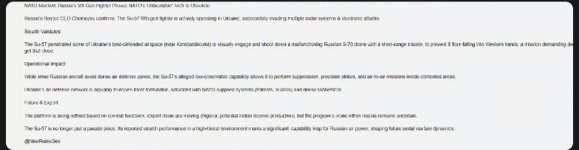
Ukraine has one of the most dense air-defense coverage currently anywhere in the world and as ROSTEC CEO has confirmed, Su-57S performs penetrating missions in contested airspace:

1000042259.jpg
1000042261.jpg

This is just the first stage Su-57. Our M2 variant would be more stealthy from all-aspects and all radar bands. With MUM-T, it will be used as our deep strike fighter in contested and even denied airspace.
 
The Su-57 (including current serial batches) is multirole from the start, internal bays carry Kh-69 stealth cruise missiles, Kh-58 anti-radiation for SEAD, and precision-guided bombs. Recent footage shows internal Kh-58 carriage for stealth SEAD, and ops in Ukraine include standoff strikes with Kh-69 without external pods compromising stealth. External targeting pods (like 101KS-N) are optional for non-stealth missions or integration, not a requirement for strike. Russian doctrine uses it in contested zones with ground/AWACS support, not "permissive." The two-seat variant (proposed as Su-57M or similar) enhances C3/drone control for deeper strikes, but the base is already strike-capable. Also, unless you can eyeball stealth or define the characteristics of the ram coating they used, your statements are nothing more than wild guesses. The Su57 have more than enough stealth for strike roles, especially more than anything we currently have in our arsenal. Not to mention it has better capability to counter and evade other missiles and jets than any jet America has in the arsenal. Lets also not forget how stealth is day by day becoming more less important of a factor in a real battlefield where enemy possess advanced radar, sam etc

Kh-58 and Kh-59 support the Su-57's OCA mission, not deep strike. So that's not what deep strike is supposed to mean.

The Russian design philosophy has always been about making dedicated aircraft for different domains. This way they maximise the potential for each design. So the Su-57's stealth and aerodynamic design specifically deals with air superiority functions and strike at long range for SEAD/DEAD.

So we have Su-35 for OCA, but Su-34 for strike. Su-30SM sits in the middle for true multirole. So Su-35 and Su-57 are not multirole by airframe, they are multirole by weapons loadouts, the same as the F-22. Which means, just because the Su-34 can fire the R-77 doesn't make it air superiority.

Anyway, the Russians pointed out in the beginning of the Felon program that they will make different variants for strike (Su-34 equivalent) and multirole (Su-30 equivalent).

Aint no way you created your own version and nomenclature for this jet and used that to define capability as your wishes

People do this all the time. Su-57 was originally called Su-50 by the media. J-36 and J-50 are placeholder names too, until officially confirmed. We call the next gen strike jet JH-XX 'cause the JH makes it simpler. Mig-41 is also made up. So Su-60 is the natural transition for Russia's multirole version. Of course there's Su-58 too. The Su-34 equivalent can be called Su-60/62/64. Choose your poison.

Please quote the official source of this said claim by Russians so we can analyze it. E-pilot is an AI assistant for workload reduction/threat triage, integrated with fusio, it's not "separate."Western analyses note it's less seamless than F-35 today, but ongoing combat feedback + custom Indian integration (full source code offered) closes that gap. With MKI-ization, we control depth.

It's an old Russian source from 10 years ago by a Rostec offical. I don't have that link. The Russians had openly claimed they are not aiming for F-35 class sensor fusion at the moment and will eventually do so in later variants. We are approaching that era now, still a few years away. It has the hardware necessary for sensor fusion, in some ways more than the F-35, but remember, even the F-35's sensor fusion is WIP. So what makes you think the Russians are ahead?

The Russians develop technologies by iteration and only push reliable systems into operations. That's why we still only see interim engines.

The Su-57 has more sensors than the F-35 and the sensors themselves are much larger and will generate more data, and the focus on easing pilot workload is much lesser than on the F-35 'cause they want specialist pilots to control the jet whereas the F-35 ecosystem is made for rookies to pick things up quickly. The Su-57 pilots are part of the sensor fusion loop.

The e-pilot "fuses" already sensor-fused electronics data (onboard and offboard) with flight controls data, like a human pilot, it's being designed to assist and later replace the human pilot. It doesn't do core sensor fusion.

Once the Su-57 becomes a true optionally-manned system, we can say for sure it has achieved sensor fusion.

With MKIzation, this is all irrelevant anyway.

Izdeliye 30 (AL-51F-1) flight testing since late 2025; not yet in operational deliveries (Feb 2026 batches use AL-41F1 with upgrades), but integration planned for Su-57M1 by end-2026. Stealth upgrades (new RAM coatings, nozzle treatments, composites >25–70%) are in production batches. I will also say how AL-51 isnt an absolute must for us since even with the interim engine, its capability still vastly exceeds that of most other jets. Heck even we are logically using an interim engine for AMCA which doesnt even have 100KN thrust until we develop one with france which has like 110-120KN thrust. If the engines can fullfill the mission requirments, there is no reason to be adamant on wanting the latest version when its already good enough.

We want to operate it against China in an environment where thrust goes down by 40% and you still want us to buy the Su-57 with a weaker engine that already makes it underpowered in the plains even in cold environments?

AMCA's a domestic project and the IAF can afford to go slower, they can't do that for an import.

Aint no way you seriously believe that america will sell the f47 to anyone let alone India. Not to mention the dependency and strings attached to america is simply not worth it.

They plan on exporting it. And even with strings attached, we want a fighter that can deal with China primarily, the intended target of the sale. It's a more desperate option when the time comes, but a 6th gen import is necessary. The SCAF JV interest came as a surprise, but the IAF is moving in a predictable fashion in terms of force structure; LCA, Rafale, AMCA, and imported 6th gen.

The Su-57 is an aberration for now, all official interest "shown" by the IAF have been fake since 2018. So there's a pretty good chance the goal remains the 4 types I mentioned.

  • Two-seat prototype: late 2026/early 2027 flight → decision/MKI-zation → operational ~2035 (realistic with Russian willingness).
  • F-47/GCAP: Similar 2035 availability, but US/UK will pressure against Russia deals (CAATSA risks).
  • FCAS/SCAF: In crisis, negotiations "all but dead," NGF part collapsing (Airbus-Dassault disputes), "SCAF is dead" per officials/analysts (Feb 2026). No demonstrator soon; service 2045+ at best. "Main capability by 2045" is fantasy; it's not a viable bridge.

Let's make things a lot clearer.

Su-57M1E is the only jet that can act as a bridge between today and SCAF (2040-45) for MKI replacement.
Su-60, F-47, and GCAP act as a bridge for ADA's next gen jet for MKI replacement (2055) or even a further delayed SCAF JV (2050+).
SCAF isn't a bridge. If pursued, it will become the main replacement for the MKI, first 2 squadrons aimed for replacement after 2045, with bulk from 2055.

My opinion used to be that ADA would need 20 years from 2035 onwards to develop their jet in time for MKI's bulk replacement (2055). So they would need a modernized Su-57 or F-47/GCAP inducted between 2035-40 as the bridge. And with the IAF claiming repeatedly that they had no interest in the Su-57, it was clear they had other things in mind, which led me to speculate that the SCAF won't be in the running as the bridge between Rafale and ADA's next jet.

But now that the IAF plans on abandoning ADA for MKI and chasing after SCAF (2040+), the F-47/GCAP options become irrelevant. This is how the Su-57/60 acts as the bridge to SCAF. It also makes up for AMCA's delays. ADA of course continues to develop for the era after SCAF for the IAF.

Long story short, instead of a stopgap F-47/GCAP the IAF wants to go for SCAF as the main capability. And maybe Su-60 acts as the bridge, if not the Su-57M1E.
 
  • Like
Reactions: YoungWolf
Many experts have done computer simluation of Su-57's RCS and with IRST rotated back, its RCS drops below -30dBsm. Unlike F-22, that is dependent upon its shape and RAM for RCS reduction, Su-57's stealth not only comes from its shape but also its CNT based RAS. True simluation of Su-57's RCS is impossible in computer labs. Its frontal RCS is definitely -40dBsm in X-Band and in other search bands(like UHF, VHF, L &S), it is even more stealthy than F-22 Raptor.

Just look at this simulation for an idea:


That only demonstrates the full potential of the airframe at the macro level, not that they actually achieved it in real world testing due to inconsistencies at the micro level. Su-60 will see further improvement of this potential. But the next step is to use newer technologies to get to full potential, like more conformal antennas, the main engines, cockpit changes like a new HMDS, better treatment of sensor housing etc.

Examples:
1.jpg

There's potential for some RCS management both inside the sensor housing as well as that blade antenna.

You can tell by this how the Su-57 is optimized for frontal RCS rather than all aspect, which shows greater focus towards long range air superiority. It's not designed for true penetration missions.

2.jpg

Patching a gap with a seal instead of finding a more permanent solution.

The jet is still WIP. That's why I said the Su-57 in its current form doesn't make sense for the IAF. The M is not a true modernization over the basic Su-57 like what the Su-35S was over the Su-27, it is more like an FOC model. The Su-60 could become the first true full spec Felon.

Ukraine has one of the most dense air-defense coverage currently anywhere in the world and as ROSTEC CEO has confirmed, Su-57S performs penetrating missions in contested airspace:

View attachment 50321
View attachment 50322

This is just the first stage Su-57. Our M2 variant would be more stealthy from all-aspects and all radar bands. With MUM-T, it will be used as our deep strike fighter in contested and even denied airspace.

That doesn't mean anything. Konstiantynivka is just 10 km from the front line. Long range SAMs will be located further back and it's unlikely for the Su-57 to have crossed into SAM rings to get to the S-70. It's not like the Ukrainians have effective longer ranges SAMs than the Patriot.

The Su-57s are not flying risky missions in Ukraine.
 
That only demonstrates the full potential of the airframe at the macro level, not that they actually achieved it in real world testing due to inconsistencies at the micro level. Su-60 will see further improvement of this potential. But the next step is to use newer technologies to get to full potential, like more conformal antennas, the main engines, cockpit changes like a new HMDS, better treatment of sensor housing etc.

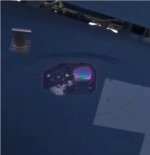
Examples:
View attachment 50336

There's potential for some RCS management both inside the sensor housing as well as that blade antenna.

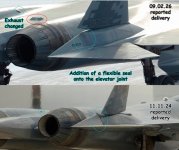
You can tell by this how the Su-57 is optimized for frontal RCS rather than all aspect, which shows greater focus towards long range air superiority. It's not designed for true penetration missions.

View attachment 50337

Patching a gap with a seal instead of finding a more permanent solution.

The jet is still WIP. That's why I said the Su-57 in its current form doesn't make sense for the IAF. The M is not a true modernization over the basic Su-57 like what the Su-35S was over the Su-27, it is more like an FOC model. The Su-60 could become the first true full spec Felon.


That doesn't mean anything. Konstiantynivka is just 10 km from the front line. Long range SAMs will be located further back and it's unlikely for the Su-57 to have crossed into SAM rings to get to the S-70. It's not like the Ukrainians have effective longer ranges SAMs than the Patriot.

The Su-57s are not flying risky missions in Ukraine.
Our Su-57M2/60MKI would most defintely be more stealthy from "all-aspects" and in "multi-bands". That's for sure.
 
Our Su-57M2/60MKI would most defintely be more stealthy from "all-aspects" and in "multi-bands". That's for sure.

The engine is key to that. We have to see where that ends up.

The 177 is not really good news for the program though.


While 117 was underpowered at 145 kN, modernizing it to 157 kN using its limited capabilities means the effective capability of the aircraft is still very low. That's also why we see the airframe as still a WIP. And this is what they are calling Su-57M1. The IAF will never buy this aircraft.

The first regiment comes with 117, which is okay for IOC. But the real danger is not just the 2nd, but even the 3rd, 4th... etc introduced with 177, then the program is at serious risk. If the 3rd regiment comes without Izd 30, then we can be sure that it's aimed for future variants. And it currently looks like that's going to happen.

The Su-60 will come with an extra ton of weight, and the engine will be a combined 4 tons lower in thrust even with the modernized engine, so Izd 30 is critical to its success.

But what will further complicate matters is the engine won't be proven when we have to decide by 2030. The MKI experience has shown that the IAF will not buy anything from Russia that's not already proven by its air force first. Throughout the 2000s, we had serious problems with the engine that the Russians took forever to fix. After plenty of emergency landings on one engine, the IAF decided that those mistakes will not be repeated with MMRCA and the IAF asked for production guarantees from the OEM. It's also why the IAF doesn't want to replace the AL-31FP, instead choosing to upgrade it. It was even worse with the automatic ejection seats, the Russians refused to even acknowledge the problem until the Su-30SM also started launching ground crew into space. They thought it was maintenance issues before realizing it was a design issue.

So there's no chance the IAF will buy anything that's not already in service in Russia. They will have to have already inducted 1 or 2 regiments before we put pen to paper.
 
The engine is key to that. We have to see where that ends up.

The 177 is not really good news for the program though.


While 117 was underpowered at 145 kN, modernizing it to 157 kN using its limited capabilities means the effective capability of the aircraft is still very low. That's also why we see the airframe as still a WIP. And this is what they are calling Su-57M1. The IAF will never buy this aircraft.

The first regiment comes with 117, which is okay for IOC. But the real danger is not just the 2nd, but even the 3rd, 4th... etc introduced with 177, then the program is at serious risk. If the 3rd regiment comes without Izd 30, then we can be sure that it's aimed for future variants. And it currently looks like that's going to happen.

The Su-60 will come with an extra ton of weight, and the engine will be a combined 4 tons lower in thrust even with the modernized engine, so Izd 30 is critical to its success.

But what will further complicate matters is the engine won't be proven when we have to decide by 2030. The MKI experience has shown that the IAF will not buy anything from Russia that's not already proven by its air force first. Throughout the 2000s, we had serious problems with the engine that the Russians took forever to fix. After plenty of emergency landings on one engine, the IAF decided that those mistakes will not be repeated with MMRCA and the IAF asked for production guarantees from the OEM. It's also why the IAF doesn't want to replace the AL-31FP, instead choosing to upgrade it. It was even worse with the automatic ejection seats, the Russians refused to even acknowledge the problem until the Su-30SM also started launching ground crew into space. They thought it was maintenance issues before realizing it was a design issue.

So there's no chance the IAF will buy anything that's not already in service in Russia. They will have to have already inducted 1 or 2 regiments before we put pen to paper.
Su-57S is already in active service for the past 5 years and its number keeps on growing. Now they have about 40 jets fully operational and by the end of the year RuAF may very well have over 50 Su-57s. Su-57M1 & M2 etc. are further iterations of the base jet. So it is matured now.

About IAF procuring Su-57s? Very soon, we all shall know.
 
  • Like
Reactions: batman
Su-57S is already in active service for the past 5 years and its number keeps on growing. Now they have about 40 jets fully operational and by the end of the year RuAF may very well have over 50 Su-57s. Su-57M1 & M2 etc. are further iterations of the base jet. So it is matured now.

About IAF procuring Su-57s? Very soon, we all shall know.

I'm referring to an all-aspect modernization and the Izd 30. The standard Su-57 doesn't meet our basic requirements, this was well known long ago.

The M1, we need to see what the next production batches look like. If it comes with Izd 30, then all is fine.

Su-27 and Su-30 were also operational for many years before MKI started emergency landing and launching ejection seats. The standard we need needs to enter production, not a previous variant. For example, we need Rafale F5 operational in France before we induct them, previous variants don't matter at that point. So M1 with Izd 30 or Su-60 with Izd 30, whichever one we choose, if at all, has to be operational in Russia before we contract it.
 
Kh-58 and Kh-59 support the Su-57's OCA mission, not deep strike. So that's not what deep strike is supposed to mean.

The Russian design philosophy has always been about making dedicated aircraft for different domains. This way they maximise the potential for each design. So the Su-57's stealth and aerodynamic design specifically deals with air superiority functions and strike at long range for SEAD/DEAD.

So we have Su-35 for OCA, but Su-34 for strike. Su-30SM sits in the middle for true multirole. So Su-35 and Su-57 are not multirole by airframe, they are multirole by weapons loadouts, the same as the F-22. Which means, just because the Su-34 can fire the R-77 doesn't make it air superiority.

Anyway, the Russians pointed out in the beginning of the Felon program that they will make different variants for strike (Su-34 equivalent) and multirole (Su-30 equivalent).


People do this all the time. Su-57 was originally called Su-50 by the media. J-36 and J-50 are placeholder names too, until officially confirmed. We call the next gen strike jet JH-XX 'cause the JH makes it simpler. Mig-41 is also made up. So Su-60 is the natural transition for Russia's multirole version. Of course there's Su-58 too. The Su-34 equivalent can be called Su-60/62/64. Choose your poison.


It's an old Russian source from 10 years ago by a Rostec offical. I don't have that link. The Russians had openly claimed they are not aiming for F-35 class sensor fusion at the moment and will eventually do so in later variants. We are approaching that era now, still a few years away. It has the hardware necessary for sensor fusion, in some ways more than the F-35, but remember, even the F-35's sensor fusion is WIP. So what makes you think the Russians are ahead?
You're twisting yourself into knots trying to keep the Su-57 as "just an air-superiority jet like the F-22" while inventing a whole Su-60 family that doesn't exist. Russia never officially announced separate "Su-34 equivalent" and "Su-30 equivalent" variants for the Felon. The two-seat version Russia is actively pitching to India right now (prototype in assembly at KnAAZ, first flight late 2026/early 2027) is the exact thing you're calling "Su-60", it's the Su-57M two-seater built for MUM-T (manned-unmanned teaming), drone control (S-70 Okhotnik and new stealth UAVs), longer missions, and yes, deeper strike/C3 roles. No "Su-60/62/64" official name, no 10-year-old source magically predicting it. It's the same airframe with a second seat for exactly the battlefield hub role you said only SCAF can do.
Kh-58 and Kh-59 support the Su-57's OCA mission, not deep strike
the Su-57 has been flying with internal Kh-58UShK anti-radiation missiles (stealth SEAD/DEAD) and internal Kh-69 stealth cruise missiles (300 km+ precision deep strike) since at least late 2025 footage and 2026 deliveries. The forward bay is literally shown loaded for stealth strike runs. This isn't "weapons loadout multirole only" like the F-22, it's the same big tandem bays Russia designed from day one for both air-to-air and heavy air-to-ground without breaking stealth. The jet has done exactly these missions in Syria and Ukraine. Calling that "not deep strike" is moving the goalposts.

The Russians never said "we'll only make dedicated single-role jets forever." The Su-57 was always advertised as multirole (stealth + supercruise + internal payload for everything). The two-seater they're offering India is the strike/C3-optimised version you keep asking for.

It's an old Russian source from 10 years ago by a Rostec offical. I don't have that link. The Russians had openly claimed they are not aiming for F-35 class sensor fusion at the moment and will eventually do so in later variants. We are approaching that era now, still a few years away. It has the hardware necessary for sensor fusion, in some ways more than the F-35, but remember, even the F-35's sensor fusion is WIP. So what makes you think the Russians are ahead?
The 2026 production batches that just got delivered to Russia (and the ones offered to India) come with upgraded avionics, "new technical configuration," and improved sensor fusion from real combat feedback. The N036 Byelka + side arrays + 101KS IRST already give 360° passive hunting the F-35 doesn't have. The e-pilot isn't "just a cockpit helper", it's integrated with the fused picture and is being upgraded toward full AI assistance. Russia never said "we're not aiming for F-35 fusion" as some permanent admission; they're iterating exactly like they always do, and the hardware (larger sensors + side arrays) is already there. F-35 fusion is still getting Block upgrades too, nobody is "done."
We want to operate it against China in an environment where thrust goes down by 40% and you still want us to buy the Su-57 with a weaker engine that already makes it underpowered in the plains even in cold environments?
Izdeliye 30 (AL-51F-1) is in flight testing and scheduled for full integration in the Su-57M by end-2026, also each AL-41F1 delivers 142 kN in afterburner, total 176–186 kN dry and 284–294 kN afterburner combined. Even at high/hot airfields (e.g., Leh ~10,000 ft + 35–40°C summer temps), thrust derates less catastrophically than single-engine designs. The F-35's single F135 (125 kN kgf dry/191KN afterburner) loses a bigger percentage of output in thin air because there's no second engine to compensate, real-world hot/high takeoff rolls and climb rates suffer more on singles. Russian doctrine (and Su-35 ops in Syria/hot deserts) shows twins handle derating better for sustained performance.

Even with the baseline AL-41F1 engines, the Su-57 performs better than many peers in hot-and-high environments like India's Himalayan bases because its twin-engine configuration provides redundancy and a higher absolute thrust margin when derated by thin air and heat, allowing sustained climb rates, supercruise capability (limited to Mach 1.3–1.6), and a service ceiling of 20,000 meters that far exceeds the F-35's 15,000 meters. The larger wing area and variable intakes help generate lift and maintain agility in low-density air where single-engine jets like the F-35 suffer greater relative thrust loss, reduced payload, and longer takeoff rolls; Russian tests and Su-35 operations (same engine family) in hot desert and mountain conditions prove the design's resilience, while thrust vectoring further aids low-speed control and quick climbs at altitude. In contrast, the F-35's single F135 engine loses more proportional power in such conditions, limiting endurance and maneuverability over contested high-altitude sectors like the LAC, making the Su-57's current powerplant a practical advantage for India's real-world operational needs rather than a weakness, with the upcoming Izdeliye 30 upgrade only widening that edge once integrated by late 2026.
The Su-57 is an aberration for now, all official interest "shown" by the IAF have been fake since 2018. So there's a pretty good chance the goal remains the 4 types I mentioned.
This one aged like milk. Talks are in "advanced technical stages" right now (Jan–March 2026 statements from UAC CEO and Indian officials). Russia is offering exactly the MKI-style deal you wanted: license production on existing Su-30 lines, maximum Indian industry content, full source code access, Indian avionics/weapons, and the two-seat drone-control version tailored for us. It's the front-runner for MRFA/interim 5th-gen because of cost, timeline, and existing ecosystem. "Fake interest" narrative died months ago.
SCAF as the main capability
SCAF/FCAS is on life support. Dassault CEO literally said in March 2026 it's "dead" if Airbus won't cooperate. Missed every deadline, industrial war between Dassault and Airbus, Germany eyeing more F-35s as backup. Service entry 2045+ at best (if it survives). Betting the farm on that as your "main MKI replacement" while calling a real, flying, combat-proven jet with drone teaming an "aberration" is wild.

Pursuing GCAP as an observer or a fully indigenous sixth-gen fighter (evolving from AMCA Mk2) is far better for India than SCAF/FCAS, which is in deep crisis with industrial disputes, missed deadlines, and service entry likely well past 2045, if it survives at all. GCAP offers low-risk access to mature 6th-gen tech (adaptive engines, AI teaming, broadband stealth) with clear timelines and export focus, allowing India to feed advancements into our own programs without heavy commitment. An indigenous path maximizes sovereignty, leverages existing DRDO/HAL momentum, creates jobs, enables export potential, and tailors the jet perfectly to high-altitude/hot-and-high threats and China-focused doctrine, avoiding SCAF’s political vetoes, workshare fights, and dependency risks while building true long-term capability by the 2050s in my opinion.
 
You're twisting yourself into knots trying to keep the Su-57 as "just an air-superiority jet like the F-22" while inventing a whole Su-60 family that doesn't exist. Russia never officially announced separate "Su-34 equivalent" and "Su-30 equivalent" variants for the Felon. The two-seat version Russia is actively pitching to India right now (prototype in assembly at KnAAZ, first flight late 2026/early 2027) is the exact thing you're calling "Su-60", it's the Su-57M two-seater built for MUM-T (manned-unmanned teaming), drone control (S-70 Okhotnik and new stealth UAVs), longer missions, and yes, deeper strike/C3 roles. No "Su-60/62/64" official name, no 10-year-old source magically predicting it. It's the same airframe with a second seat for exactly the battlefield hub role you said only SCAF can do.

Yes, they did. The Felon is a family of aircraft, not just 1 jet.

Applying the equivalent Flanker designations for ease of understanding, it will consist of ASF (Su-57), multirole (Su-60), ground strike (Su-34), and naval (Su-33).

They said it very early on.

article_5d273eacdbe561_88836560.jpg


the Su-57 has been flying with internal Kh-58UShK anti-radiation missiles (stealth SEAD/DEAD) and internal Kh-69 stealth cruise missiles (300 km+ precision deep strike) since at least late 2025 footage and 2026 deliveries. The forward bay is literally shown loaded for stealth strike runs. This isn't "weapons loadout multirole only" like the F-22, it's the same big tandem bays Russia designed from day one for both air-to-air and heavy air-to-ground without breaking stealth. The jet has done exactly these missions in Syria and Ukraine. Calling that "not deep strike" is moving the goalposts.

The Russians never said "we'll only make dedicated single-role jets forever." The Su-57 was always advertised as multirole (stealth + supercruise + internal payload for everything). The two-seater they're offering India is the strike/C3-optimised version you keep asking for.

Again, that's not deep strike. Your definition of deep strike is the same as Sweden claiming deep strike for Gripen E just 'cause of a cruise missile.

For deep strike, you need medium and large bombs.

Deep strike jets require a lot of airframe modifications compared to the ASF version. The Su-57 is advertised as a tactical striker with some ability to carry bombs, that's all.

The purpose of a deep striker is to drop a 1000+ kg bomb on a comm node or a command center in depth areas.

Strike Eagle and Fullback are deep strikers.

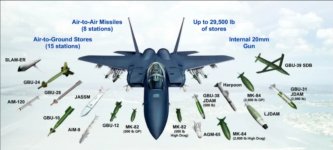
3.jpg

That is a deep strike loadout. Mk82/84, GBU10/12/28. The heavy hitters.

These are the weapons the next variant of the Su-57 will carry. For example, the targeting pod will be internally equipped. It will need a defensive laser too.

The ASF version carries a targeting pod outside for secondary strike.

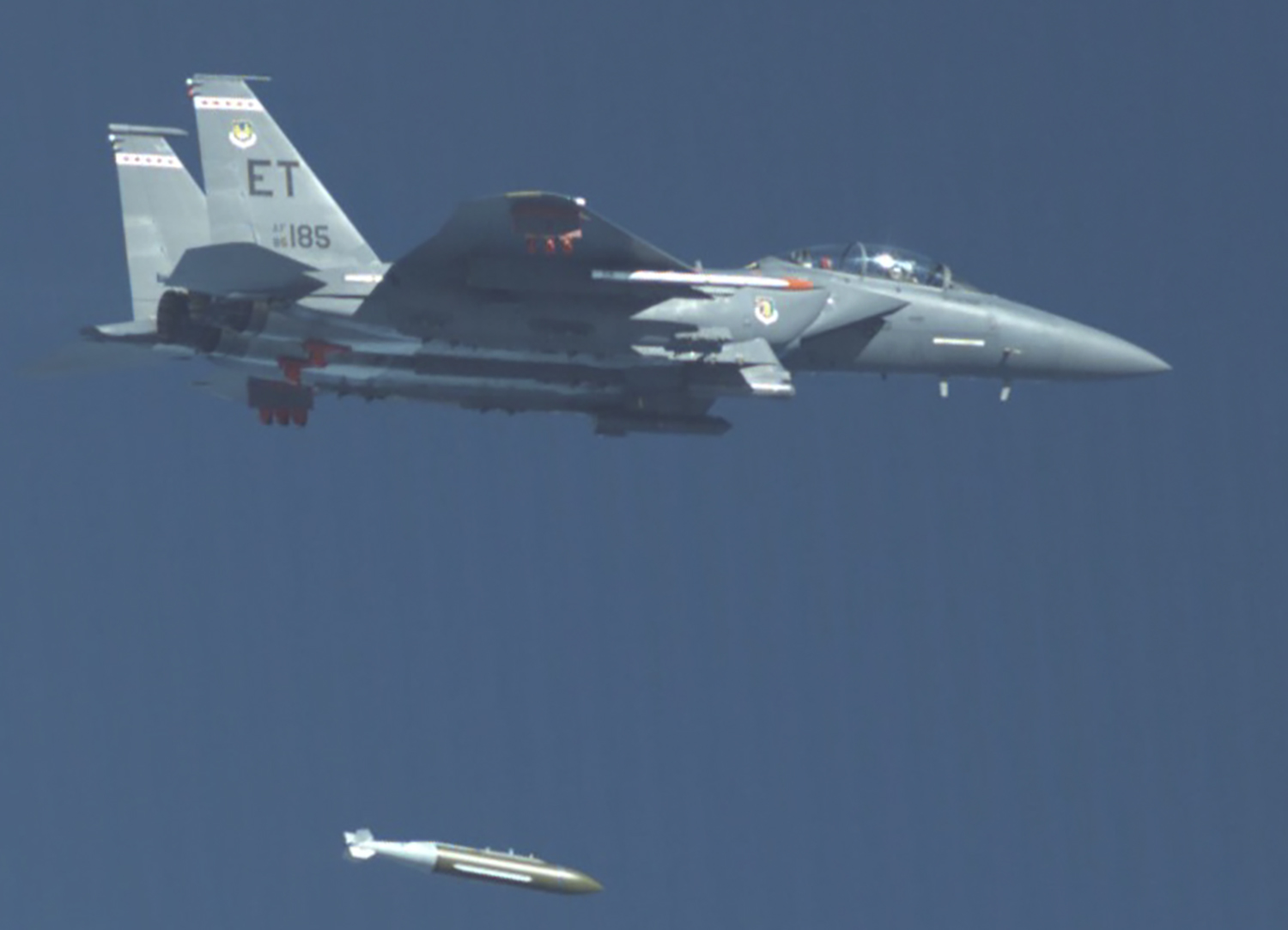
FAB-3000 on the Su-34. That's 3000 kg.

GBU-72 on the F-15E. That's 2270 kg.

These are deep strike jets.

Our deep striker will be Ghatak.

The 2026 production batches that just got delivered to Russia (and the ones offered to India) come with upgraded avionics, "new technical configuration," and improved sensor fusion from real combat feedback. The N036 Byelka + side arrays + 101KS IRST already give 360° passive hunting the F-35 doesn't have. The e-pilot isn't "just a cockpit helper", it's integrated with the fused picture and is being upgraded toward full AI assistance. Russia never said "we're not aiming for F-35 fusion" as some permanent admission; they're iterating exactly like they always do, and the hardware (larger sensors + side arrays) is already there. F-35 fusion is still getting Block upgrades too, nobody is "done."

I don't know what to tell you, these are all just your assumptions. Even the Russians were open about their plans. We know a lot about the Su-57 because they want it exported. So it's not even some kinda secret.

Even their current objective is not anywhere close to the F-35. They have clearly said multiple times the sensor fusion is designed to assist the pilot, not merely dump all processed data on him for execution.

Izdeliye 30 (AL-51F-1) is in flight testing and scheduled for full integration in the Su-57M by end-2026, also each AL-41F1 delivers 142 kN in afterburner, total 176–186 kN dry and 284–294 kN afterburner combined. Even at high/hot airfields (e.g., Leh ~10,000 ft + 35–40°C summer temps), thrust derates less catastrophically than single-engine designs. The F-35's single F135 (125 kN kgf dry/191KN afterburner) loses a bigger percentage of output in thin air because there's no second engine to compensate, real-world hot/high takeoff rolls and climb rates suffer more on singles. Russian doctrine (and Su-35 ops in Syria/hot deserts) shows twins handle derating better for sustained performance.

The F-35's unupgraded engine is underpowered in the plains even in cool conditions. The Su-57's interim engine, even after upgrade, is underpowered in hot and high conditions.

So both jets are underpowered. F-35 needs Option 1 for cool conditions, Option 2 for hot conditions, and much more than that for high. Su-57 needs Izd 30 for Indian environment.

Even with the baseline AL-41F1 engines, the Su-57 performs better than many peers in hot-and-high environments like India's Himalayan bases because its twin-engine configuration provides redundancy and a higher absolute thrust margin when derated by thin air and heat, allowing sustained climb rates, supercruise capability (limited to Mach 1.3–1.6), and a service ceiling of 20,000 meters that far exceeds the F-35's 15,000 meters. The larger wing area and variable intakes help generate lift and maintain agility in low-density air where single-engine jets like the F-35 suffer greater relative thrust loss, reduced payload, and longer takeoff rolls; Russian tests and Su-35 operations (same engine family) in hot desert and mountain conditions prove the design's resilience, while thrust vectoring further aids low-speed control and quick climbs at altitude. In contrast, the F-35's single F135 engine loses more proportional power in such conditions, limiting endurance and maneuverability over contested high-altitude sectors like the LAC, making the Su-57's current powerplant a practical advantage for India's real-world operational needs rather than a weakness, with the upcoming Izdeliye 30 upgrade only widening that edge once integrated by late 2026.

That's irrelevant. The basic design of the Felon is set for Izd 30. All these interim engines are just scams, let the Russians fund it themselves.

And it's not merely thrust, the Izd 30 has many features that are required to unlock the full potential of the jet. Without it, the jet is half-as*ed. The FADEC, the electrical system, the ignition system, the cooling system, fuel consumption, acceleration, and other performance metrics etc, all specific important features missing on the interim engines.

It's like claiming F119 is fine as an interim engine instead of XA103 for F-47.

This one aged like milk. Talks are in "advanced technical stages" right now (Jan–March 2026 statements from UAC CEO and Indian officials). Russia is offering exactly the MKI-style deal you wanted: license production on existing Su-30 lines, maximum Indian industry content, full source code access, Indian avionics/weapons, and the two-seat drone-control version tailored for us. It's the front-runner for MRFA/interim 5th-gen because of cost, timeline, and existing ecosystem. "Fake interest" narrative died months ago.

June 2025.
“On F-35A and Sukhoi Su-57 E, whatever has been discussed has been informal. We don’t have any formal consultation going on on these,” Singh told ANI in a podcast. He added that the focus is on indigenous capability: “What I can talk about is our fifth-generation fighter, which will be the AMCA.”

March 2026.
Our fifth generation fighter is going to be the AMCA. On the other two candidates that you mentioned, we've not taken a call as yet, but as of now, that is the way we are proceeding.

Rahul Shivshankar:

So you're saying we haven't taken a call on the Russian and the American offer that's on the table?

Rajesh Kumar Singh:

Yes.

We continue to take from the Russians equipment that we need, and we will do so with the Americans and the French or anybody else, where we identify weapons or platforms that we really need. But more than any of this, we really want to double down on indigenization and try to make sure that either we do it ourselves, or at least where the TRL level is a bit low in India, at least we get TOT and do it through the Make in India route.

Rahul Shivshankar:

But is the Sukhoi 57 on the table? Because a number of people don't think it's the best.

Rajesh Kumar Singh:

Yeah, so again, which is why I mentioned that we have not taken a call on this yet. And the issue that you mentioned, the comparisons, all of that, I would not be able to really answer. But yes, all of those issues have prevented us from taking a final call on this.


How many times do you want to keep falling for lobby attempts even after official rebuttals?

The "advanced technical stages" is just some internal negotiations between UAC and HAL, nothing to do with the govt.

SCAF/FCAS is on life support. Dassault CEO literally said in March 2026 it's "dead" if Airbus won't cooperate. Missed every deadline, industrial war between Dassault and Airbus, Germany eyeing more F-35s as backup. Service entry 2045+ at best (if it survives). Betting the farm on that as your "main MKI replacement" while calling a real, flying, combat-proven jet with drone teaming an "aberration" is wild.

Sure. If it dies in Germany, and India's involvement does not resurrect it, then it dies. I'm cool with that anyway.

But yes, the Su-57 is no longer a replacement for the MKI. It was when MKIs were supposed to begin replacement in 2025-30, but now it's been moved to 2045-55, so will obviously be replaced by more advanced jets.

Pursuing GCAP as an observer or a fully indigenous sixth-gen fighter (evolving from AMCA Mk2) is far better for India than SCAF/FCAS, which is in deep crisis with industrial disputes, missed deadlines, and service entry likely well past 2045, if it survives at all. GCAP offers low-risk access to mature 6th-gen tech (adaptive engines, AI teaming, broadband stealth) with clear timelines and export focus, allowing India to feed advancements into our own programs without heavy commitment. An indigenous path maximizes sovereignty, leverages existing DRDO/HAL momentum, creates jobs, enables export potential, and tailors the jet perfectly to high-altitude/hot-and-high threats and China-focused doctrine, avoiding SCAF’s political vetoes, workshare fights, and dependency risks while building true long-term capability by the 2050s in my opinion.

A 6th gen import bridge is necessary, whether it's F-47 or GCAP.

The IAF is unlikely to go for Su-57. And I'd rather see a proper 6th gen import over the Su-60.

India entering SCAF is dependent on Airbus' exit.

ADA will also have independent programs with higher technical specifications compared to the import, even if it's SCAF. The navy also needs a stealth jet after TEDBF.
 
  • Like
Reactions: YoungWolf
Yes, they did. The Felon is a family of aircraft, not just 1 jet.

Applying the equivalent Flanker designations for ease of understanding, it will consist of ASF (Su-57), multirole (Su-60), ground strike (Su-34), and naval (Su-33).

They said it very early on.

article_5d273eacdbe561_88836560.jpg


Again, that's not deep strike. Your definition of deep strike is the same as Sweden claiming deep strike for Gripen E just 'cause of a cruise missile.

For deep strike, you need medium and large bombs.

Deep strike jets require a lot of airframe modifications compared to the ASF version. The Su-57 is advertised as a tactical striker with some ability to carry bombs, that's all.

The purpose of a deep striker is to drop a 1000+ kg bomb on a comm node or a command center in depth areas.

Strike Eagle and Fullback are deep strikers.

View attachment 50431

That is a deep strike loadout. Mk82/84, GBU10/12/28. The heavy hitters.

These are the weapons the next variant of the Su-57 will carry. For example, the targeting pod will be internally equipped. It will need a defensive laser too.

The ASF version carries a targeting pod outside for secondary strike.

FAB-3000 on the Su-34. That's 3000 kg.

GBU-72 on the F-15E. That's 2270 kg.

These are deep strike jets.

Our deep striker will be Ghatak.


I don't know what to tell you, these are all just your assumptions. Even the Russians were open about their plans. We know a lot about the Su-57 because they want it exported. So it's not even some kinda secret.

Even their current objective is not anywhere close to the F-35. They have clearly said multiple times the sensor fusion is designed to assist the pilot, not merely dump all processed data on him for execution.


The F-35's unupgraded engine is underpowered in the plains even in cool conditions. The Su-57's interim engine, even after upgrade, is underpowered in hot and high conditions.

So both jets are underpowered. F-35 needs Option 1 for cool conditions, Option 2 for hot conditions, and much more than that for high. Su-57 needs Izd 30 for Indian environment.


That's irrelevant. The basic design of the Felon is set for Izd 30. All these interim engines are just scams, let the Russians fund it themselves.

And it's not merely thrust, the Izd 30 has many features that are required to unlock the full potential of the jet. Without it, the jet is half-as*ed. The FADEC, the electrical system, the ignition system, the cooling system, fuel consumption, acceleration, and other performance metrics etc, all specific important features missing on the interim engines.

It's like claiming F119 is fine as an interim engine instead of XA103 for F-47.


June 2025.
“On F-35A and Sukhoi Su-57 E, whatever has been discussed has been informal. We don’t have any formal consultation going on on these,” Singh told ANI in a podcast. He added that the focus is on indigenous capability: “What I can talk about is our fifth-generation fighter, which will be the AMCA.”

March 2026.
Our fifth generation fighter is going to be the AMCA. On the other two candidates that you mentioned, we've not taken a call as yet, but as of now, that is the way we are proceeding.

Rahul Shivshankar:

So you're saying we haven't taken a call on the Russian and the American offer that's on the table?

Rajesh Kumar Singh:

Yes.

We continue to take from the Russians equipment that we need, and we will do so with the Americans and the French or anybody else, where we identify weapons or platforms that we really need. But more than any of this, we really want to double down on indigenization and try to make sure that either we do it ourselves, or at least where the TRL level is a bit low in India, at least we get TOT and do it through the Make in India route.


Rahul Shivshankar:

But is the Sukhoi 57 on the table? Because a number of people don't think it's the best.

Rajesh Kumar Singh:

Yeah, so again, which is why I mentioned that we have not taken a call on this yet. And the issue that you mentioned, the comparisons, all of that, I would not be able to really answer. But yes, all of those issues have prevented us from taking a final call on this.


How many times do you want to keep falling for lobby attempts even after official rebuttals?

The "advanced technical stages" is just some internal negotiations between UAC and HAL, nothing to do with the govt.


Sure. If it dies in Germany, and India's involvement does not resurrect it, then it dies. I'm cool with that anyway.

But yes, the Su-57 is no longer a replacement for the MKI. It was when MKIs were supposed to begin replacement in 2025-30, but now it's been moved to 2045-55, so will obviously be replaced by more advanced jets.


A 6th gen import bridge is necessary, whether it's F-47 or GCAP.

The IAF is unlikely to go for Su-57. And I'd rather see a proper 6th gen import over the Su-60.

India entering SCAF is dependent on Airbus' exit.

ADA will also have independent programs with higher technical specifications compared to the import, even if it's SCAF. The navy also needs a stealth jet after TEDBF.
IAF has already given go ahead for Su-57. All the jets that we decide to procure would be with our own radars, mission computers, weapons and much more along with being locally manufactured in India. I know, you don't want to accept it, but give it some time then we all shall know;)
 
  • Like
Reactions: batman
Yes, they did. The Felon is a family of aircraft, not just 1 jet.

Applying the equivalent Flanker designations for ease of understanding, it will consist of ASF (Su-57), multirole (Su-60), ground strike (Su-34), and naval (Su-33).
Like I said, the su57 is a different jet and was made as a multirole jets, you can't equate it to an older jet made with more focus on a single role. Its not hard to understand that just because Su57 is odd or even numbered, it isnt a single role specific jet, you just keep assume it as so even though there is no such evidence behind such claims.

you're doubling down on a 2010s-era view of the Su-57 while ignoring 2026 realities. Deep strike isn't just dumping 2–3 ton dumb bombs from external pylons like the Su-34 or F-15E, that's non-stealth, high-risk in contested airspace. True deep strike in peer fights means penetrating defended zones stealthily and hitting high-value targets (command nodes, air defenses, logistics) with precision standoff munitions. The Su-57 does exactly that with internal Kh-69 stealth cruise missiles (300+ km range, low-observable, designed for Felon bays, used in Ukraine strikes on protected sites) and Kh-58UShK anti-radiation for SEAD/DEAD, all carried internally to preserve RCS. Recent 2025–2026 footage and reports show loaded bays with these for offensive missions; it's not "tactical only" or "secondary strike." Heavy glide bombs like UMPK are being integrated too (external when needed, internal for stealth runs). The jet's large tandem bays were built for multirole from the prototype stage, no "major airframe mods" needed for strike like you claim for dedicated versions.

The two-seat variant Russia is offering India (prototype assembly at KnAAZ, first flight late 2026/early 2027) is the enhanced C3/drone-control/strike version you want, no separate "Su-60" designation, just the Su-57M two-seater pitched with full ToT, Indian weapons, and internal targeting/defensive systems. It's the bridge for deeper ops and MUM-T.

Sensor fusion: 2026 batches have upgraded systems from combat feedback, hardware (larger side arrays + IRST) already superior for 360° passive in some ways; software iterating fast. Russians don't "admit" permanent lag, they evolve like always.

Engine: AL-41F1 twins give better hot/high redundancy and margin than F-35's single F135, proven in demanding conditions, climbs higher, supercruises limited. Izdeliye 30 unlocks more, but base isn't "scam" or "half-assed." The Su-57 with its current twin AL-41F1 engines (total dry thrust ~17,600 kgf, afterburner ~29,000–30,000 kgf) is not underpowered in hot/high environments compared to other 4th- and 5th-generation fighters, in fact, it holds strong advantages over several peers due to its twin-engine redundancy, high absolute thrust margin, large wing area for better lift in thin air, and thrust vectoring for sustained maneuverability. Against the F-35 (single F135: dry ~12,700 kgf, AB ~19,500 kgf), the Su-57 delivers significantly more total thrust (nearly double dry, 50%+ more AB), resulting in superior climb rate (to 20,000 m ceiling vs F-35's 15,000 m), supercruise (Mach 1.3+), and better hot/high endurance without the F-35's documented single-engine derating penalties and reduced payload/range in thin/hot conditions like the Himalayas. Versus the F-22 (twin F119: dry ~18,000 kgf, AB ~31,000 kgf), the Su-57 is very close in raw thrust and T/W ratio (~1.15–1.22 vs F-22's ~1.26), with similar high-alt performance but added TVC edge in post-stall maneuvers. The J-20 (twin WS-10C interim: dry ~17,000 kgf, AB ~28,000 kgf) is comparable to the Su-57's current setup but lacks proven TVC and variable intakes for hot/high optimization, giving the Felon a kinematic slight edge until J-20's WS-15 matures. European 4.5-gen like Rafale (twin M88: dry ~9,950 kgf total, AB ~15,000 kgf) and Eurofighter Typhoon (twin EJ200: dry ~12,000 kgf total, AB ~18,000 kgf) fall well short in total thrust and high-alt ceiling (both ~18,000 m max), struggling more in thin air without the Su-57's twin redundancy and power. Russian 4th-gen like Su-35 (same AL-41F1 twins) matches the Su-57's current power but lacks stealth and advanced bays. Overall, the AL-41F1-powered Su-57 is far from "underpowered", its twin setup and design make it one of the strongest performers in hot/high scenarios among operational fighters, outperforming the single-engine F-35 and closing on the F-22/J-20 until the Izdeliye 30 upgrade arrives.

Official status (Defence Secretary Rajesh Kumar Singh, Rising Bharat Summit March 2026): "We have not taken a call" on Su-57 or US offers; focus is AMCA as fifth-gen, indigenisation priority. No formal consultations, UAC/HAL talks are exploratory, not govt-approved. "Advanced stages" is Russian hype, not IAF commitment.

SCAF/FCAS: Dassault CEO (March 4) said it's "dead" if Airbus won't cooperate, ongoing crisis, workshare fights, Germany questioning need, delays to 2045+. Not a viable "main MKI replacement."

The path: AMCA core + possible interim like customized two-seat Su-57M if needed, but official words prioritize indigenous. Betting on dying SCAF or inventing timelines is fantasy, facts say double down on our own program with smart observer access (e.g., GCAP) for tech, not foreign drama.
 
  • Like
Reactions: Rajput Lion
IAF is correct in saying that we need to join a 6th gen fighter program now or once again we would be caught chasing the trend rather than setting it. Going with FCAS/NGF isn't a bad idea, especially if both IAF & IN will get the same jet(ala Rafale). But even if we join today we would only get operational jets between 2040-45. AMCA MK2 would also become operational from 2038 onwards. IAF is looking to increase the number of AMCA MK1 from 40 to 80 jets to sustain production by the time MK2 becomes ready. But despite that, there is still a gap of 10-15 years, where IAF won't have its own stealth fighter. PLAAF is deploying more and more J-20s in Tibet and soon PAF will be flying J-35AEs.

Thus our only option at the moment is to choose between Su-57 & F-35. Out of these two, Su-57 aligns with our 'Make in India' initiative and there are no operational bondages. F-35 is American. So it is out. We'll be domestically manufacturing 2-seat Su-57M2I or Su-60MKI variant in over 100 numbers. That's our only option to counter Chinese and Pakistani VLO jets.
 
  • Like
Reactions: batman
Like I said, the su57 is a different jet and was made as a multirole jets, you can't equate it to an older jet made with more focus on a single role. Its not hard to understand that just because Su57 is odd or even numbered, it isnt a single role specific jet, you just keep assume it as so even though there is no such evidence behind such claims.

Su-35S is also "multirole."

you're doubling down on a 2010s-era view of the Su-57 while ignoring 2026 realities. Deep strike isn't just dumping 2–3 ton dumb bombs from external pylons like the Su-34 or F-15E, that's non-stealth, high-risk in contested airspace. True deep strike in peer fights means penetrating defended zones stealthily and hitting high-value targets (command nodes, air defenses, logistics) with precision standoff munitions. The Su-57 does exactly that with internal Kh-69 stealth cruise missiles (300+ km range, low-observable, designed for Felon bays, used in Ukraine strikes on protected sites) and Kh-58UShK anti-radiation for SEAD/DEAD, all carried internally to preserve RCS. Recent 2025–2026 footage and reports show loaded bays with these for offensive missions; it's not "tactical only" or "secondary strike." Heavy glide bombs like UMPK are being integrated too (external when needed, internal for stealth runs). The jet's large tandem bays were built for multirole from the prototype stage, no "major airframe mods" needed for strike like you claim for dedicated versions.

If missile does the penetration, then the aircraft isn't a penetrative jet.

The two-seat variant Russia is offering India (prototype assembly at KnAAZ, first flight late 2026/early 2027) is the enhanced C3/drone-control/strike version you want, no separate "Su-60" designation, just the Su-57M two-seater pitched with full ToT, Indian weapons, and internal targeting/defensive systems. It's the bridge for deeper ops and MUM-T.

I don't think you understand how Russians do designations. The two-seat jet will not be called Su-57U or UM or UM2, which is a trainer designation, it will be given a new number.

Sensor fusion: 2026 batches have upgraded systems from combat feedback, hardware (larger side arrays + IRST) already superior for 360° passive in some ways; software iterating fast. Russians don't "admit" permanent lag, they evolve like always.

Larger sensors and sensor fusion are not the same things.

Engine: AL-41F1 twins give better hot/high redundancy and margin than F-35's single F135, proven in demanding conditions, climbs higher, supercruises limited. Izdeliye 30 unlocks more, but base isn't "scam" or "half-assed." The Su-57 with its current twin AL-41F1 engines (total dry thrust ~17,600 kgf, afterburner ~29,000–30,000 kgf) is not underpowered in hot/high environments compared to other 4th- and 5th-generation fighters, in fact, it holds strong advantages over several peers due to its twin-engine redundancy, high absolute thrust margin, large wing area for better lift in thin air, and thrust vectoring for sustained maneuverability. Against the F-35 (single F135: dry ~12,700 kgf, AB ~19,500 kgf), the Su-57 delivers significantly more total thrust (nearly double dry, 50%+ more AB), resulting in superior climb rate (to 20,000 m ceiling vs F-35's 15,000 m), supercruise (Mach 1.3+), and better hot/high endurance without the F-35's documented single-engine derating penalties and reduced payload/range in thin/hot conditions like the Himalayas. Versus the F-22 (twin F119: dry ~18,000 kgf, AB ~31,000 kgf), the Su-57 is very close in raw thrust and T/W ratio (~1.15–1.22 vs F-22's ~1.26), with similar high-alt performance but added TVC edge in post-stall maneuvers. The J-20 (twin WS-10C interim: dry ~17,000 kgf, AB ~28,000 kgf) is comparable to the Su-57's current setup but lacks proven TVC and variable intakes for hot/high optimization, giving the Felon a kinematic slight edge until J-20's WS-15 matures. European 4.5-gen like Rafale (twin M88: dry ~9,950 kgf total, AB ~15,000 kgf) and Eurofighter Typhoon (twin EJ200: dry ~12,000 kgf total, AB ~18,000 kgf) fall well short in total thrust and high-alt ceiling (both ~18,000 m max), struggling more in thin air without the Su-57's twin redundancy and power. Russian 4th-gen like Su-35 (same AL-41F1 twins) matches the Su-57's current power but lacks stealth and advanced bays. Overall, the AL-41F1-powered Su-57 is far from "underpowered", its twin setup and design make it one of the strongest performers in hot/high scenarios among operational fighters, outperforming the single-engine F-35 and closing on the F-22/J-20 until the Izdeliye 30 upgrade arrives.

Say what you want, mate. The IAF ain't going for a Felon with interim engines no matter how impressed you are with them.

Even the Russians claim the jet is underpowered, hence the second interim upgrade to a 157 kN engine that will allow supercruise at mach 1.6 instead of the actual mach 2.

Izd 30 is not an upgrade, it's the core engine.

Official status (Defence Secretary Rajesh Kumar Singh, Rising Bharat Summit March 2026): "We have not taken a call" on Su-57 or US offers; focus is AMCA as fifth-gen, indigenisation priority. No formal consultations, UAC/HAL talks are exploratory, not govt-approved. "Advanced stages" is Russian hype, not IAF commitment.

Hmm? What?

SCAF/FCAS: Dassault CEO (March 4) said it's "dead" if Airbus won't cooperate, ongoing crisis, workshare fights, Germany questioning need, delays to 2045+. Not a viable "main MKI replacement."

Dassault's position is they want executive control with 80% workshare on NGF or they will go for a more advanced design at a later date on their own while chooing to further evolve the Rafale in the interim.

IAF's participation is the wild card. That's the only way it becomes a viable MKI replacement.

Personally, I'd prefer ADA develops a true next gen jet fitting for the time it's inducted in the 2050s, ie, the amount of time it will actually take to develop a more advanced jet indigenously. Of course, 6th gen import acting as a bridge between 2035 and 2055. But I'm obviously fine with the IAF deciding the best course of action.

The path: AMCA core + possible interim like customized two-seat Su-57M if needed, but official words prioritize indigenous. Betting on dying SCAF or inventing timelines is fantasy, facts say double down on our own program with smart observer access (e.g., GCAP) for tech, not foreign drama.

No one's gonna give us any access without a buyer's contract.