

I have a question @randomradio can a terminal interceptors intercept missile in its mid course phase if it is travelling in highly depressed trajectory.(150-200km)

Prithvi I and II are liquid. Prithvi III is solid + liquid. TGT is all solid.

However I get what you are saying here.
Same as Brahmos which had 600km range from day one and even carried fuel fir that range, but had 300 km range due to software limiting it to that range, because of legalities.
For S-400 such limitations are not in the detection and tracking/ looking on , ranges.
But modules and missile types being provided.
For example is the 400km range 40N6E being sold to india?
Is the ground attack capability module and software is being sold to india?
Since S-400 is a highly modular system, capabilities can be added by integration of new appropriate modules.
That's where legalities play their role.
Detection and tracking range is the same.
I have a question @randomradio can a terminal interceptors intercept missile in its mid course phase if it is travelling in highly depressed trajectory.(150-200km)
Is there any documentation for this?
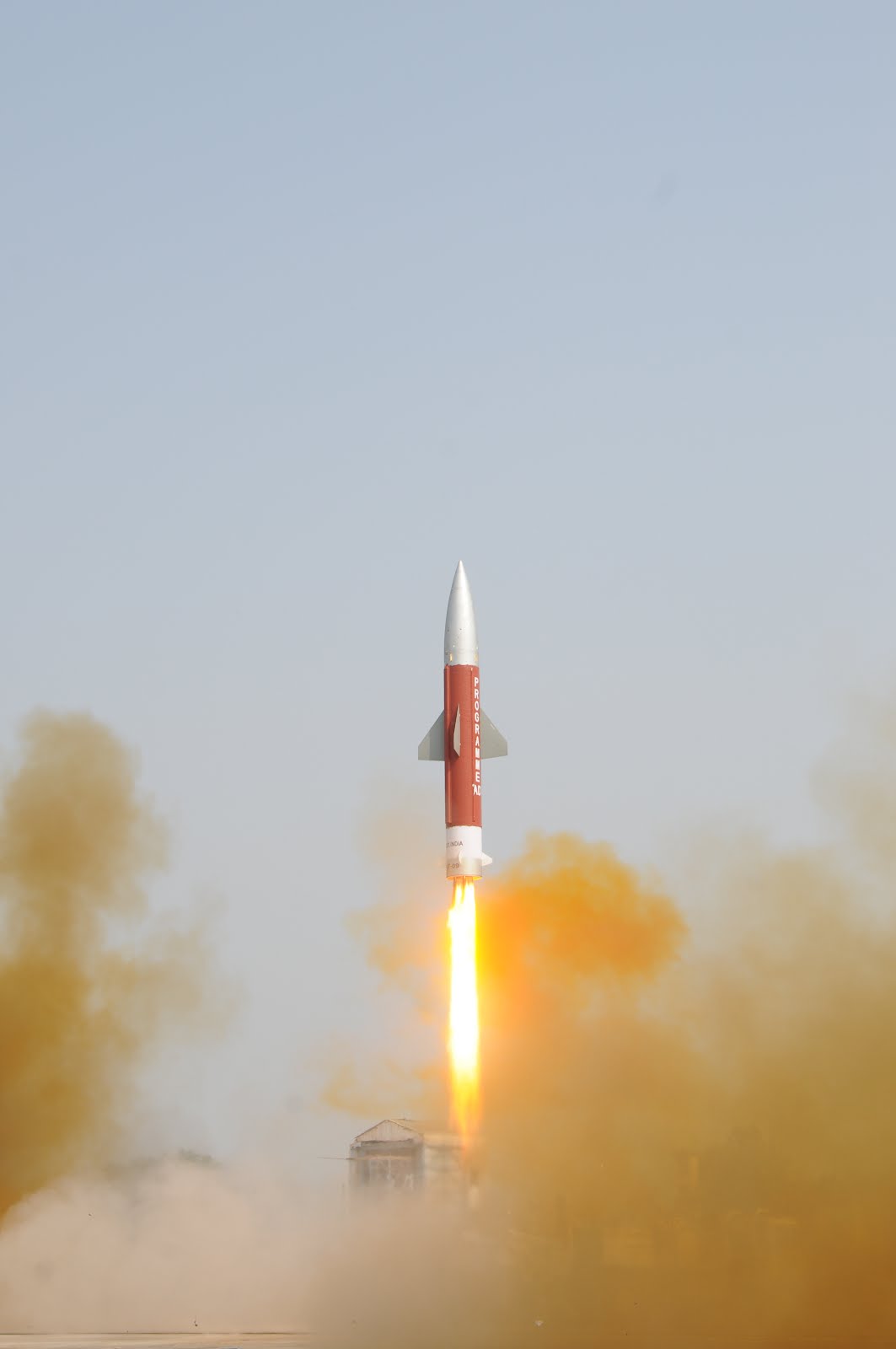
Cuz the pic of TGT boosting has the missile giving off reddish-orange smoke which is very indicative of N2O4 and/or UDMH being present. No solid fuel being burnt here:
The clear lack of a smoke trial (result of alumina particles in solid fuel) is also indicative of liquid fuel on the ship-launched TGT as well:
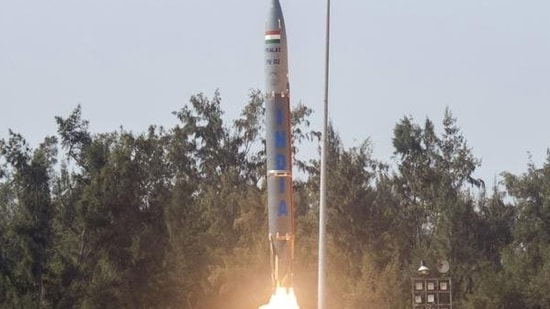
I don't think the image of the two stage target missile was ever released.
The image you posted is Prithvi II.
So we have no picture, no document, and no quote from a DRDO scientist or even a respected journalist...but we somehow know that TGT was all-solid?
The image is the TGT...it clearly has Programme-AD written on side of it and TGT-09 written near the nozzle.
And the video shows the ship-launched TGT taking off from a Sukanya-class OPV.
No if the missile is travelling within the kill altitude of interceptor.The interceptor needs a lot more altitude, like the ASAT or SM-3.
No if the missile is travelling within the kill altitude of interceptor.
There are only quotes from both scientists and journalists. Personally, I haven't seen a pic, if there is one.
In any case why are we discussing this? I don't recall the point. PAD is also in a solid + liquid config.
I'm not sure if all TGT launches were released publicly.
Any link?
PAD is solid + liquid cuz the KV needs that extra push for reorienting toward target.
The point is still that surrogate testing using a much lower energy missile cannot sufficiently replicate the kinematics of a much larger, higher energy missile.
The US would never have built IRBM or ICBM-class target missiles if that were the case. If all they had to do was modifying the trajectories of Lance, Pershing or ATACMS class missiles to replicate longer-range types. We're seriously low-balling the criteria here.
Which I why I can't help but see this as a knee-jerk response to the S-400 delay.

Are you saying there were two different kinds of TGT missiles?
Cuz all the TGTs we have seen so far show clear evidence of liquid fuel burning.
It's the opposite, liquid gives you more oomph. We use solid in the military 'cause it's cheap and easy to store and use.
The US also uses representative missiles for GMD tests, an IRBM modified to mimic an ICBM.

Yes, one single stage, another two stage. Which is why I don't think we have seen all the images of all the TGT missiles to date. Only 3 PDV tests were conducted, officially.
During earlier development, yes. But intercepting a real ICBM-class target was always a major milestone which was finally reached in 2017.
GMD Missile Defense Hits ICBM Target, Finally - Breaking Defense
WASHINGTON: Two days after North Korea’s latest missile launch, the US conducted a successful test of its homeland missile defense system for the first time in almost three years. Codenamed FTG-15, today’s event was also the system’s first test ever against an “ICBM-class” target, as opposed to...breakingdefense.com
The target was the aforementioned ICBM-T2. It launched from the Marshall Islands while the GBI took off from Vandenberg, California - a distance of roughly 8,000 kms. The MDA could not have declared the GMD operational against ICBM-class threats with a straight face if such tests weren't completed successfully.
Well I've never seen this, or even heard of it.
You sure you aren't confusing a report about the PAD with a TGT?
Exactly. An IRBM with a small payload could act as an ICBM. So something like the Agni III without a 1000-2000Kg payload should be able to function like an ICBM. Your argument was DRDO needs to use an Agni II itself. So by extension, your argument really is that the GMD should be tested with a Minuteman III or Trident, and not some modified IRBM class missile, for it to actually become operational.


Similarly, we have a target missile that's originally an SRBM pretending to be an MRBM. Replace the 1000Kg explosive with a 100Kg warhead and you get what you want out of it.
Then are you trying to say a Prithvi was launched into space with just a single stage? Come on...
Did you read the article? It was tested against ICBM-T1/T2 i.e. the only ICBM-class target missile in US MDA service. The ICBM-T literally uses a Trident-I C4 boost stage, that's a proper ICBM class missile.
View attachment 25174
View attachment 25175
They were comfortable using IRBM-class targets for a while, when the GMD program was still largely in a technology development phase (remember, it had a very poor success rate at one point) but once that was sorted, testing against a full-range ICBM target was mandatory for achieving the full capability required of the system.
In other words, there are limits to surrogate testing. The US has developed target missiles that represent every range class of BM employed by potential enemies, no SRBMs trying to pass off as MRBMs or IRBMs trying to pass off as ICBMs. They developed a specific tool for everything.
If we want our BMD shield to be as comprehensive a solution, so should we. Unless of course if we are comfortable with setting up a "naam ke vaaste" BMD shield...which would only be the case if it were a knee-jerk decision. Which was my point all along.
Reduction of payload would help increase performance a bit...but certainly not by as much as 8 x times which is what is required (in range terms), or about 3 x times which is needed in apogee terms to mimic a Shaheen-II.
Why not? Single-stage V2s crossed Von Karman line back during WW2.

 theprint.in

 timesofindia.indiatimes.com
I'd argue the ICBM T1 was representative of the Satan and Sarmat. 'Cause once you hit the ICBM range, there's no upper limit today. Maybe the next one would be a Global BM.
So a Trident 1 pretending to be a Satan/Sarmat here. It's the same argument. The Trident 1 is a 7500Km missile mimicking a 16000+Km missile.
Great, then it can also mimic an MRBM. So I stand corrected, but you just ended up supporting my argument, so you proved yourself wrong too.
So, then forget about both stages being solid, let's just assume it's the usual solid and liquid combo. Then, it's good enough to mimic an MRBM.
“The BMD programme has been completed. All tests carried so far have been successful, including the radars and missiles. The IAF, which is responsible for the country’s air defence, and the DRDO, which has developed the system, will now move a joint proposal for the government’s clearance,” a top government official told ThePrint.India’s ballistic missile shield ready, IAF & DRDO to seek govt nod to protect Delhi
BMD programme envisaged for Delhi. This, along with the Russian S-400 Triumf air defence system, aims to secure India from all kinds of incoming missiles.
While you believe P1 is a TD, the DRDO and IAF don't.
Ever since 2021, particularly after the S-400 was deployed, including a limited deployment of P1, India's tone has changed a lot with respect to Pakistan. I don't think it would be incorrect if we link what Rajnath Singh said about taking back PoK recently to our new BMD achievements.
Rajnath Singh: India’s goal is to take back PoK turf: Rajnath Singh | Srinagar News - Times of India
It was the first military operation of independent India, a move that changed the course of the India-Pakistan war in 1947-48 in which Indian troops r
 www.sps-aviation.com

Peak acceleration for Sprint was around 100 G , while it average around 65 G achieving 0 to mach 10 ( 3,403 mt/s ) in around 5 seconds & was a great achievement back than...it could hit a Warhead moving 8 km/s.We really need to mimic this performance.

It's not the same as Prithvi mimicking an MRBM though.
Once your missile can cross that 5500 km ICBM mark, you don't need to gain more altitude to increase your range - you are already in the area of least atmospheric resistance. Hence pretty much all ICBMs, the 7000km ones or 16000km ones, all have roughly the same typical mission profile apogee of about 1000-1200 kms. There's no point in going much higher than that because after a point you can just orbit the RV/MIRV bus and gain range that way.

One of the TGTs was reportedly intercepted at an altitude of 70-80 kms by the PDV. That's the highest we've known the TGT to travel, understandably to enable exo-atmospheric interception. What we don't know is how high it went for the endo-atmospheric tests which is where velocities come into play for the AAD.
So the only thing we can fall back on is the knowledge that the missile is question, on average possesses about 1/5th (and that's being generous) of the kinematic capabilities (range) of the missile its supposedly mimicking. So if that 70-80 km in PDV test was close to the TGT's apogee, it would be nowhere near its terminal velocity. Whereas a Shaheen-II with an apogee of say 150km would have already achieved a significant portion of its terminal velocity by the time it got to 70-80 km. You see why they may not be representative after all?
I'm aware of the proposal to deploy - I just remain unconvinced that it isn't something that was proposed as knee-jerk reaction to the S-400 delay that happened around the same time (they must've been internally aware of it for a few months in advance).
Russia to delay delivery of S–400 air defence missile systems to India by 2 years
As I said, even the S-400 isn't a dedicated BMD system a-la THAAD or even PAC-3, but its better than nothing. I reckon the proposal to deploy the tech already developed under P1 was along the same lines i.e. better than nothing.
Either way, its been nearly 3 years since that article you posted. Where is the BMD shield? Did they roll the plan back now that S-400s have finally arrived?
If due to the recent sanctions S-400 deliveries get affected again, could the proposal be revived? Remains to be seen.
 delhidefencereview.com


