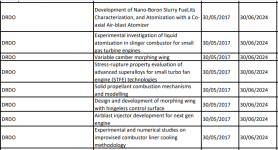
Did wonder if this has any link to recent eoi initiated, though that is dcppSo, why is the Long Range Land Attack Cruise Missile project under Make-1 while there is a DRDO project for the same?


Did wonder if this has any link to recent eoi initiated, though that is dcppSo, why is the Long Range Land Attack Cruise Missile project under Make-1 while there is a DRDO project for the same?
 copied from source you know where
His recent contributions are collapsible mandrels, extendable exit cone and multi-nozzle based under water propulsion motors for Project K5.
Totally irrelevant number is max range for a nation like india. We will always be contested. There will never be a fighter sized sitting idle at that range and low altitude.So first firing of Astra from mk1 at 20000ft , ~6km alt, if it was tested for much of the marked area of 90-100km , then we can guess what a further higher alt release at 10km can achieve, service ceiling of tejas is prob about 15km @Rajput Lion
You are all of that no one is denying it.Yes. But if you state its high range then you'll get labelled as a jingo, optimist etc. Let them live in denial

Totally irrelevant number is max range for a nation like india. We will always be contested. There will never be a fighter sized sitting idle at that range and low altitude.
Even DRDO never used to give that number. Lately they also started hyping.
Even the R-77 from the 90s can reach this range if you toss it from high enough altitude. The low air density and gravity will do most of the work as its dropping from high altitude. But when you reach near target its energy is all exhausted. Thus, it can be dodged very easily. There has never been such history of success with this tactic.In the uni level lectures at IITs , people like Dr Kota H sometimes stated Astra was ranged 45-50km for which it was intended, in context of him mentioning they were involved in project astra bvr. Given with time the tech, need and capability enhancement like the radars range and identifying the foe ability all icreased simultaneously , so did Astra range extension in phases to todays 100-110 km.
Unlike wvr/dogfighting, the reach does matter a bit in bvr fight solely in comparison to your adversary reach in a simple equation. Most of air engagements are usually 1-1. I think current reach shows maturity in terms of solid rocket motor and propellant tech, plus seeker which in case of astra mk1 is at par with what the western stuff would be at fraction of cost.

 www.thedrive.com
Yes , but the question is whether we had enough maturity in developing the same tech and how long it would have taken for that tech to mature enough to be on par with our 2 adversaries. One of them helps the other and the other actually has access to usa weapons. So if we were to make our own weapons, we definitely needed something that is not only at par with the chinese, but also with the usa.Even the R-77 from the 90s can reach this range if you toss it from high enough altitude. The low air density and gravity will do most of the work as its dropping from high altitude. But when you reach near target its energy is all exhausted. Thus, it can be dodged very easily. There has never been such history of success with this tactic.
You can see similar tactic in this ukraine conflict. As its not viable to use regular BVRs in such long range engagements. They use Mig-31BM and R-37 combo. Its a way bigger missile with more propellant.
Russia’s MiG-31 Foxhounds Proving To Be A Threat To Ukrainian Aircraft
The unique MiG-31BM with its very long-range air-to-air missiles is a serious menace to Ukrainian aircraft.
No, the question here was not about technology. But usefulness of the so called Rmax. Its simply not a good parameter. We definitely have reached maturity on fundamental BVR related tech.Yes , but the question is whether we had enough maturity in developing the same tech and how long it would have taken for that tech to mature enough to be on par with our 2 adversaries. One of them helps the other and the other actually has access to usa weapons. So if we were to make our own weapons, we definitely needed something that is not only at par with the chinese, but also with the usa.
On a real fight its not common to use in extreme ranges. It can be used as a deterrence. For example, AMRAAM use against MKI by Pakistani F-16s. They know its not going to hit. And MKIs can evade it easily.The other thing is, going up and then climbing down on the enemy jet is a common feature for any bvr weapon, the problem before was the bvr losing energy in endgam phase, thereby giving a small nez, both time and range wise. Rocket motor and propulsion tech has improved hugely, so now the engagement can last for over 5 sec which was common for Rus R73 types. Which is why those often came short.
let IAF decide in which envelope which bvr they would like to use. I am not much about generalization of bvrs because each different tech associated product would give its own pros and cons. So Mk1 will have one kind of use envelope, mk2 will have a longer one, sfdr/meteor will have another. In the engagement its up to IAF to decide on which bvr to use to the best of its usp.No, the question here was not about technology. But usefulness of the so called Rmax. Its simply not a good parameter. We definitely have reached maturity on fundamental BVR related tech.
On a real fight its not common to use in extreme ranges. It can be used as a deterrence. For example, AMRAAM use against MKI by Pakistani F-16s. They know its not going to hit. And MKIs can evade it easily.
Nothing fundamentally changed in rocket motor development. Otherwise we wouldn't have gone for dual pulse.
You are sliding away from the topic. The question here is Astra BVR missile and its Rmax utility in real world. So its not general BVR missile but single pulse solid rocket BVR missile. They all have similar characteristics.let IAF decide in which envelope which bvr they would like to use. I am not much about generalization of bvrs because each different tech associated product would give its own pros and cons. So Mk1 will have one kind of use envelope, mk2 will have a longer one, sfdr/meteor will have another. In the engagement its up to IAF to decide on which bvr to use to the best of its usp.
The second part, that's where the crunch is. We know IAF would not initiate a bvr fight on its own, 90% of the time it takes putting our fighter airborne in the face of an incoming pack of Pakistani/chinese. That itself is the deterrence. Weapon engagement happens rarely. In case it happens
we know Pakistani lot would fire from the border & hastily retreat. In that case tejas even with lo-lo profile can still give 250-280km combat radius, plus with a 100km bvr to boost. Plot that along the western border area centering our airbases and immediately you would get way more confidence as compared to a R-77 use case. Almost certainly astra would successfully hit at least 1 bogey in tail chase if engaged I think.
This is why it will be up to IAF to decide which version to use more and in what situation, engagement profile basis. It would not be like the radar station picks up incoming pack and we scramble astra mk1 armed lca immediately to deter.You are sliding away from the topic. The question here is Astra BVR missile and its Rmax utility in real world. So its not general BVR missile but single pulse solid rocket BVR missile. They all have similar characteristics.
Let me reiterate, in low altitude its impossible to get more than half of max range because of air density. If the target is maneuvering from low to high then its even harder because of gravity. There are basic physics that limits all missiles.


Even USAF is on record worried about PL-15's range and hence developing AIM-260 JATM and here we're discussing whether max range/long range is effective or not, lol.This is why it will be up to IAF to decide which version to use more and in what situation, engagement profile basis. It would not be like the radar station picks up incoming pack and we scramble astra mk1 armed lca immediately to deter.
The example I gave is the lowest combat circle with the highest bvr range just for general coverage where a pak incoming target pack will be quite vulnerable against our jets compared to before. Law of physics is true for both but this time they will face a bigger vulnerability zone that stretches deep within their own territory instead of where they intend to strike. This is considering limited max range that Astra mk1 is capable of at specific altitude.
Even at a 280km combat radius with further 55-60km astra strike zone at the low alt engagement situation, it goes quite deep inside pak own territory ie they will know if they try to repeat shooting their bvr from the border and turn back, some of them will not return to their base. That is a major risk any mission planner will want to avoid.
You have to consider that in this case, IAF jets will be reactive, hence they will follow a certain method and protocol to engage the hostile pack. The previous example you gave re Ukr with Mig31-R37M , that is a different sort of mission which is air superiority or CAP whatever they are doing. In that case, a very long range missile is fired from high alt. Here , lca mk1a is not doing that. So Rmax need not be the longest.
Again, why are you wandering off? Mk2 or SFDR dont exist in production. We are specifically talking about Astra mk1/R-77/AMRAAM class of missiles.let IAF decide in which envelope which bvr they would like to use. I am not much about generalization of bvrs because each different tech associated product would give its own pros and cons. So Mk1 will have one kind of use envelope, mk2 will have a longer one, sfdr/meteor will have another. In the engagement its up to IAF to decide on which bvr to use to the best of its usp.
The second part, that's where the crunch is. We know IAF would not initiate a bvr fight on its own, 90% of the time it takes putting our fighter airborne in the face of an incoming pack of Pakistani/chinese. That itself is the deterrence. Weapon engagement happens rarely. In case it happens
we know Pakistani lot would fire from the border & hastily retreat. In that case tejas even with lo-lo profile can still give 250-280km combat radius, plus with a 100km bvr to boost. Plot that along the western border area centering our airbases and immediately you would get way more confidence as compared to a R-77 use case. Almost certainly astra would successfully hit at least 1 bogey in tail chase if engaged I think.
 defenseissues.wordpress.com
PL-15 is dual pulse.Even USAF is on record worried about PL-15's range and hence developing AIM-260 JATM and here we're discussing whether max range/long range is effective or not, lol.
Then you are referring to a limited timeframe where only astra mk1 is available against pak amraam irrespective of the fighter jet type used and its radar, and also assuming amraam would give much bigger range in same profile of engagement than Astra. Is there any proof of such? In such engagement amraam itself will give 50-55 or slightly few more km range itself, and I think in that situation you always engage your enemy from a higher altitude than the hostile pack to deny the area and drive them off before it even gets close.Again, why are you wandering off? Mk2 or SFDR dont exist in production. We are specifically talking about Astra mk1/R-77/AMRAAM class of missiles.
In lo-lo there is no 100km. I dont know how to explain more. I can suggest some links to refer if you dont mind.
The Russian Philosophy of Beyond Visual Range Air Combat
guided missile, russian missile, R-73, R-27, R-37, R-77, AAM-L, RVV-AE, Archer, Arrow, Alamo, Adder, Novator, Vympel, Agat, Avtomatikaausairpower.net
Evading air-to-air missile
Missile evasion is a very important part of modern air combat, yet many people believe it is impossible. But this is false, for several reasons. First reason is that missile cannot turn tighter tha…
PLA Air to Air Missiles
Technical Report APA-TR-2009-0802; Title: PLA Air to Air Missiles; Abstract: The PLA-AF and PLA-N operate a diverse mix of indigenously manufactured and imported Russian Air to Air Missiles (AAM), carried by a no less diverse fleet of combat aircraft. While imported Russian R-27 / AA-10 Alamo...www.ausairpower.net
PL-15 is dual pulse.
I was hoping they will call QRSAM trishul.
Maybe they used the older version for the theory part, building block etc.I was hoping they will call QRSAM trishul.